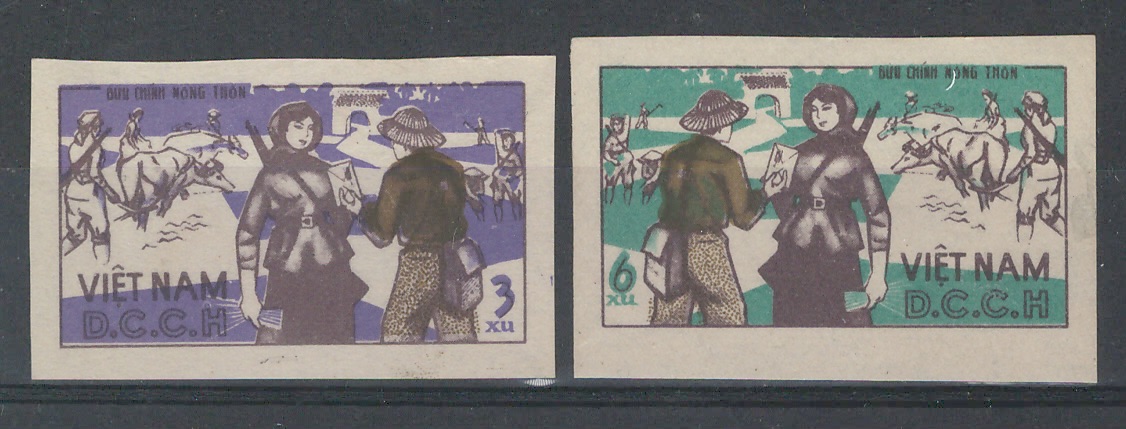
These stamps were not intentionally issued imperforate, however a very small number of imperforate stamps have come to market.
Registration Nr. 101524
]]>By Klaus Gebhardt and Frank Duering
Introduction
Classic rare stamps of obscure territories and countries such as Mauritius or British Guiana were prominently reported about only a few years or decades after they were issued in the middle of the 19th Century. At the time stamp collecting had become a fashionable hobby of aristocrats and the upper middle class. Since the number of stamps issued by country were relatively small until the beginning of the 20th Century the focus of collectors was global and did not have the more narrow character of today’s country or motive collectors. As a result even very remote or small territories authorized to issue their own stamps became well known among collectors. Some stamps, such as the Mauritius Post Office stamps or the British Guiana 1c magenta became legends in the philatelic field that almost reached mythical proportions. Not only were these stamps celebrated by all collectors but by the population at large through newspaper articles, auction results and even books that described their origin, rarity and value.
With the greater number of stamps being issued in the 20th century and collectors turning to specialization this wide focus became much narrower. Collectors tended to concentrate on ‘their’ country or motive, ignoring the larger world around them. For countries that were either small or politically less prominent this led to the curious effect that stamps which were rarer than even the fabled examples above were almost forgotten. This is the case with the extremely rare stamps of South Central Vietnam that were issued between 1950/51 and 1954. Today only one stamp catalogue (Michel) even lists and attempts to price these stamps, while all other catalogue makers have so far ignored them. The Michel catalogue that covers Vietnam is only available in German. That means information about these stamps is mostly open to German language speakers and that, of course, contributes to their relative obscurity in the philatelic community. This brochure is trying to change this.
Larger Historical Context
At the end of World War II the surrender of Japan in September of 1945 to the United States created a power vacuum in Indochina. Japan had occupied the Northern part of Indochina in September of 1940 in an arrangement with the French Vichy Government that was left in place to continue the administration of the territory. In July of 1941 this occupation extended also throughout the Southern part of Indochina but became total in March of 1945, when the Japanese disarmed and imprisoned the French troops across all of Indochina to take full control. A nationalistic movement created in May of 1941 to fight the Japanese, called League for the Independence in Vietnam (Việt Nam Độc Lập Đồng Minh Hội or Viet Minh in short) used the power vacuum that existed in August of 1945, after the Japanese influence had vanished, to declare Vietnam’s independence. Japanese troops were still in the country but had not been disarmed yet by the Chinese north of the 16thparallel and by the British south thereof. This was completed by the beginning of October of 1945 and thereafter French troops began reentering the country in order to reassert their previous colonial influence. Already with the neutralization of the French troops in March 1945 by Japan, the Vieth Minh, under their leader Ho Chi Minh, had begun to establish their influence on the Indochinese country site. With Japan out of the picture, the Viet Minh began to reorient their fight for independence against the French. French troops were slowly built up again starting from the South and by March of 1946 they begun to reenter the area North of the 16th parallel. Thus began a bitter power struggle with the Viet Minh mostly occupying the country side and the French the large cities, towns and important roads. The Viet Minh were backed in this by China and the Soviet Union, fellow communist countries, that had recognized Vietnamese independence in 1950. The French in turn were supported by the United States. This brutal proxy war came to an end in May of 1954, when the French lost a decisive battle at Dien Bien Phu and with the Geneva Agreements that ended all hostilities in July of 1954 and granted Vietnam territorial integrity and independence from the French.
Parallel Postal Systems
The power struggle between the Viet Minh and the French, with each side controlling different parts of the country, created a unique parallel administrative system under which the Viet Minh generally controlled small towns, hamlets and the country side, while the French focused on the larger towns and cities and on controlling major transportation infrastructure important to moving around troops and weapons. Of course, the controlled territories changed very frequently during the war which lead to either an expansion or contraction of the postal coverage afforded to either party. The Viet Minh organized themselves in 6 different administrative districts (Lien Khu) which were not necessarily contiguous due to French intervention. One of these districts below the 16th parallel, the South Central area of Vietnam remained under the control of the Viet Minh even after the French had re-occupied the South. This was the 5th Interzone (Lien Ku V.) that consisted of the coastal area just north of Nha Trang to Quinhon, south of Tourane (now called Da Nang). Exhibit 1 shows an approximate map of this area. It was created for administrative purposes in July/August of 1951 by the Viet Minh Congress and was intended as a decentralized civilian administration in support of the centralized military administration.[1]Here the Viet Minh post offices remained open through August 1954[2].

Until November of 1945 Indochinese postage stamps were used even in areas controlled by the Viet Minh.[3]In November of 1945 and through 1946 the Viet Minh started to issue their own postage stamps. For the most part these were Indochinese postage stamps that they had found in the postal archives in Hanoi and that were simply overprinted with the new country name “Viet-Nam Dan-Chu Cong-Hoa” or abbreviated “VNDCCH” (The Peoples Democratic Republic of Vietnam). However, five new stamps with the portrait of Ho Chi Minh were also issued in September 1946.[4] They also featured the country name of ‘Viet-Nam Dan-Chu Cong-Hoa’. Until April, 1946 when the Viet Minh demonetized Indochinese postage stamps, either only VNDCCH stamps or a combination of Indochinese and VNDCCH stamps were used in the area controlled by the Viet Minh.[5]After April 20, only VNDCCH stamps were sold at the post offices; due to scarcity of material, Indochinese stamps, however, could still be used.
On December19th, 1946, after continual notorious French provocation, the Viet Minh decided to attack French forces in Hanoi. This is known as the “Clash of Hanoi” in the history books. Well prepared, the French hit back and soon took over Hanoi expanding from there into all main towns north of the 16th parallel over the following months. With the territorial control of the French increasing in the central parts of Vietnam, the communication between the five Interzones located in the North and the 5th Interzone located in the central part of the South became interrupted, making postal traffic and the exchange of supplies among the districts very difficult and dangerous.[6] This resulted in a severe curtailment of supply shipments. With VNCCH stamps running out in the 5th Interzone, the civilian administrative district was authorized to issue its own stamps. Economic conditions and the availability of raw materials was very constrained all over the North but in 1950 (the exact date is unknown) the first postage stamps of the 5th Interzone were issued featuring a portrait of Ho Chi Minh. They also show ‘Viet-Nam Dan-Chu Cong-Hoa’ as the country name. Given the war time conditions, the stamps were a rather primitive affair. They consisted of crude individual handmade clichés that were assembled to a sheet (the exact sheet size is unknown but is thought, based on one surviving sheet fragment, to be at least 20) and printed in monochrome colors using a letterpress method (the Michel Catalogue notation that identifies the printing method of the first stamps as ‘stone print’ is incorrect). All stamps were imperforated and ungummed. Color tones vary slightly between printings. Since the clichés were handmade they also show slight variations in the design. Also for expediency sake, the value in each cliché was left blank, so that a different value could be inserted each time stamps with a different denomination were printed. Nothing is known about the printing quantities for each stamp, but, owed to the material constraints and the scarce postal traffic that was even possible, they must have been small and are likely made on a need basis.
Postal use in all Viet Minh held areas was very low as is evidenced by the scarcity of surviving postal history material. Letters for soldiers typically were free of charge and the same was true for official letters (until July 1953), although exemptions exist. This means only private mail had to be franked and there simply was not much of that. Mail transfers from one Lien Ku to another were organized in “Trams”. These were foot messengers that went through or around French occupied areas.[7] Most mail in the North emanated from large towns or regions under the control of the French and there either Indochinese or French stamps or free franks were used instead of VNCCH stamps.[8]
The Postage Stamps of the 5th Interzone
No official postal communications are known to survive that define the postage rates and surcharges used from 1950 through 1954 in the 5th Interzone. However, by observing the very few surviving letters, the following picture has so far emerged[9]:
| Approx. Time Frame | Standard Letter Rate | Surcharge for Registered Mail |
| 2nd Quarter 1951 | 10d | 20d |
| 4th Quarter 1951 | 15d | |
| 1st Quarter 1952 | 30d | 60d |
| 2nd Quarter 1952 | 100d | 200d |
| 2nd Quarter 1953 | 300d | 600d |
| 2nd Quarter 1954 | 500d |
As one can easily see, inflation was rampant in the 5th Interzone. This of course presented a problem for the postal administration as constantly new stamps had to be prepared.
Almost no documentation about postal directives appears to have survived the humid climate and the enduring wars the country suffered through many decades. However, an official looking document that purports to be issued by the postal authorities of the 5th Interzone was obtained by the well known philatelist and Vietnam stamp specialist Theo Klewitz (Exhibit 2). On May10, 1951 the postal authorities of the 5th Interzone announced in it the future publication of postage stamps for the zone. All in all, 12 different stamps were announced either in honor of Ho Chi Minh’s birthdays (May19,1951 and May19,1952) and for the 2nd party delegate conference. The stamps announced were:
| 1d | Violet |
| 3d | Pink |
| 4d | Light red |
| 5d | Green |
| 7d | Deep purple |
| 10d | Lively red |
| 10d | Saffron |
| 25d | Green |
| 35d | Dark red |
| 35d | Green |
| 100d | Dark brown |
| 100d | Brownish Grey |

The document has been examined by Vietnamese scholars to document its authenticity. The language and writing used in it represent the Vietnamese that was in use at that time. Judging by the uneven spacing of the individual characters it was clearly not produced using a typewriter or computer but by hot metal typesetting. It is likely that the Viet Minh possessed this technology. Contrary to common lore, not all Viet Minh were operating out of the jungle. The 5thInterzone was a fairly large geographical area that included real towns along with all their infrastructure. All of this supports the authenticity of the document.
On the other hand, there are facts that undermine the authenticity of it. Only three of the stamps announced in the document were ever issued and only two in the approximate colors indicated therein. Also, famous philatelist J.Desrousseaux reported that the civil administration of the 5th Interzone was established in a meeting of congress between July 16th and August 2nd 1951.10 This means the publication of the document would predate the existence of the civil administration of the 5th Interzone under which authority the document was purported to be issued by a few months. It is of course possible that the Military Government issued the decree ahead of the formation of the civil administration under its own name but that is unlikely as there was no need for the military Government to placate a future civil Government. Further it is odd, that a document published in May of 1951, a time when the standard letter rate was already at 10 Dong in the Lien Khu 5, would announce stamps in the denominations of 1 Dong, 3 Dong, 4 Dong and 5 Dong for issuance later on that year, tariffs that would have had very little possible usage in late 1951. Also strange is the announcement of stamps that essentially spanned over more than one entire year. Did the Government already anticipate rampant inflation and indirectly announce future rates ahead of time? Why, otherwise, were two 100 Dong stamps announced that represented 900% inflation of the standard letter rate over one year? What was the anticipated purpose of these high denomination stamps in 1951? The situation is further complicated by the fact that counterfeits in the exact denomination and colors as indicated on the document were produced in the 1970’s by a former North Vietnamese veteran (see details further on in this publication). Affine to Vietnam’s postal history he might have had information of planned issues and may have had the knowledge to produce the document himself in order to ‘properly’ document his creations and avert suspicion by collectors; or may likewise have “completed” what did not get finished of the announcement. Finally, a very similar and official looking document has appeared that seemingly proves the existence of the stamps later unmasked as pure “cinderellas”produced by the same forger.
But then again, if the forger created this document to “legitimize” his forgeries, why did he cast doubts on it so profoundly by “issuing” stamps and varieties so far beyond what he announced in this document?
We may never know, if the 5th Interzone publications that have appeared are actually genuine and were just used by the forger to create his products or if he created the publications to make his forgeries more credible. This chicken and egg question will have to be answered by each reader individually.
Although no verified genuine postal announcements are thought to exist, we do know the approximate issuance date of the 5th Interzone stamps by looking at the few surviving letters and by the date cancels on individual used stamps.
The first batch printed in 1950/1951 had the following denominations11:
| Michel Nr. | Denomination | Color |
| 1 | 1d | Violet-grey |
| 2 | 5d | Dark green |
| 3 | 10d | Green blue |
| 4 | 10d | Lilaq rose |
| 5 | 15d | Brown |


Michel states that these stamps were issued in 1950 and some cancels support that year, but written documentation for this is not available. Other sources, although likewise not proven, indicate the latter part of 1951 as the date of issuance. It is thought that by the time the 1 Dong value was prepared, the postal rates for a single letter was already at least 5 Dong. No single franking of the 1 Dong stamp is known to exist. All ten used 1 Dong stamps can only be found on a single letter sent in January of 1952. Unused 5th Interzone stamps are generally much rarer than used stamps. But the 1 Dong stamp is the second most “common” stamp in unused condition of the 22 different 5th Interzone stamps issued between 1950 and 1954 (though “common” is quite a misnomer for eleven surviving specimens!). Nevertheless, this supports the theory that the 1 Dong stamp was basically obsolete upon issuance. It is unknown, why there are two different color variations for the 10 Dong stamp. 10 Dong was either the most common rate used at the time requiring re-prints and/or, due to material shortages, the same ink simply could not be procured for a second printing run. The additional color variation of the 1 Dong stamp in grey-green originally listed in Michel may well have been an early proof12 as, apart from the color variation it also shows a slightly different cliché from the issued stamps.
With inflation running red hot and an isolated war time economy that essentially had to support itself in absence of any material central Government aid, at least three of the 5 stamps listed above were overprinted with a new value to save on paper. This happened in March of 1952. So far, the following denominations have become known[10]:
| Michel Nr. | Denomination | Color |
| 6 | 30d on 5d | Dark green |
| 6A (not assigned yet) | 50d on 15d | Brown |
| 7 | 60d on 1d | Violet-Grey |


The overprints for the 30 and 60 Dong value were made in red ink and the one for the 15 Dong value in Black. Again, the clichés for the overprint were made by hand and hence they show slight variations from each other. While the 30 and 60 Dong value represent the standard letter rate and the standard registered letter surcharge, it is not clear why a 50 Dong stamp became necessary. May be the stamp represented a further progression of the standard letter rate after the tariff had been raised to 30 Dong and it was already anticipated that inflation would quickly raise this to 50 Dong? It is also possible, though less likely, that the stamp was produced to save on precious printing paper, when the standard letter rate was raised to 100 Dong in the 2ndquarter of 1952. In this case, though one would have expected that the overprint would already have been adjusted to 100 Dong as that would have saved even more paper as just one stamp would have been necessary to cover the full cost of a letter.
Inflation kept marching on and by the 2nd quarter of 1952 a new stamp with a 100 Dong denomination was issued, followed then by higher denominations in 1953. While the image of those new stamps was almost identical to the image of the stamps produced in 1951 they were not printed using the same clichés or plates. Apparently new clichés were carved, a 100 dong stamp issued and then clichés were further retouched as slight differences between 100 and subsequent values suggest. As outlined by Düring14 among other indicators, this can be seen by the words ‘Buu-Chinh’, which are slightly smaller than the same words on the 1951 stamps. Also, while the first issue prints appear slightly “fuzzy” and printing was rather uneven, the second issue looks much sharper and clear. Finally, the nominal value appears to be part of each cliché and was not manually inserted as was the case for the first printing. This is evident by the fact that the partial print failures of the letter “B” in “BUU” that are very common in the first issue do not appear on the second issue. The following denominations were issued[11]:
| Michel Nr. | Denomination | Color |
| 8 | 100d | Light green |
| 9 | 200d | Orange-Red |
| 10 | 300d | Blue |
| 11 | 400d | Red |


Also in 1953 the first Service Stamps made their first appearance. These were required after the monetary reform in July of 1953. Before this date official mail was transported free of charge.16 These stamps depict a mother with child with a column of soldiers walking away in the rice paddies in the background. This issue is therefore known as “Family Left Behind” in philatelic circles. Apparently, having faced rampant inflation for a while now, the postal authorities decided to denominate these stamps not in Dong but by weight of rice in the husk. This was a rather clever way to avoid having to adjust stamp nominals all the time. Stamps from 50 grams of rice to 1 kilogram of rice were issued. Again, the clichés were manually carved and therefore each stamp in the sheet looks slightly different. Here is an overview of the stamps that were issued17:
| Michel Nr. | Denomination | Color |
| D1 | 0.05kg rice | Pale red |
| D2 I | 0.3kg rice | Pale red/small Buu-Dien |
| D2 II | 0.3kg rice | Pale red/large Buu-Dien |
| D3 | 0.3kg rice | Pale violet |
| D4 | 0.6kg rice | Blue-green |
| D5 | 0.6kg rice | Violet-blue |
| D6 | 1.0kg rice | Green-olive |


Being service stamps they were only used on official mail of the civil Government. Based on actual postal history observation it can be determined that the standard letter rate in 1953/54 within the 5th Interzone was 0.3kg rice and the rate for long distance letters (communication with other interzones) stood at 0.6kg rice.18Goanvic speculates on his website (http://www.histoire-et-philatelie.fr/) that the higher price for the intra-interzones letters was warranted due to the greater difficulties in getting letters through the French lines. Klewitz indicated that the travel time for couriers between the North and South was usually 20 days so one can assume the same was true for the reverse direction19. This time consuming travel would certainly support a higher tariff. In a precursor to the so called ‘Ho-Chi-Minh-Trail’, mail was already routed through neighboring Laos in order to make North-South and South-North travel less hazardous.20 It is unclear why the 0.05kg and 1.0kg denominations were required. Desrousseaux speculated that the 0.05kg value was intended for printed matter but due to lack of preserved letters this cannot be proven. The various colors of the most common used stamps (0.3kg rice and 0.6kg rice) supports the theory that postal authorities used whatever color they could get their hands on to produce stamps when they were needed. Michel lists two types of the 0.3kg rice stamp in pale red color. The first version shows a smaller version of ‘Buu-Dien’ than the second version that is a bit larger. Since no complete sheets are known to have survived, it is unknown if these two versions were just the result of different clichés on the same sheet or actually represent two different printings using different plates.
In 1954 some Ho Chi Minh stamps of the first (overprinted) and second issue were repurposed for official use by overprinting them with the words ‘Tem Su Vu’ and the new value in kilo rice. The overprint was in black. The original value of the stamps was obliterated by vertical black lines. The following stamps are known to exist[12]:
| Michel Nr. | Denomination | Color |
| 7 | 0.3kg rice over 30 Dong in red over 5 Dong | Dark green |
| 8 | 0.05kg rice over 300 Dong | Blue |
| 9 (but unassigned yet) | 0.3kg rice over 15 Dong | Brown |


By 1954 the low denominations of the 1951/1952 overprint issue had become redundant and to save on paper and make the stamps useful again they were overprinted. The 0.3kg and 0.6kg rice nominal did not change until 1954 when the 5th Interzone was disbanded by the Geneva Convention. This indicates that the Viet Minh plan to use kilo rice as the nominal value actually did serve its purpose.
Global Inventory of the Postage Stamps of the 5th Interzone
Since the stamps were encountered by Theo Klewitz and his Vietnamese contacts, it became quickly clear that the number of genuine surviving 5th Interzone stamps was very small. This can be attributed to the relative political isolation of the Viet Minh Government, the limited use, the continued wars that ravaged the country until 1975 and the difficult climatic conditions under which paper disintegrates in a few years. Also, one has to keep in mind that no Viet Minh soldier or civilian would have wanted to be seen in possession of Viet Minh stamps as this would have quasi confirmed the enemy status of that person to the French troops. It is therefore likely that a lot of envelopes were destroyed on purpose.
In 2016, the Society of Indochinese Philatelist (SICP) published an article in its quarterly journal that was the first attempt, to establish the known quantities of genuine 5th Interzone stamps.22 This was quite an undertaking as it involved studying a number of historical publications that dealt with these stamps and consultation among the various experts on these stamps within the SICP. Given the overwhelming number of counterfeit stamps on the market (see later on in this paper) only stamps that had physically been seen by an SICP member known to be very familiar with the genuine stamps were included in the count. Duplicates that had appeared in older publications and auction catalogues were eliminated. Luckily, most of these stamps are so unique (due to their cancels, faults, the way they were cut and their variable print) that it was fairly easy to recognize them and avoid double counts.
Here is the rather informative result of this global count:
| Michel Nr. | Nominal Value | Color | # Mint | # Used |
| 1 | 1 Dong | Violet-Grey | 11 | 10 |
| 2 | 5 Dong | Dark Green | 6 | 25 |
| 3 | 10 Dong | Green-Blue | 0 | 6 |
| 4 | 10 Dong | Lilaq-Rose | 1 | 7 |
| 5 | 15 Dong | Brown | 2 | 8 |
| 6 | 30 Dong on 5 Dong | Dark-Green | 3 | 13 |
| 6A | 50 Dong on 15 Dong | Brown | 0 | 1 |
| 7 | 60 Dong on 1 Dong | Violet-Grey | 3 | 4 |
| 8 | 100 Dong | Light-Green | 0 | 4 |
| 9 | 200 Dong | Orange-Red | 0 | 4 |
| 10 | 300 Dong | Blue | 0 | 3 |
| 11 | 500 Dong | Red | 0 | 1 |
| D1 | 0.050kg Rice | Pale-Red | 0 | 5 |
| D2 I | 0.300kg Rice | Pale-Red | 0 | 4 |
| D2 II | 0.300kg Rice | Pale-Red | 0 | 7 |
| D3 | 0.300kg Rice | Matte-Violet | 0 | 13 |
| D4 | 0.600kg Rice | Blue-Green | 0 | 3 |
| D5 | 0.600kg Rice | Violet-Blue | 0 | 2 |
| D6 | 1.000kg Rice | Green-Olive | 0 | 3 |
| D7 | 0.300kg Rice on 30 Dong on 5 Dong | Dark Green | 16 | 11 |
| D8 | 0.050kg Rice on 300 Dong | Blue | 0 | 3 |
| D9 | 0.300kg Rice on 15 Dong | Brown | 0 | 1 |
| Total | 42 | 138 |
The service stamps Michel Nr. I, II and III were not included in this table as the official character of these stamps is in question. So far, none of these stamps have been documented on genuine letters of the period or with genuine cancels in use at the time in the 5th Interzone. Known examples are either mint or show fake or favor cancels.
The author of the SICP article does not represent that the above count is complete and an accurate reflection of all LK V stamps in existence. Clearly, it is to be expected that some specimen lie in collections that have not seen the light of day for a long time or in the collection of very private philatelists who prefer their material not to be known to the public. However, given the fact that most stamps that were passed on over the past 60 years from the original collector generation to later collector generations remain essentially the same, and that hardly any „new“ inventory of these stamps come to the market, as witnessed by the author’s over 20 years of studying collection websites and public auctions, it is also fair to assume that this „unknown“ inventory is not very large.
Interesting but not necessarily surprising is the finding that, generally, the number of mint stamps is much lower than the inventory of used stamps and that of many issues not even a single specimen was preserved in mint condition. This is especially true for the Service stamps. One has to understand that these stamps were not produced for collectors, but they represented issues for South-Central Vietnam, that became necessary, because the 5th Interzone area controlled by the Viet Minh was isolated by French troop intervention and so whatever supplies of overprinted Indochinese stamps or Ho Chi Minh stamps (NVN Michel Nr- 2 to 6) in use in the North at the time were initially still available in the LK V, could not be replenished to the area.23 A shortage of certain nominals also was caused by the fact that postal rates in the Lien Khu 5 differed from the rates in force in the rest of the Viet Minh controlled areas.24 The civil administration of the 5th Interzone was established in July/August 1951 on a consolidated basis of Regions 5 ,6 and 15 (Highlands subdivision). The 5th Interzone included provinces as Quang Nam , Da Nang , Quang Ngai , Central Highlands (Gia Lai), Cong Tum , Dak Lak , Lam Dong) , Binh Dinh, Phu Yen, Binh Thuan, Dac Lac, Lam Vien, Dong Nai Thuong and Khanh Hoa (Nha Trang) . Hoai Nhon (Binh Dinh) was the ” capital ” of the 5th Interzone25.
In counting the used stamps, the author did not distinguish between stamps on or off cover. They were all counted as used. Also, the author did not eliminate any damaged stamps from the count. Based on damage that is visible from the front of the stamps, at least 20% of the total inventory shows imperfections. The postal officers that cut or tore these stamps from the sheets were not particularly careful. Often some part of the design was simply cut or torn off, although the clear space between the stamps in the sheet was actually pretty large. Some stamps received the same treatment when envelopes were opened by scissor. It is clear, that additional imperfections (paper thins) were created when the stamps affixed by a starch-rich rice glue were taken off cover unprofessionally. Clearly, damaged stamps do not hold the same value as sound copies, but it would be highly imprudent to reject such stamps entirely for one’s collection by applying preservation standards for stamps that were produced and used under much less challenging conditions. Let’s keep in mind that most of these 5th Interzone stamps are rarer than the fabled Blue and Red Mauritius stamps (12 and 15 surviving copies respectively, mint and used)! Some of the issues (Michel Nr. 6A, 11 and D9) so far are actually as rare as the world’s most expensive stamps, the British Guyana 1 cent magenta that sold for $9,480,000 in 2014 and Sweden’s Tre Skilling Banco color misprint that sold for SFR 2.88 million (approximately U.S.$2.3 million) in 2010!26
This comparison of course leads one to the difficult field of relative value of these 5th Interzone stamps. Today, the only catalogue listing LK V stamps is the Michel catalogue (Suedostasien 2017). In any attempt to assess the value of those stamps, it will be important to not only look at their relative number of copies still in existence, but also, at their state of concentration. Michel Nr. 1 is a good example for this. While there are 11 stamps mint and 10 used, in existence, these stamps are highly concentrated in 3 items. All used copies are on a single letter and no one would ever dream of taking these stamps off. The mint stamps known exist in one strip of 5, one strip of 3, and three single stamps. Again, no reasonable philatelist would ever cut apart a unit, as there are only 3 mint units left overall across all 5th Interzone stamps that include more than one stamp. A similar situation exists with Michel Nr. 3 where 3 of the 6 used stamps are found on a single cover; and to a lesser degree Michel Nr. 6 where 10 of the 13 used specimens are on a single letter.
These considerations will then have to be played against the true demand in the market for those issues which to assess also provides for a substantial challenge: individual 5th Interzone stamps hardly ever come to market (often, they move from one collector to another in a private transaction) and hence, there is no public record of the prices paid. Also, until recently, the surviving quantities of these stamps was unknown to philatelists and now, that the absolute and relative scarcity of these stamps will become more widely known may lead to greater demand than before. Further, the flood of fake 5th Interzone stamps produced in Vietnam and most likely Hong Kong, still offered, by reputable, but ignorant auction houses, have created a great deal of insecurity among Vietnam stamp collectors who are understandably reluctant to buy yet another fake copy for a lot of money.
All these circumstances need to be taken into account when assessing, whether a price tag of e.g. €4,000 or €5,000 reflects the proper value of a stamp of which only a single copy currently is known to exist.
The idea of this brochure is therefore to provide information to collectors worldwide along with a depiction of all known, genuine 5th Interzone stamps so that in acquiring any of these stamps they have the security to get the genuine item.
Some philatelist believe, that none of these stamps should ever be shown in a publication as this would only attract additional and better fakes but these beliefs are misguided. First, there are already scans of genuine stamps available in publications and these have not resulted in newly created “better” fakes. Also, these stamps are not easy to fake as everyone, whoever has seen genuine and fake stamps side by side, can attest to. The way the color is absorbed by the paper, the often, uneven letterpress print that differs a bit from stamp to stamp and the handmade rice paper itself is very hard to imitate. Also, since most copies are in fact used and have very characteristic cancellations, creating convincing duplicates becomes even harder. Creating a reliable and professional reference standard that allows collectors to distinguish originals and fakes will in fact make it much harder for new fakes to be accepted by the philatelic community and will over time unmask all the fake stamps that are out there and hence become a bulwark against counterfeits.
So while not all philatelist known to own genuine 5th Interzone stamps have participated in the publication of this paper it is expected that, similar, to the very detailed record available for the 27 Mauritius stamps, this paper will eventually be able to document all known specimens in great detail and hence provide the certainty that collectors require. Collectors who would like their genuine stamps to be included in future editions of this paper can submit a high-resolution scan (600dpi minimum) of both sides of each stamp to northrock.info@gmail.com. The stamp will then be examined by at least three experts of the Society of Indochinese Philatelists (whose members also serve to expertise Indochina stamps for the American Philatelic Society) to ensure that it is in fact genuine. In some cases an original submission may be required but for most cases a high resolution scan should be sufficient. Make sure to include a detailed description of all faults or repairs and the provenance of the stamp (as far as known).
Counterfeit and Cinderella Stamps of the 5th Interzone
The Society of Indochinese Philatelists (www.sicp-online.org), created in 1971 to support the exchange of information among stamp collectors about Indochina, Cambodia, Burma and Vietnam, has in its ranks the foremost specialist and experts on Vietnam philately. It can draw on the knowledge and expertise of great philatelists such as the late J.Desrousseaux and the late T.Klewitz, to name just a few. Searching through its archives of publications it appears, that the fake and fantasy issues concerning the 5th Interzone became known sometime in the early 1970s. Initially they were only sold in Vietnam but quickly made their way into auction catalogues worldwide. Members first took these newly discovered issues very seriously as the material that was sold was well made and looked like it could be genuine. It also came in some instances with documentation that looked like official stamp announcements by the postal authorities of the 5th Interzone. However, over a few years, and after consulting with the Philatelic Society of Vietnam, it became clear that all these newly appearing stamps were either fakes or cinderellas. Since then the Society has been warning collectors about acquiring them. On their website (www.sicp.org) here is a section under ‘Fake and Fantasies’ that allows collectors worldwide to read up on these issues even if they are not members of the Society.
The Society went even further. To track down where the fakes were coming from, members of the Society visited Vietnam to find the forger. The late Joe Cartafalsa was a pioneer in rooting out the details. On the SICP website Joe reports: ‘Later during that trip, I learned that the forger was a retired Viet Minh soldier who had been a fighter in LK5 during the war against the French. He was disabled, and given a job in the History Museum in Hanoi after the French defeat. Sometime before 1975 (1975 is when his fakes were first sold outside Vietnam in Europe and the United States), this veteran used his time in the museum to learn about the names of the party members, their families, addresses, etc. The fakes were produced along with postal markings and cachets. I also learned that the forger died around 1997.’ The name of the forger was Tran Ngoc Chuong, as determined by SICP President, Richard Aspnes in a subsequent visit to his family. It is a fact that no additional reprints of fake 5th Interzone stamps have surfaced in the last two decades. But, of course, the damage had already been done. Numerous philatelist worldwide, who had never seen a genuine 5thInterzone stamps were duped to buy individual stamps at over $100 a piece and complete covers that were often priced in excess of $1,000. Today virtually all 5th Interzone stamps offered on E-Bay, Delcampe, by auction houses and dealers are fakes. The idea of this publication is to change that and provide collectors with the confidence so that they distinguish originals from fakes and can only acquire genuine 5th Interzone stamps.
Fakes
Faked stamps so far have been identified as being from two different proveniences:
The “Hanoi” fakes
Tran Ngoc Chuong was a rather prolific forger. The variety in fake Ho Chi Minh- and Family left behind- stamps he produced is staggering. Apart from nominals that had actually been issued in the 5thInterzone (true fakes) he also produced nominals that never existed, nominals that existed but in different colors and of course numerous fake ‘Tem Su VU’ overprints (all of which could also be referred to then as fantasies or cinderellas). If one can compare them to the originals, the fakes are actually pretty easy to spot but since the available number of originals is very limited they were nevertheless effective.
The “Hong Kong” fakes; stamps of this origin started to show on the market place in the early 90ies. Whether or not they truly stem from a Hong Kong source, cannot ultimately be proven; typically this group of fakes/fantasies is crafted more skillfully
Characteristics allowing to discriminate between genuine and fake, both of “Hanoi” and “Hong Kong” origin, have been presented in detail in a SICP publication in 201227. It’s contents is still valid with the following exception as it provides supplementary information for the assessment of overprints:
-the red overprints of the original reflect bright red under UV Light while that of the fakes reflects dark red.
Below are non-exhaustive assortments of (scans for each group)
Ho Chi Minh fakes- of the “Hanoi provenience”:


Here is an example of a mixture of fake and fantasy cover. The 30 Dong on 5 Dong in blue was never issued, while the 60 Dong on 1 Dong violet-grey existed but is represented by a fake. All markings or cancels are fakes.

Ho Chi Minh- fakes of the “Hong Kong provenience”:

Family left behind- fakes of the “Hanoi provenience”:


Even complete letters with fake markings and cancels were produced:
Cinderellas
Below is an assortment of issues that were never authorized or issued by the post office. As a result, they should be referred to as “Cinderellas” or fantasy issues rather than forgeries no matter whether with or without overprints or whether on or off cover:


These also appear on fantasy covers which show fake markings and cancels:


Again, fantasy covers with fake markings and cancels exist:

Here is an example of a fake and cinderella/fantasy cover of the Ho Chi Minh issue (Hanoi Fake):

The 30 Dong on 5 Dong is fake (as this nominal was in fact issued) while the 5 Dong on 10 Dong is of pure fantasy. All markings/cancels are fake.
Genuine 5th Interzone Ho Chi Minh Stamps
This chapter of this paper is dedicated to individually list and describe the known and surviving specimens of 5th Interzone stamps that have been determined to be genuine by at least three experts of the SICP. The panel of experts will consist of the long-time SICP members Lu, Düring, Goanvic and Gebhardt. So far this listing is incomplete, as some collectors are not yet willing to publish depictions of their genuine stamps. We hope that the listing will become more complete as time goes on.
Ho Chi Minh Issue
1 Dong, violet grey 1950/51
Mint copies.
Multiples
Unique strip of five. Largest known unit of this stamp. Paper fold between second and third stamp from the left. Small stains at bottom left, bottom and top of the first stamp on left. Stain at bottom of fourth stamp from the left. Small stain to the right shoulder of HCM and bottom right of the fifth stamp from the left. Hinge traces on the first and fifth stamp but no paper thins. Paper shows tropical toning. Provenance: Tran Nguyen (former Postmaster of North Vietnam), Vo Khac Du (Nha Trang), Tran Trong Khai (Stamp Dealer), Father Linh Bui, Lucian Lu (SICP member), Gebhardt (SICP member).

Singles
Clean, unused copy with large margins; very light toning at left and right bottom areas:

Proof ?

This is most likely the formerly listed Michel No. 2 grey-green version of the 1 dong value. The stamp listed for the first time in the 1965/66 edition of Michel’s “Übersee Katalog”. It shows key elements of the genuine final version such as the separately inserted value field but was printd of a different cliché. It was removed from listing as of the 2015 version of the catalogueas it most likely represents a non-issued proof; provenience: Trinh Xuân-Côn (secretary to prime minister’s office), T. Klewitz, N.N.
Used copies
No used copy off cover are known to exist of this value.
5 Dong, dark-green 1950/1951
Mint copies
Mint with hinge. Small thin below hinge. Some age stains on the back (middle right). Provenance: Vaclav Fejtek (Czech collector), D.Schwichtenberg (Daughter of Feijtek), Gebhardt (SICP Member)

Mint with hinge. Small age spot top right margin. Provenance: Vincent Longins, France, Gebhardt (SICP Member)

Proof ?
Stamp shows key elements of the genuine final version such as the separately inserted value field but was printed using a different cliché; provenience: Trinh Xuân-Côn (secretary to prime minister’s office), T. Klewitz, N.N.

Used Copies
Block of four on piece. Largest known unit of this stamp. Cancelled with circular Hoai Nhon Buu Dien canceler and manual insertion of date. In addition, rectangular date cancel showing May 12, 1950. This is evidence that these stamps were produced and used already in 1950. Bottom left stamp surface abrasion on top of stamp eliminating “NA” in “Vietnam”. Bottom right stamp showing larger surface abrasions on the right side of the stamp. Provenance: Tran Nguyen (former Postmaster of North Vietnam), Vo Khac Du (Nha Trang), Tran Trong Khai (Stamp Dealer), Father Linh Bui, Lucian Lu (SICP member), Gebhardt (SICP member).

Single on piece; slight toning left of forefront; provenience: Tran Nguyen (former Postmaster of North Vietnam), Vo Khac Du (Nha Trang), Tran Trong Khai (Stamp Dealer), Father Linh Bui, Lucian Lu (SICP member), N.N.

Used, circular cancel “Phong Dac Biet”. Cut on the left just touching the print image. Small thins on back in center and at top of the stamp. Provenance: V.Longin (France), Gebhardt (SICP Member)

Used, rectangular Buu Dien cancel illegible (Thanh-Hoa?). Tight margins but not touching the image. Tiny pin prick hole just below “5”.

10 Dong Red 1950/1951
Used Copies
Single on piece; provenience: Tran Nguyen (former Postmaster of North Vietnam), Vo Khac Du (Nha Trang), Tran Trong Khai (Stamp Dealer), Father Linh Bui, Lucian Lu (SICP member), N.N.

Proof ?
Stamp shows key elements of the genuine final version such as the separately inserted value field but is printed of a different cliché, here, no value yet inserted; provenience: Trinh Xuân-Côn (secretary to prime minister’s office), T. Klewitz, N.N.
30 Dong red on 5 Dong dark green 1952/1953
Mint
Mint with hinge. Tiny pin prick at middle/bottom of image. Provenance: Vaclav Fejtek (Czech Collector), D.Schwichtenberg (Daughter of Feijtek), Gebhardt (SICP Member)

Used
Used with illegible circular cancel. Stamp was initially missing a small art of the design “M” in Vietnam and “VN”. Expertly restored. Some margin added to right side.
Provenance: V.Longin (France), Gebhardt (SICP Member).

Used with circular but illegible canceler. Wide margins. Small paper thin on back at bottom left. Provenance: V.Longin (France), Gebhardt (SICP Member).

On Cover
Mono-franking of 10 copies of 30 dong on 5 dong on cover; one pair (folded at rim of cover) and 2 untouched blocks of four (cover manually folded after franking);provenience: Trinh Xuân-Côn (secretary to prime minister’s office), T. Klewitz, N.N.

50 Dong black on 15 Dong brown 1952/1953
Mint
No mint copy known to exist
Used
Used with circular date canceler from Hoai Nhon on June 15th (1952?) and blue pen manuscript. Only known specimen of this stamp. Small tear on top right, barely affecting the image. Larger paper thin on back at the top. Provenance: V.Longin (France), Gebhardt (SICP Member)

60 Dong violet grey 1952/1953
Mint
Mint vertical pair

100 Dong light green 1952/1953
Used with cancel fragment showing “Ngay” and “54”. Horizontal paper fold through center of the stamp caused by attaching it to a creased envelope. Marked with a “L” in circle (Lucian Lu’s SICP expert mark) Provence: Tran Nguyen (former Postmaster of North Vietnam), Vo Khac Du (Nha Trang), Tran Trong Khai (Stamp Dealer), Father Linh Bui, Lucian Lu (SICP member), Gebhardt (SICP member).

Wide margin copy plus fragment of second stamp on piece; cancelled with manuscript date April 21; provenience: N.N.

200 dong, red 1953
Used
Provenience: Trinh Xuân-Côn (secretary to prime minister’s office), T. Klewitz, N.N.

300 dong, blue 1953
On cover
Provenience: Trinh Xuân-Côn (secretary to prime minister’s office), T. Klewitz, N.N.

500 dong, red 1953
Used
Provenience: Trinh Xuân-Côn (secretary to prime minister’s office), T. Klewitz, N.N.

0.050 kg rice on 300 dong blue 1954
Single used copy on piece; provenience: provenience: Tran Nguyen (former Postmaster of North Vietnam), Vo Khac Du (Nha Trang), Tran Trong Khai, Father Linh Bui, Lucian Lu (SICP member), N.N.

300g rice on 30 Dong on 5 Dong 1954
Mint
Mint with hinge. Small margins but not cutting into design. Tiny age spot on HCM’s forehead. Provenance: Klewitz (SICP Member), Schwirtz (SICP Member), Gebhardt (SICP Member)

MNH copy, ink handwriting on back; provenience: Trinh Xuân-Côn (secretary to prime minister’s office), T. Klewitz, N.N.

Used off cover
Used with illegible circular date canceler. Wide margins. Marked with a “L” in circle (Lucian Lu’s expert mark). Provenance: Tran Nguyen (former Postmaster of North Vietnam), Vo Khac Du (Nha Trang), Tran Trong Khai (Stamp Dealer), Father Linh Bui, Lucian Lu (SICP member), Gebhardt (SICP member).

Used with an illegible circular date canceler. Wide margins. Provenance: Vo Khac Du (Nha Trang),This stamp was then in a Vietnamese gold medal collection until 2002 (name of the collector known but withheld for privacy reasons) when it was acquired SICP member Palladino.

On Cover
Provenience: Trinh Xuân-Côn (secretary to prime minister’s office), T. Klewitz, N.N.

Service Stamps (‘Familiy left behind issue’)
0.050 g rice red 1953
Mint
No mint stamps known to exist
Used
Pair; right stamp with water mark ; provenience Trinh Xuân-Côn (secretary to prime minister’s office), T. Klewitz, N.N.

300g Rice pale red, large Buu Dien Inscription 1953
Mint
No mint stamps known to exist
Used
with circular canceler showing “Phu-Yen” and a date of April 4 (1953?). Hinged with a small paper thin on center back. Small paper separation not affecting the image on back. Marked with a “L” in circle (Lucian Lu’s expert mark). Provenance: Tran Nguyen (former Postmaster of North Vietnam), Tran Trong Khai, Father Linh Bui, Lucian Lu (SICP member), Gebhardt (SICP member).

300 g rice, pale red, small Buu Dien inscription 1953
Mint
No mint stamps known to exist
Used
Provenience: Trinh Xuân-Côn (secretary to prime minister’s office), T. Klewitz, N.N.

On Cover
300 g rice, small and large Buu Dien inscription on cover to Ho Chi Minh, 14.1.1954, backstamped Tam Ky, 17.1.1954; friendship handstamp on back; Provenience: Trinh Xuân-Côn (secretary to prime minister’s office), T. Klewitz, N.N.

300 g rice, large Buu Dien inscription on cover to Chinh Phu mailed on February 12nd, most likely in 1954. Provenience: Ted Hallock, David Fosters.

300g rice pale violet 1953
Mint
No mint stamps known to exist
Used
Used with circular canceler showing “Phong Dac”. Irregular cut. 3 wide margins but just cut into design at bottom left of the stamp. Provenance: D.Foster (SICP Member), Gebhardt (SICP Member).

Used pair; provenience: Trinh Xuân-Côn (secretary to prime minister’s office), T. Klewitz, N.N.

On cover
Cover sent to Ho Chi Minh, 11.9.1953, backstamped Tam Ky, 13.9.1953; two singles tied to cover; provenience: Trinh Xuân-Côn (secretary to prime minister’s office), T. Klewitz, N.N.

600g rice blue-green 1953
Mint
No mint stamps known to exist
Used
Used with circular canceler “Buu Dien”. Large margins. Small paper thin on back at bottom left of the stamp. Provenance: Klewitz (SICP Member), Duering (SICP Member), Gebhardt (SICP Member).

Used; provenience: Trinh Xuân-Côn (secretary to prime minister’s office), T. Klewitz, N.N.

600 g rice, violet-blue 1953
Mint
No mint stamps known to exist
On cover
Two singles on cover tied by cancel, 4.1.1954, backstamped Tam Ky, 7.1.1954; provenience: Trinh Xuân-Côn (secretary to prime minister’s office), T. Klewitz, N.N.

1.000g rice, green 1953
Mint
No mint copies known to exist
Used
Used copy; on hinged piece, marked with a “L” in circle (Lucian Lu’s expert mark), provenience: Tran Nguyen (former Postmaster of North Vietnam), Tran Trong Khai, Father Linh Bui, Lucian Lu (SICP member), N.N.

[1] Desrousseaux, J., Les Postes et Courriers Francais en Extreme-Orient, Livre 6, page 431
[2] J.Desrousseaux; SICP Journal III Nr. 3 of June 1973, Whole Nr. 12
[3] J.Desrousseaux; SICP Journal III Nr. 3 of June 1973, Whole Nr. 12
[4] J.Desrousseaux; SICP Journal III Nr. 3 of June 1973, Whole Nr. 12
[5] J.Desrousseaux; SICP Journal III Nr. 3 of June 1973, Whole Nr. 12
[6] Desrousseaux, J., Les Postes et Courriers Francais en Extreme-Orient, COL.FRA, Livre 6, pages 430-435
[7] Dessrousseaux, J., The Indochinese Philatelist , November 1973, Whole Number 14
[8] J.Desrousseaux; SICP Journal III Nr. 3 of June 1973, Whole Nr. 12
[9] J.Goanvic; L’Indochine Francaise Dans La Tourmente 1939-1955; http://www.histoire-et-philatelie.fr/pages/008_indo/5000_page_de_garde_indochine.html
10 J. Desrousseaux; Les Postes et Courriers Francais en Extreme-Orient, Livre 6; Page 431
11 Michel Suedostasien 2017
12 F.Duering, Supplement ICP Journal Whole Nr.204; September 2012
[10] Michel Suedostasien 2017
14 F.Duering, Supplement ICP Journal Whole Nr.204; September 2012
[11] Michel Suedostasien 2017
16 Desrousseaux, J., Journal of the Society of Indochinese Philatelists SICP, Nr. 14, November 1973
17 Michel Suedostasien 2017
18 J.Goanvic; L’Indochine Francaise Dans La Tourmente 1939-1955; http://www.histoire-et-philatelie.fr/pages/008_indo/5000_page_de_garde_indochine.html
19 T.Klewitz, Supplement to SICP Journal Whole Nr. 200, November 2011
20 Desrousseaux, J., Les Postes et Courriers Francais en Extreme-Orient, COL.FRA, Livre 6, pages 430-435
[12] Michel Suedostasien 2017
22 Gebhardt, K., Journal of the Society of Indochinese Philatelists SICP, Volume XLVI Nr.3, May 2016,
23 T.Klewitz, Supplement to SICP Journal Whole Nr. 200, November 2011
24 J.Desrousseaux, The Indochinese Philatelist, November 1973, Page 22
25 Tran Trong Khai, On Postage Stamps of Democratic Republic of Vietnam issued by local post (1951-1954)
26 https://en.m.wikipedia.org/wiki/Treskilling_Yellow/https://en.wikipedia.org/wiki/British_Guiana_1c_magenta
27 F.Duering, Supplement ICP Journal Whole Nr.204; September 2012
Registration Nr. 090026
]]>
 Here are two cancelled to order sets. The left pair shows horizontal ribbing while the right pin shows vertical ribbing. Note that the second 5xu stamp is taller than all the other stamps. This had to do with the manual perforation setting in the early days of North Vietnam.
 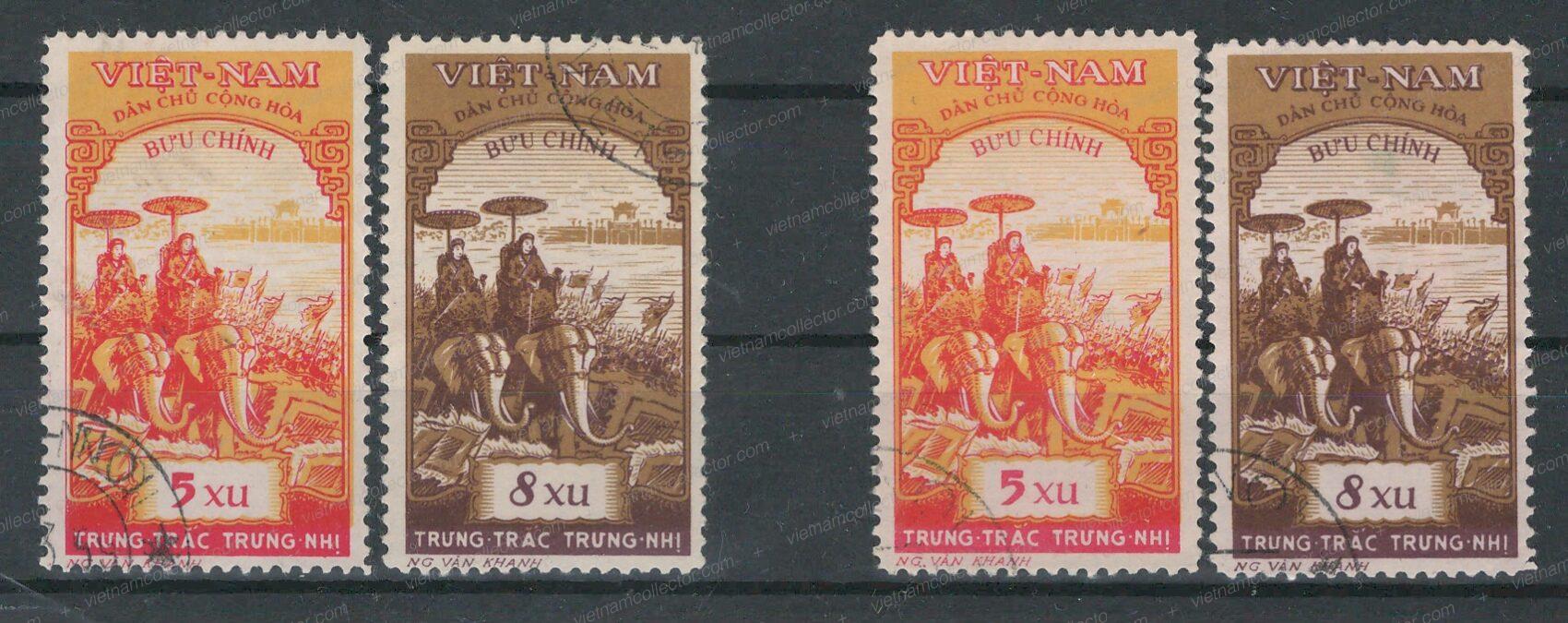 Mixed franking of the 5xu The Sisters Tru”ng stamps (2) together with stamps from the Worker Congress and Young Pioneers sets paying an overall postage of 12xu on an international air mail letter sent in June of 1961 from Hanoi to East Germany.
 Colorful mixed franking on which the smaller 20D and 60D HCM values were used. They are rare to find on cover. Since the letter was mailed just one month after the currency devaluation in 1959 it carries a dual currency franking as follows: 250 Old Dong :1,000 = 0.25 New Dong (or 25 Xu) plus 5 Xu for total franking of 30 Xu. Sent on April 9th, 1959 to Czechoslovakia.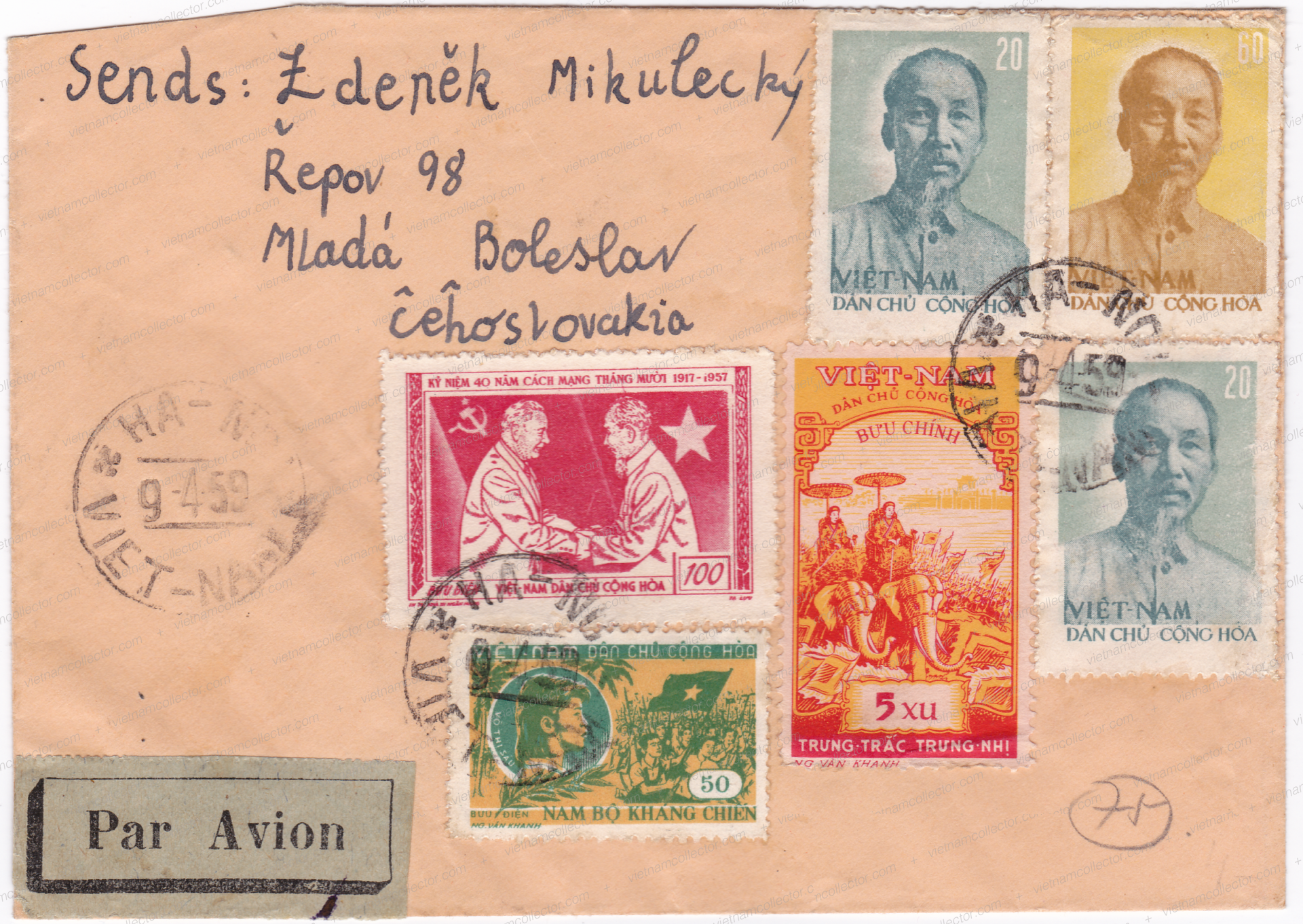
Interesting mixed currency franking featuring one of the Cam Phase stamps in 150 Old Dong, the 12 Year Republic 20Old Dong and two of the Tru’ng Sister stamps in 13 new xu. The old Dong was devalued by 1,000:1 so the two old stamps were only worth 17xu. So, there overall franking amounted 30xu which represented the surface letter rate to China. The 8xu Tru’ng Sister stamp is due to its unusual nominal value very hard to find on cover.
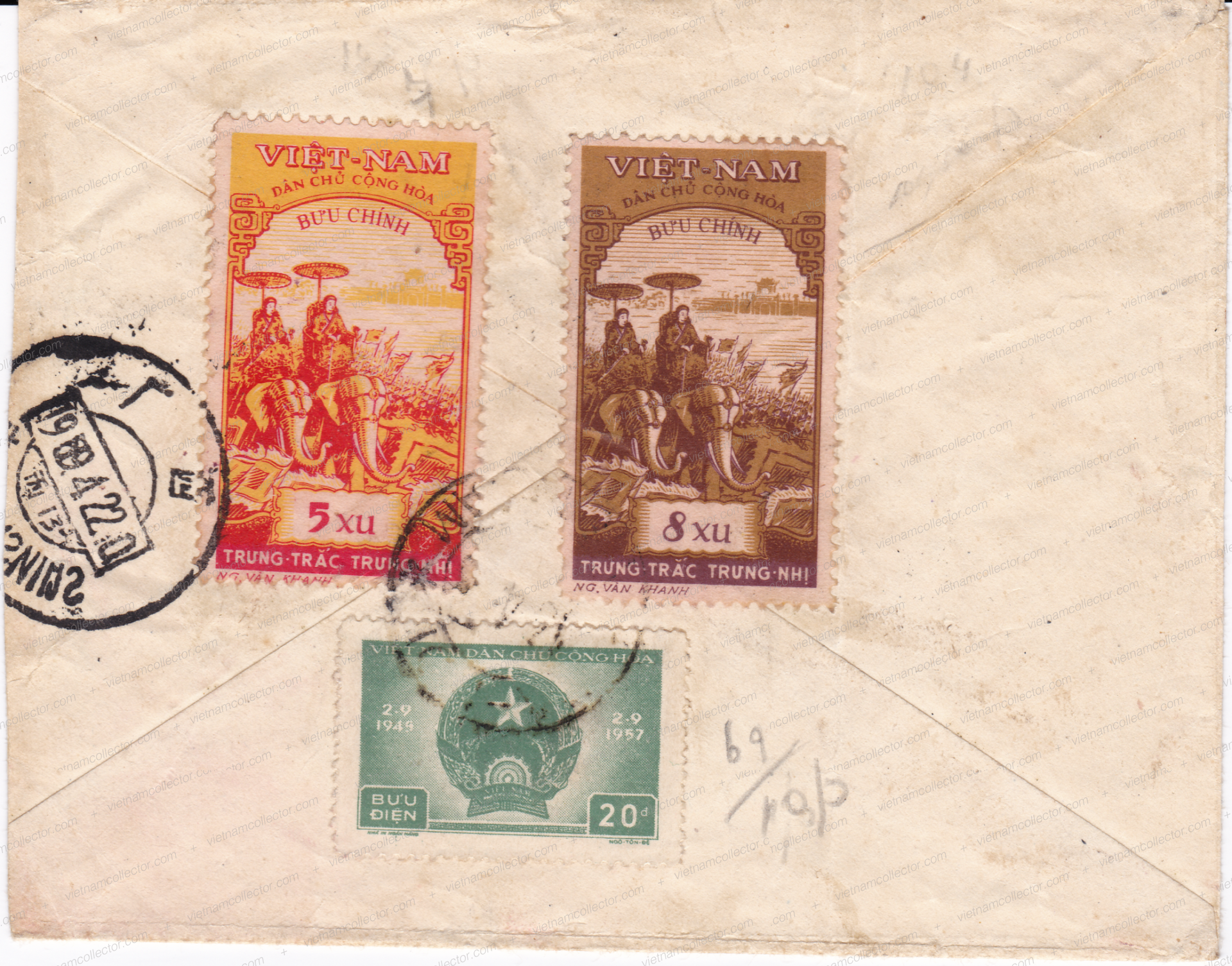
Complete letters are pretty hard to find. Here is a mixed currency franking from April, 1959. On March 1st, 1959 the Old Dong was devalued by 1,000:1 which meant that the stamps in the old currency (250D) were worth 0.25 New Dong or 25 Xu. A value with 5 Xu of the New Dong was added for a total postage of 30 Xu. That covered the surface rate to Eastern European countries, in this case Romania. Arrival cancel on the reverse.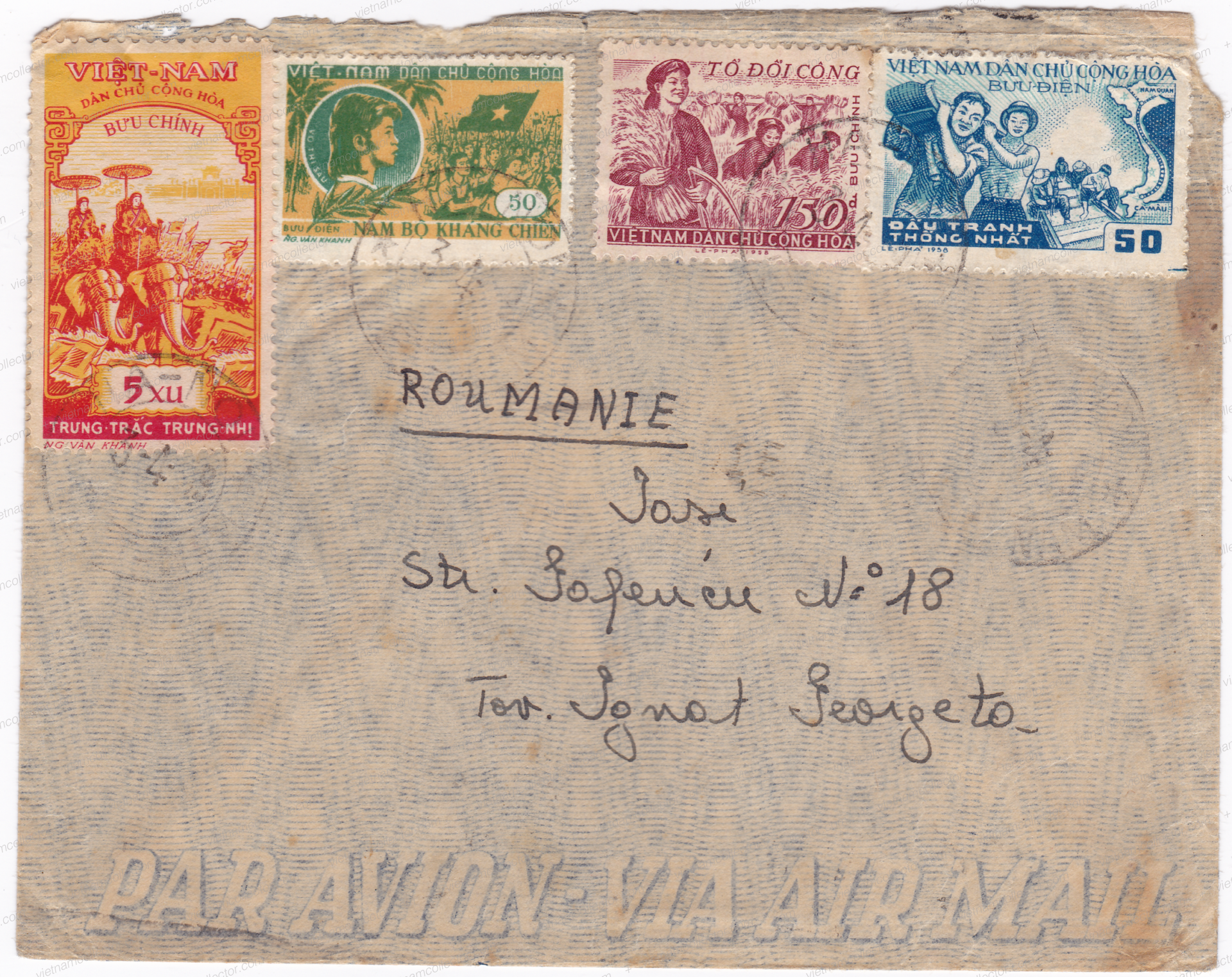
Mixed currency franking mailed April, 1959 from a guest of the Hotel Metropole to Czechoslovakia. The values in Old Dong amounted to 460D which at the time were worth 0.46 New Dong or 46 Xu. Added was a stamp with 5 Xu of the new currency for a total franking of 51 Xu.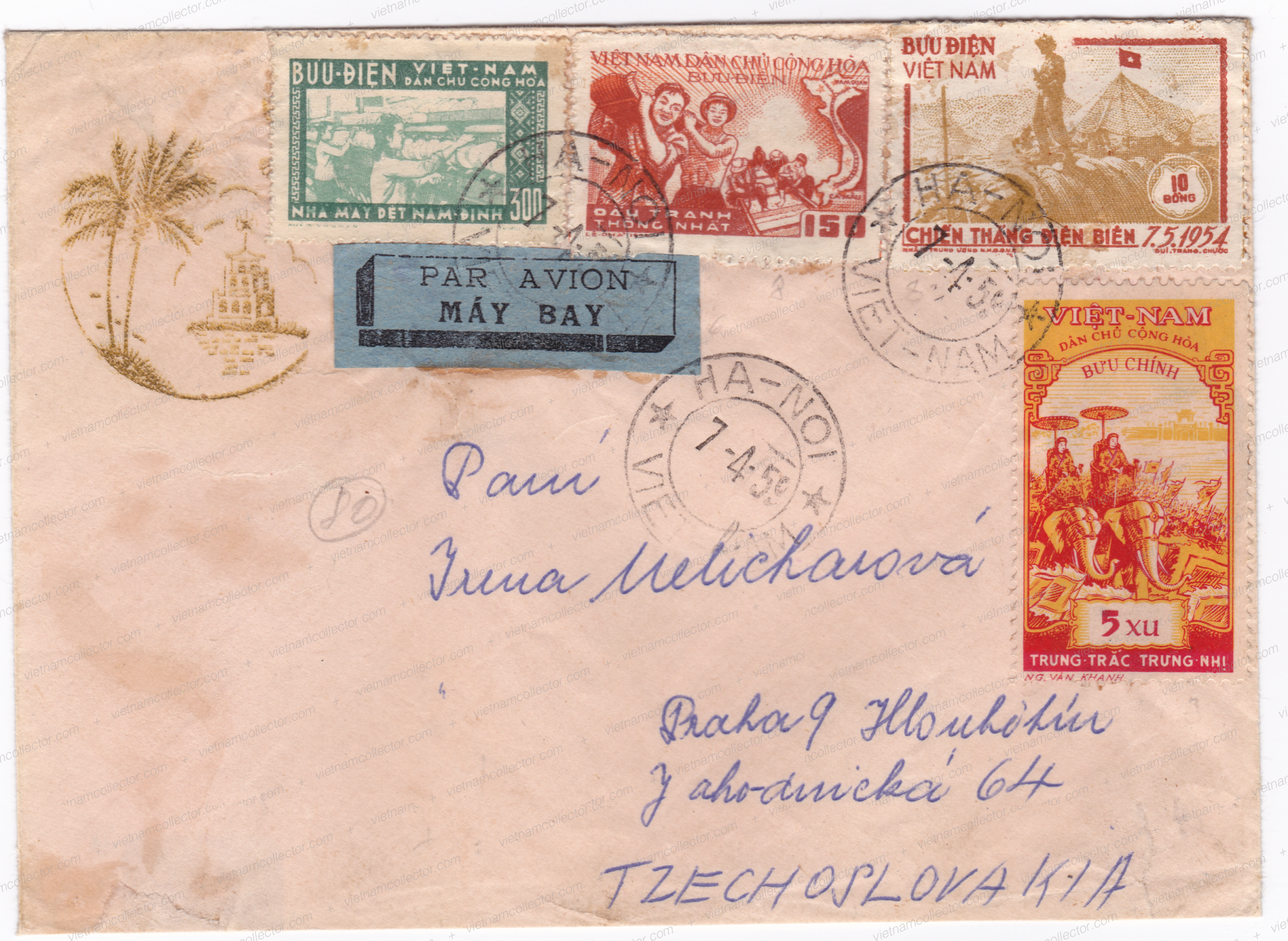
Registration Nr. 100200
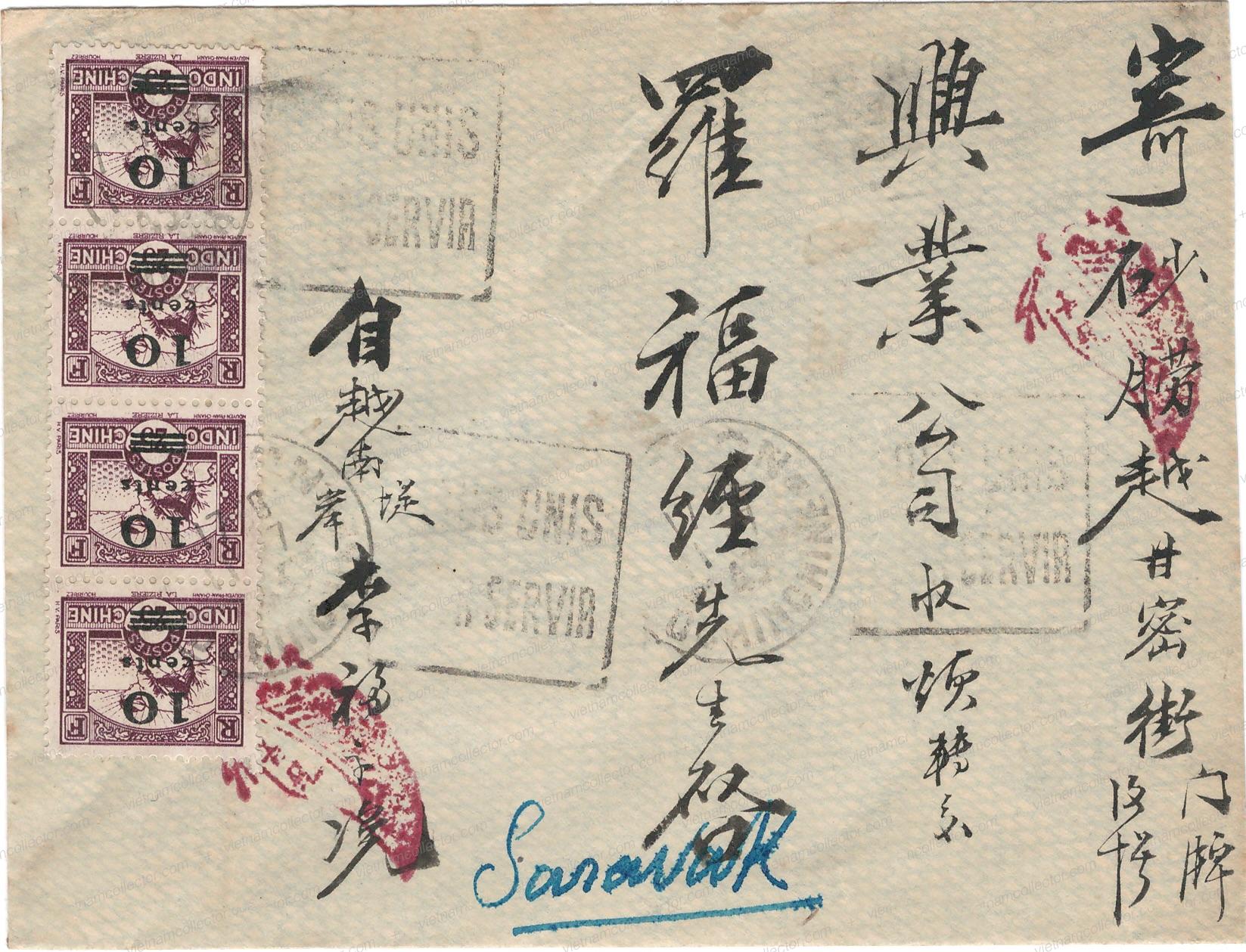
]]>International letter sent in July of 1943 from Saigon to Sarawak in Malaysia. Properly franked with 40C made up of four of the overprint stamps of the Domestic Scene series. International letters during the Japanese occupation period are very rare. Malaysia was also occupied by the Japanese forces at that time so the letter was not censored.
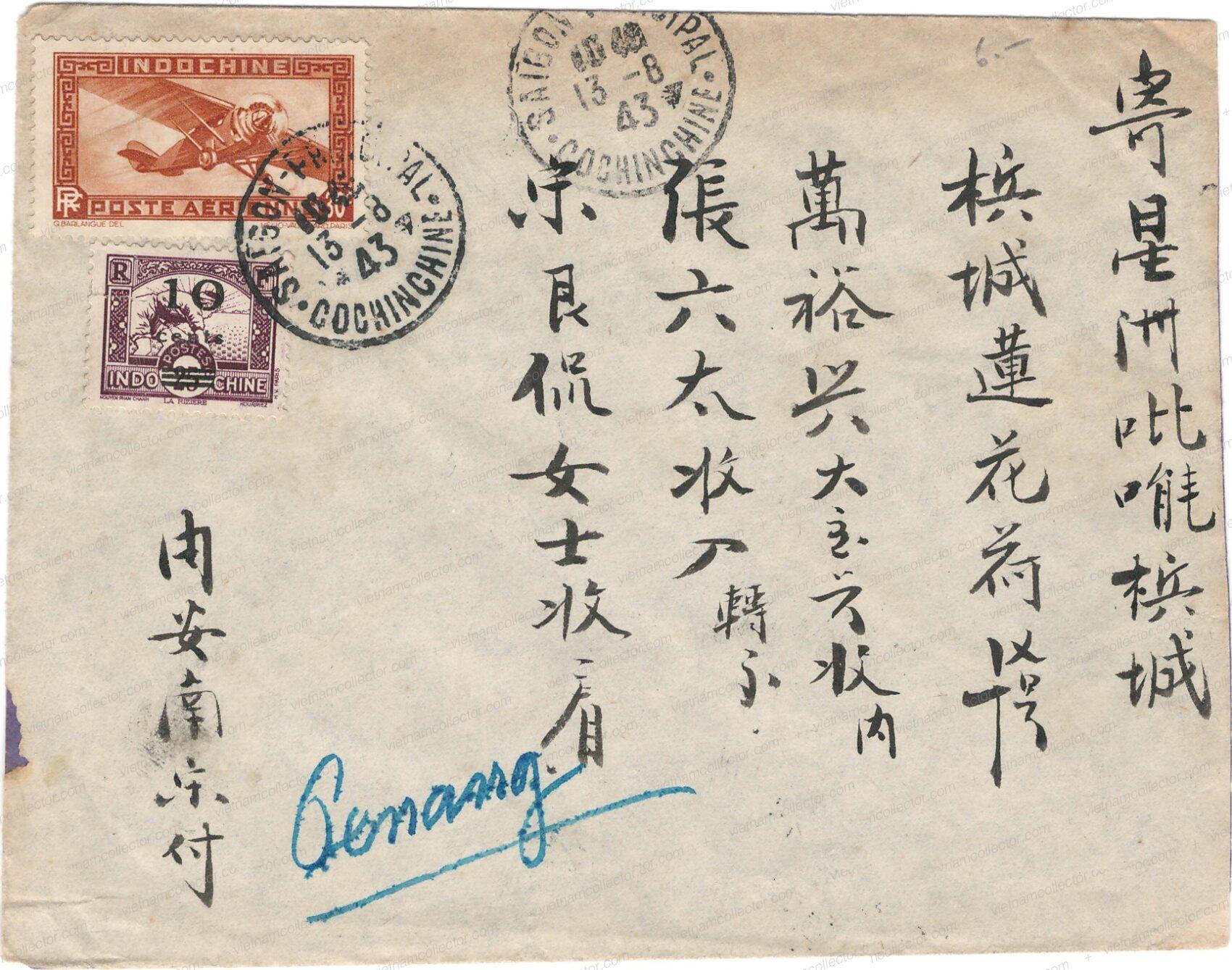
International letter sent in July of 1943 from Saigon to Penang in Malaysia. Properly franked with 40C made up of one of the overprint stamps of the Domestic Scene series plus a 30C Air Mail stamp. International letters during the Japanese occupation period are very rare. Malaysia was also occupied by the Japanese forces at that time so the letter was not censored.
Registration Nr. 090280
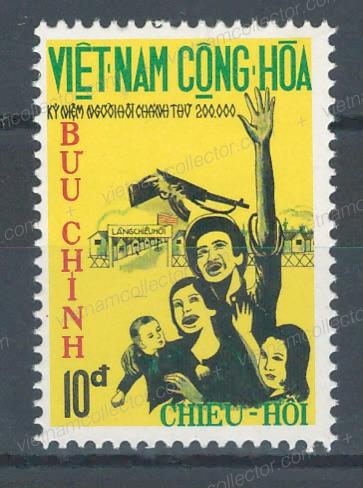
]]>Here is the mint never hinged stamp.
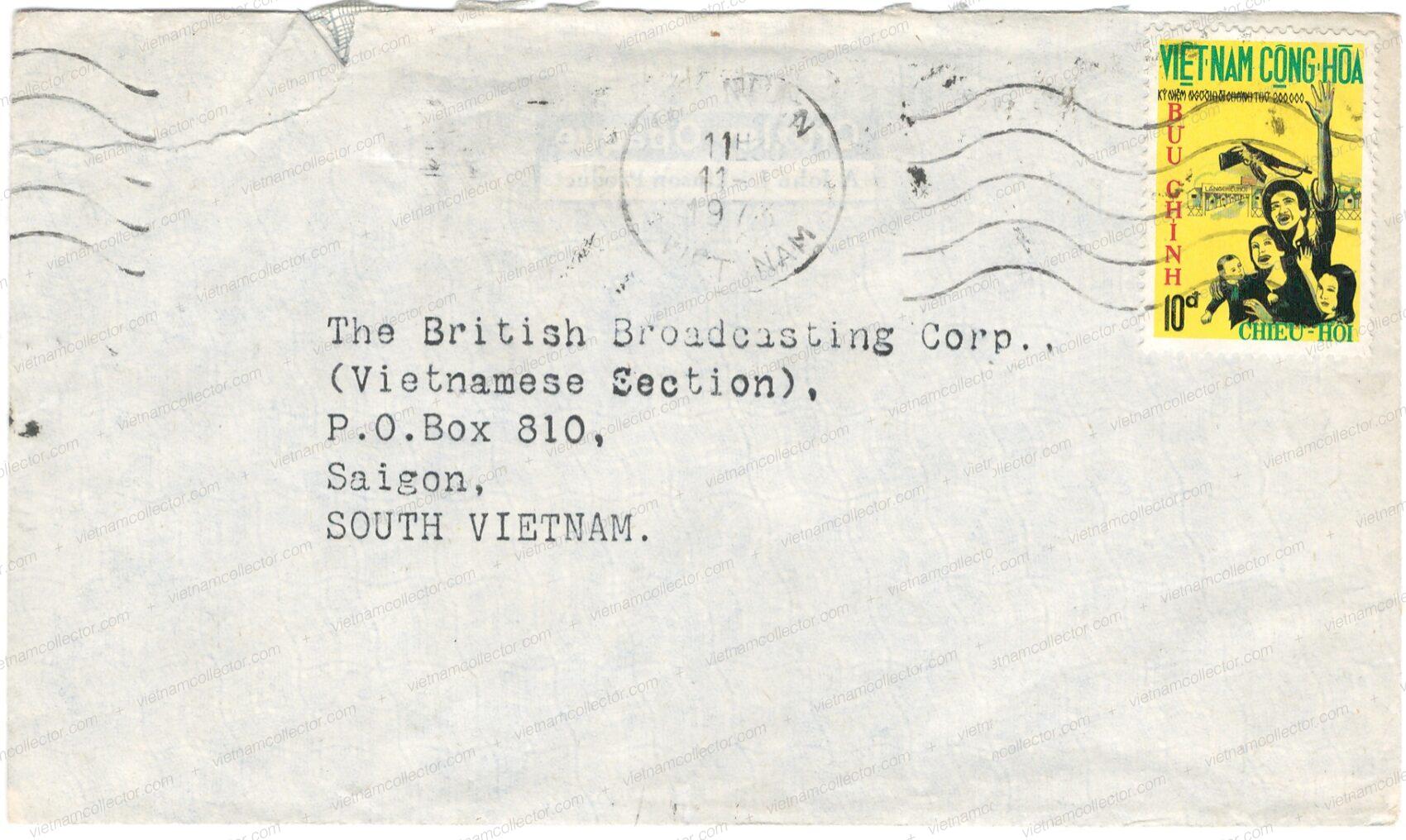
Single franking of the stamp on a domestic letter sent to the BBC television station in Saigon in 1973.
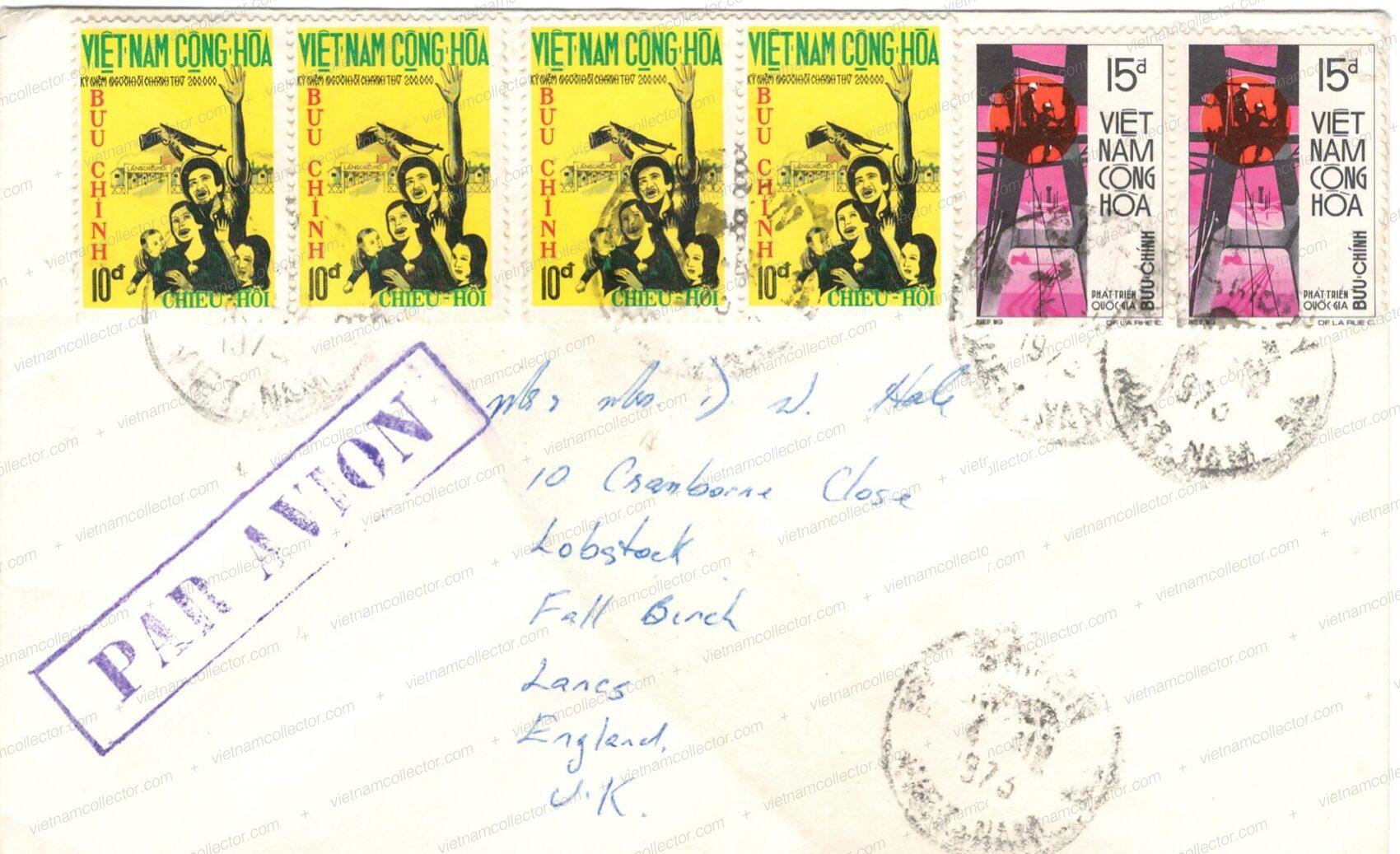
Mixed franking of the 10D Returnee stamp (4) together with the 15D National Development stamp (2) paying an overall postage of 70D on an international air mail letter sent in December of 1973 from Saigon to England.
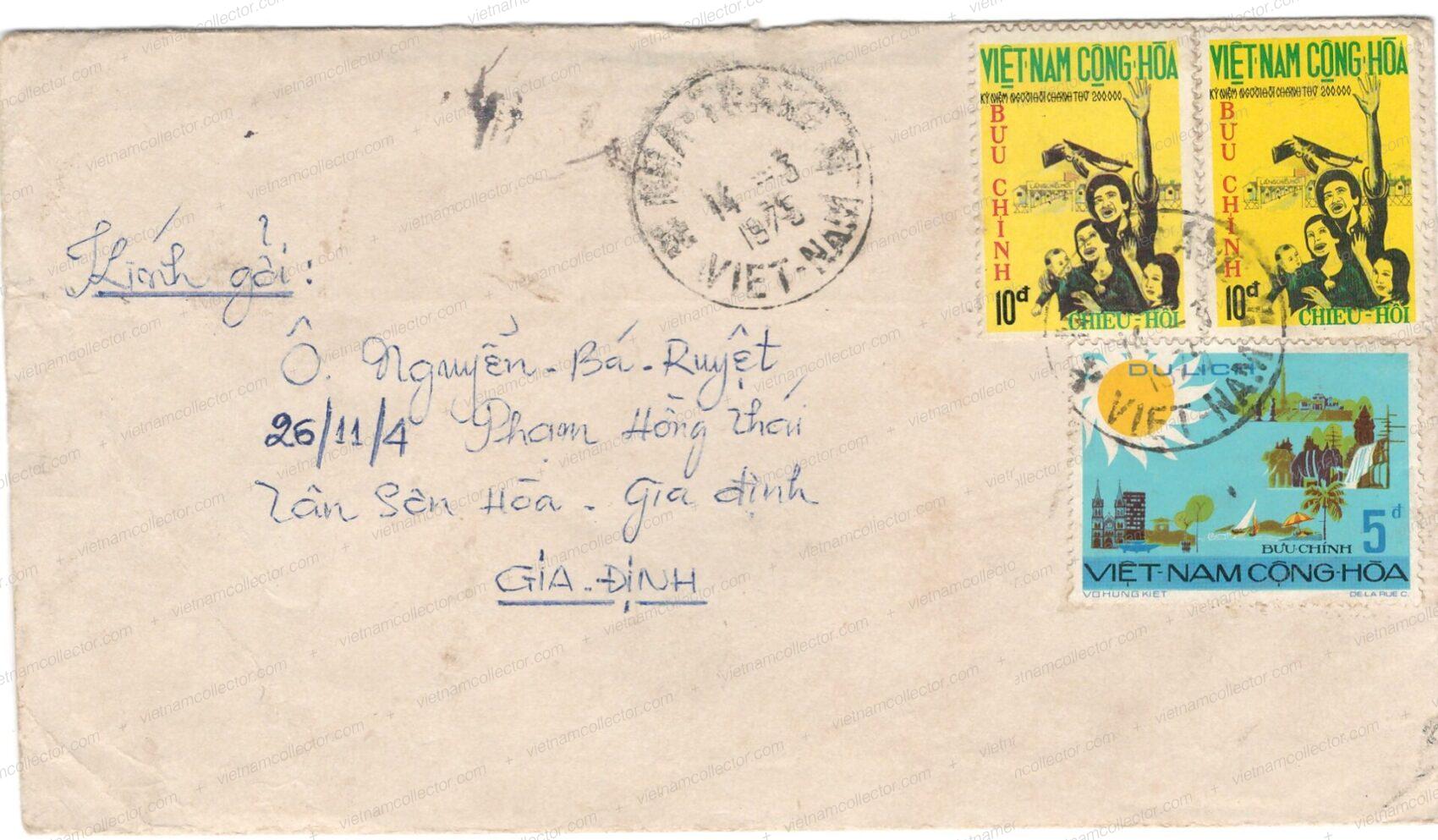
Mixed ranking of the Returnee stamp (2) together with the 5D National Sights stamp paying an overall postage of 25D on a domestic letter sent in March off 1975 from Nha Trang to Gia Dinh. This was just six weeks prior to the Fall of Saigon.
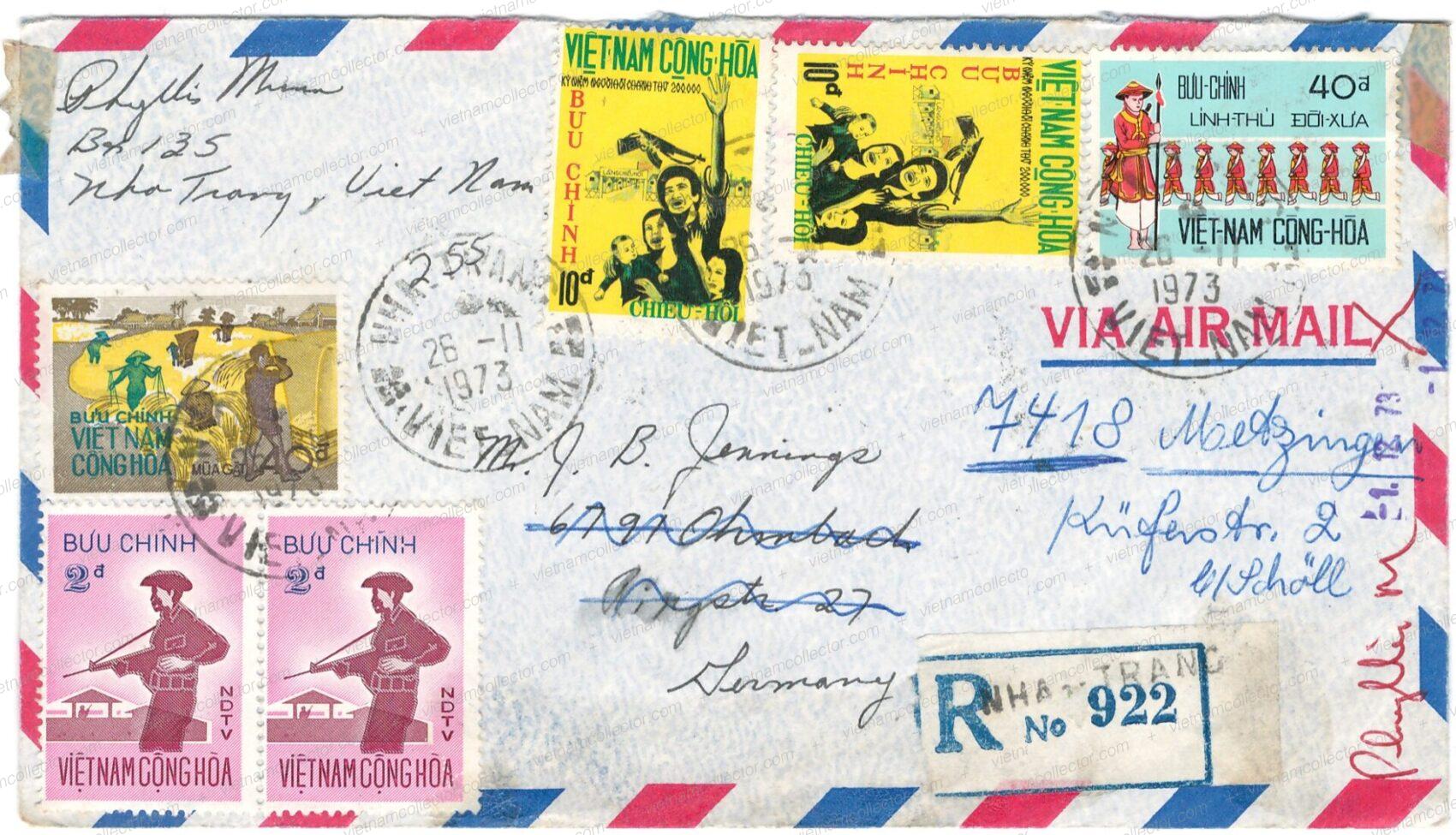
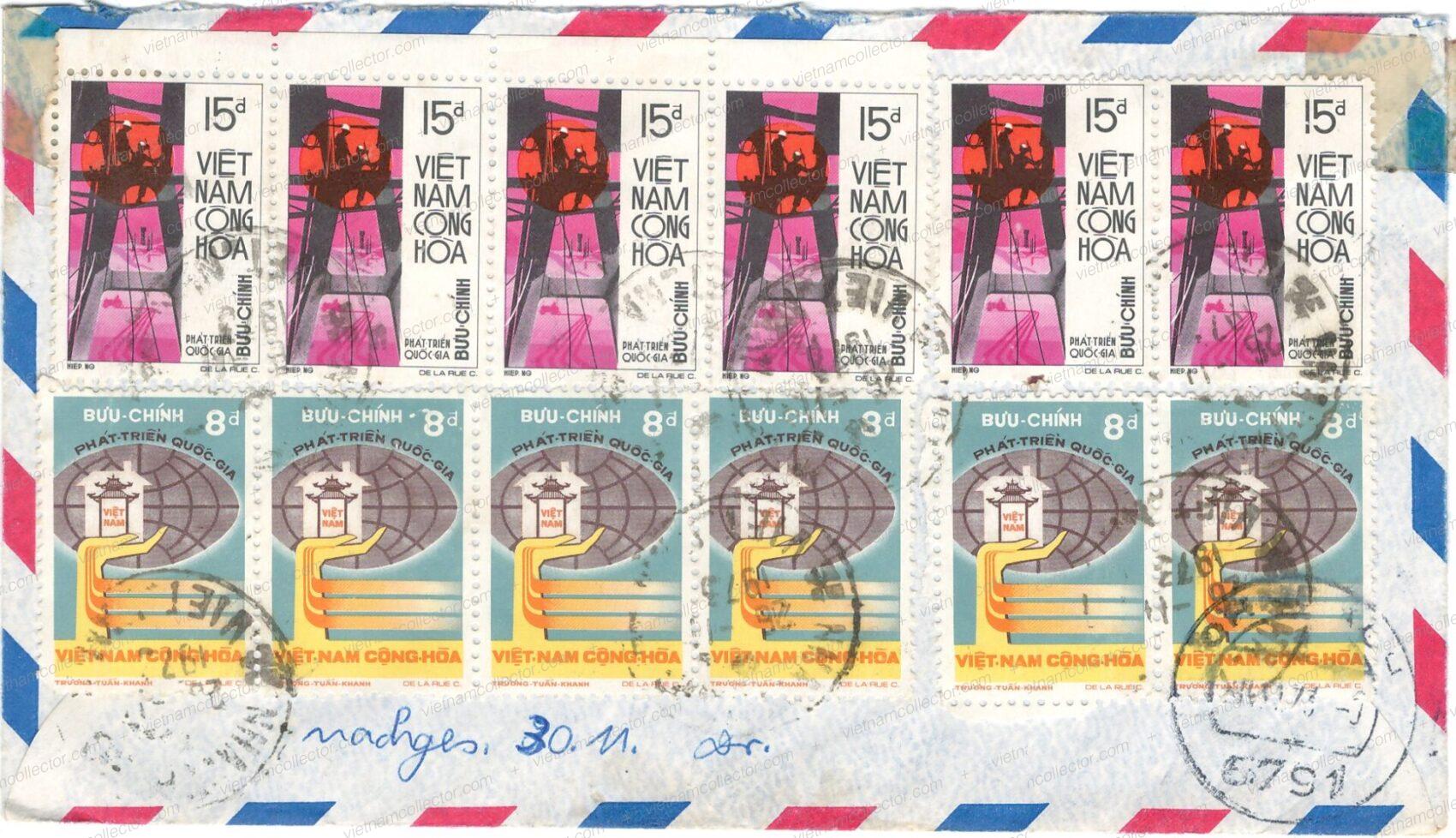
Mixed franking of the Returnee (2), National Development (6&6), Civilm Defense, Harvest and Wax Soldier stamps paying an overall postage of 242D on a registered international air mail letter sent from Nha Trang to Germany in November of 1973.
Registration Nr. 201250
]]>Very little is known about the exact locations of these reeducation camps as the Government had no interest for the wider world to learn about them. They were administered by the military and usually only an alphanumeric code preceded by a Hom Thu or Hop Thu number would be used to identify a specific location.
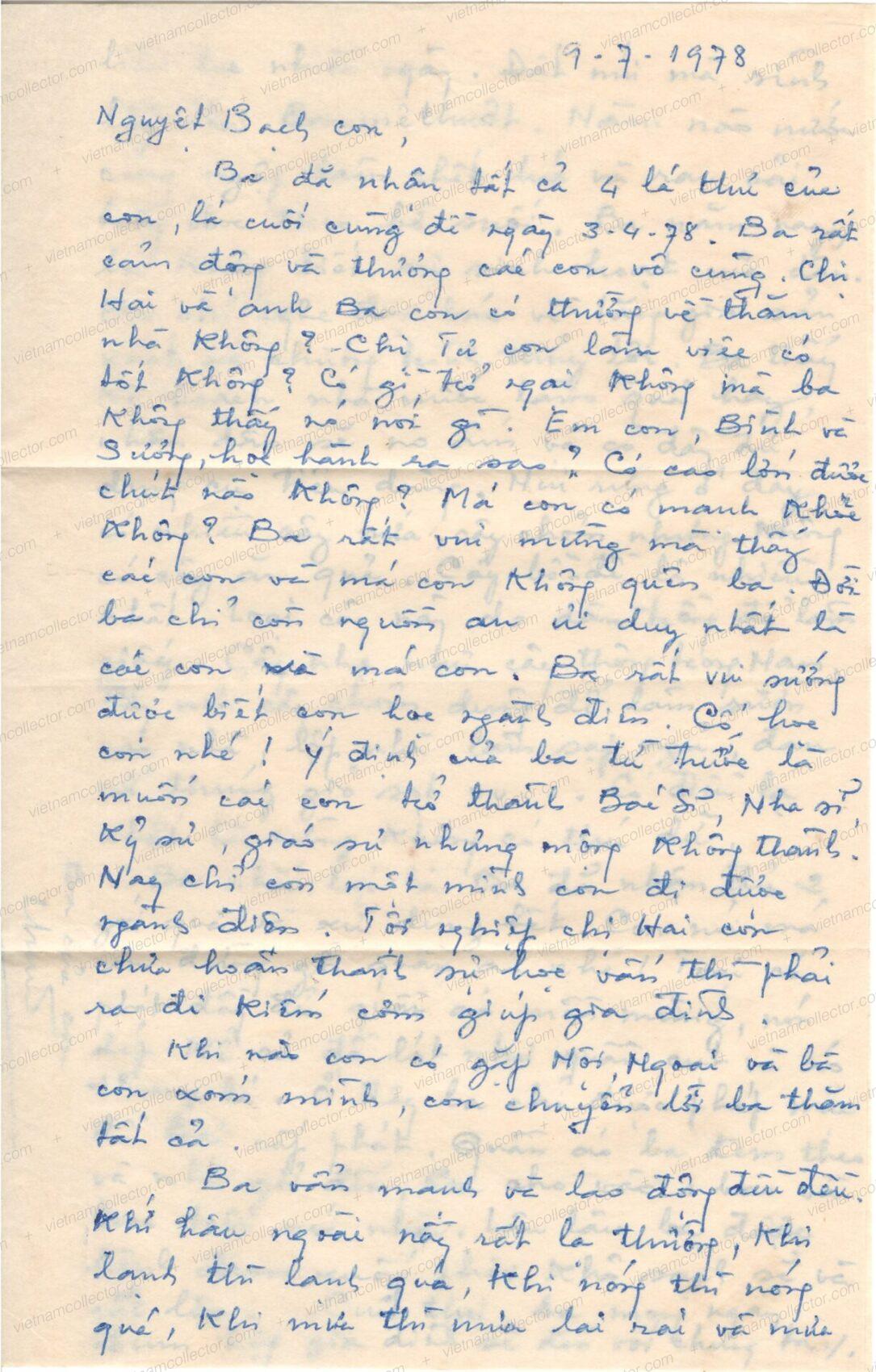
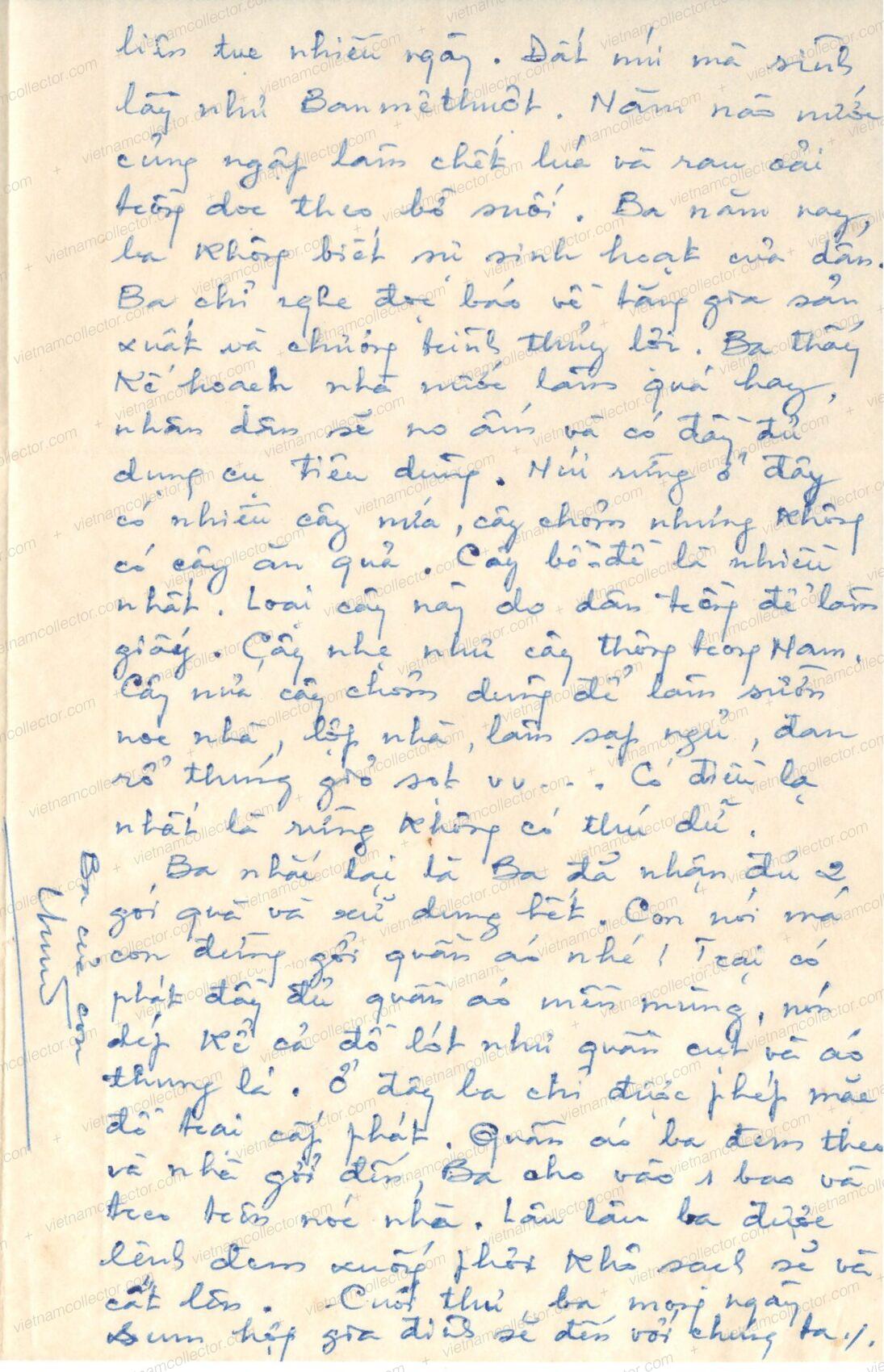
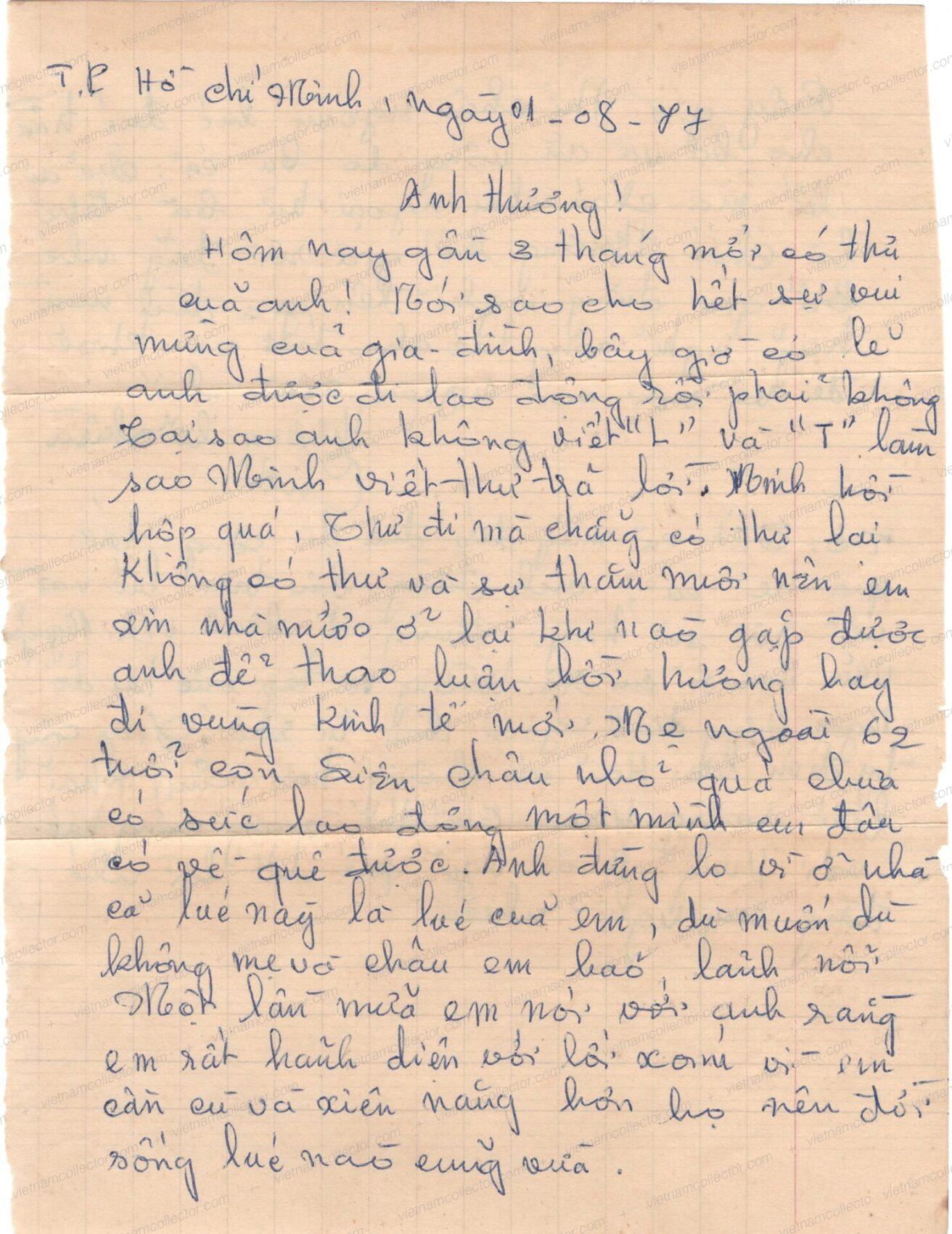
This is an attempt to list these covers so that any scholars that may be interested in these camps are able to study them on-line and may contribute more information about them in the future. The editor has also included the correspondence contained in the envelopes. Due to the strict censorship inside the camps the content of the letters is not expected to provide any great insight or secrets about them but they will nevertheless provide a snapshot in time about peoples feelings.
The camp covers are listed in alpha-numerical sequence below:
Camp 1B
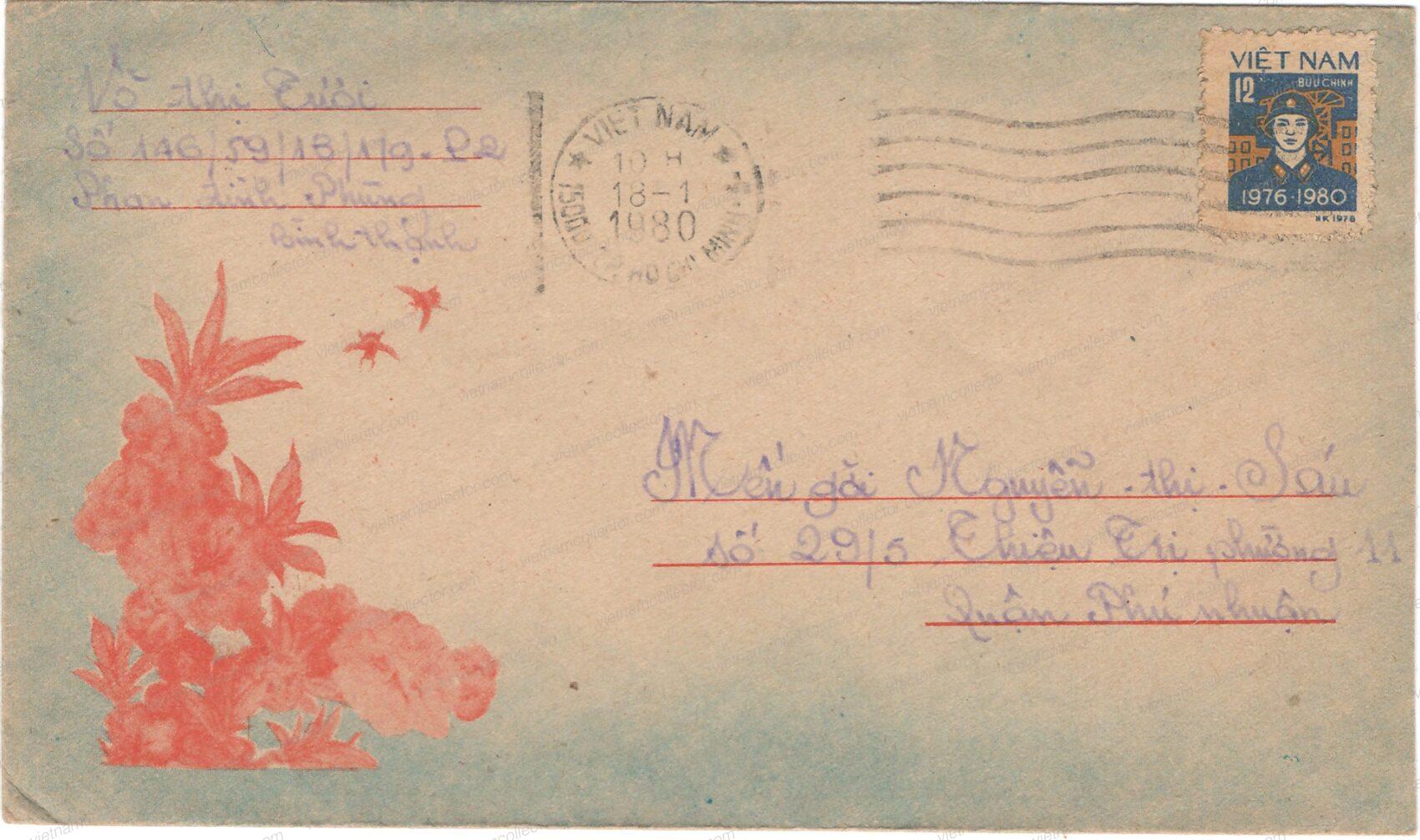
Letter sent by a guard from Camp 1B in Binh Thanh to a civilian in January of 1980. Franked with a civilian 12xu Five Year Plan stamp . The letter was processed in HCM City as indicated by the machine cancel. Bin Than is a suburb of Ham City and this jail was used for high level Government prisoners awaiting political trials.
Camp 1C
Letter sent by a guard at Camp 1C to a civilian in HCM City in January of 1977. The letter is franked with the military free frank from 1975. The letter was processed in Kien A which is a suburb of Hai Phong. The sender also indicates a Hai Phong address. This may or may not be an indication that the camp was located in Hai Phong area but since camp mail was always transported by military pouch to a larger postal processing center one can never be sure.HCM City machine arrival cancel on the reverse.
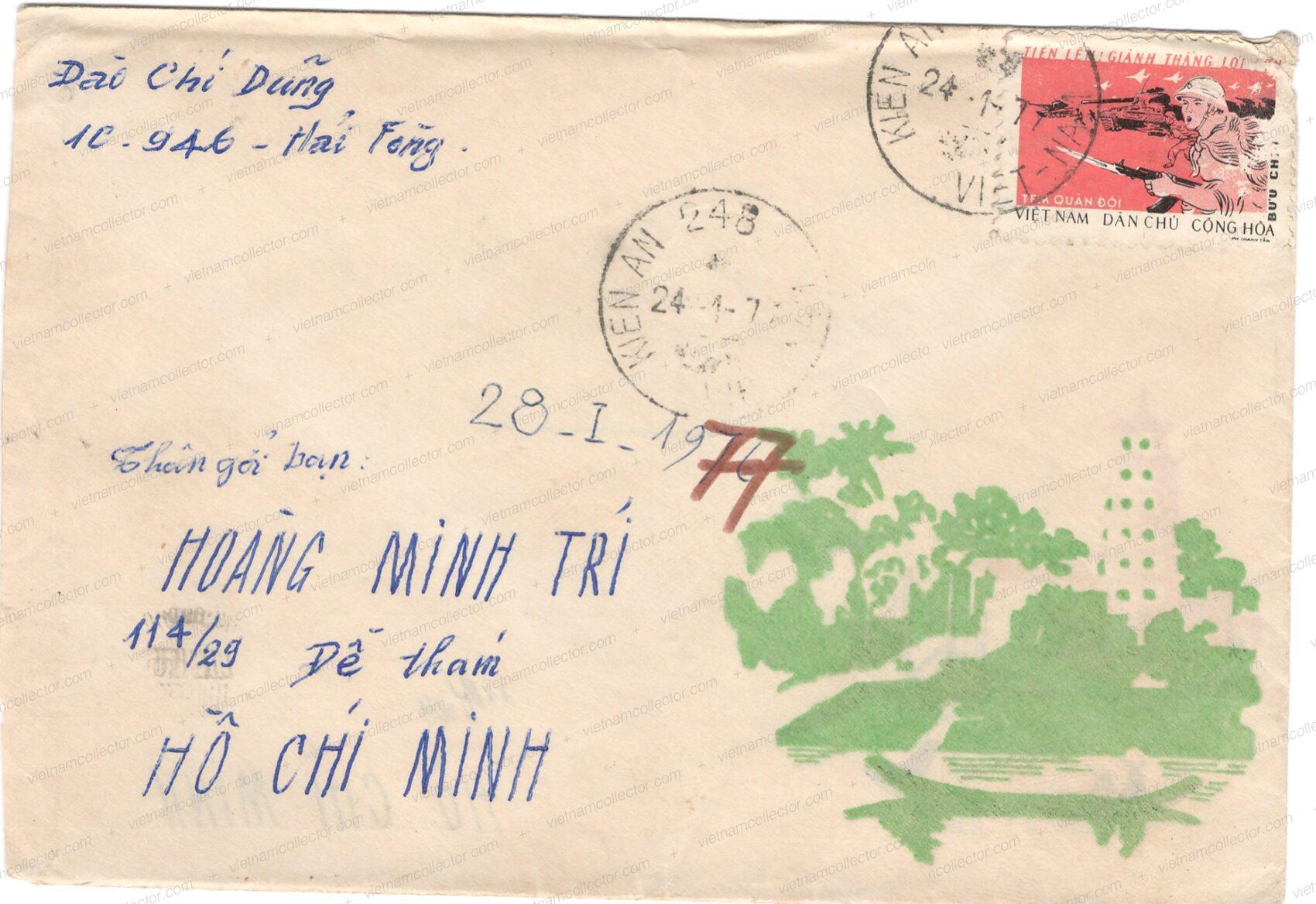
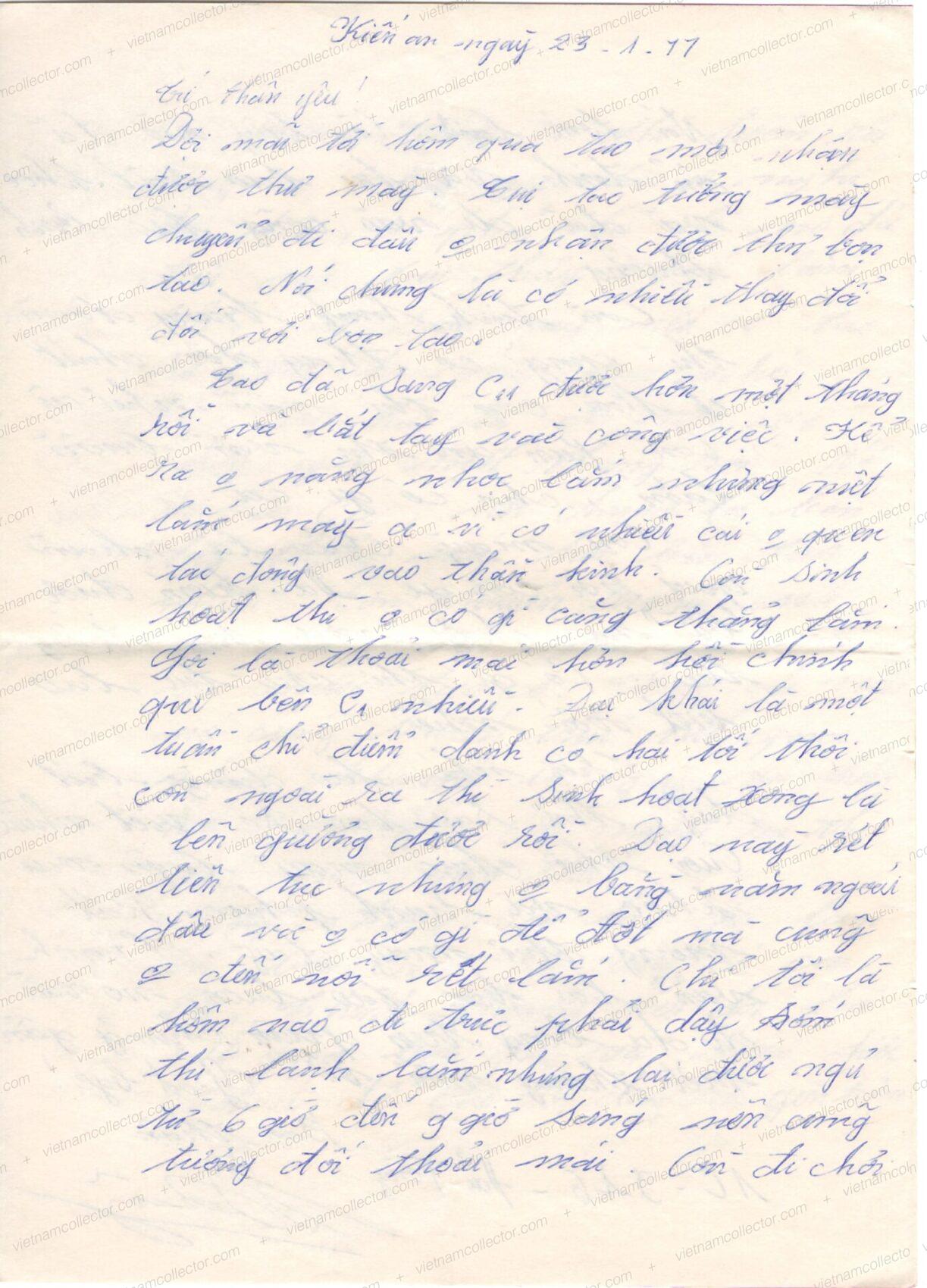
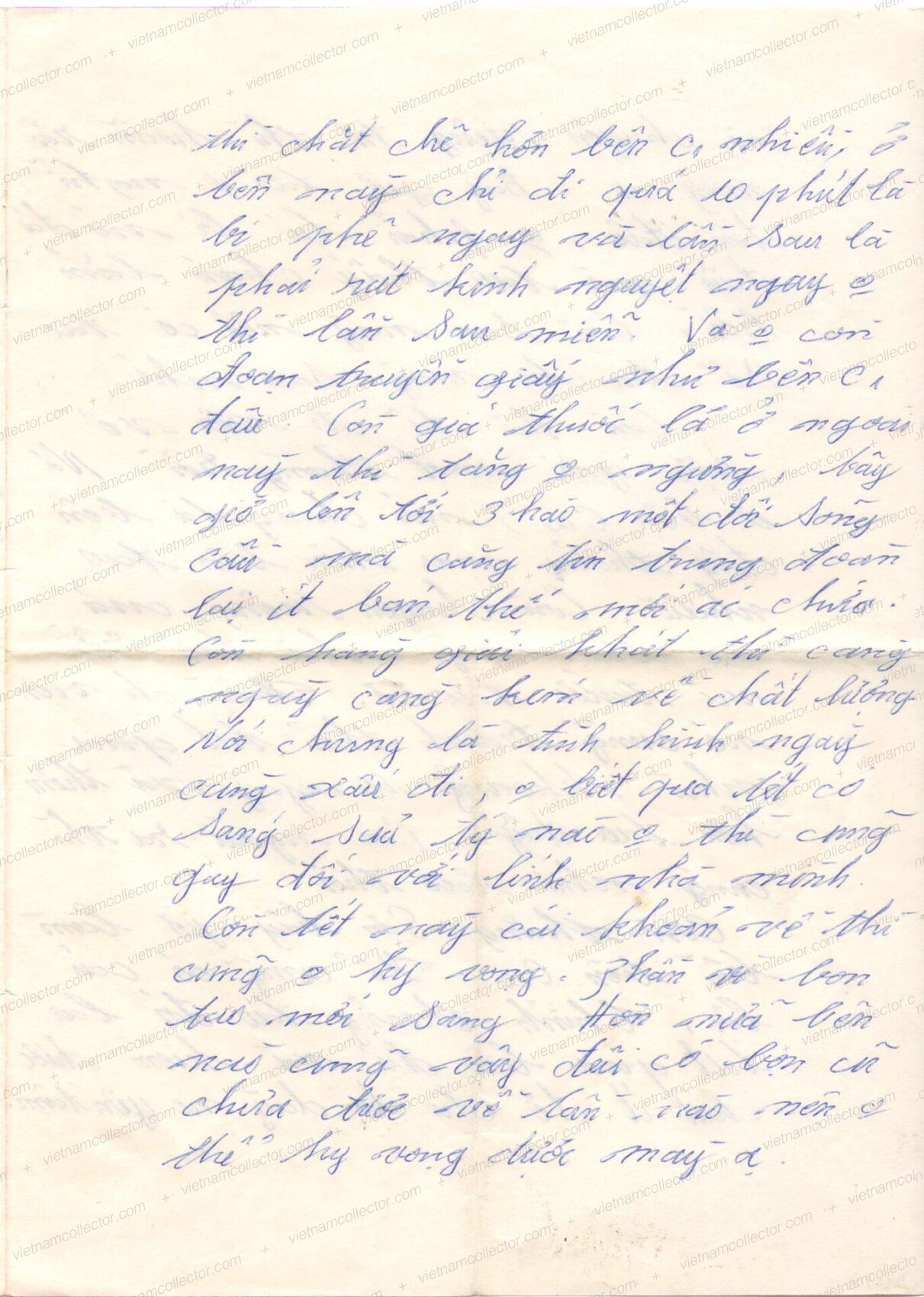
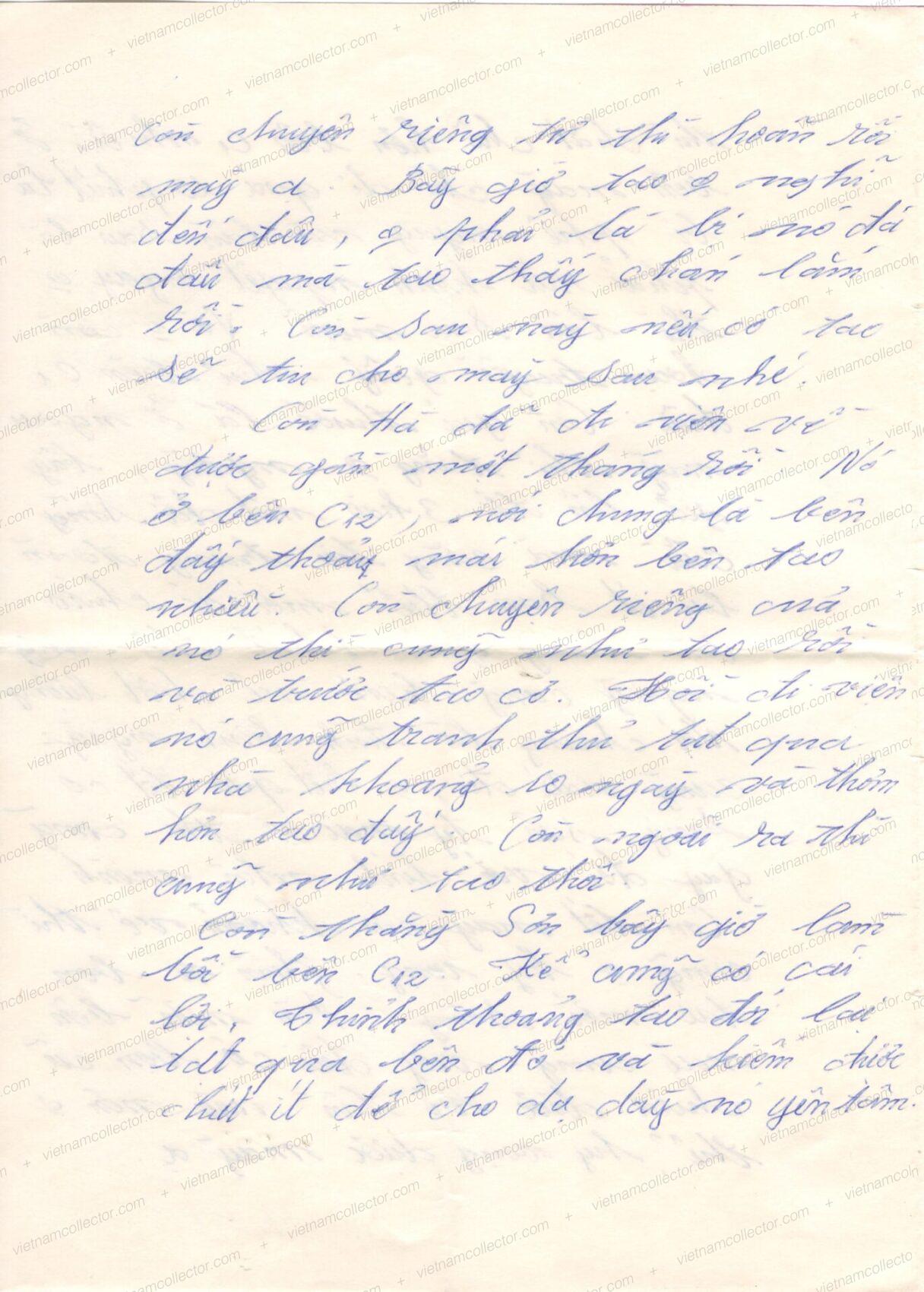
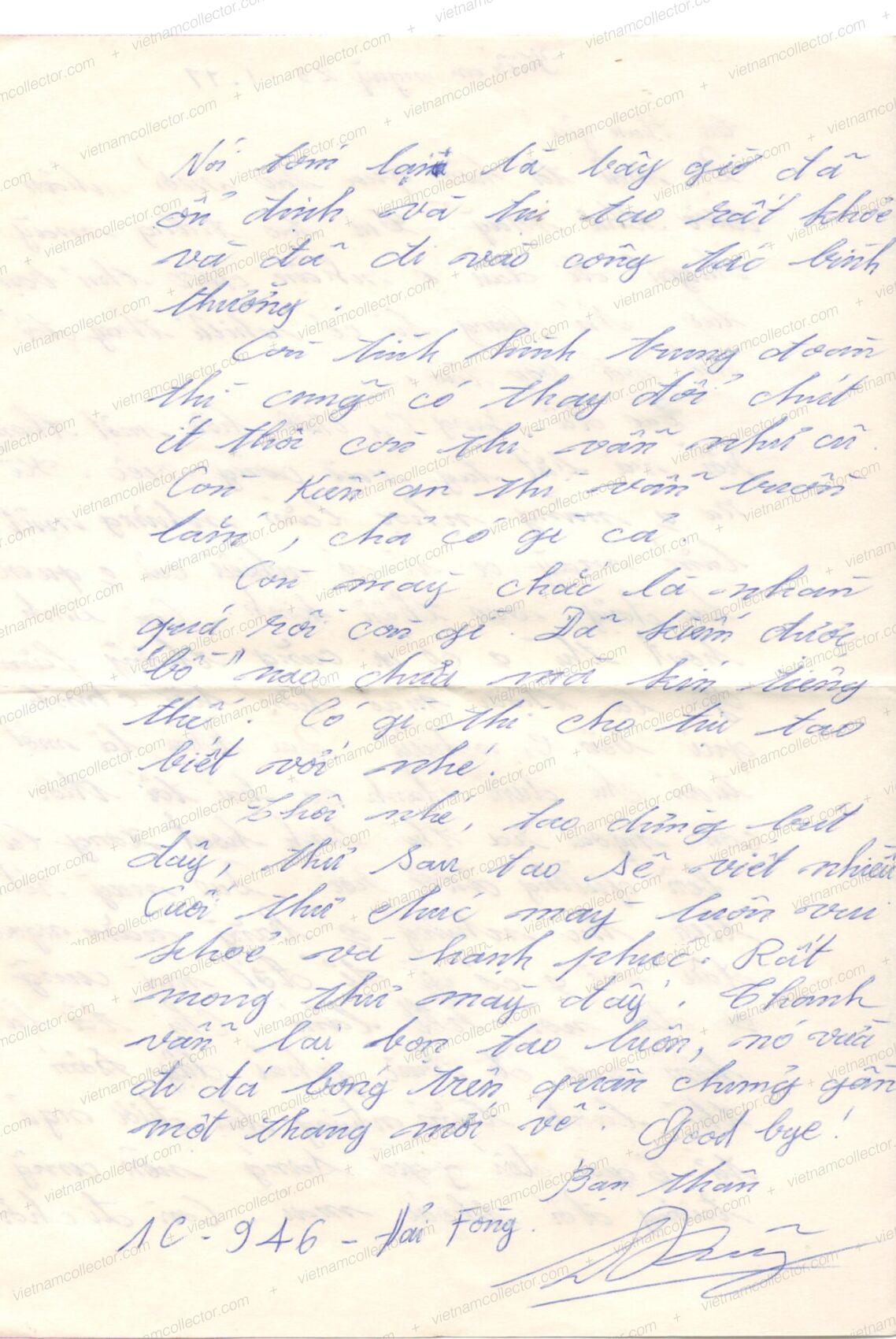
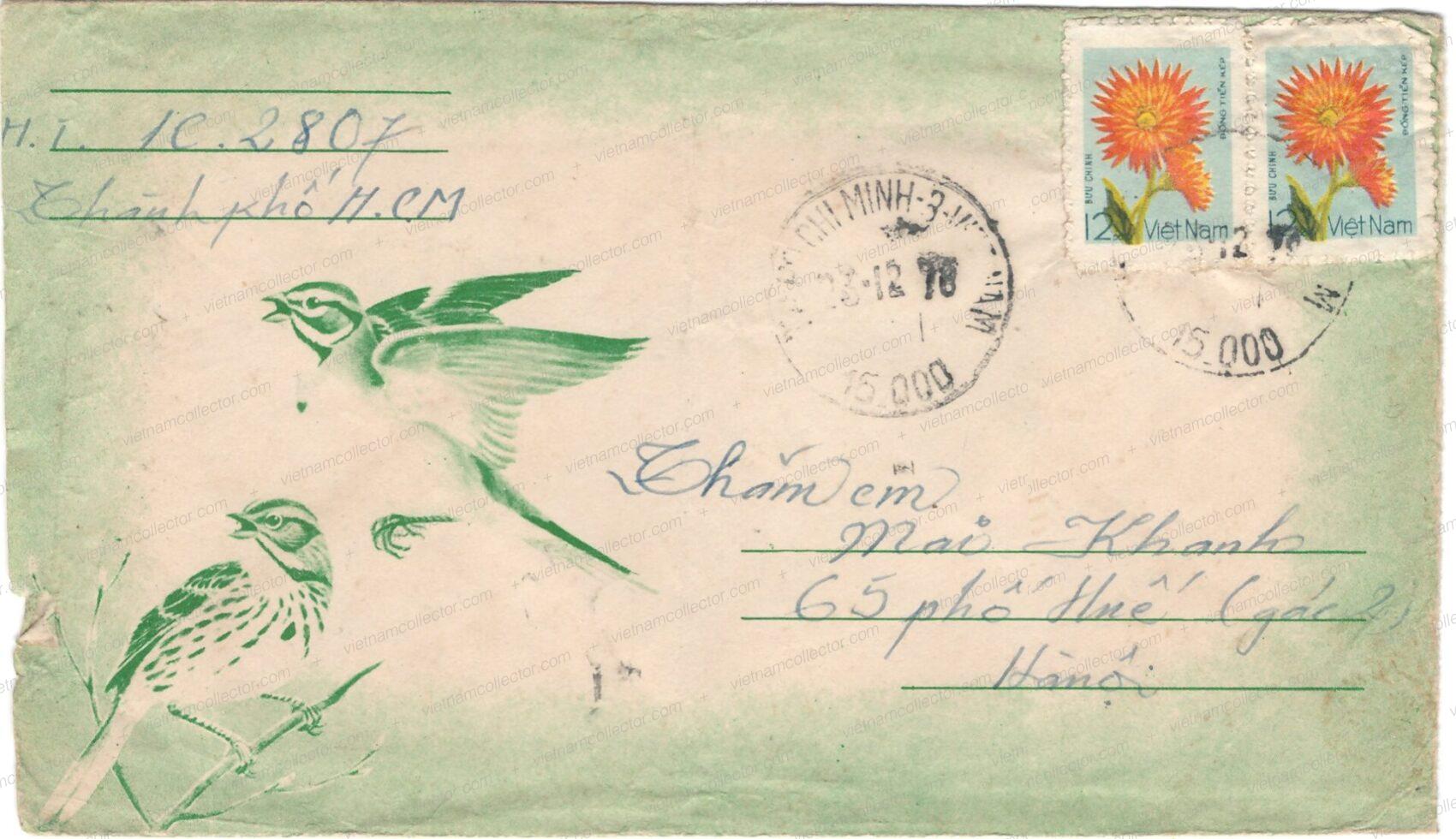
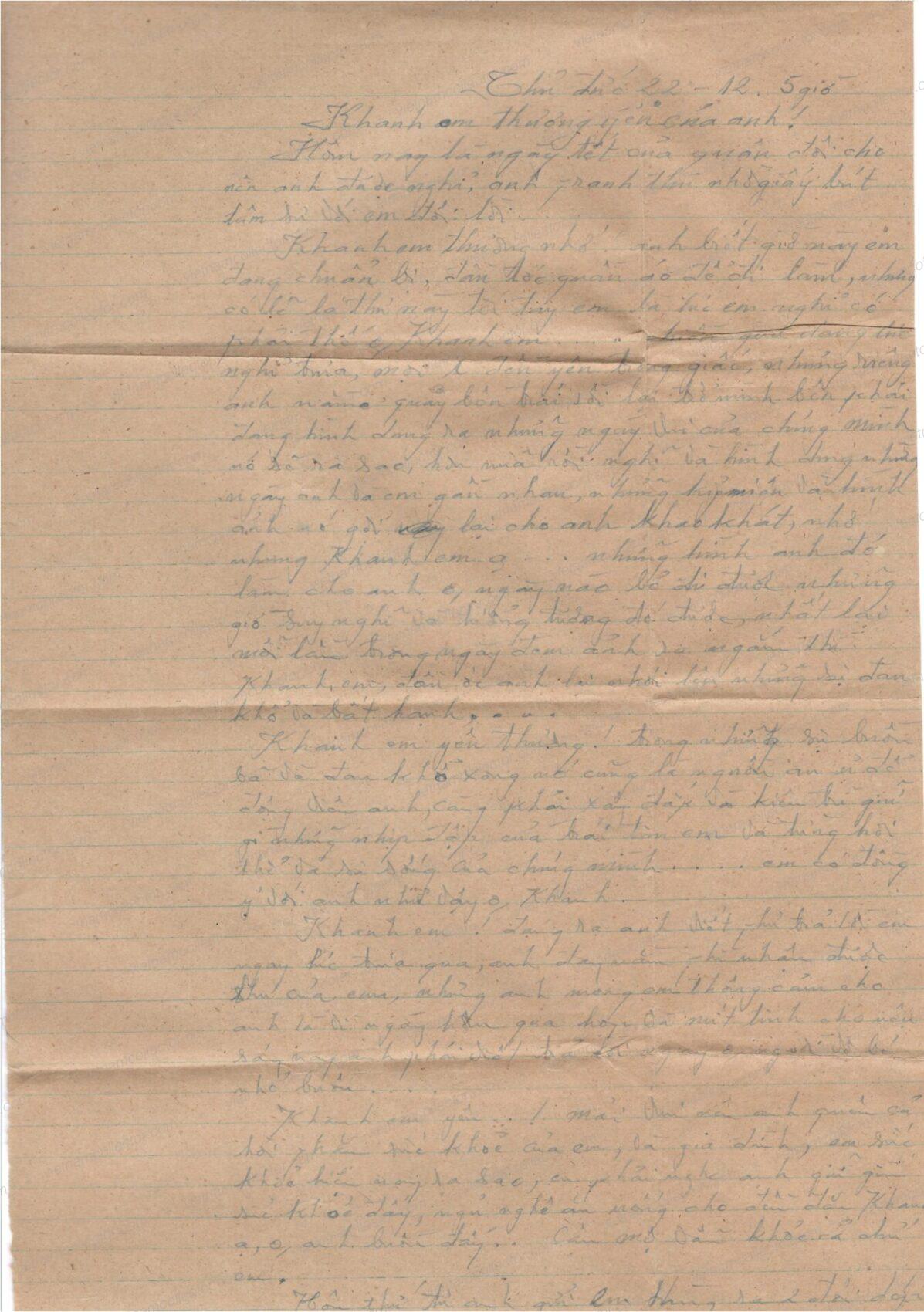
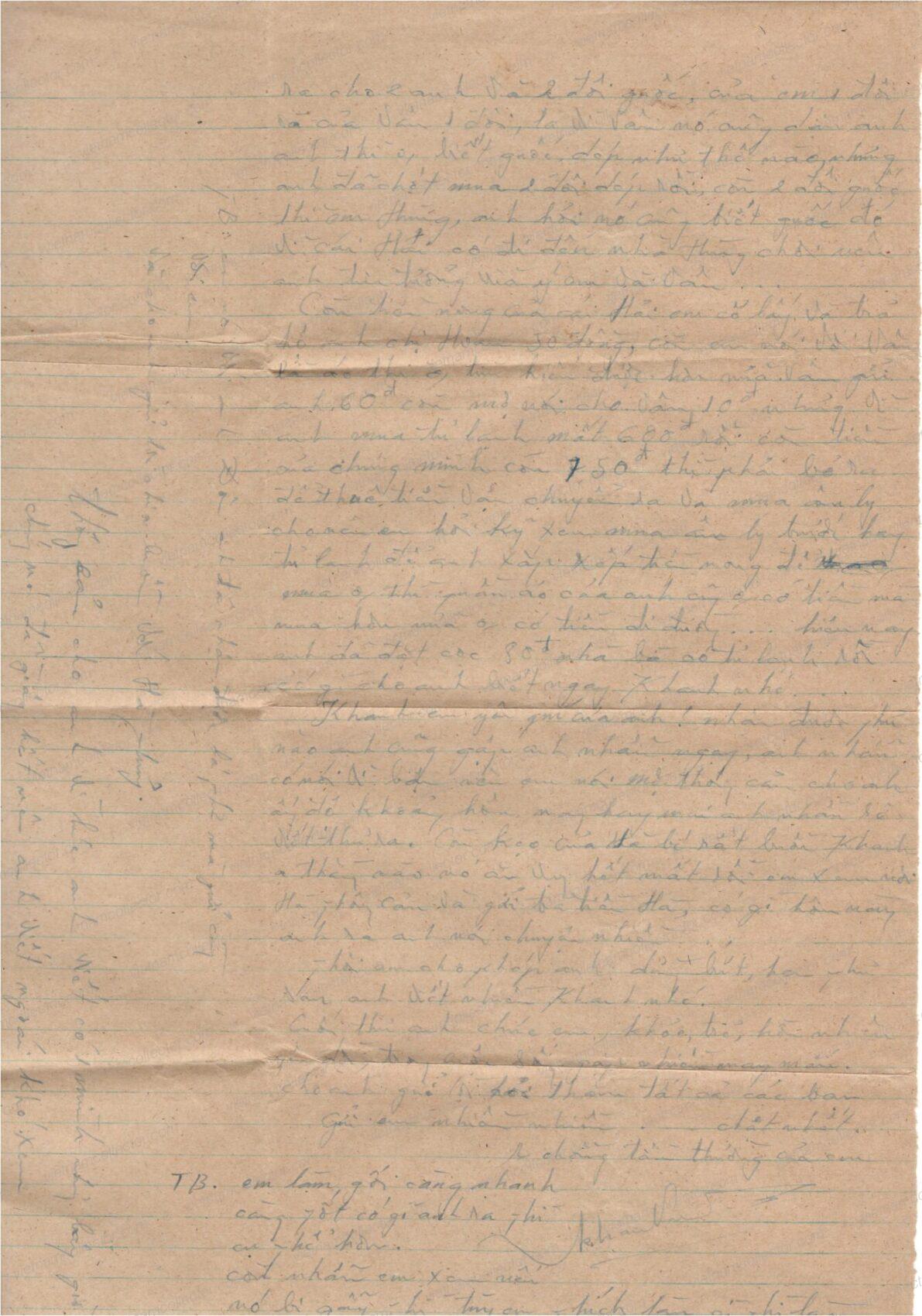
Letter sent by a guard located in Camp 1C to a civilian in Hanoi. Franked with two 12xu flower stamps and paying the 2nd weight level of the standard letter tariff. The letter was processed in HCM City in December of 1978 which may or may not be an indication that the camp was located in the South. Little else is known about this camp. Hanoi machine arrival cancel on the reverse.
Camp 15NV
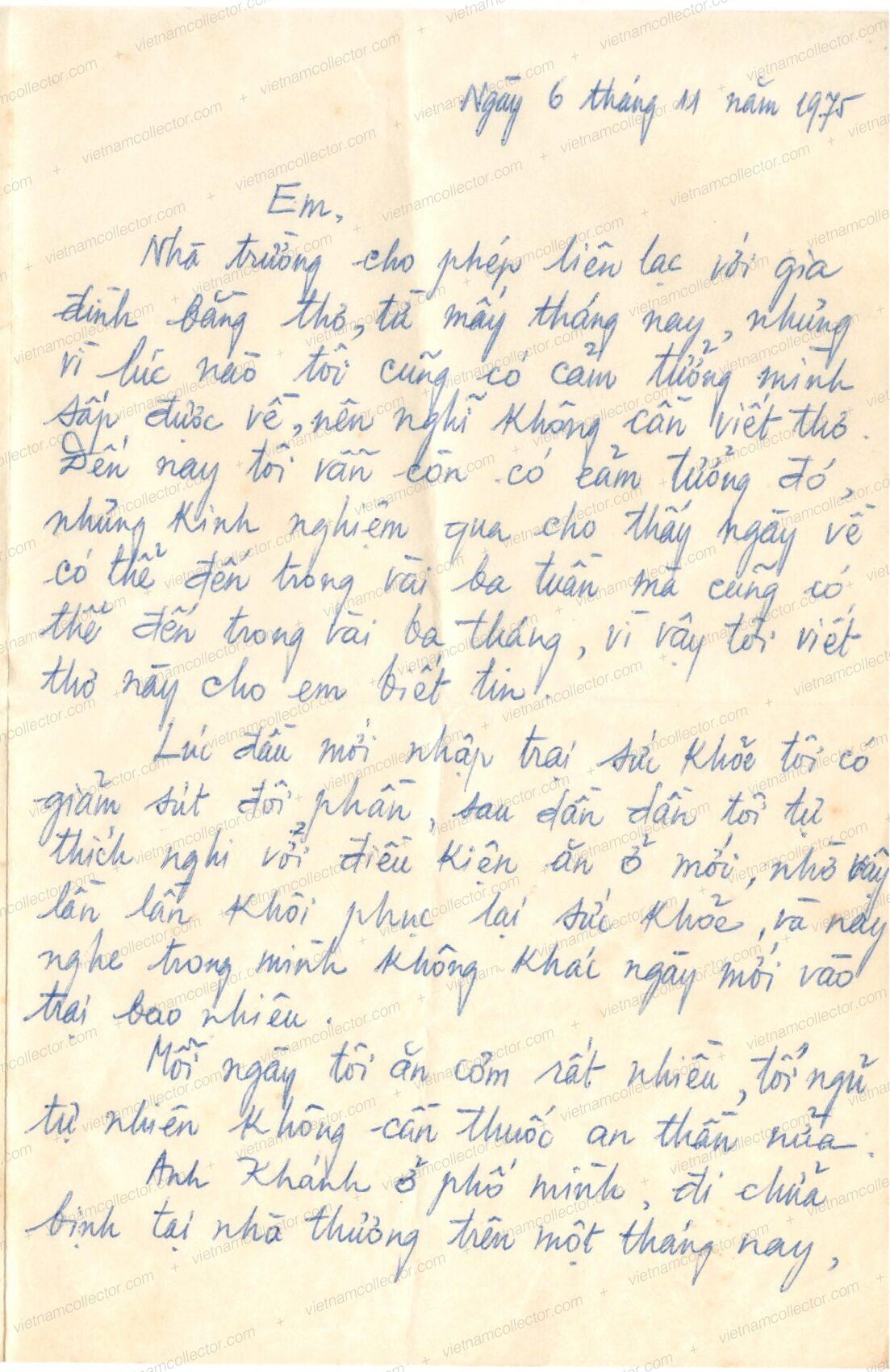
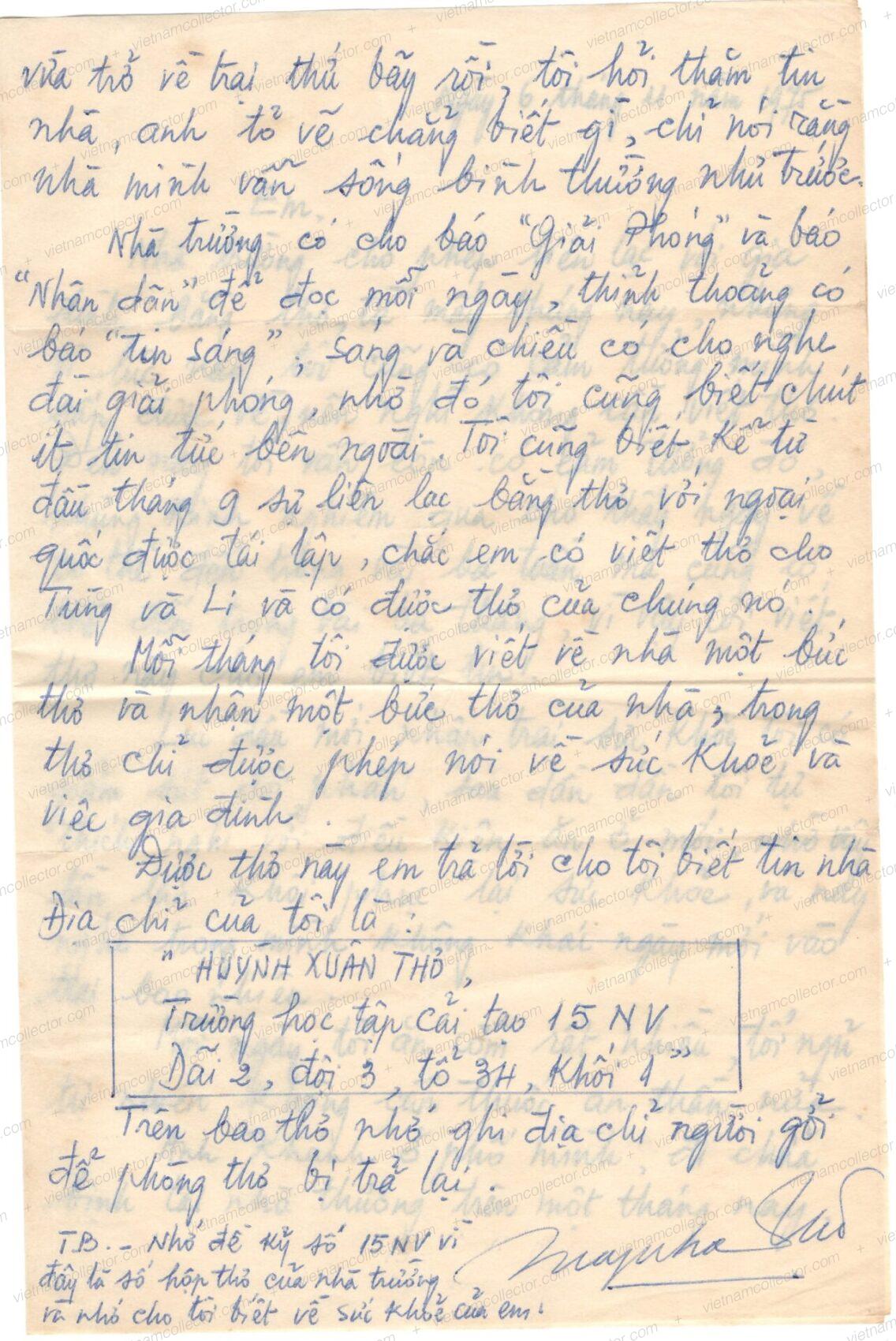
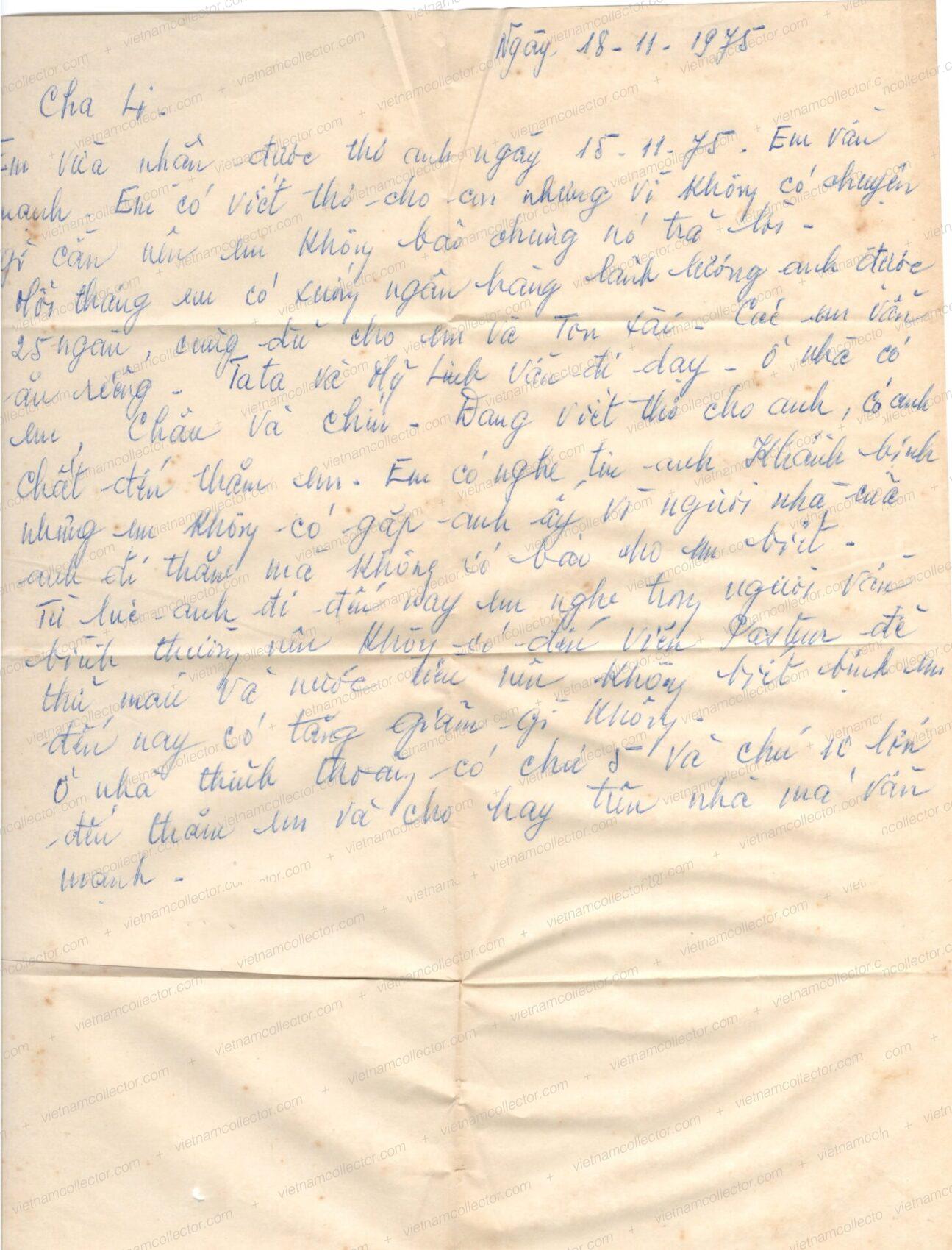
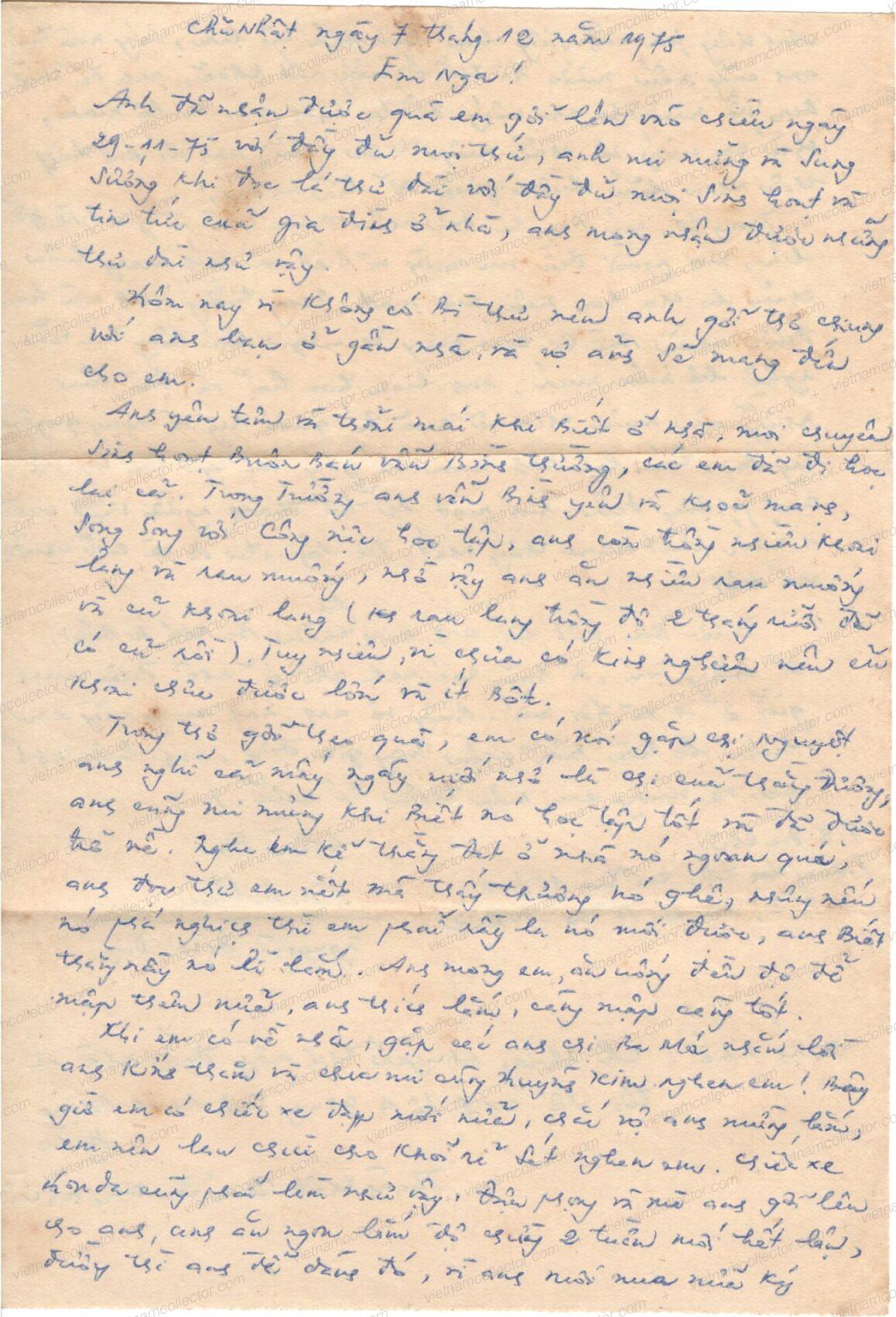
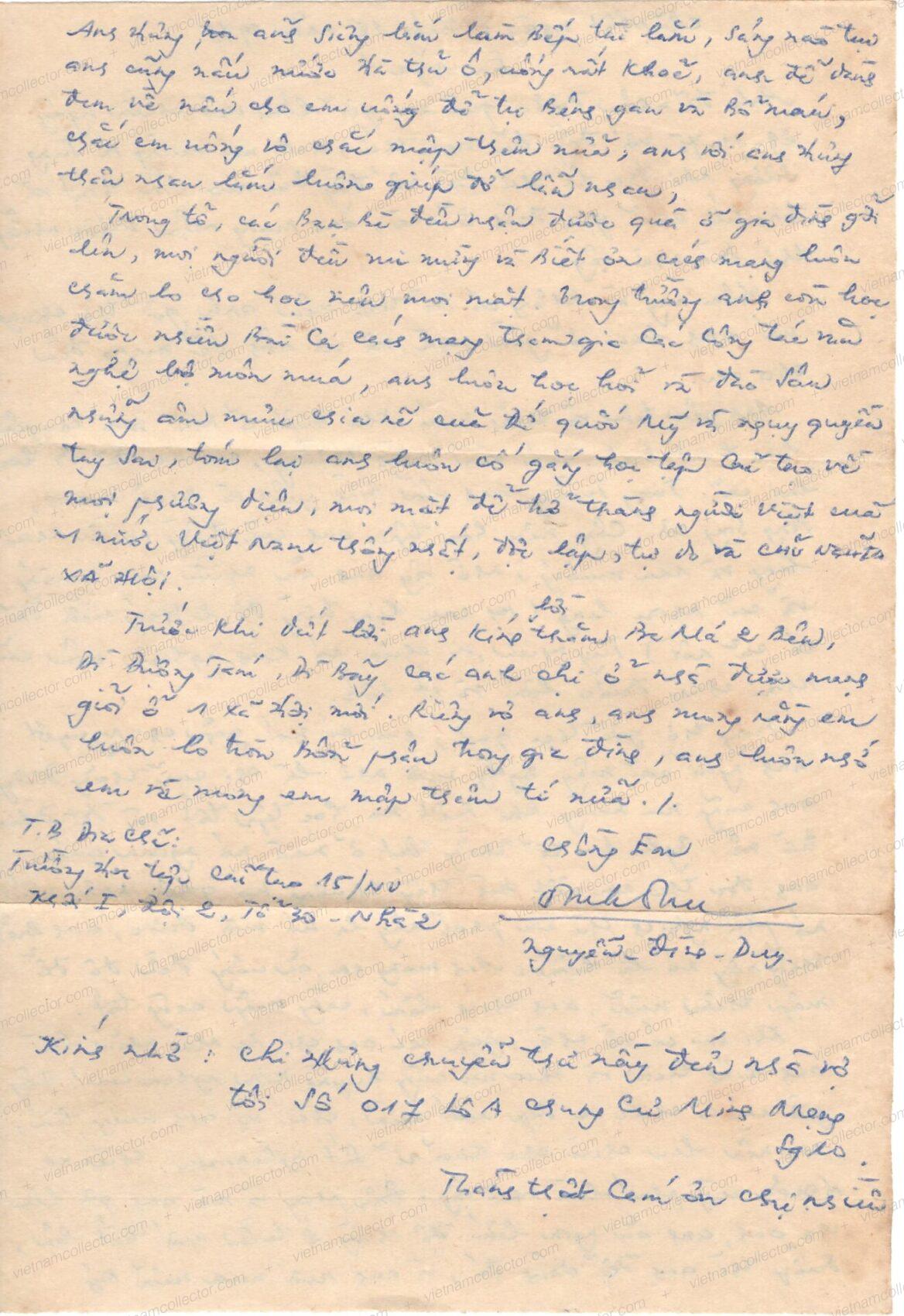
Letter sent by an inmate to a civilian in Saigon (HCM City) in November of 1975. This camp 15NV is associated with Long Thanh District East of HCM City. The November 6th letter was most likely the first communication sent by this inmate as he/she made it a point to write his/her detailed mail address on the second page. The envelope also contained a letter from November 18th that, based on the date, cannot be from the same envelope but it may be from the same correspondence.
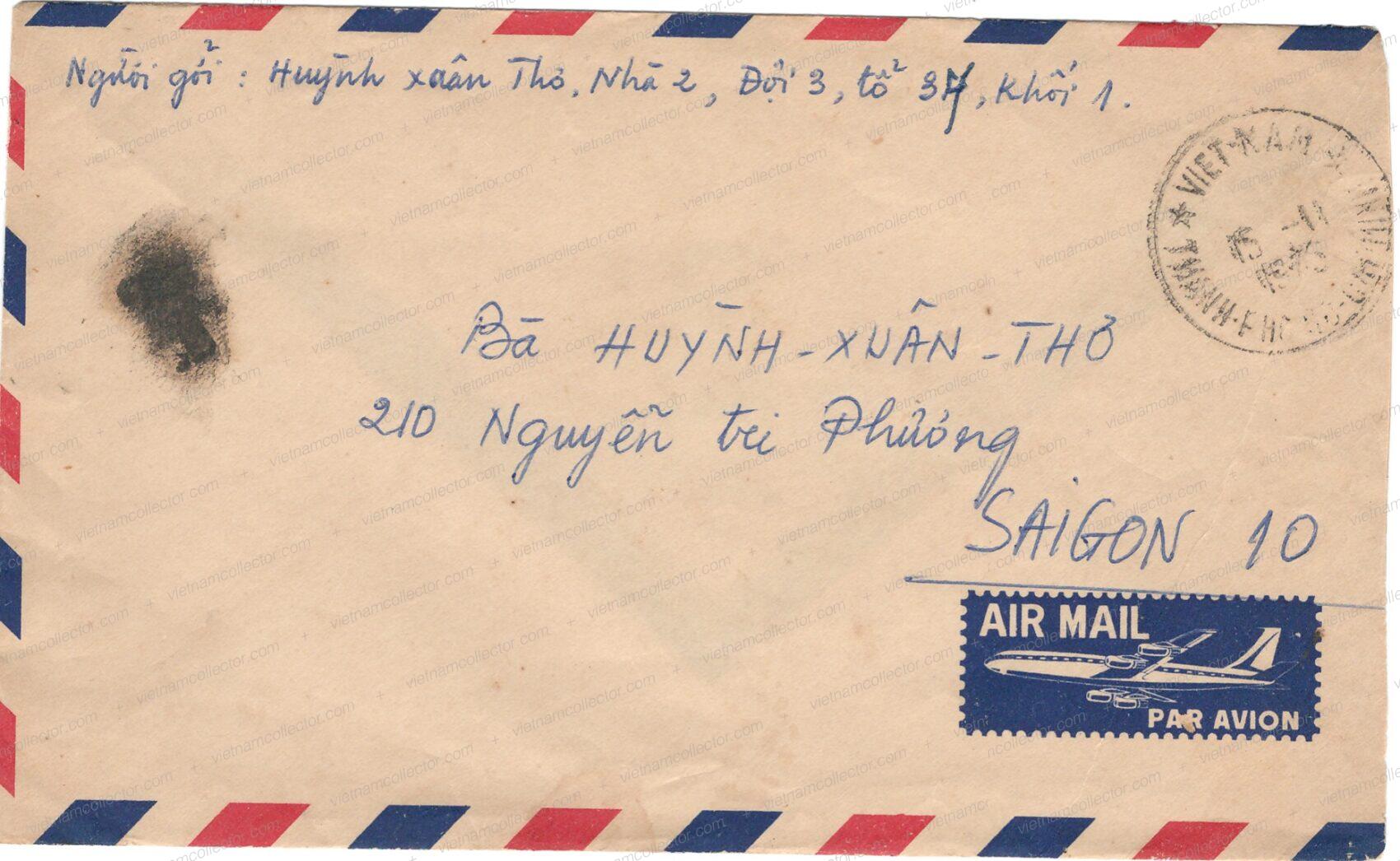
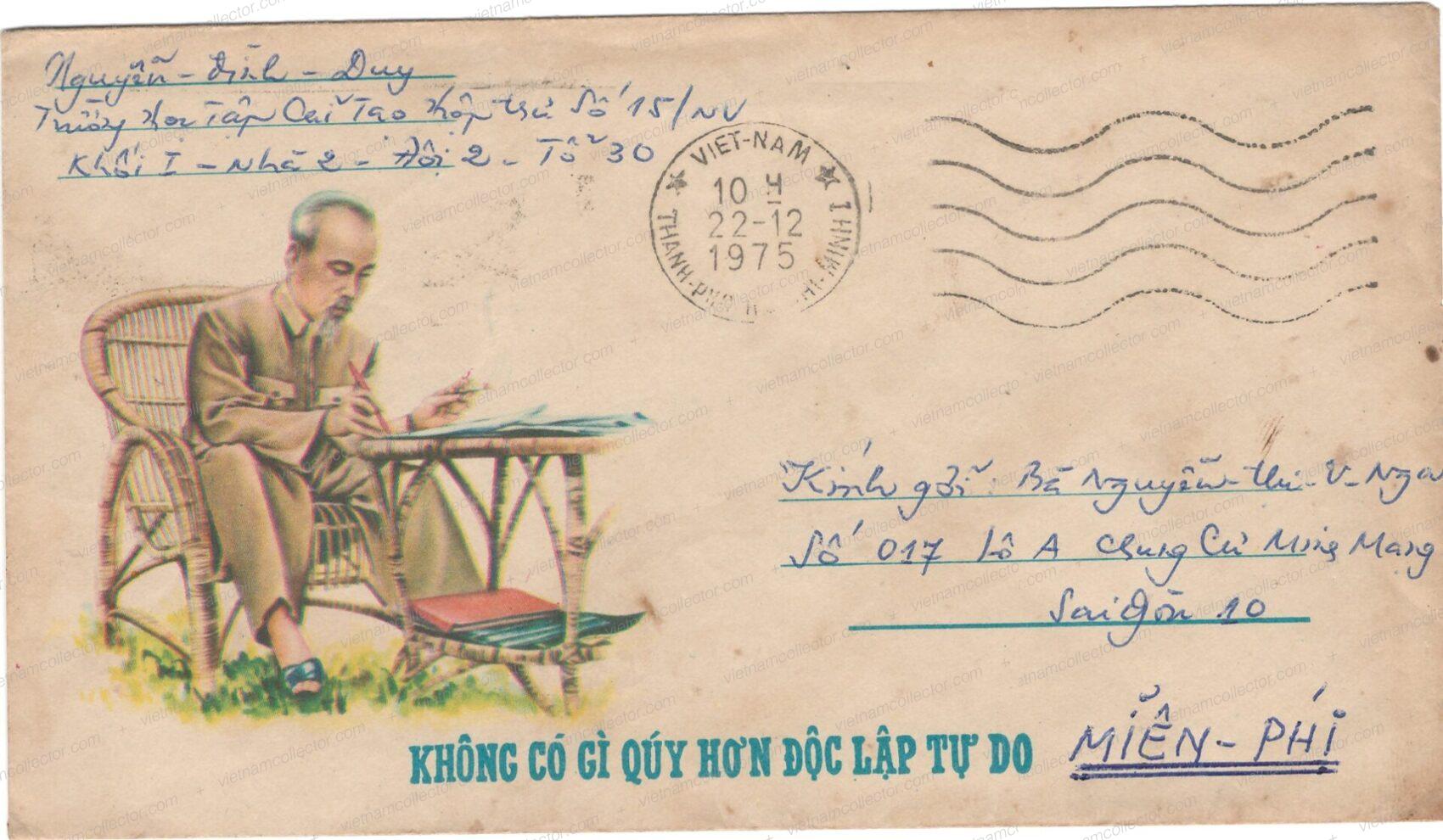
Letter sent by an inmate of Camp 15 NV to a civilian in Saigon (HCM City) in December of 1975. The letter carries the manuscript “Mien Phi” (= Free) to indicate that no postage was due at the time. Cancelled with the machine HCM City cancel.
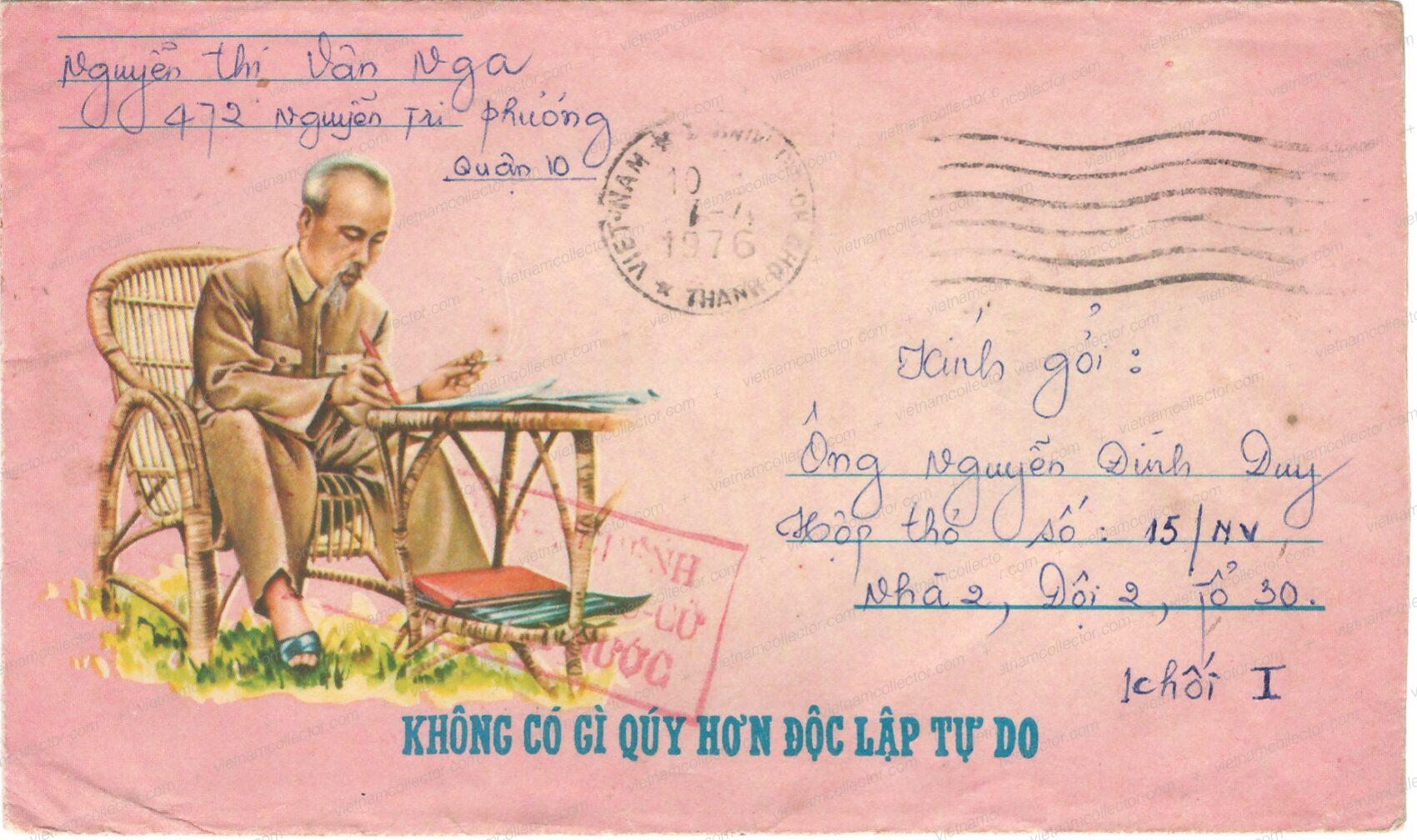
Rare incoming letter sent by a civilian in Quan 10 to an inmate in Camp in Camp 15NV. The letter carries a red propaganda cachet „Nhiệt liệt hoan nghênh và tích cực tham gia bầu cử Quốc hội chung cả nước“ (=Welcome! Active participation in the election for the national assembly of the entire country).
Here is an interesting group of four letters all from the same correspondence. The first one is an outgoing letter sent from the inmate to a relative in HCM City and the other three are all rare incoming letters sent to the inmate. The one from February 6th, 1976 shows no signs of postal transportation so it may have been delivered to the camp by private messenger. The others carry a HCM City machine or regular canceler. The cover from February 24th contained two letters. One of them is dated in May of 1976 so it belongs to another envelope. The last cover shows a red propaganda cachet „Nhiệt liệt hoan nghênh và tích cực tham gia bầu cử Quốc hội chung cả nước“ (=Welcome! Active participation in the election for the national assembly of the entire country).
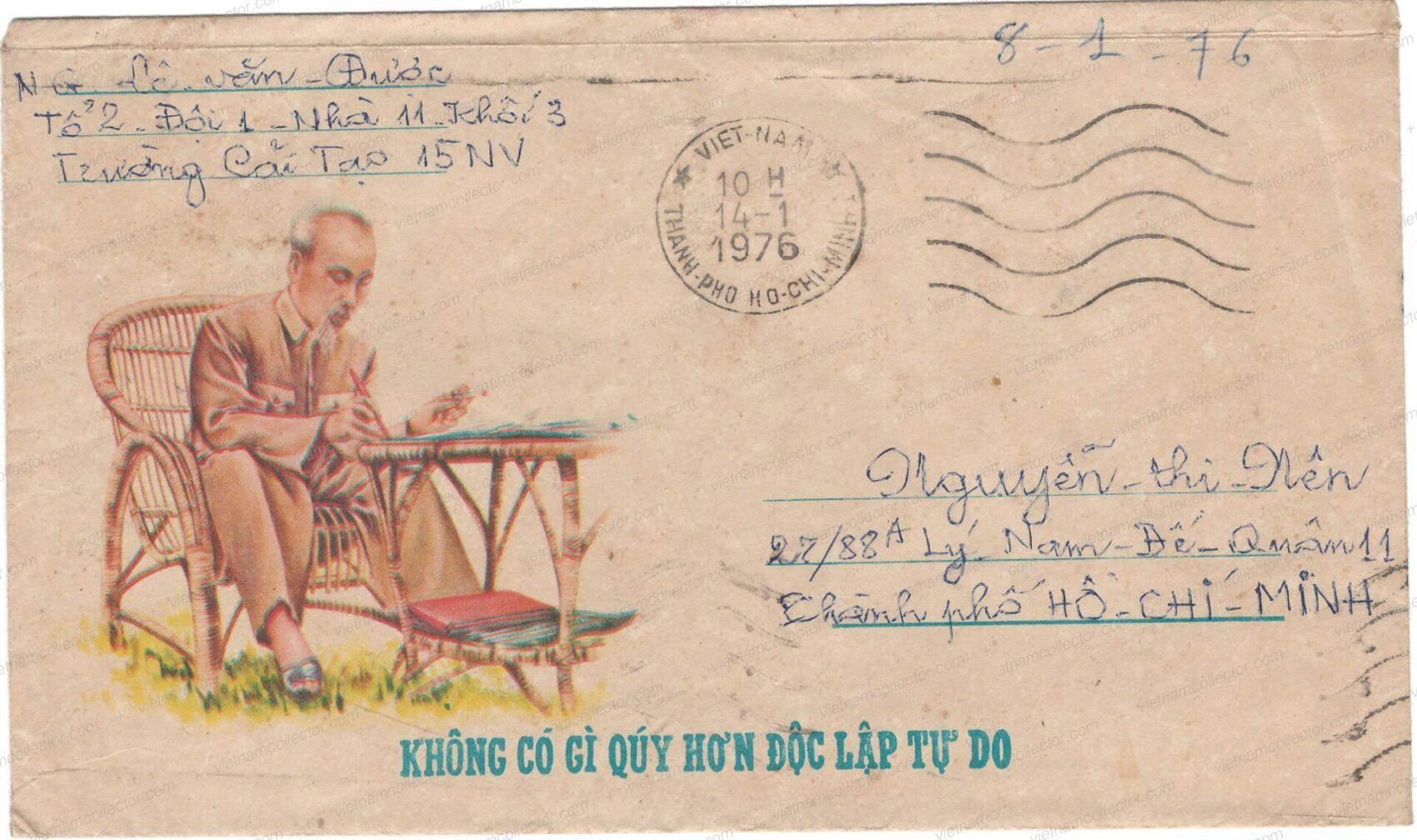
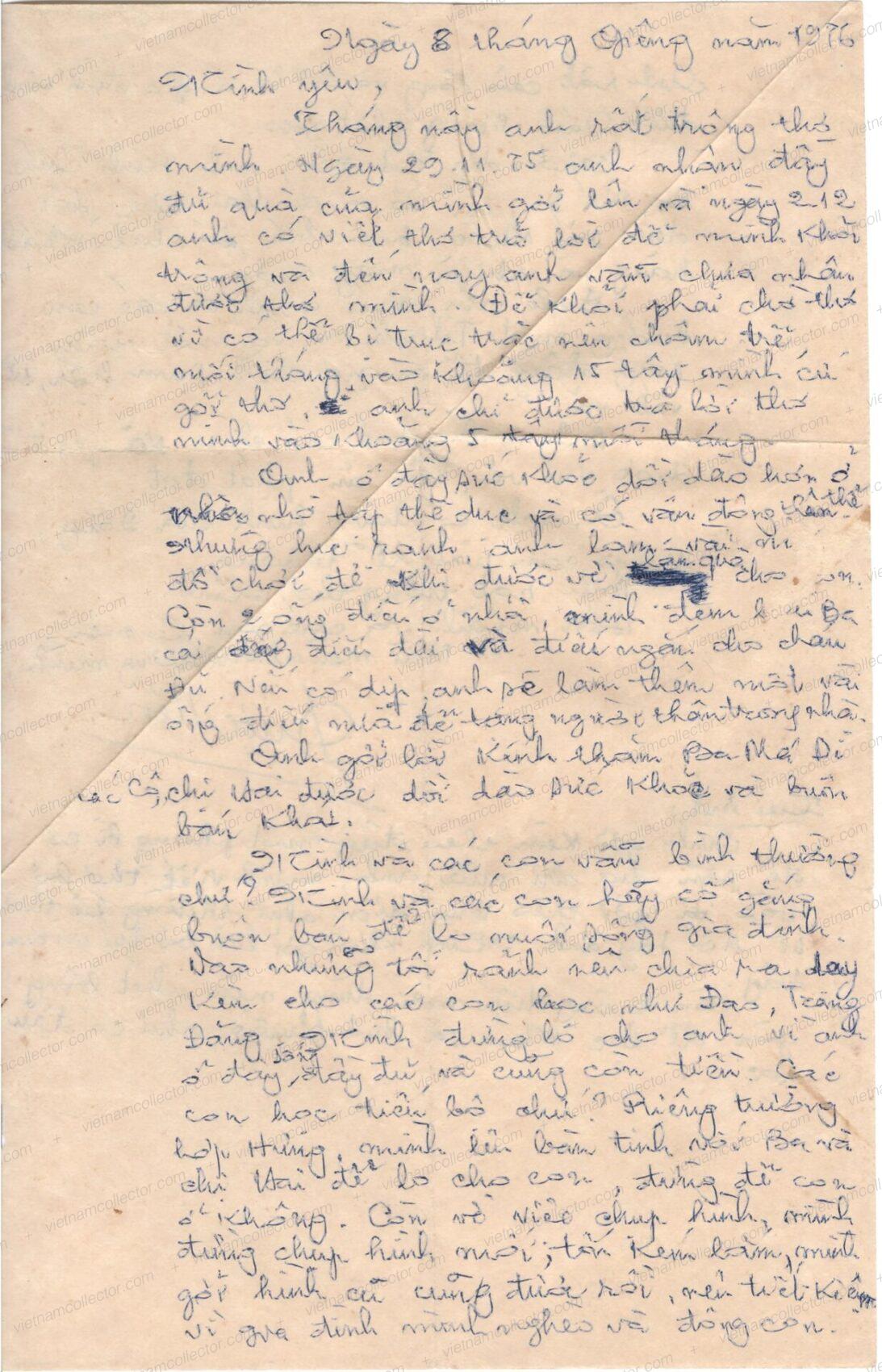
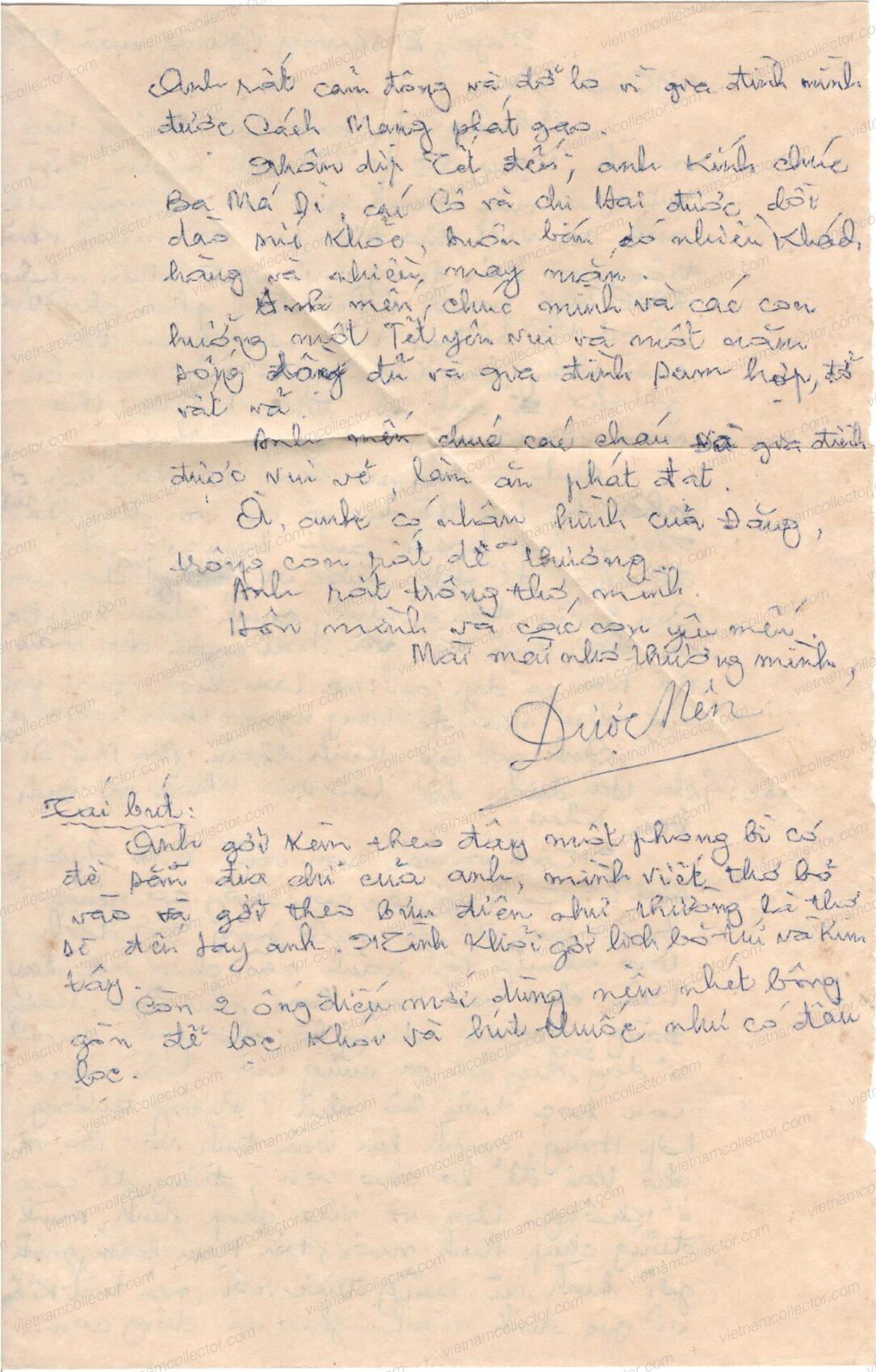
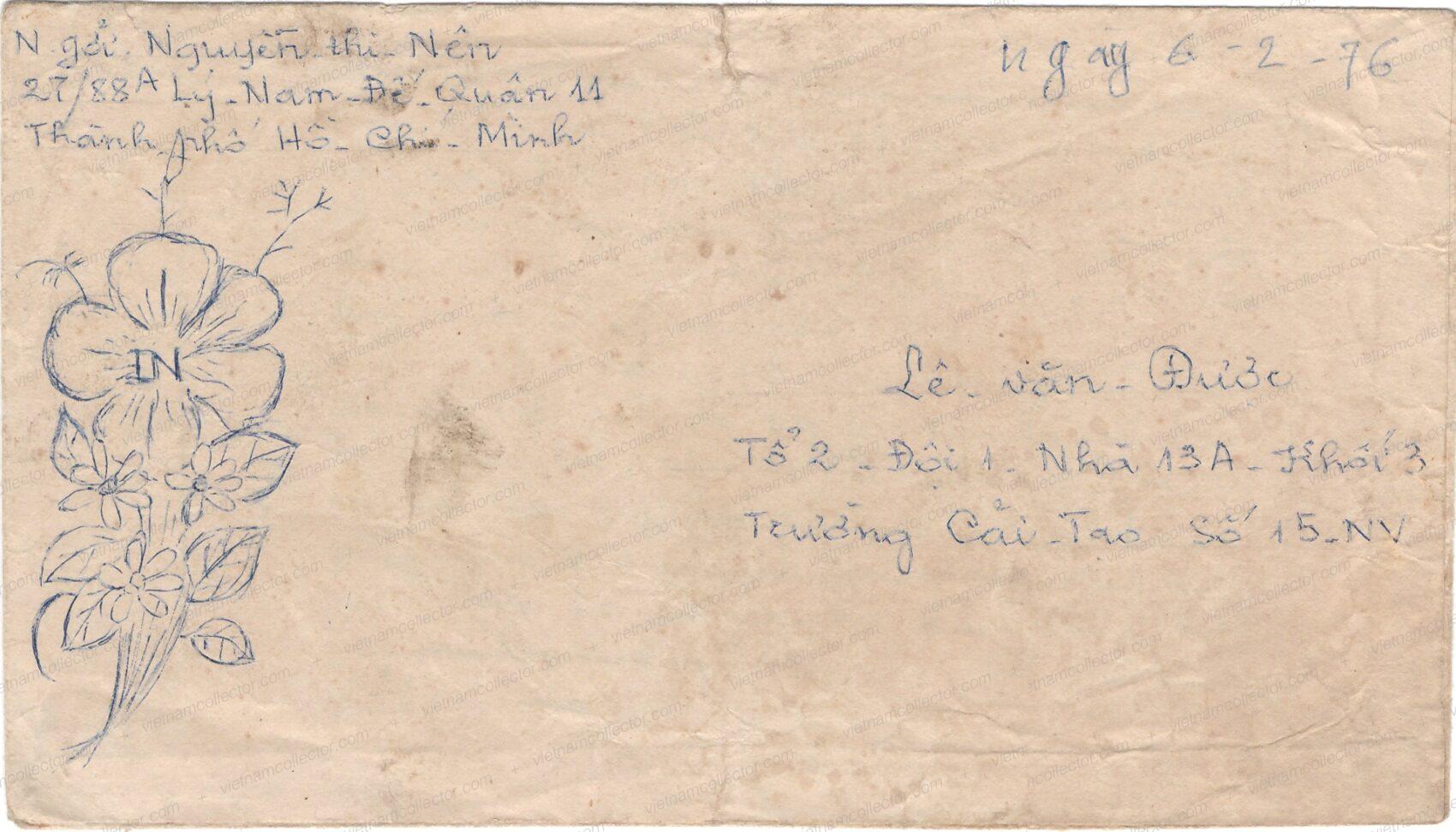
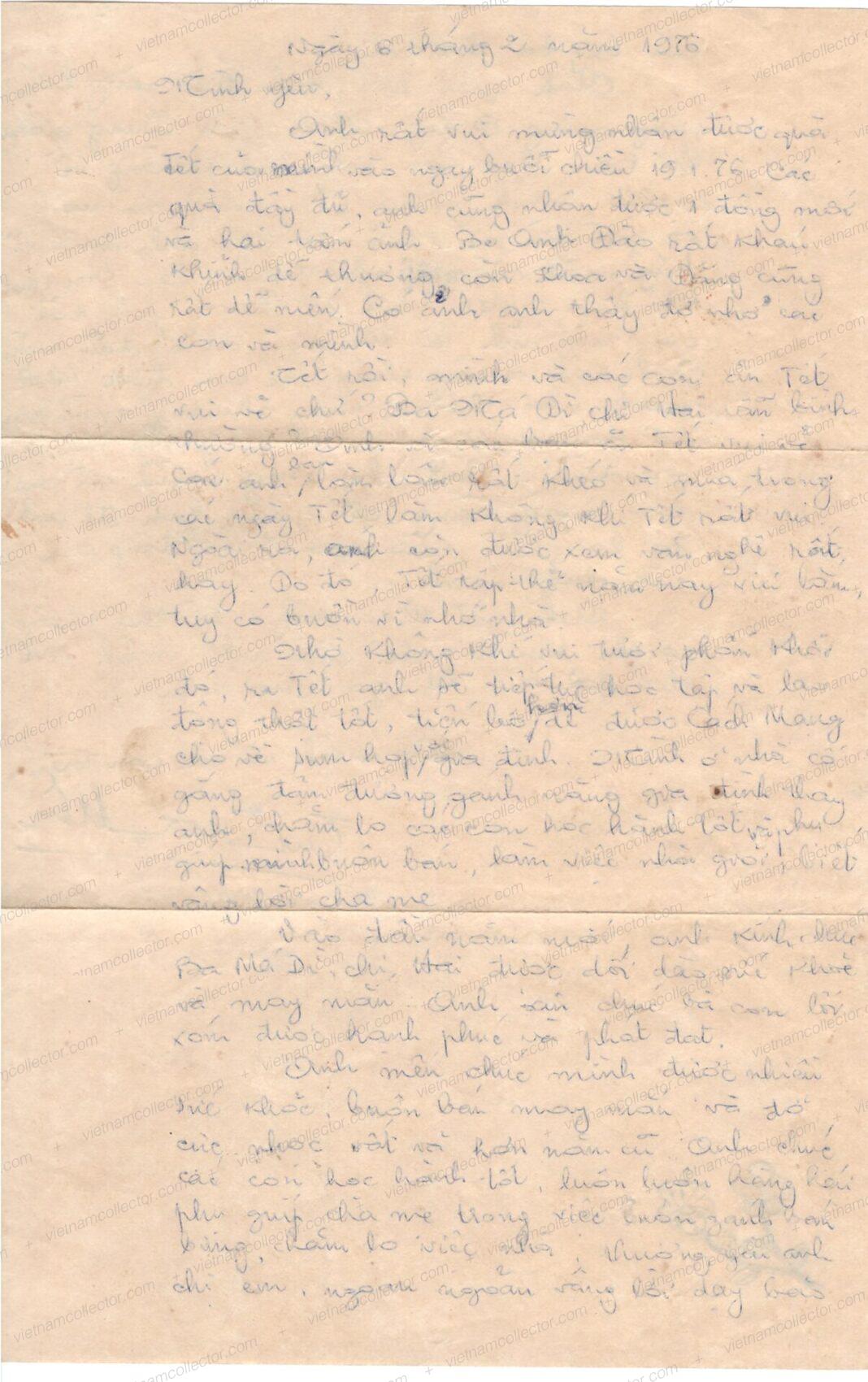
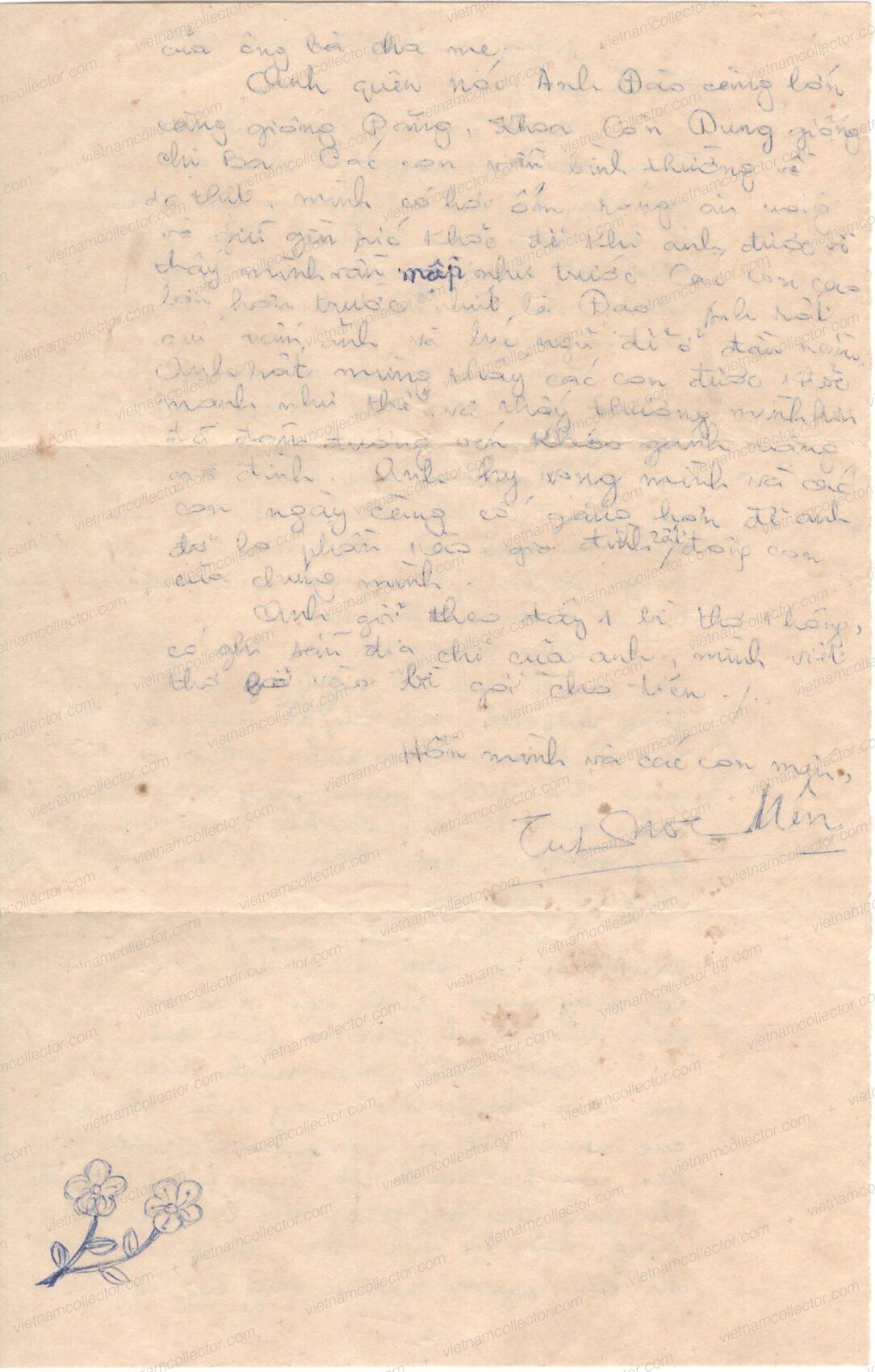
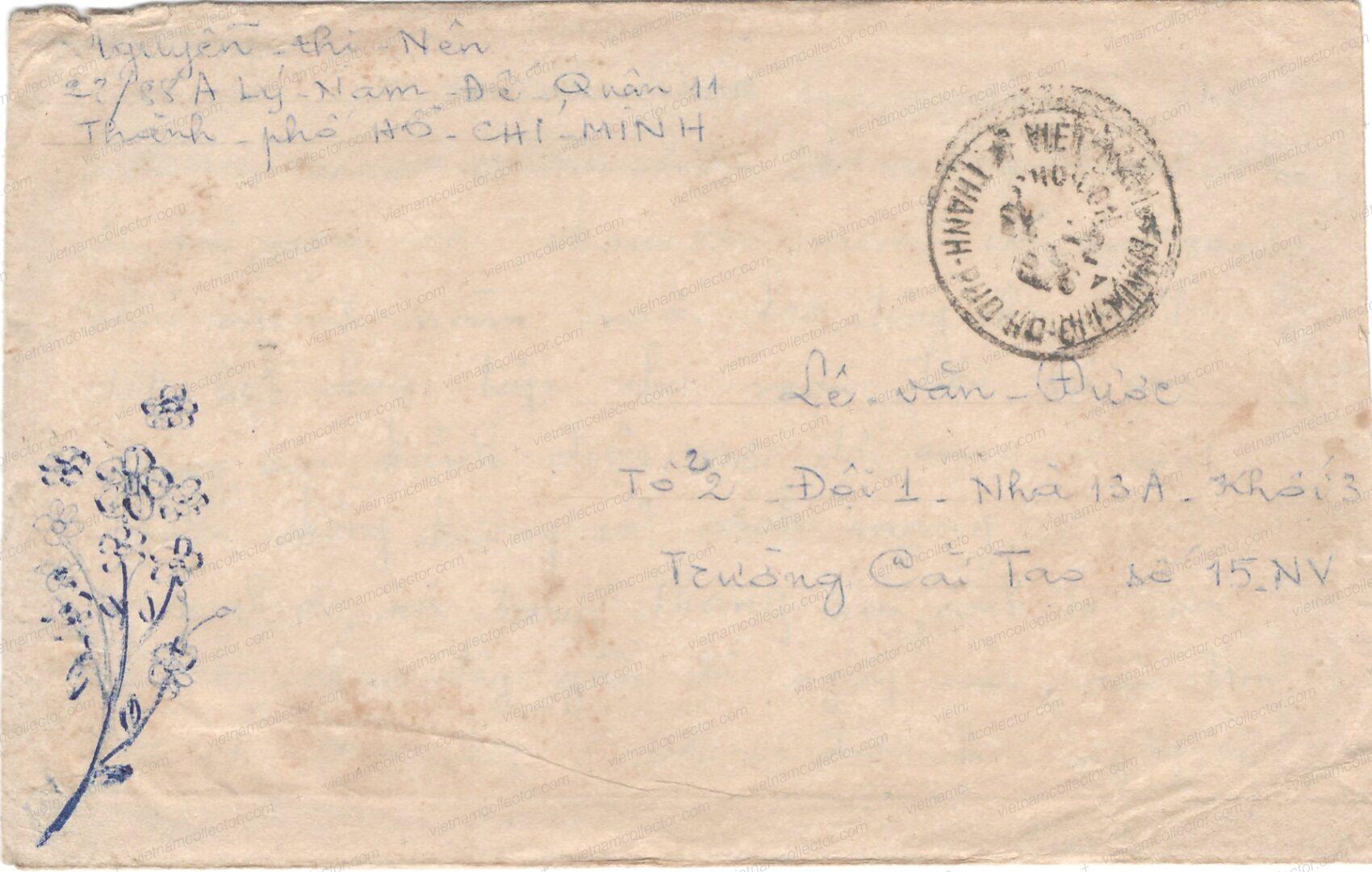
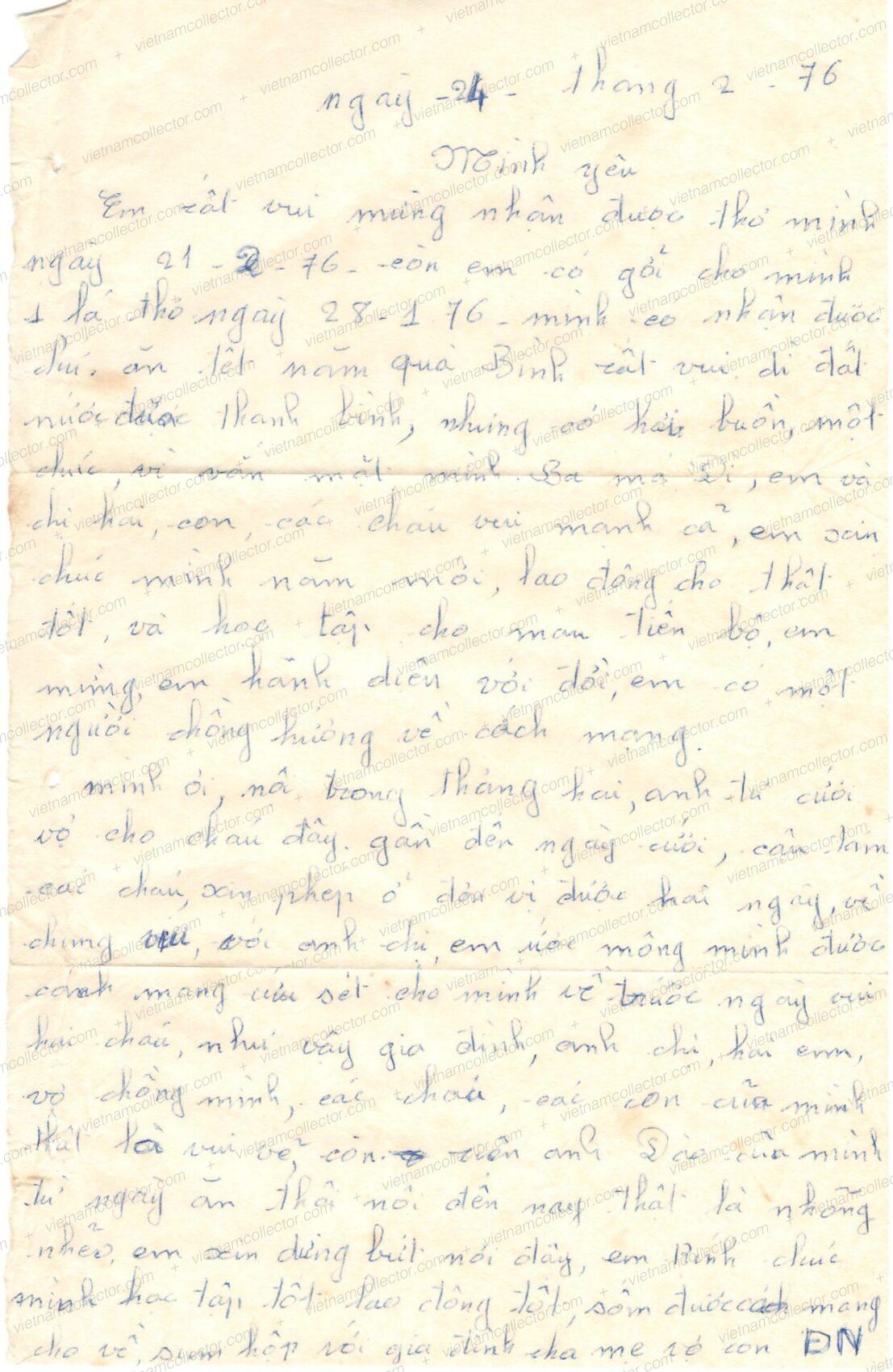
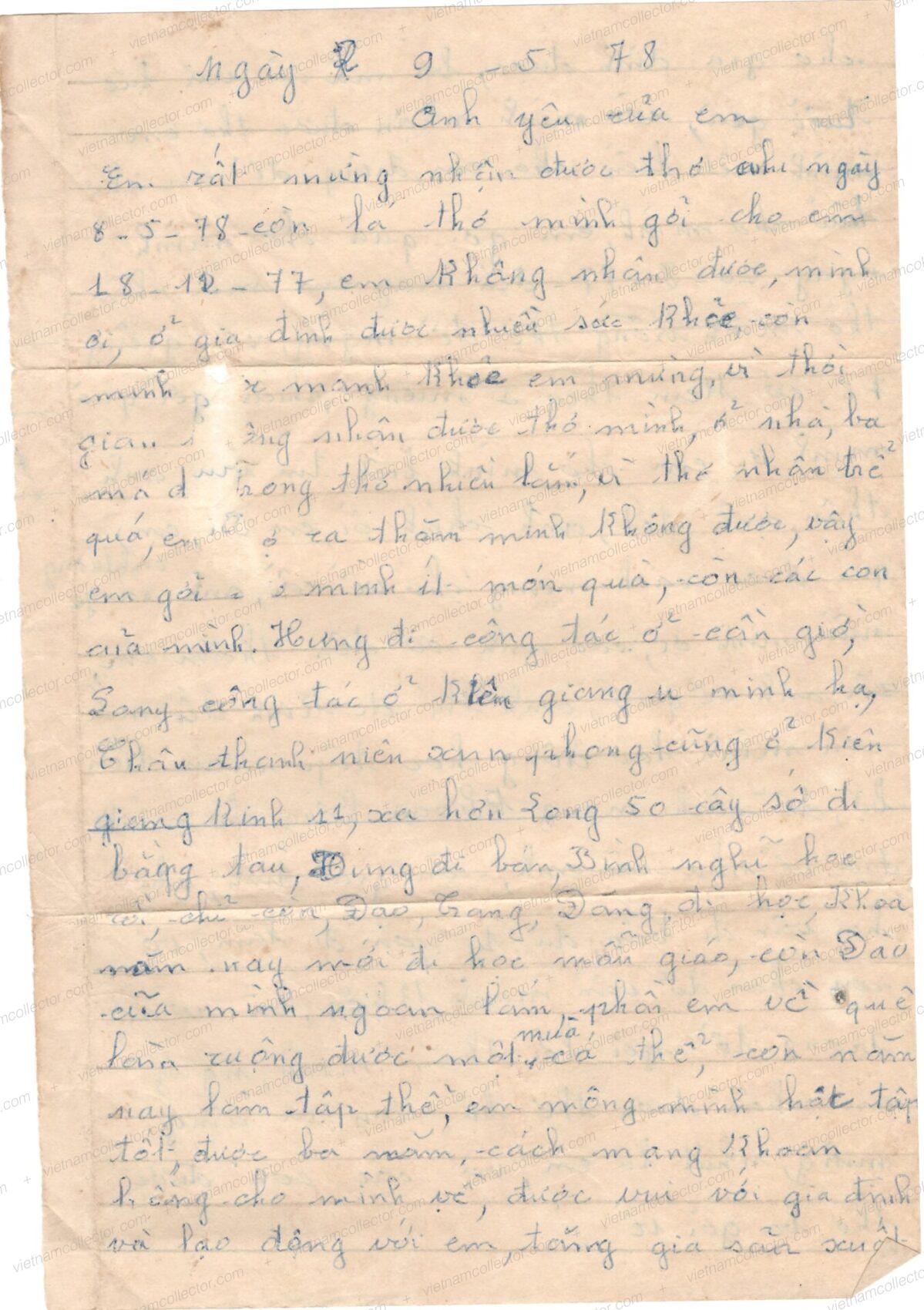
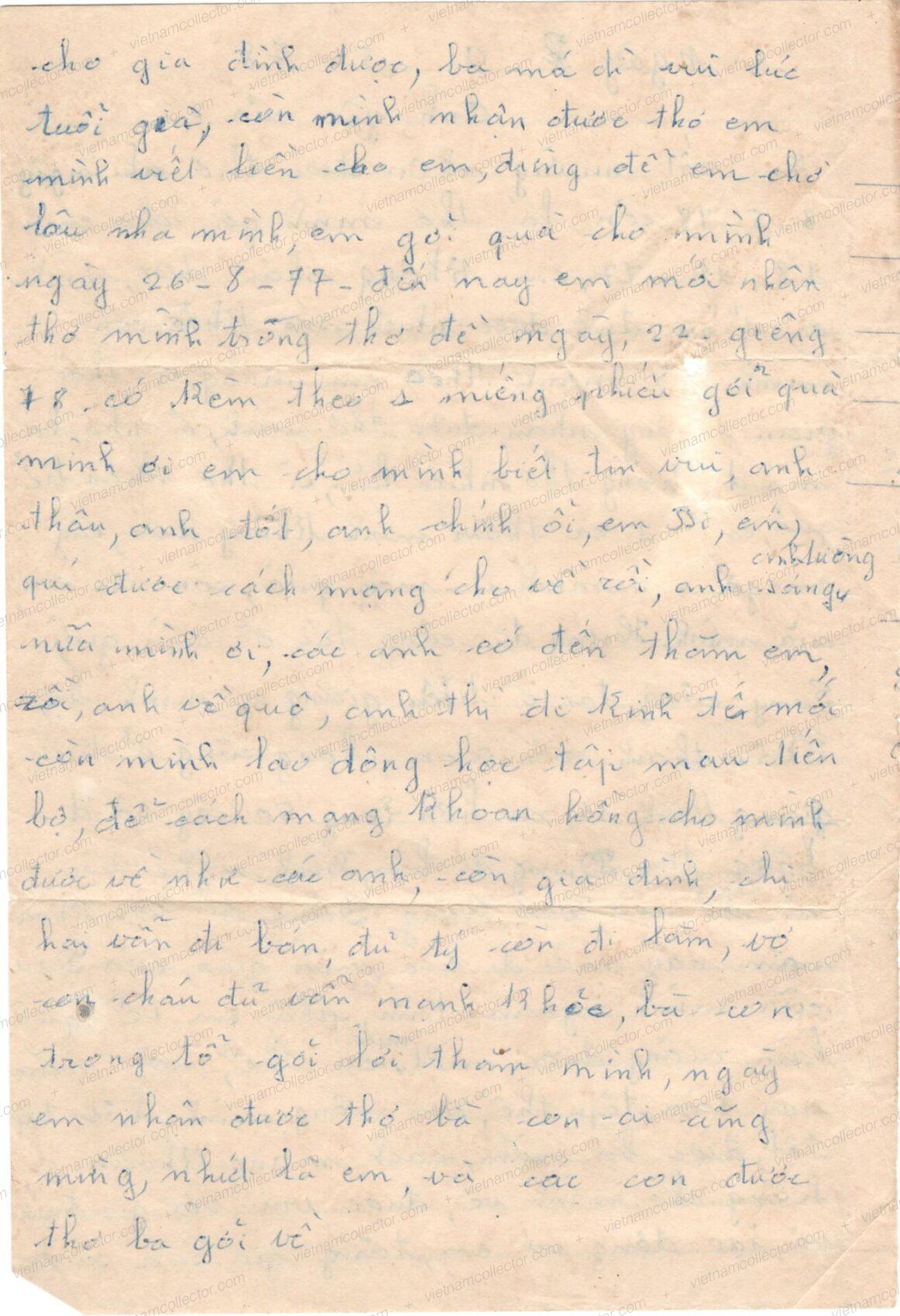
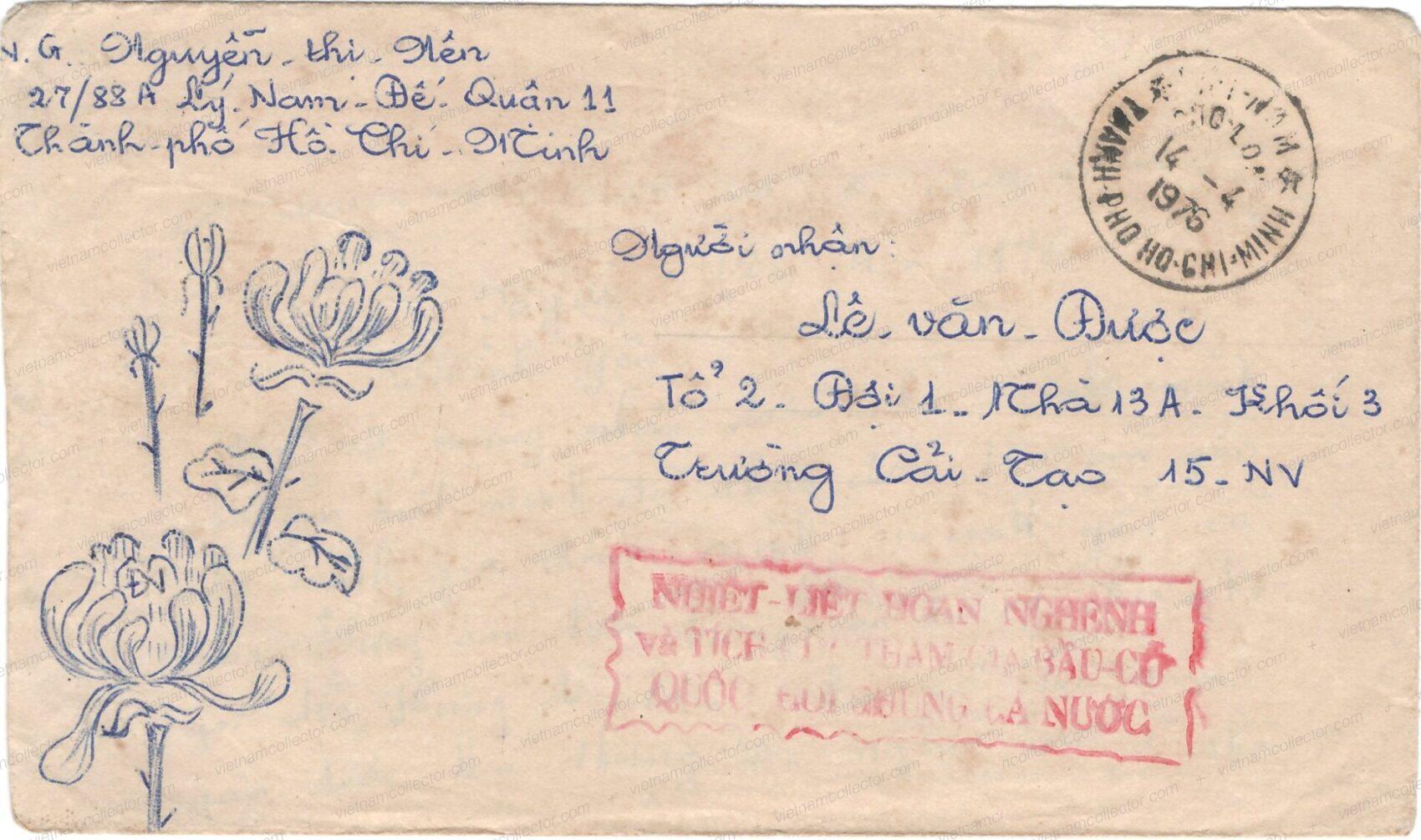
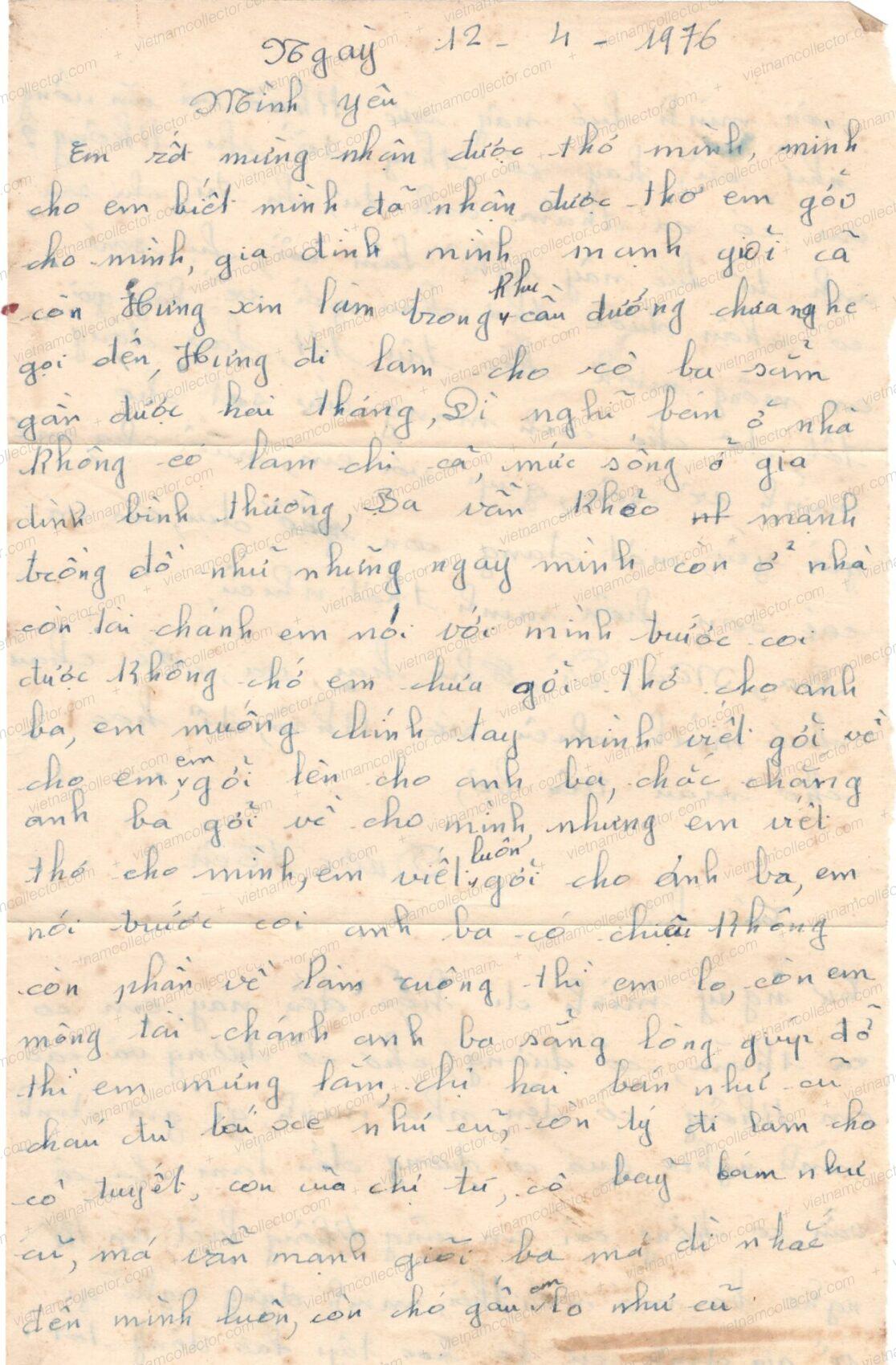
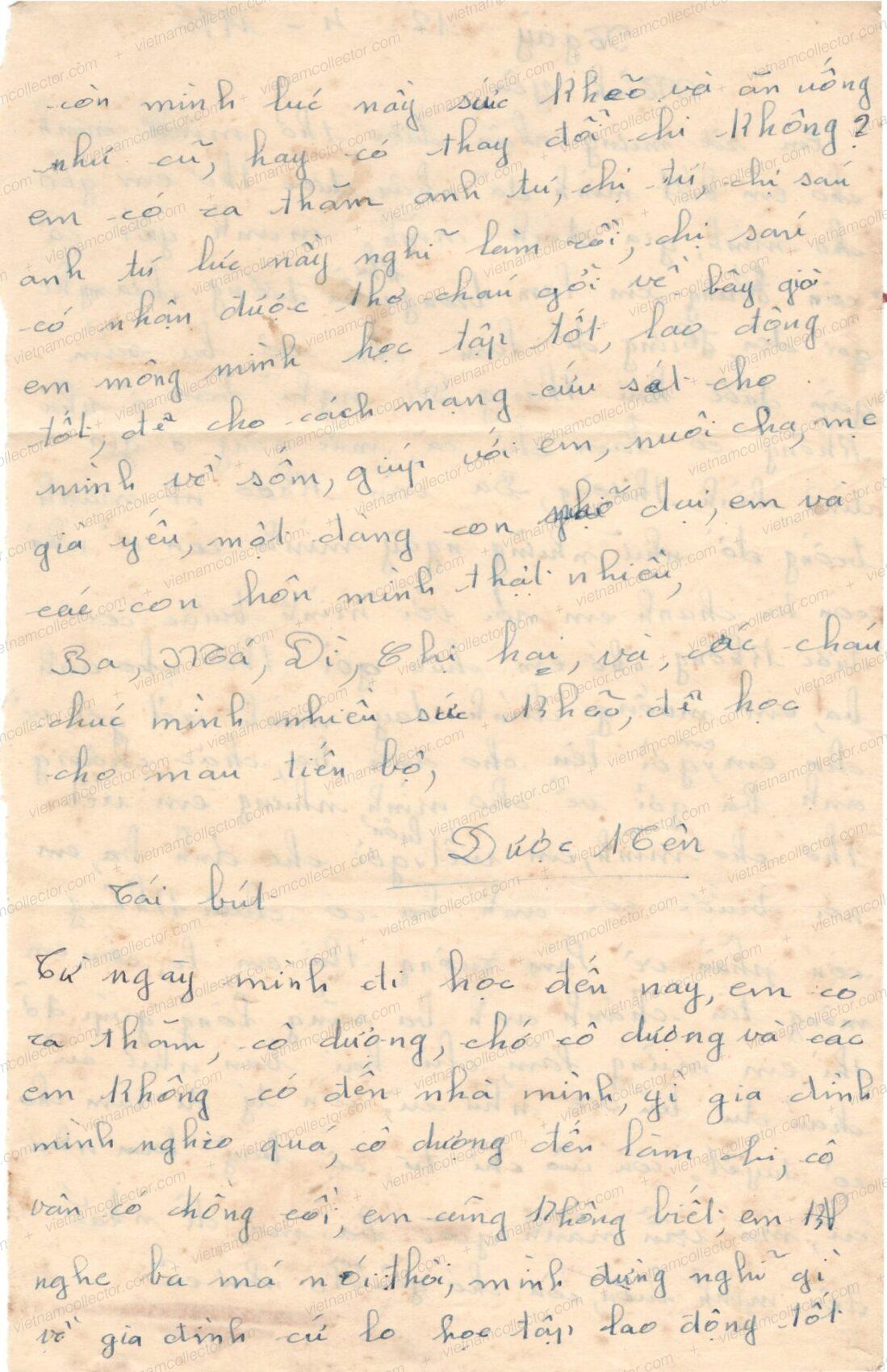
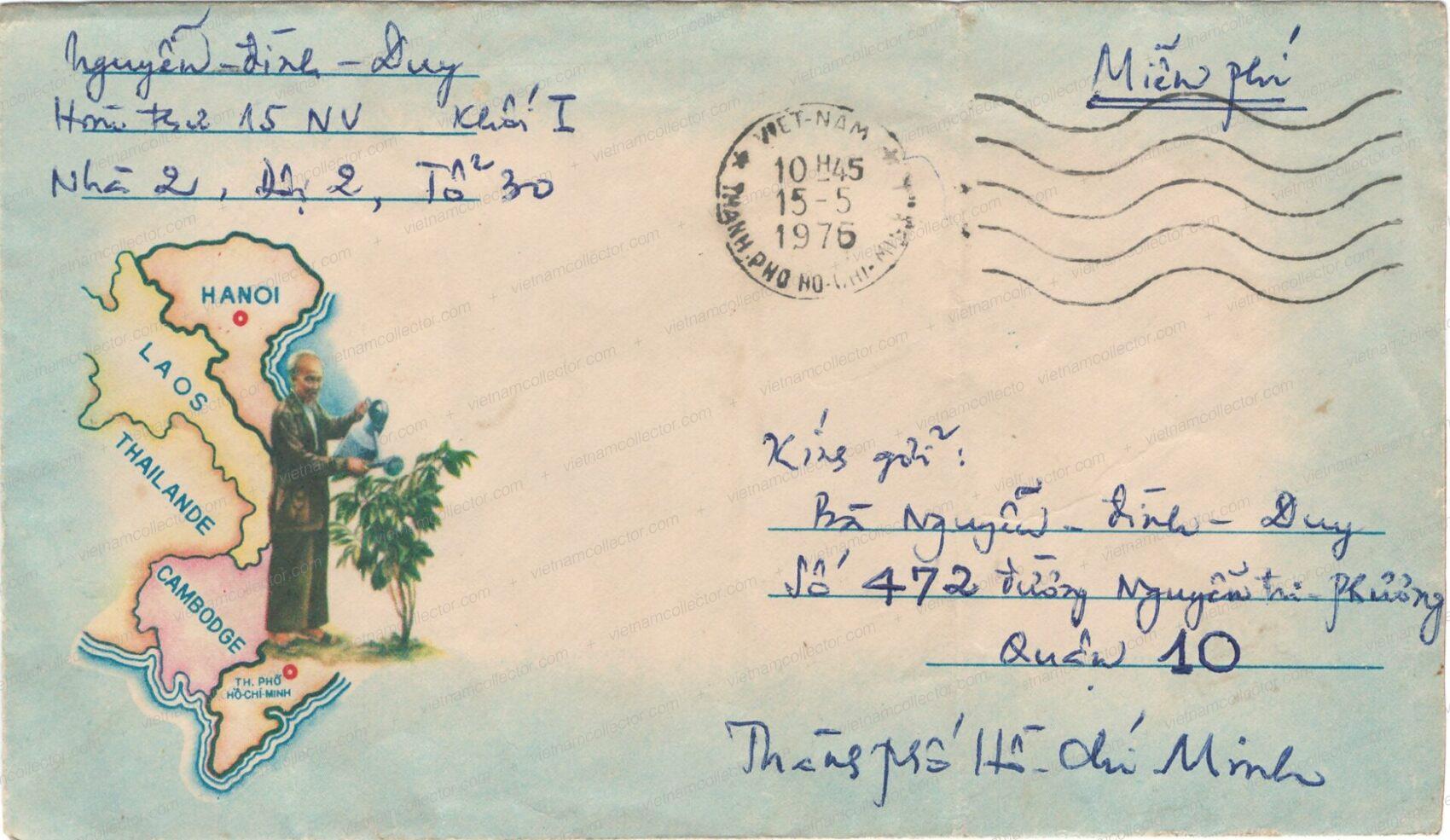
Letter sent by an inmate of Camp 15 NV to a civilian in Saigon (HCM City) in May of 1976. The letter carries the manuscript “Mien Phi” (= Free) to indicate that no postage was due at the time. Cancelled with the machine HCM City cancel.
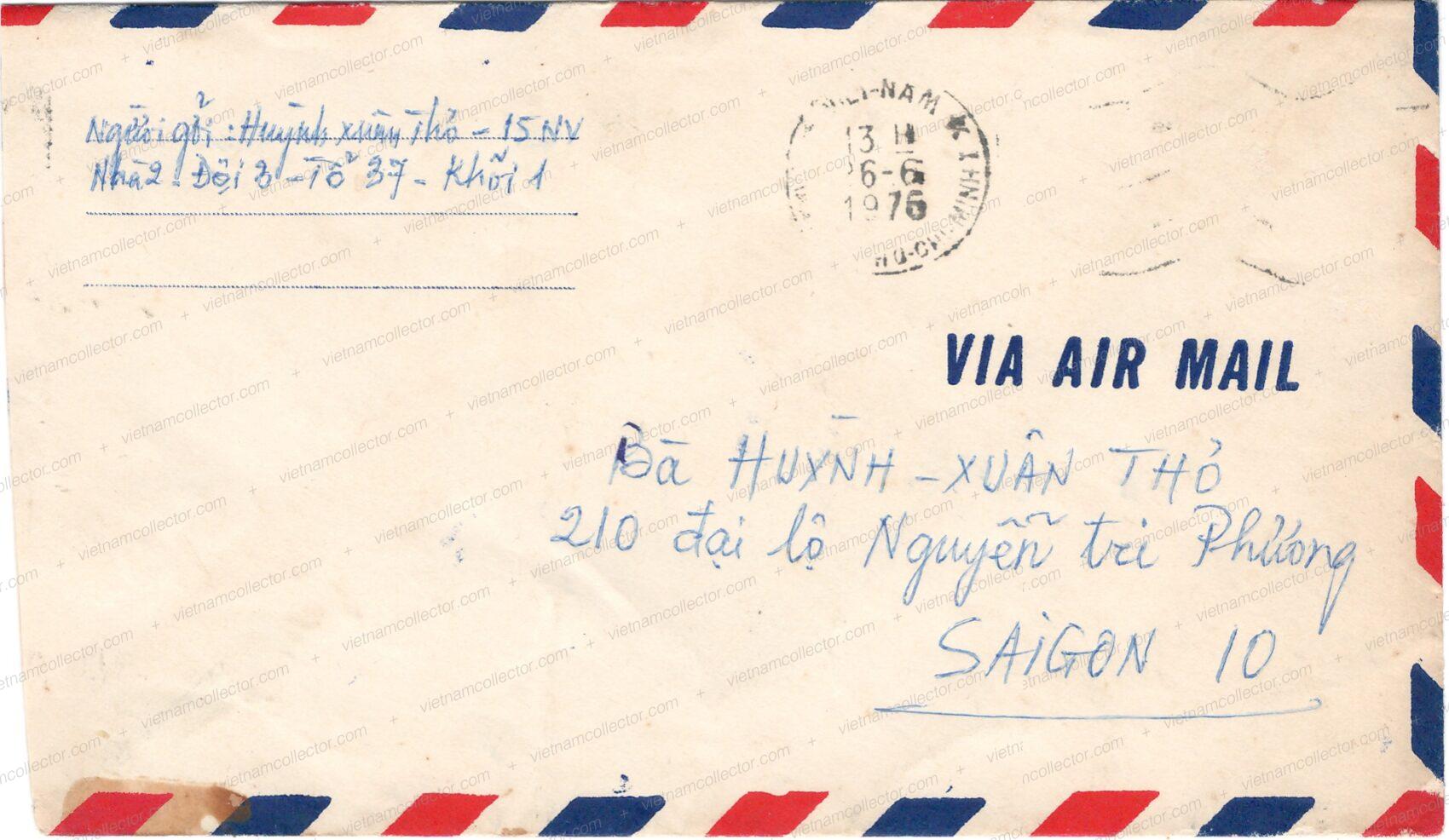
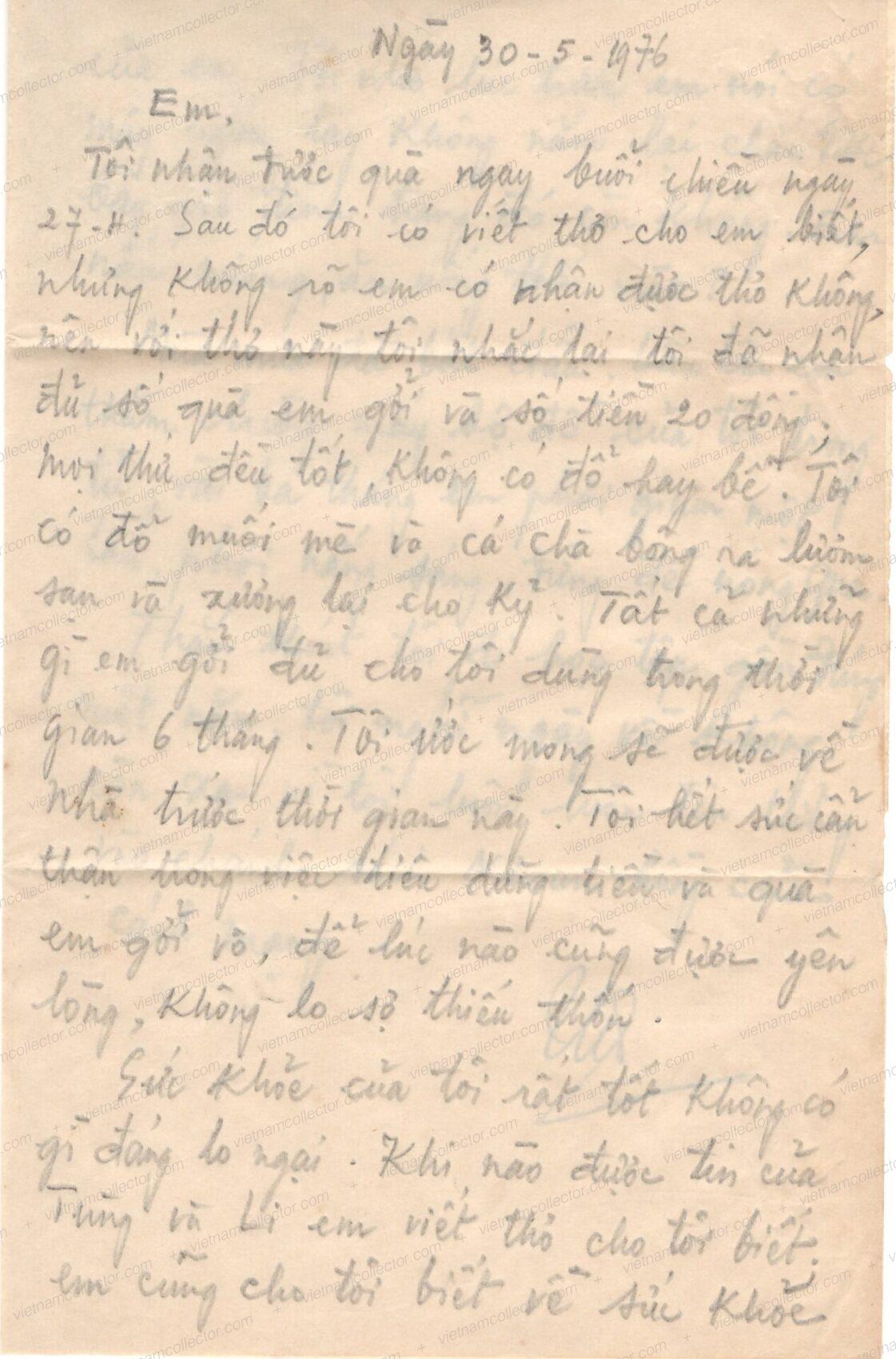
Letter sent by an inmate of Camp 15 NV to a civilian in Saigon (HCM City) in June of 1976. Cancelled with the machine HCM City cancel.
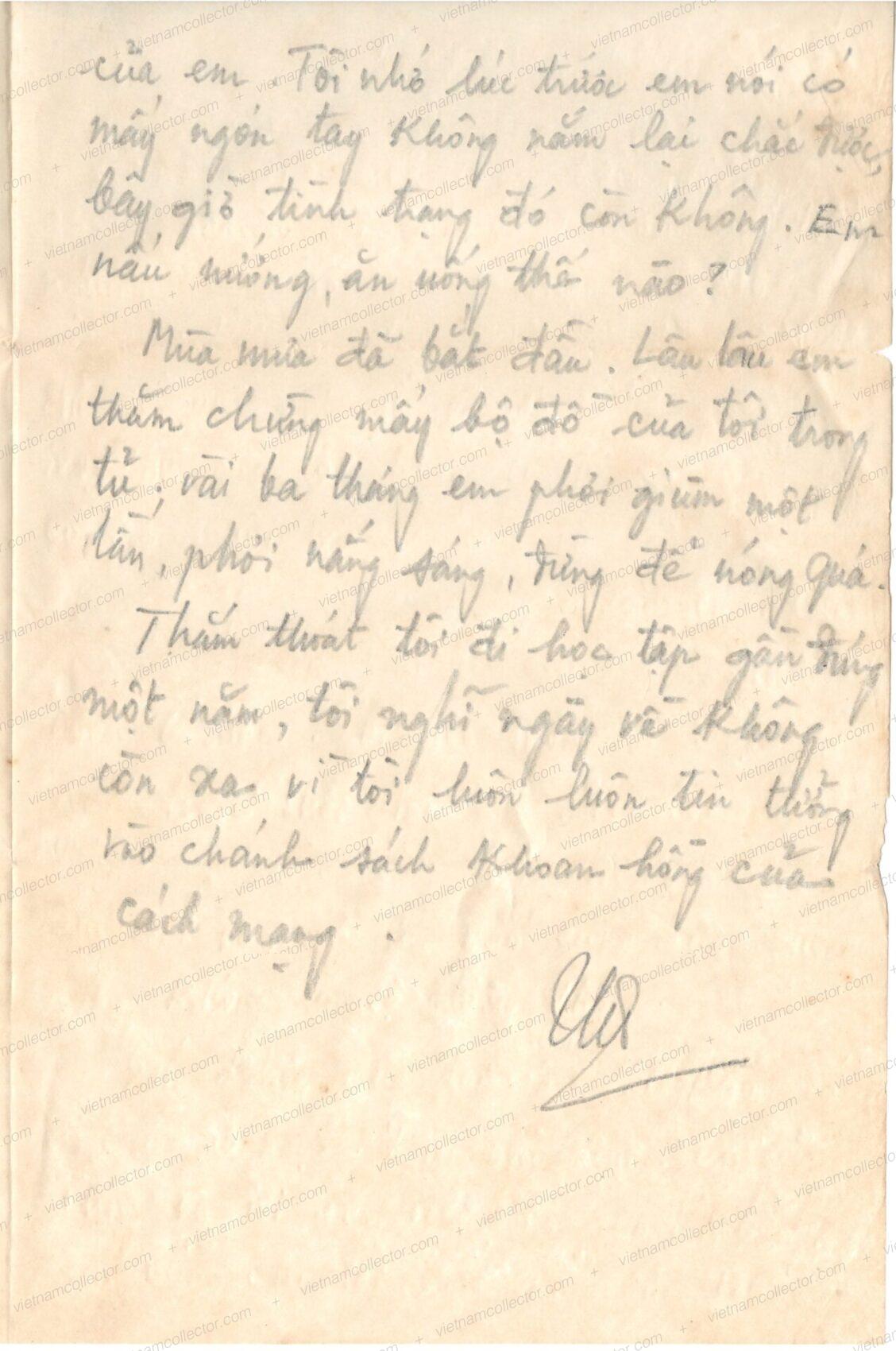
Camp AH1NT
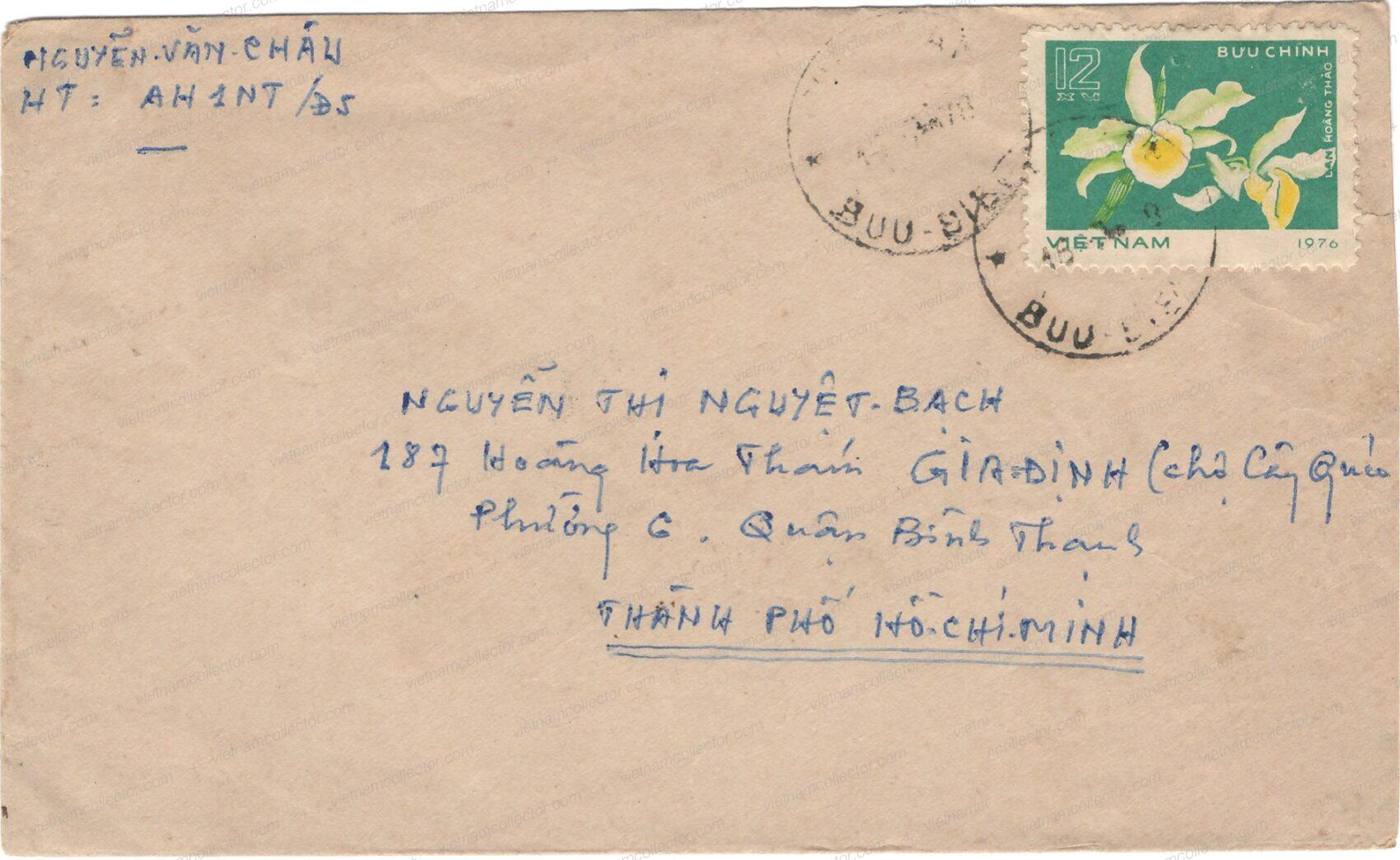
Letter sent in August of 1978 mailed from Camp AH1NT. Nothing is known about the camp”s location. Franked with a civilian orchid stamp from 1976. The letter was mailed by an inmate to a civilian in HCM City. Unfortunately the cancel on front is illegible. HCM City arrival cancel from August 5th, 1978 on the reverse.
Camp A2
Very late letter from November of 1987 indicating that the camps were still operational twelve years after the end of the war. Sent by a civilian located in HCM City to a person located in Camp A2 that was apparently located in Lam Dong, a suburb North of Ham City. Franked with two 5D stamps from 1987 paying an overall postage of 10D.
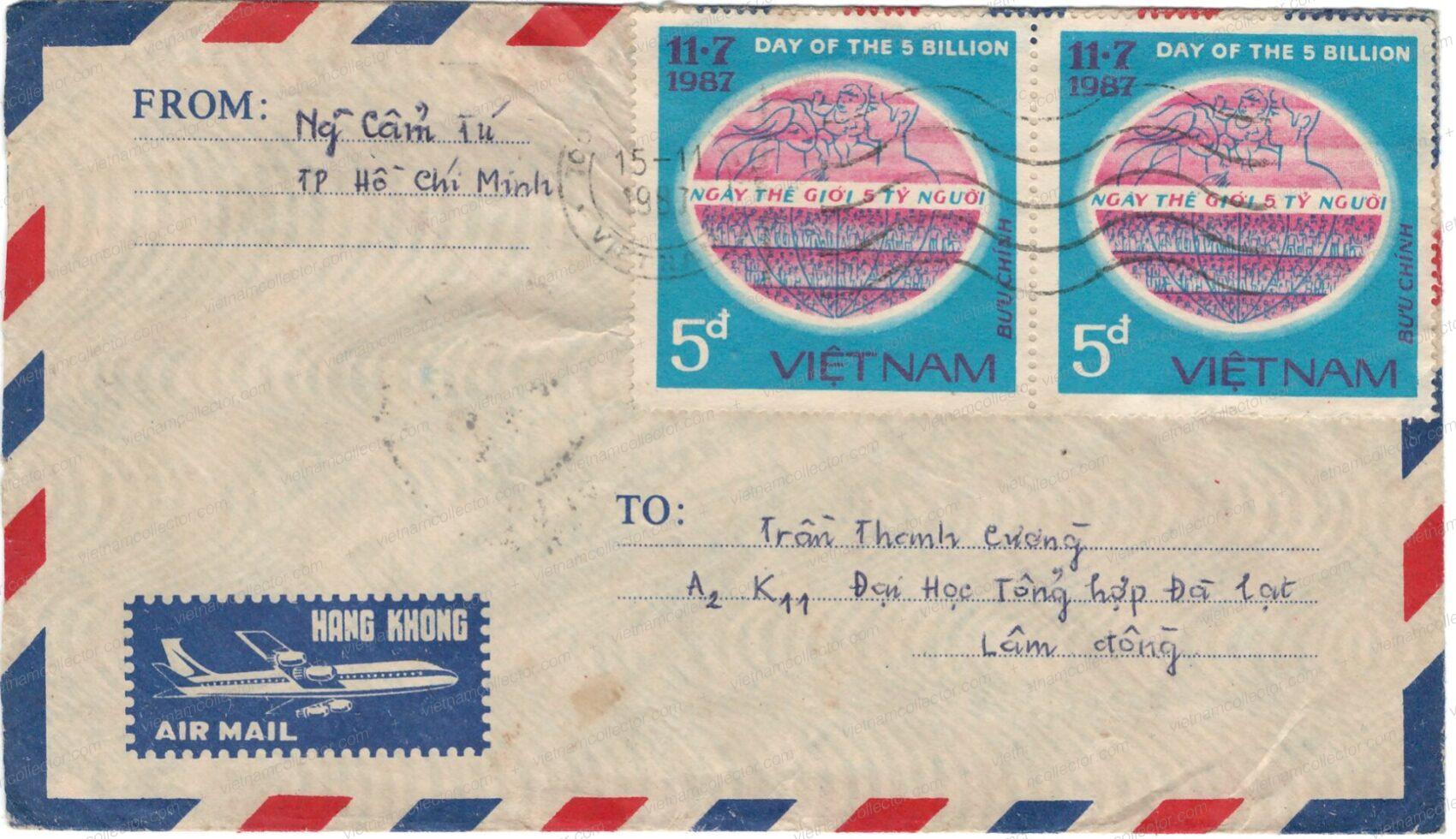
Camp A6
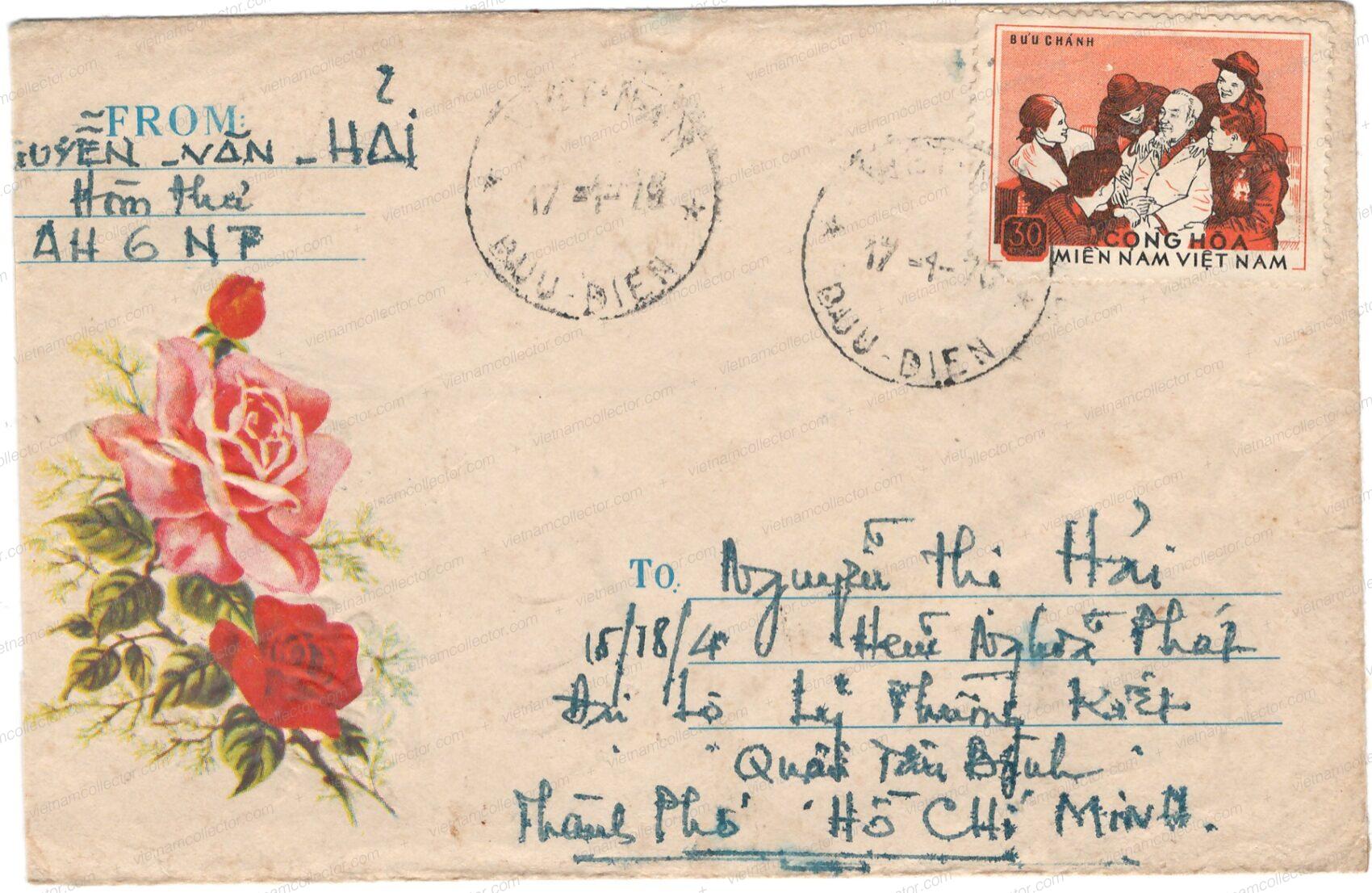
Letter sent by an inmate or guard of camp A6 in April of 1979 to a civilian in HCM City. The use of 30D National Liberation stamp is somewhat of a puzzle as Camp A6 was located in Yen Bai, which is North East of Hanoi, and its was designated for important prisoners. The stamp was issued in South Vietnamese Dong and hence was not valid postage in North Vietnam until after the currency reform in 1975. At that time the South Vietnamese Dong was devalued by 500:1 against the North Vietnamese Dong. This meant the stamp was only worth the equivalent of 6xu at the time of mailing. 6xu represented the intra-city tariff so would not be enough to cover the long distance from Yen Bai to HCM City in the South. However the real remarkable part if this cover is the canceler. The mute “Viet-Nam Buu Dien” cancel has, according to SICP member Bob Munshower, only been documented six times. Manuell and machine HCM City arrival cancels on the reverse.
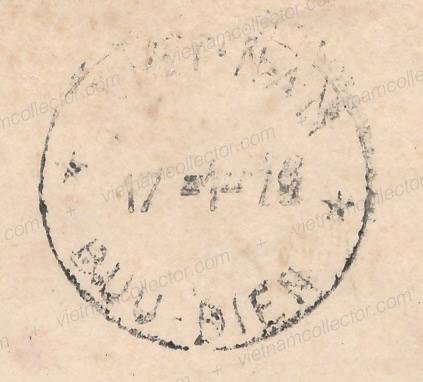
Detailed scan of the rare mute cancel.
Camp B1
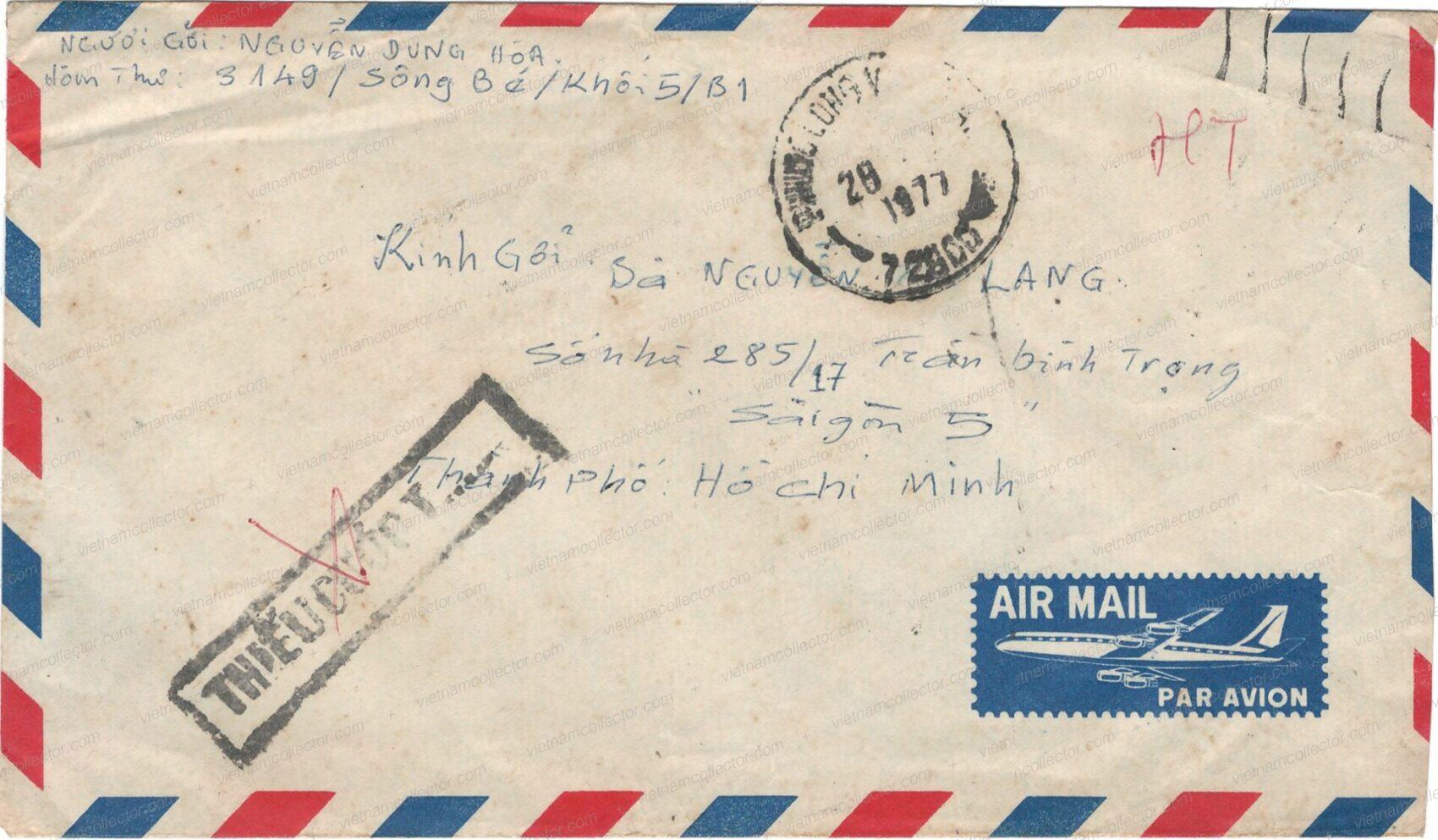
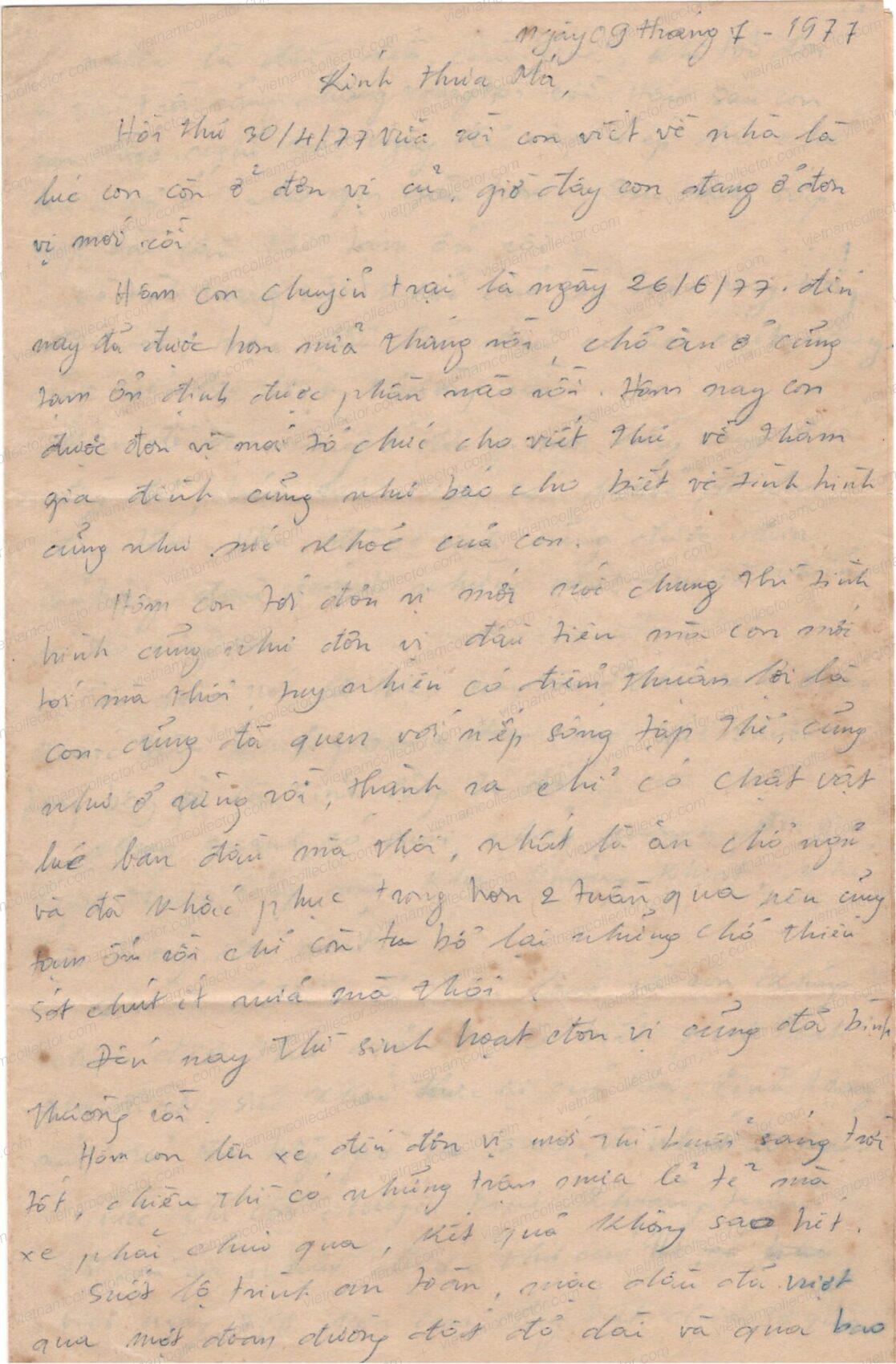
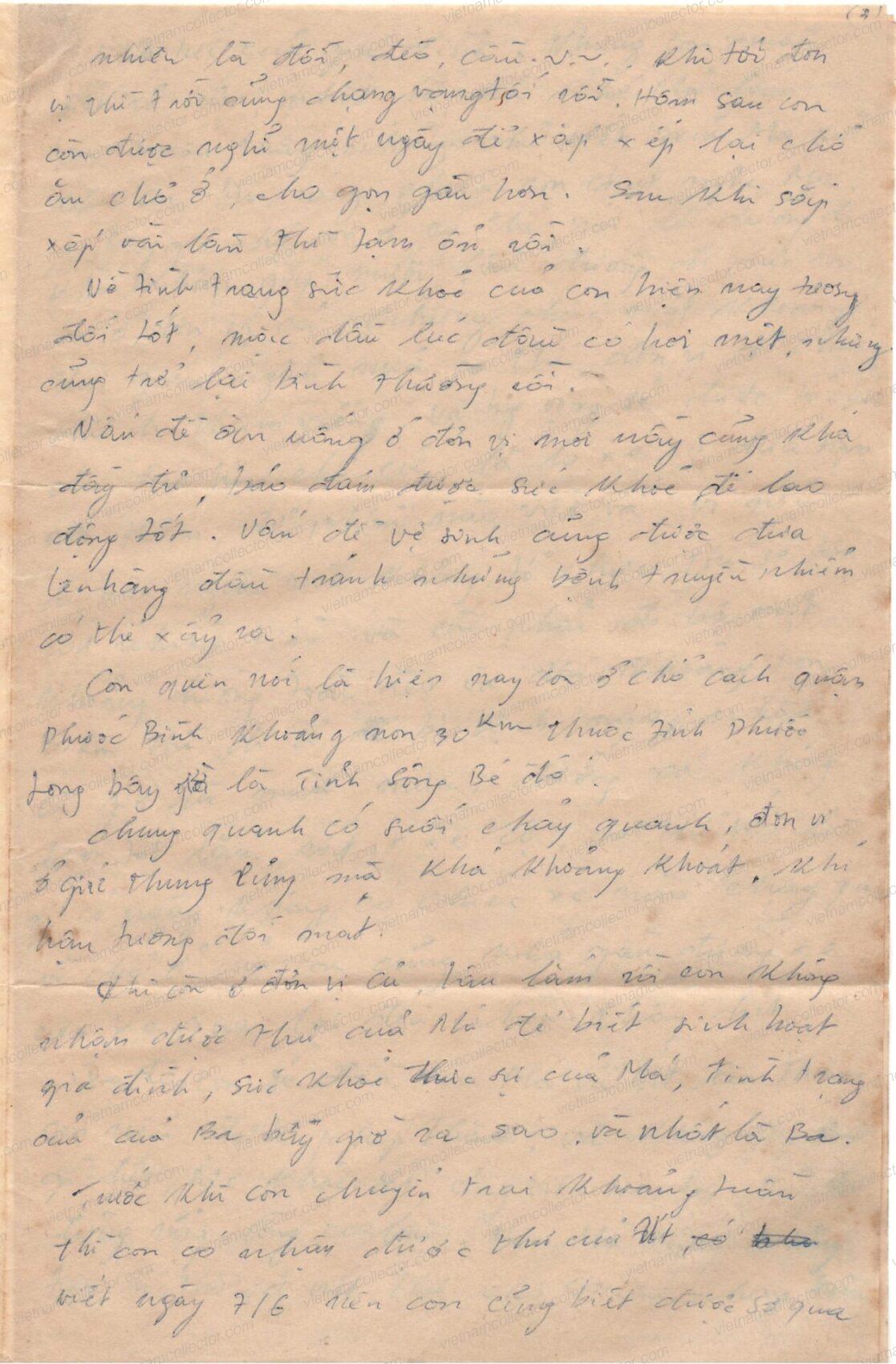
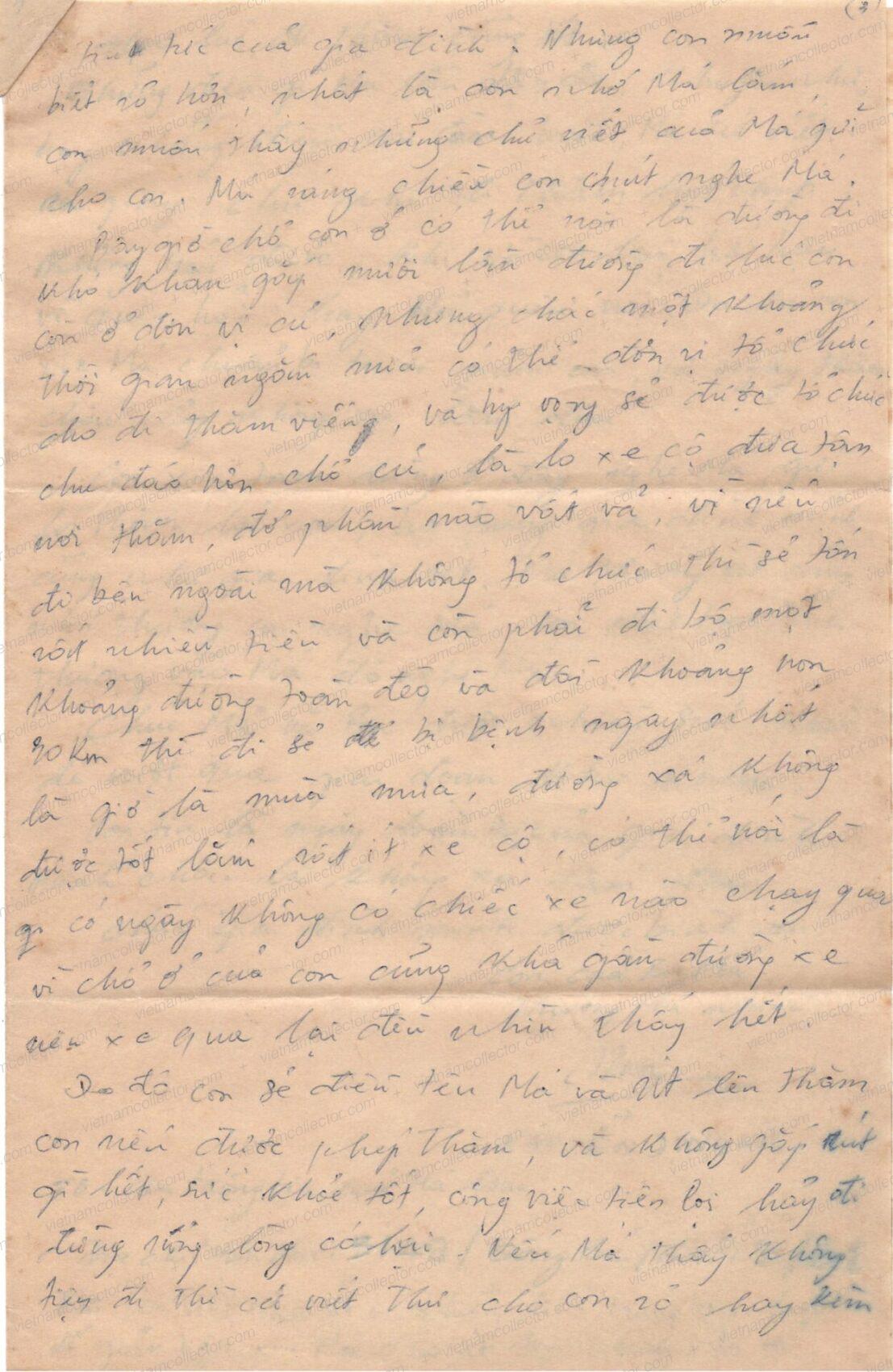
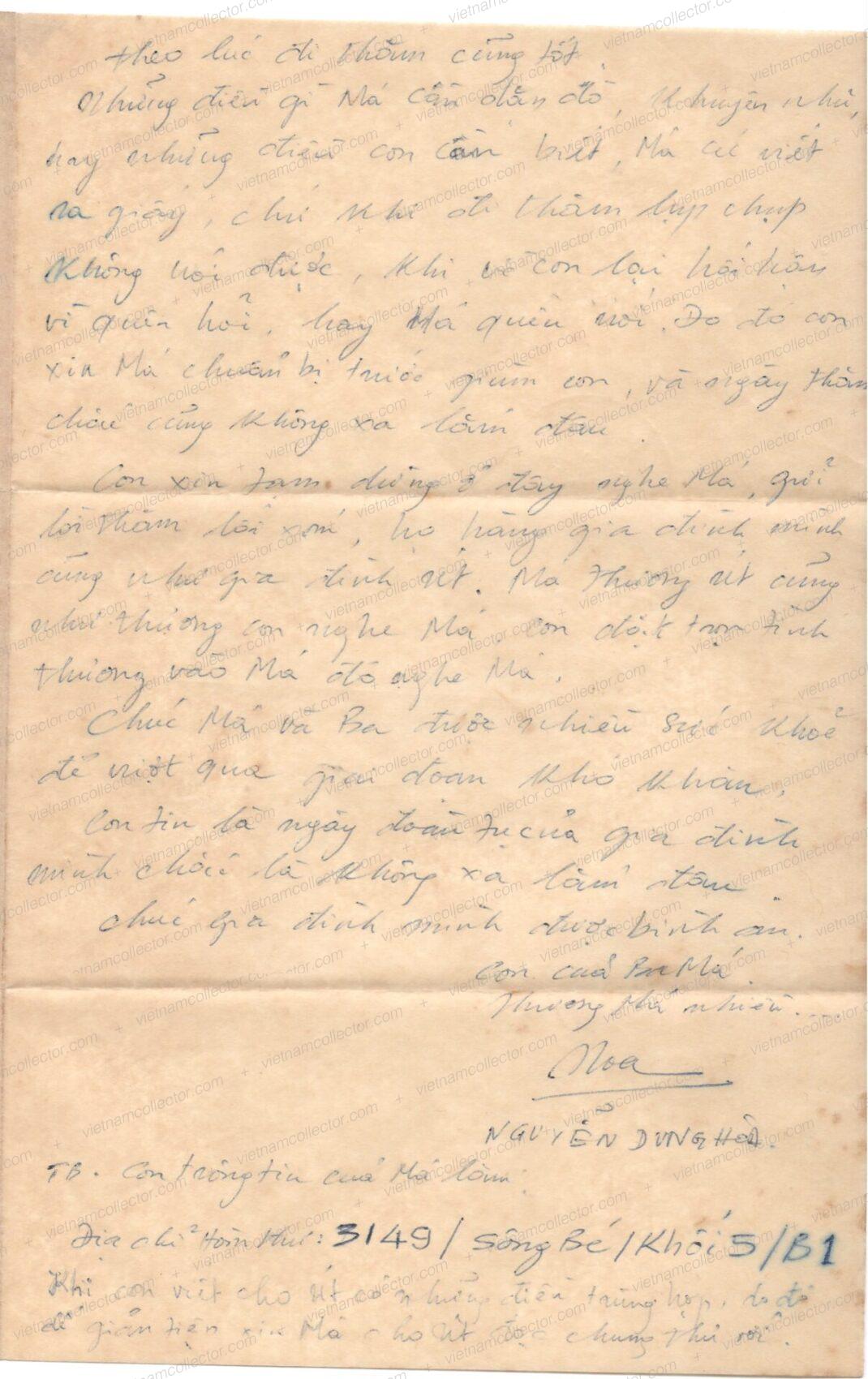
Letter sent by an inmate of Camp B1 in July 1977 to a civilian in HCM City. The letter was sent without postage which was the reason it initially received a black boxed cachet that indicated that additional postage was due. However, that cachet was stricken out manually by a red cross that also wrote “HT” that stands for How Thu (a military post office box) which meant no additional postage was collected. The letter is cancelled with an unusual double-ringed canceler from Phuoc Long. HCM City arrival cancels on the reverse.
 Camp B3
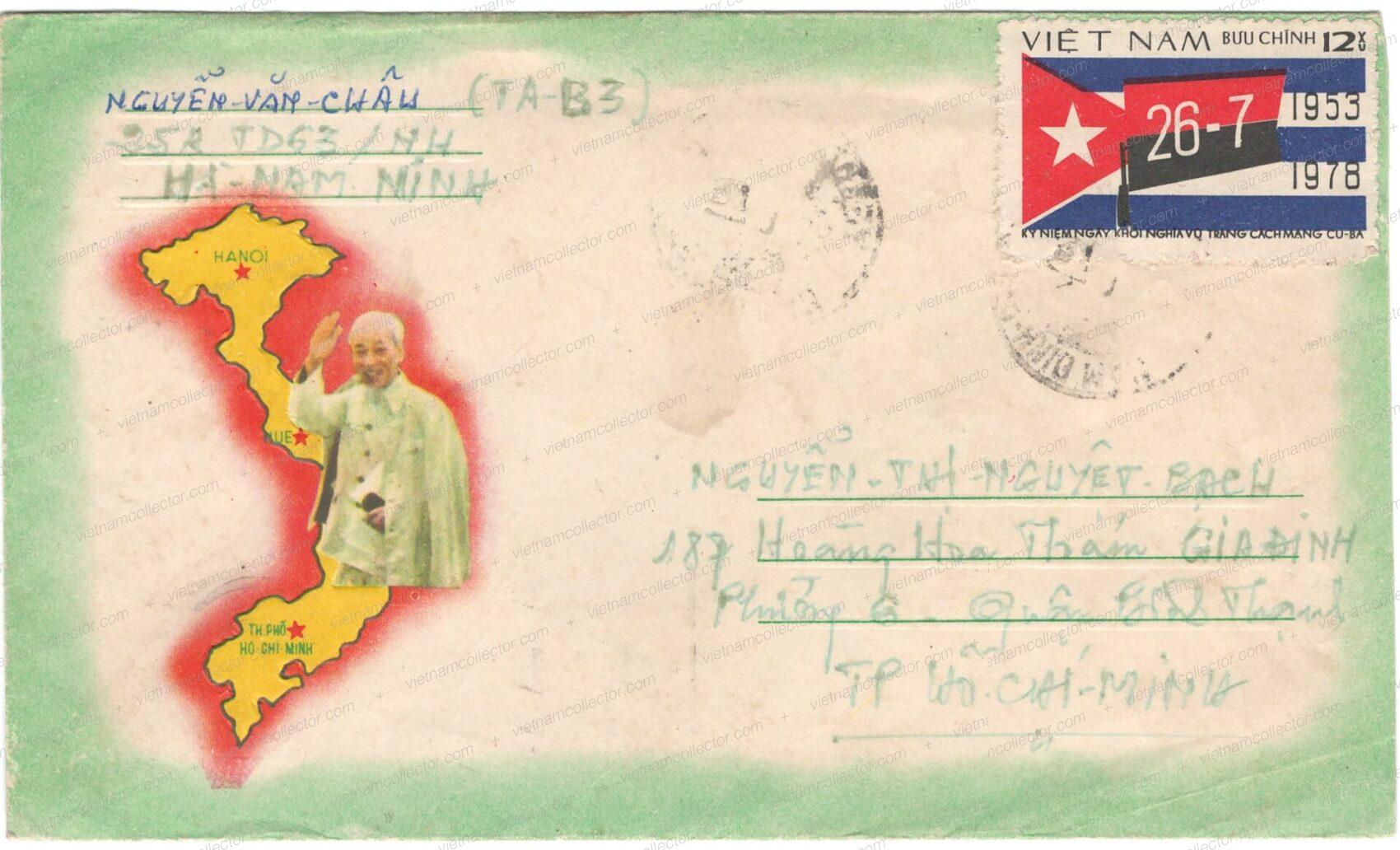
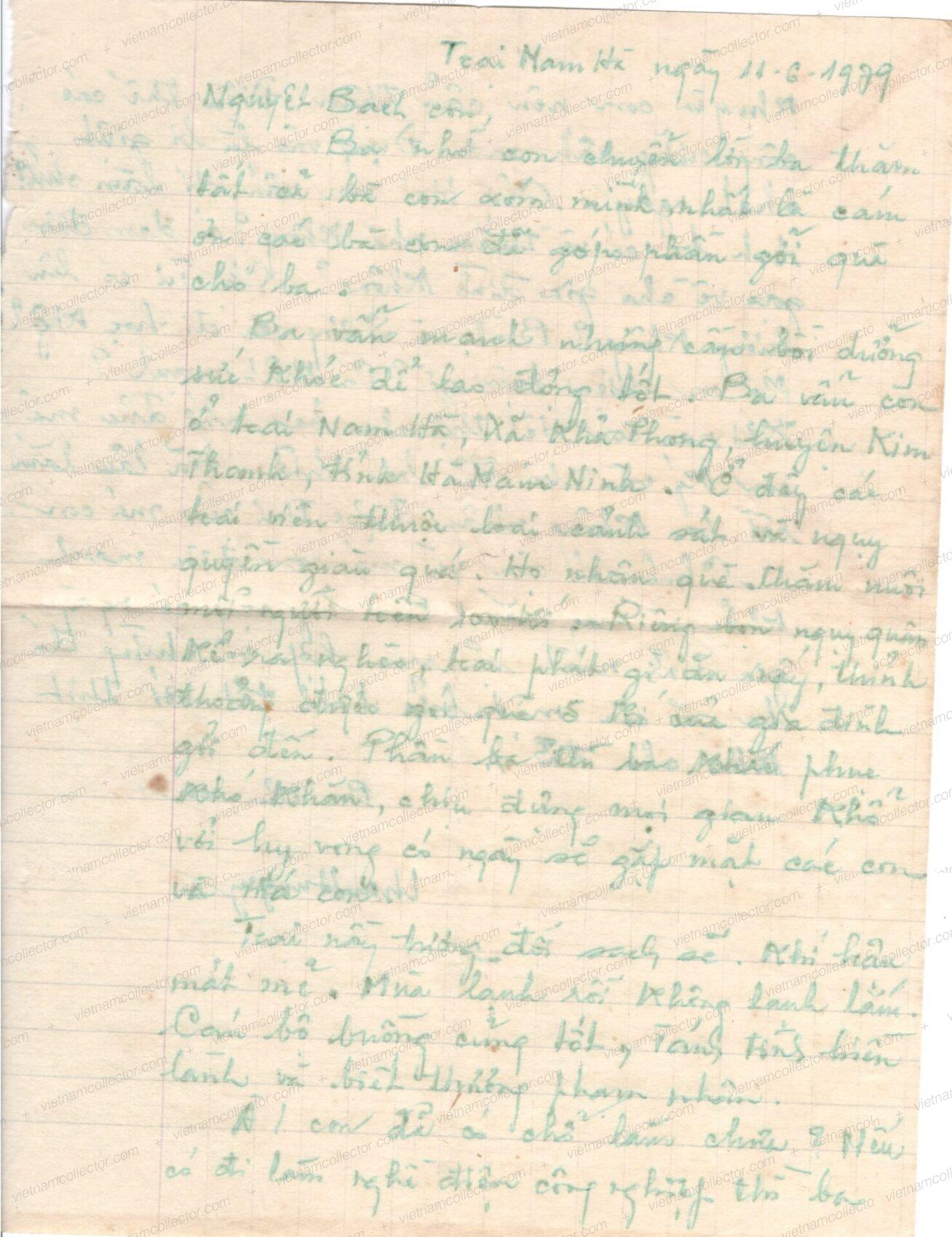
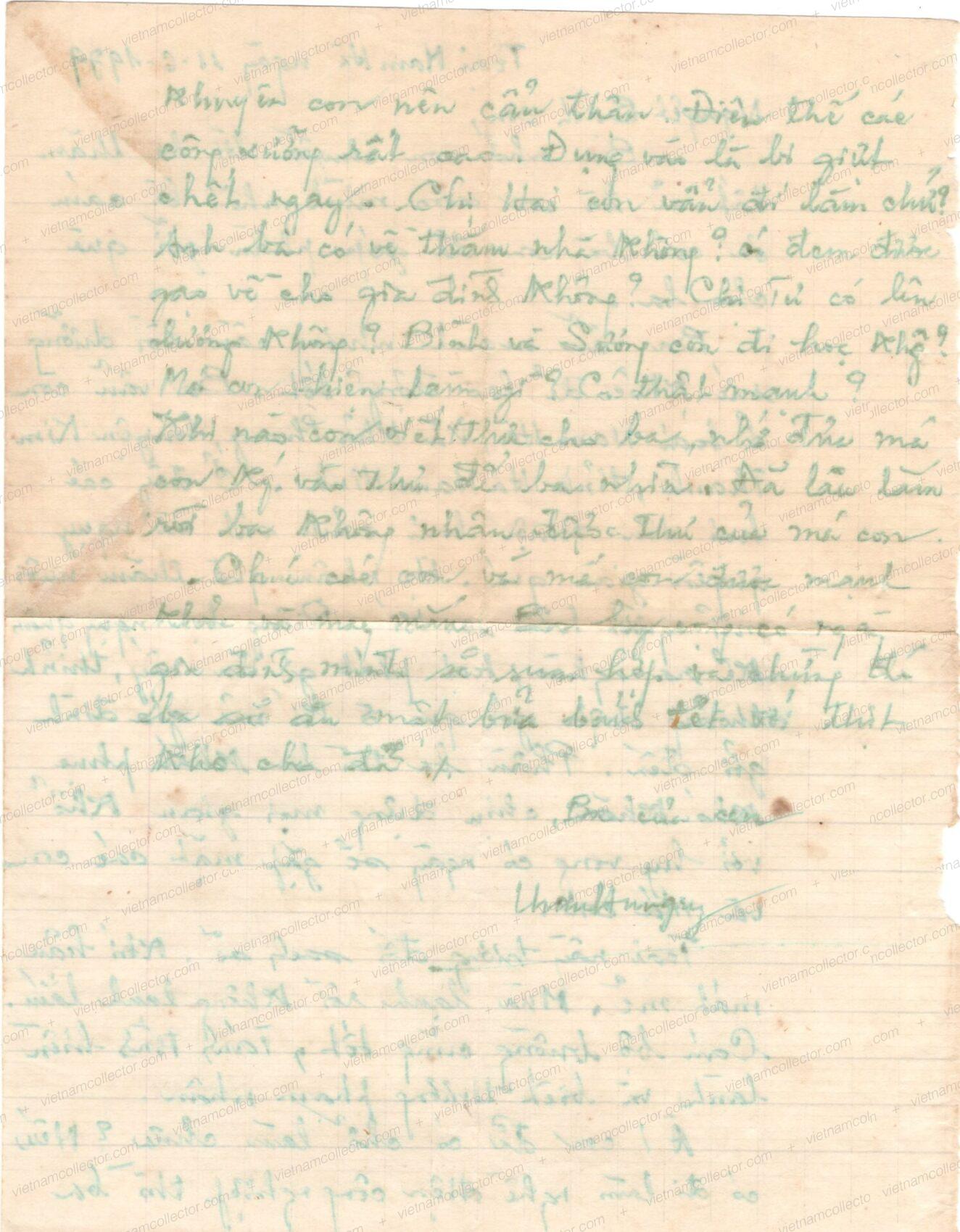
Letter sent in a patriotic envelope from an inmate in Camp B3 to a civilian in HCM City in June of 1979. Nothing is known about the camp”s location. Franked with a civilian stamp from 1978. The stamp has a weak Nam Dinh canceler which suggests that the camp was located in the Nam Dinh area. HCM City arrival cancel on the reverse.
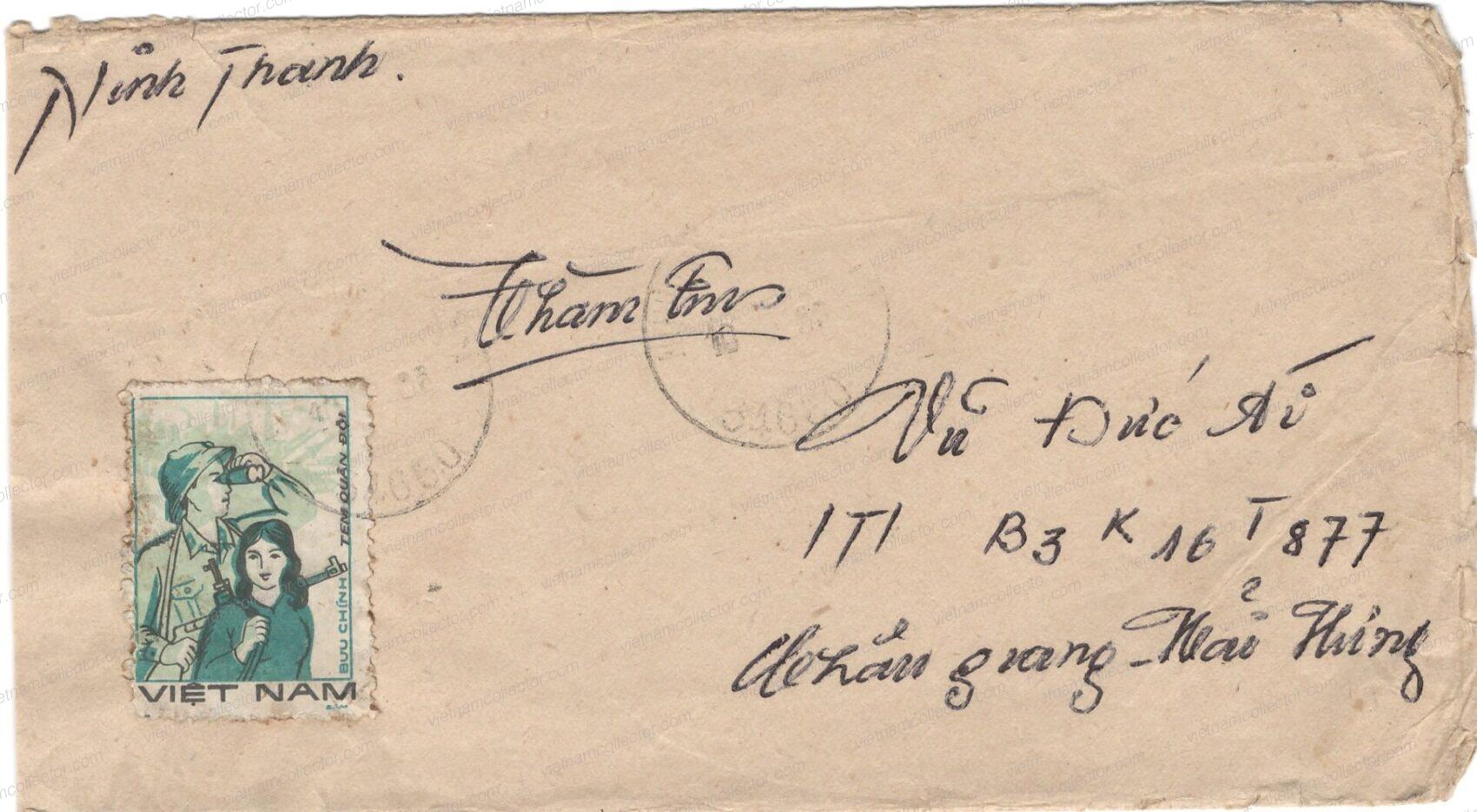
Letter sent by a member of the military to a guard located at camp B3. Franked with a military free frank from 1984. Canceled with a weak canceler from the Pleiku district (Zip Code 54630)
Camp B5
Letter sent by an inmate or guard of Camp B10 located in Hanoi to a civilian in HCM City. The letter is franked with two 12xu HCM Mausoleum stamps paying an overall postage of 24xu (second weight level) cancelled with the Hanoi machine canceler. HCM City arrival canceler on the reverse.
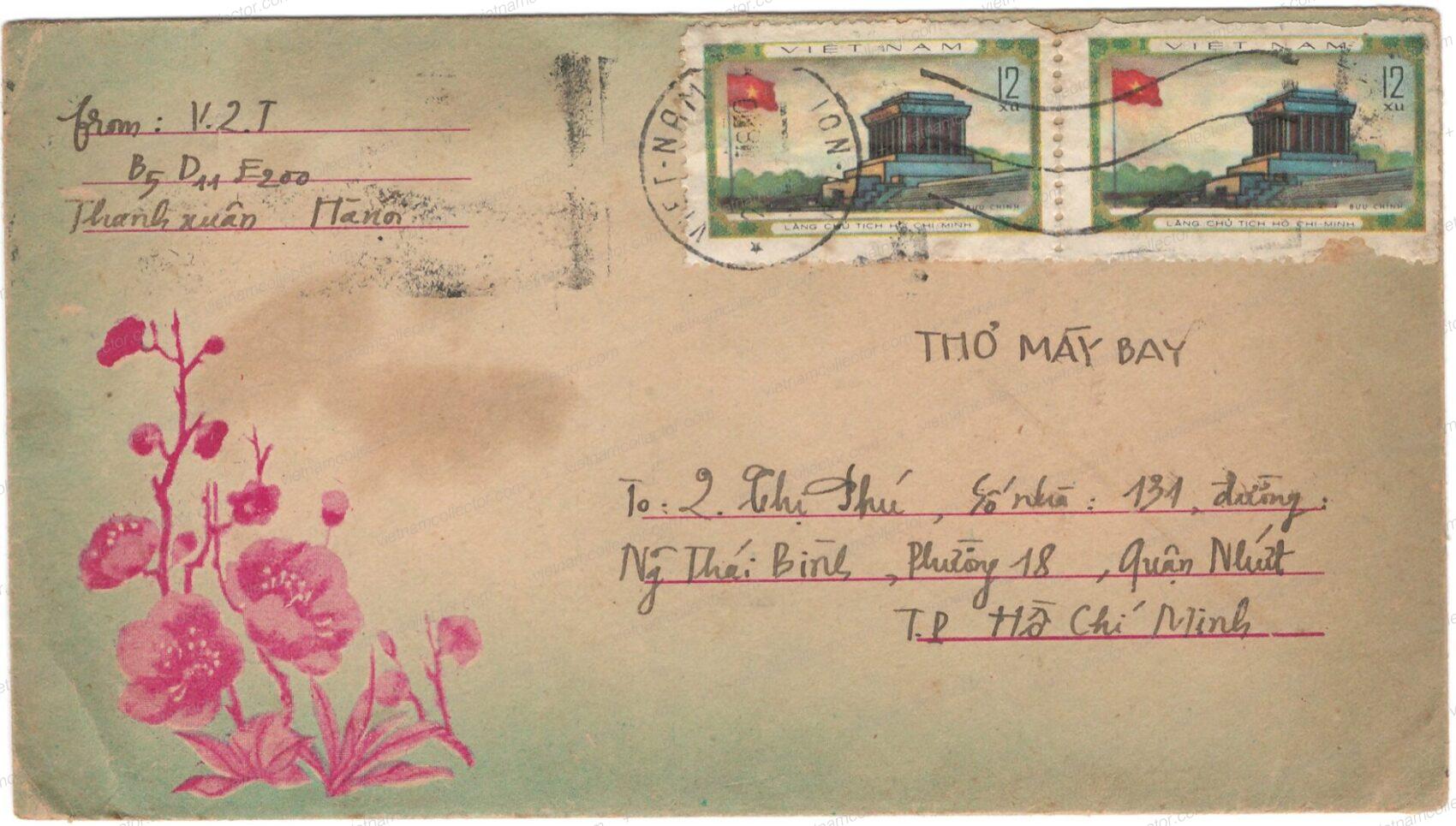
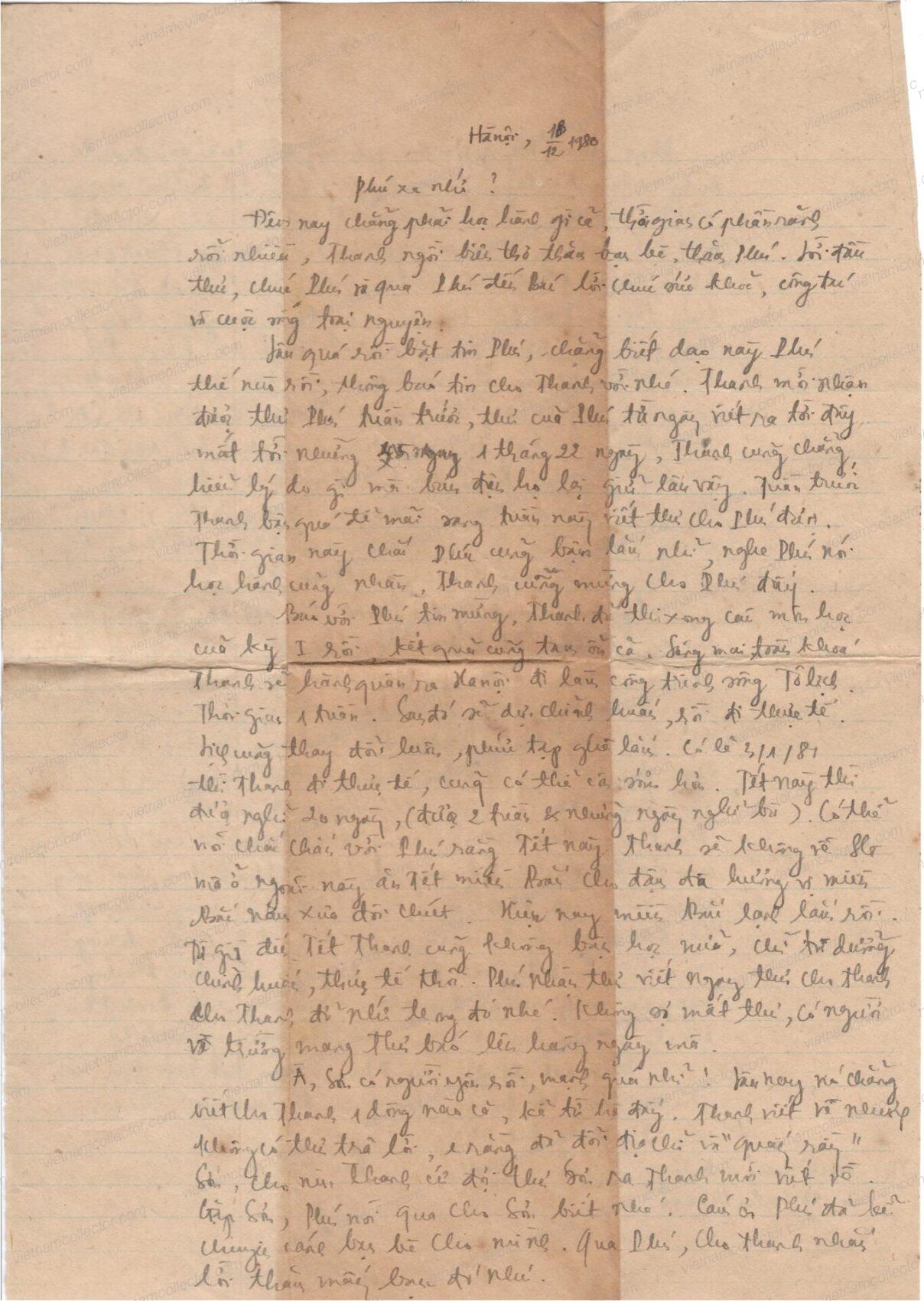
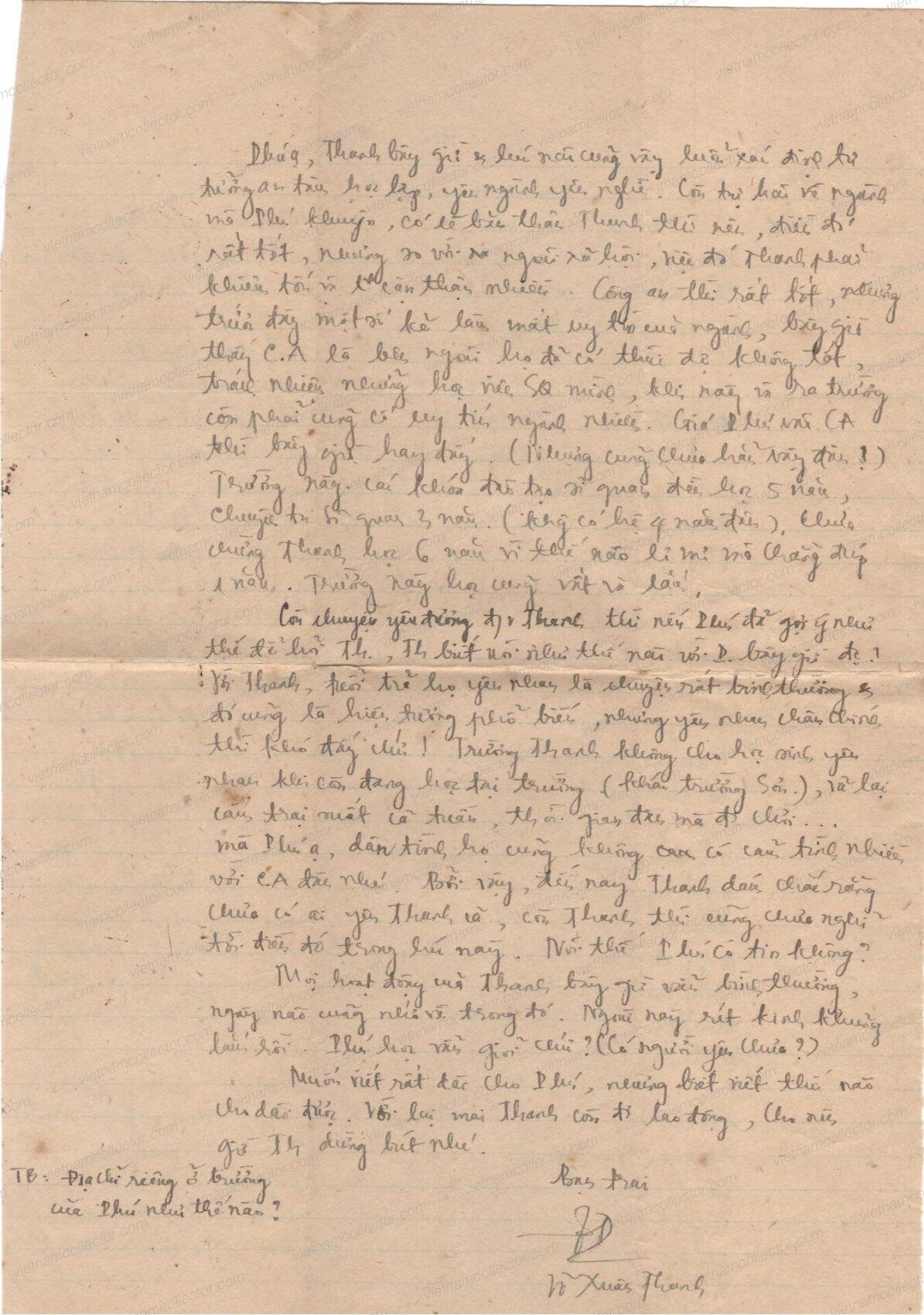
Camp B10
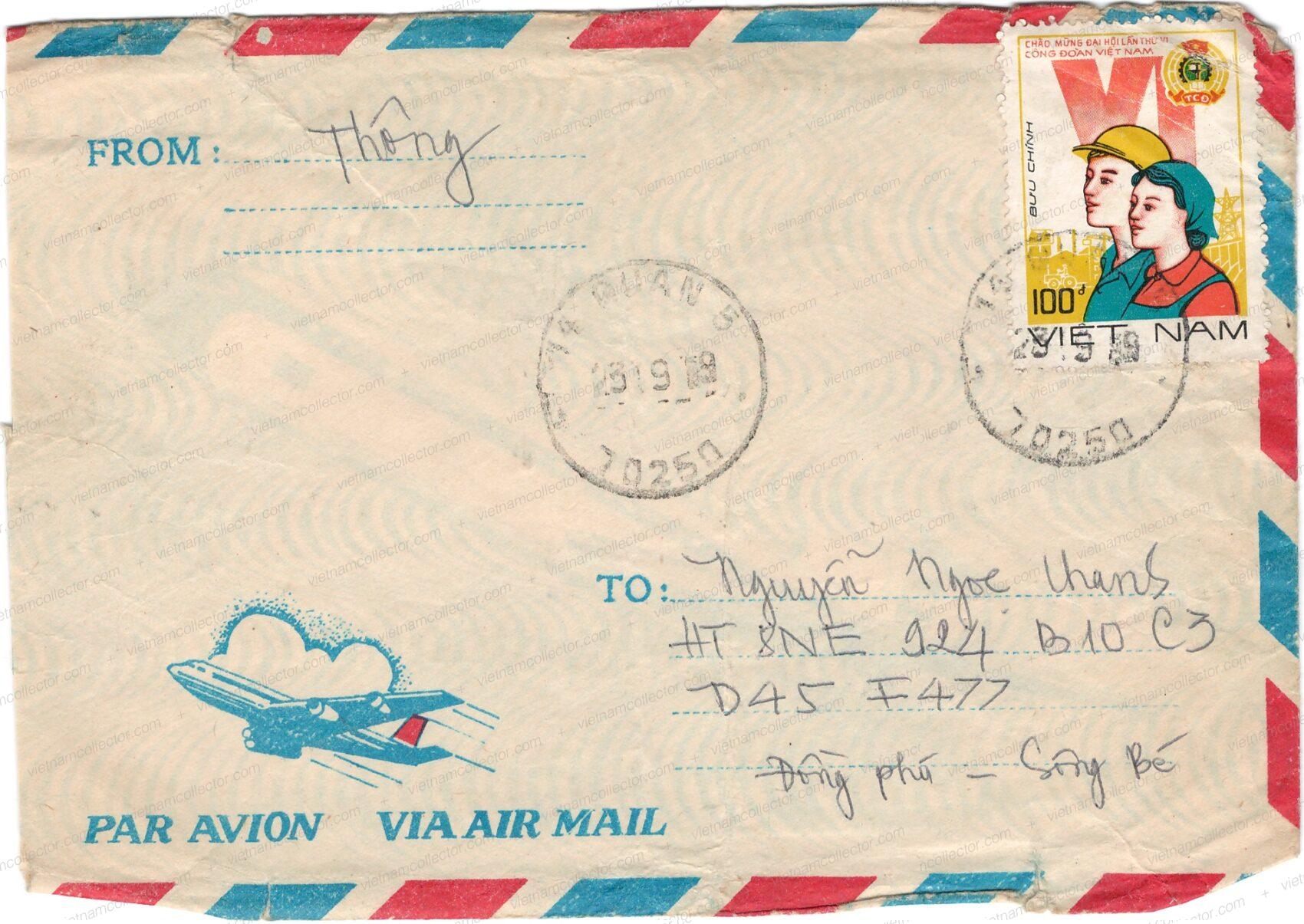
Rare incoming letter sent by a civilian in September of 1989 to an inmate or guard at Camp B10. Franked with a 100D stamp from 1988. The Quan 5 70250 zip code puts the postal processing center into the HCM City region. SICP member Bob Munshower suggested that this camp was located in the Dong Phu area and that it was a brutal camp that tortured inmates and had a high death rate.
Very similar cover from October of 1989 but this time franked with two 100D stamps paying the 200D tariff of the second weight level. The letter was also processed in the HCM City area (zip code 70652). HCM City machine cancel on the reverse.
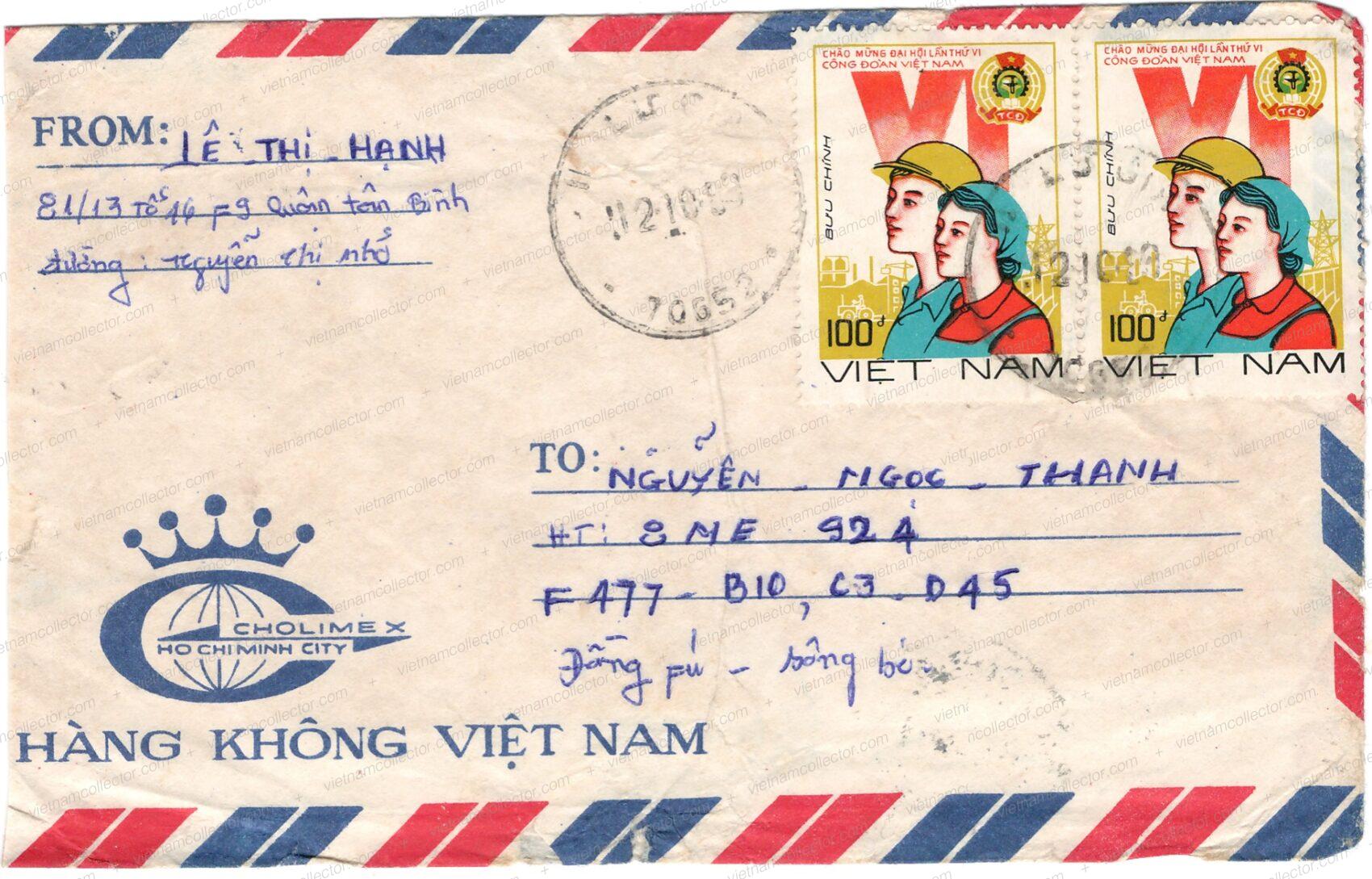
Camp B11
Incoming letter sent by a civilian in HCM City to a guard or inmate in Camp B11. The letter is franked with a 100D stamp from 1988 and cancelled with the circular Quan 5 canceler from the HCM City region . Camp B11 is associated with the Soing Be region and was used to house low level political prisoners.
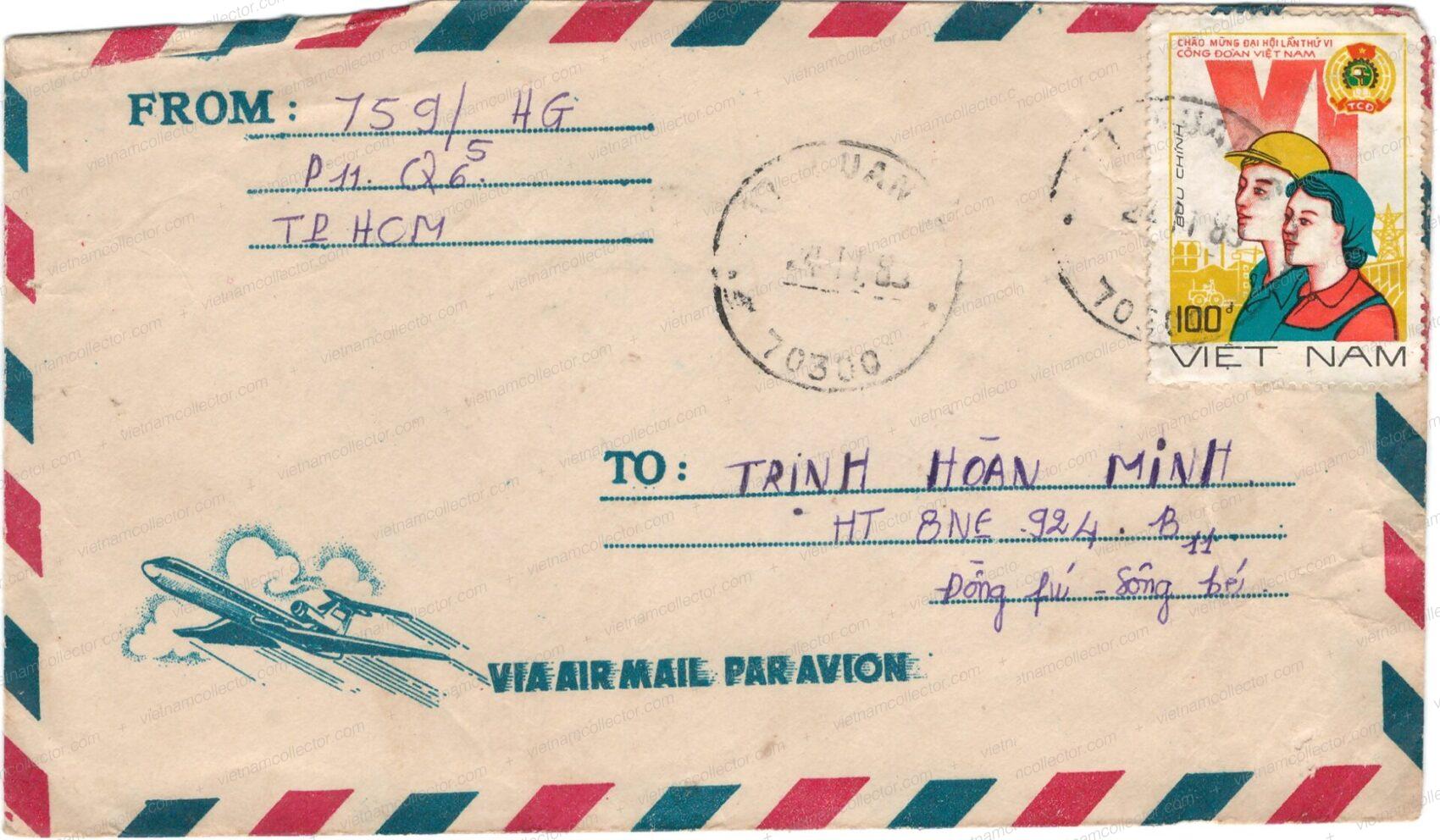
Camp B21
Here is an interesting letter that was apparently sent from one prison guard to the other. It must have been of private nature and hence was franked with civilian postage stamps in the amount of 13xu. This actually represents an obvertpayment of 1xu so the 1 xu stamp was probably just added for patriotic fervor. The letter was sent in August of 1977 from Camp A13 to Camp B 21. Camp 21 is associated with the Song Be region North/East of HCM City.Cancelled with the HCM City cancel. Phuong Long transit cancel on the reverse.
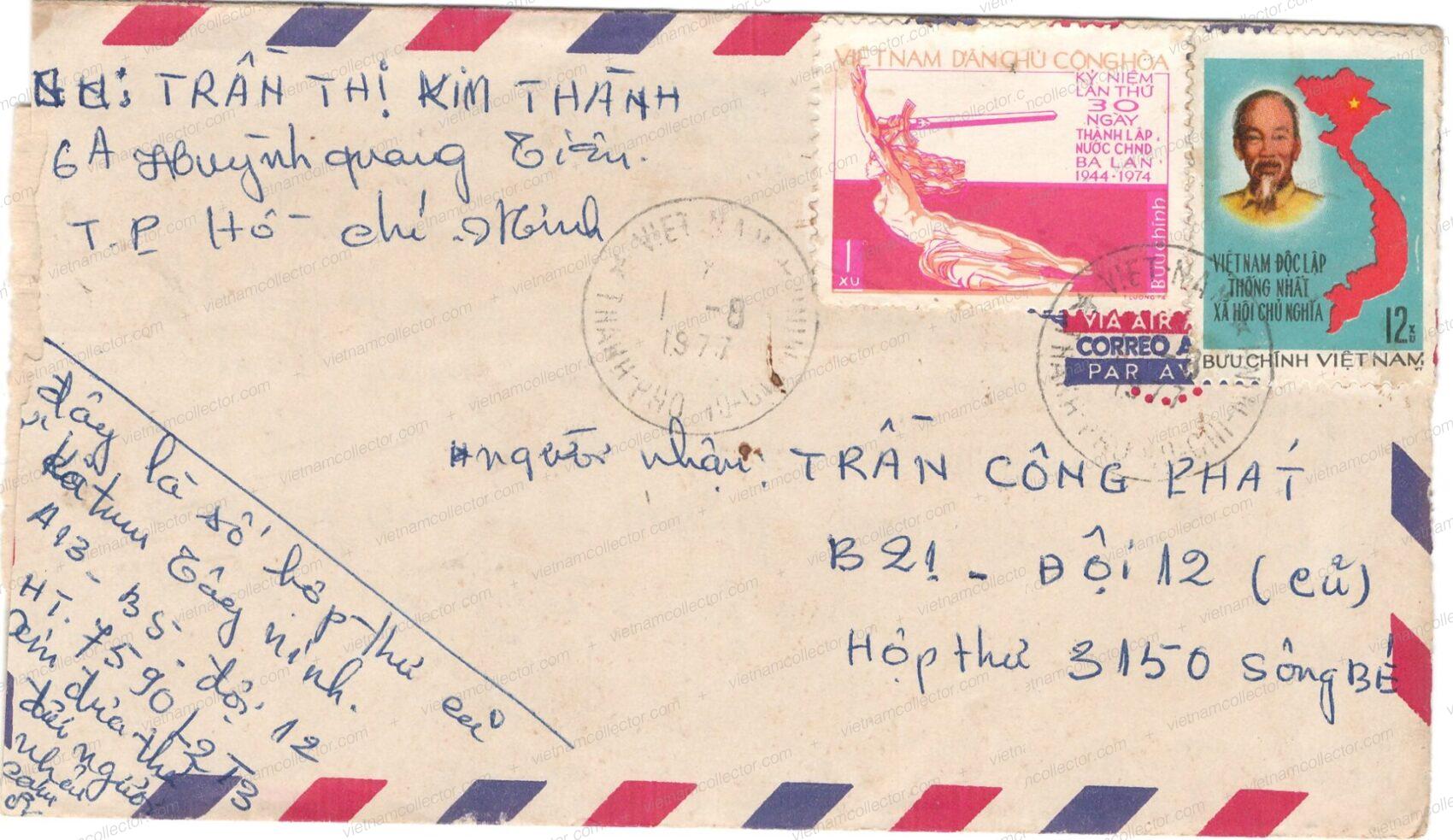
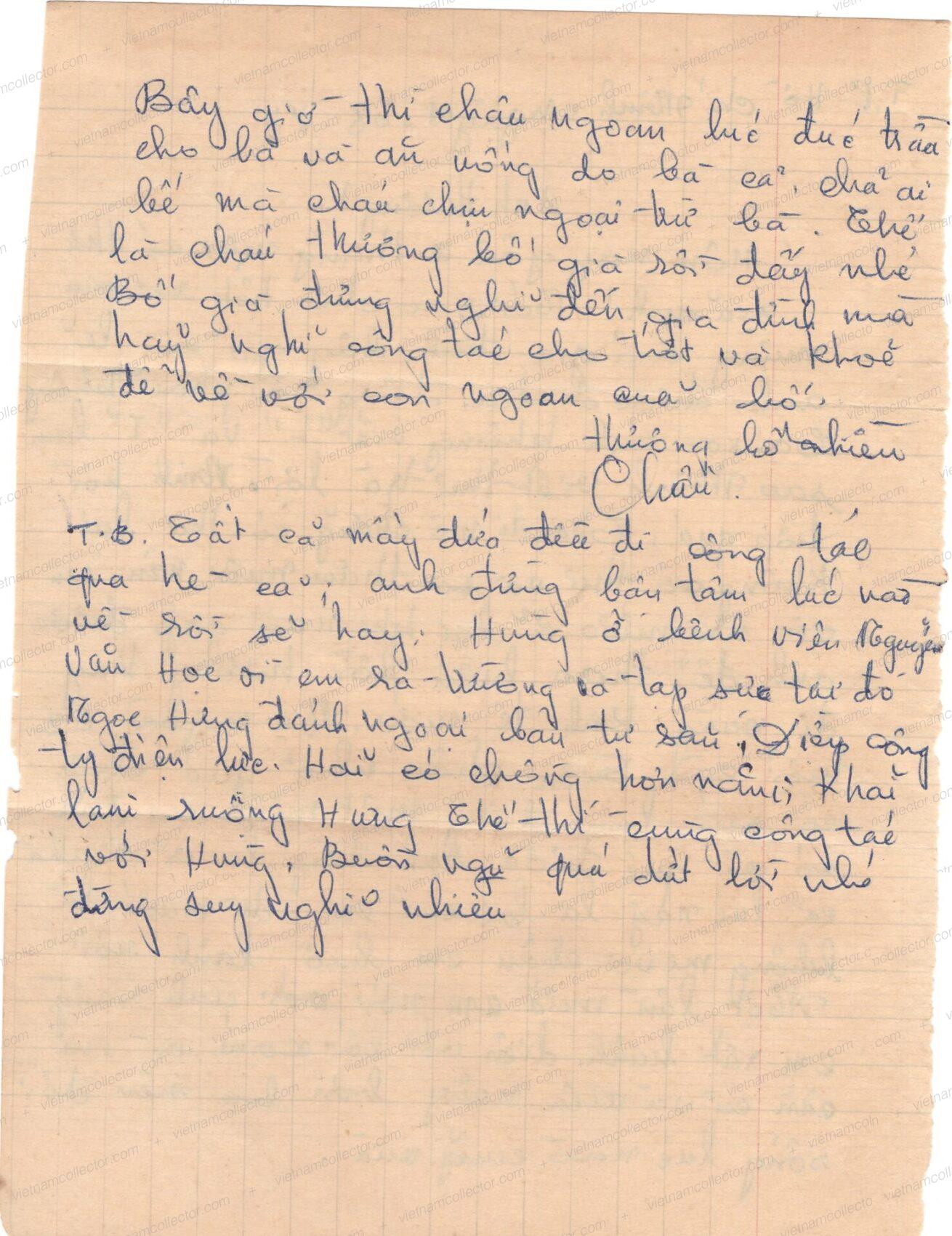
Camp C3
Letter sent by a member of the military guarding Camp C3 top a civilian in Tan Binh. Franked with a civilian 1D stamp from 1986 that was cancelled with a cancel from Binh Phuoc (zip code 71301). Various transit and arrival cancels on the reverse.
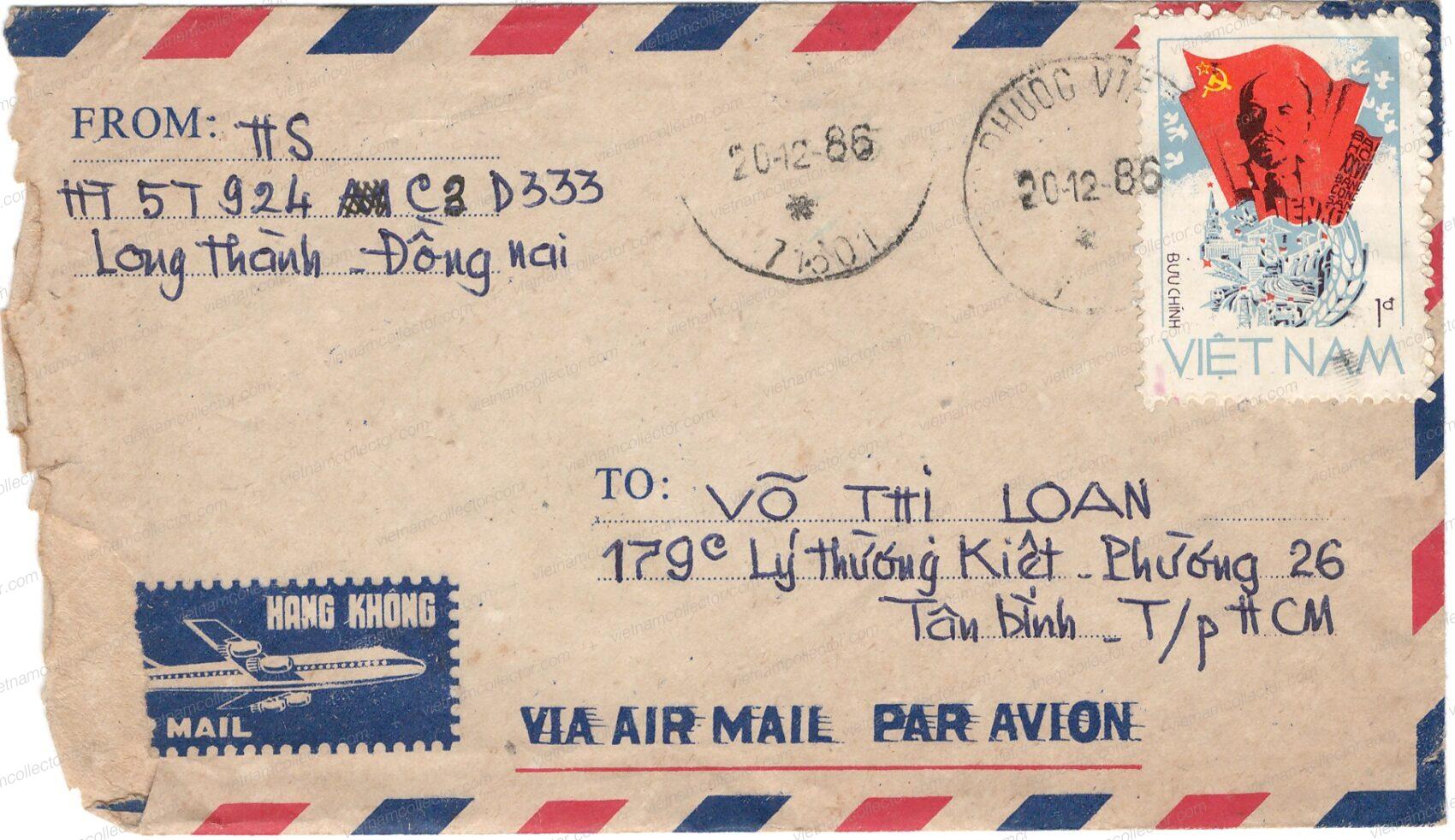
Camp D9
Letter sent from the main prison in Long Than sent to a civilian in Quan 1. Franked with a 12xu HCM stamp from 1976. Canceled with the circular Long Than cancel in March of 1978. HCM City machine cancel on the reverse. Cam D9 was known as a general mid-level camp.
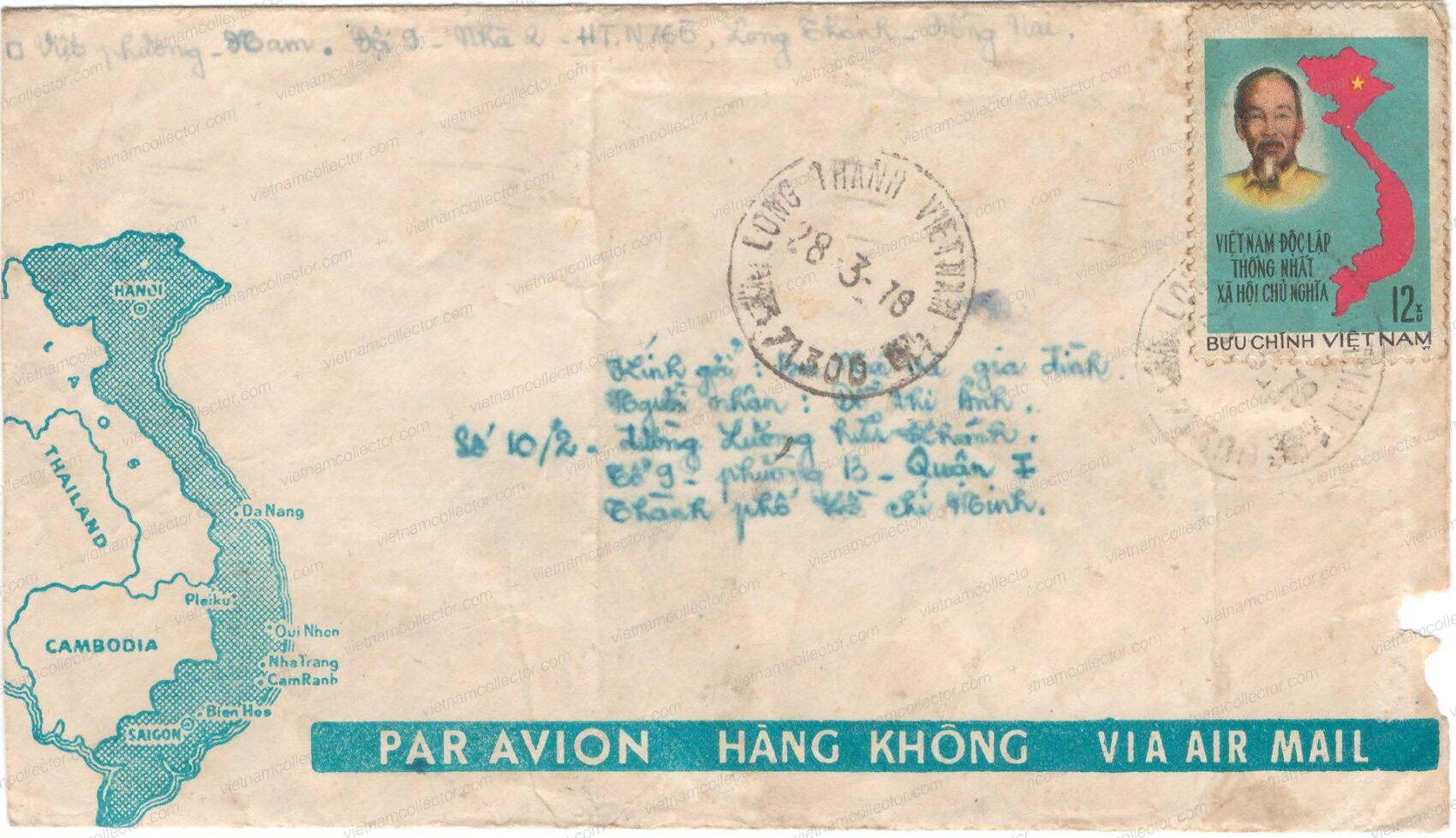
Camp E8
Letter sent in May of 1977 by a guard of Camp E8 to a civilian in Mytho. Camp E8 is associated with Phuoc Long. The letter is franked with the military free frank from 1975 and was apparently transported by military pouch to Mytho were the letter was canceled with the machine canceler of that city.
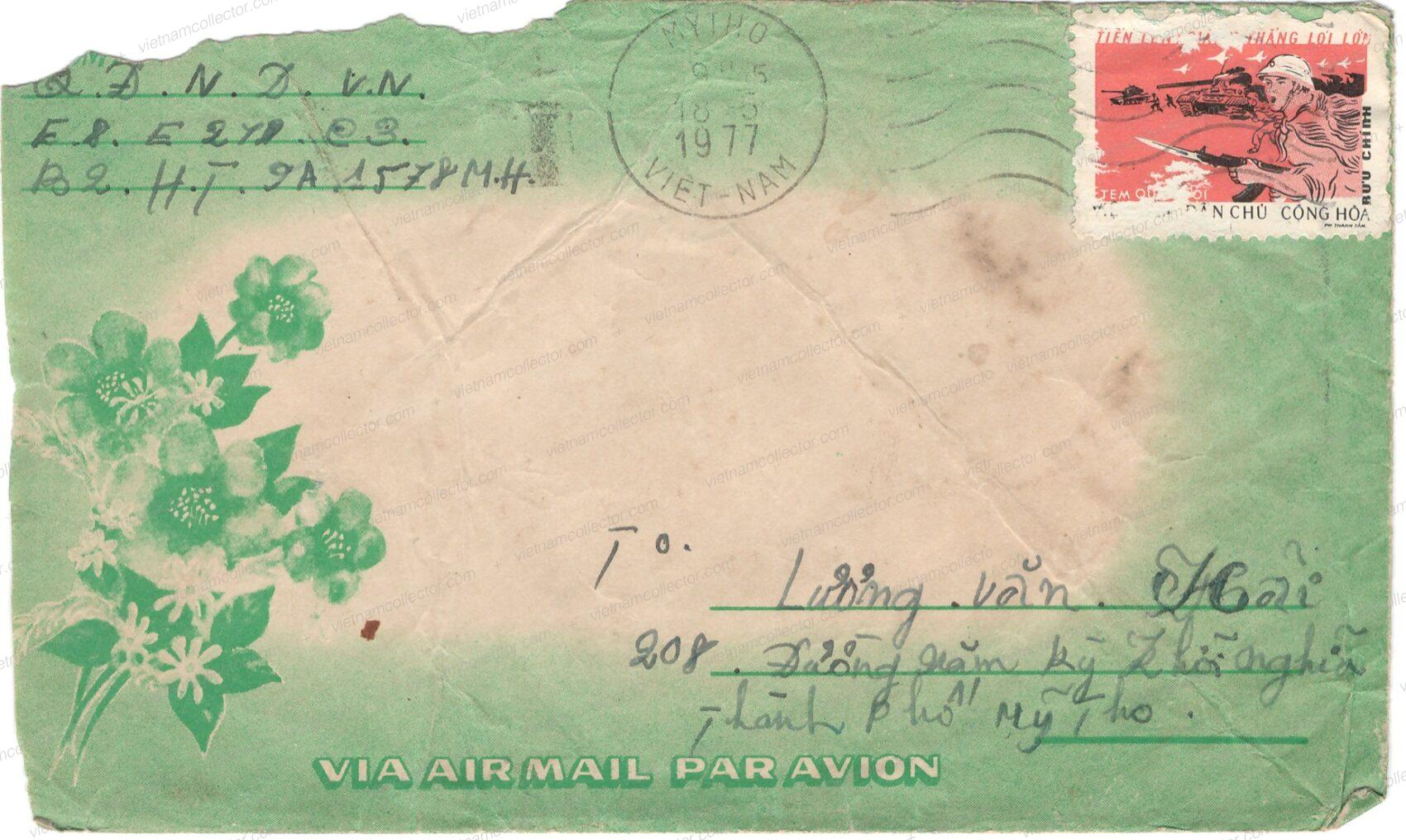
Camp K1
Letter sent by an inmate of Camp K1 to a civilian in HCM City in November of 1981. The camp is associated with Gia Lai Province and Kon Tum. Franked with a 20xu October Revolution and 10xu Sunflower stamp paying an overall tariff of 30xu. Cancelled with a 54353 cancel outside of Pleiku. Binh Thanh transit cancel on the reverse.
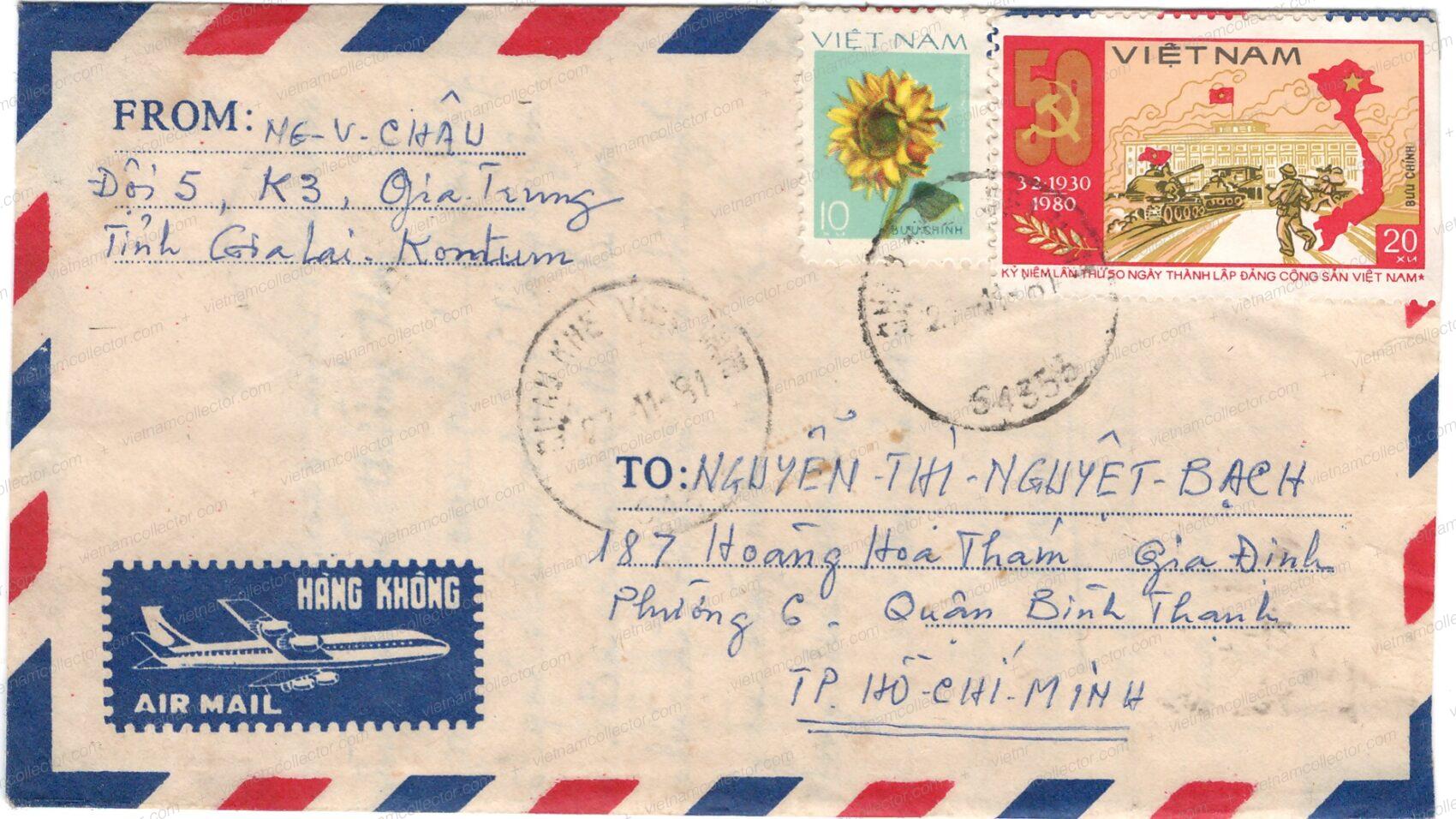
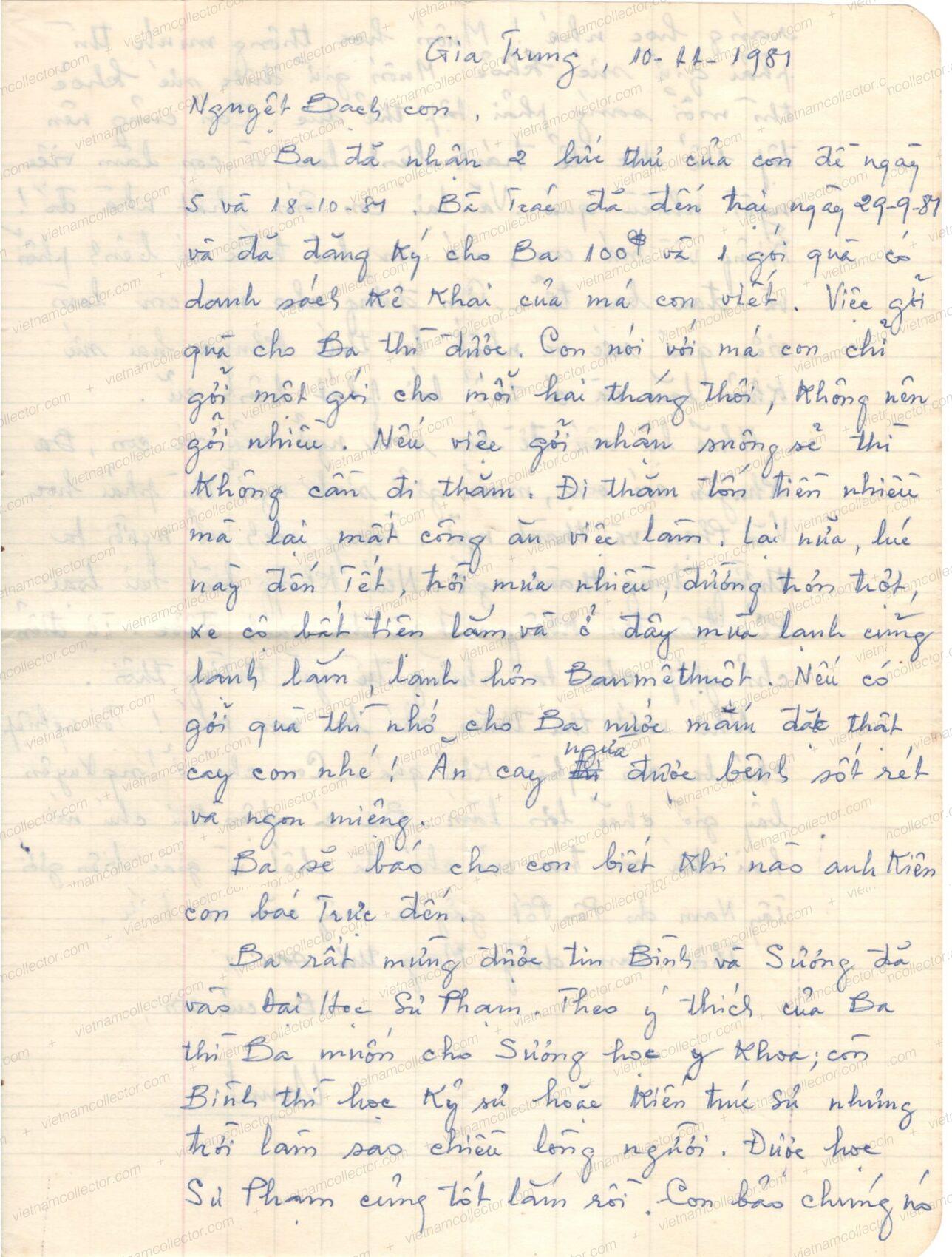
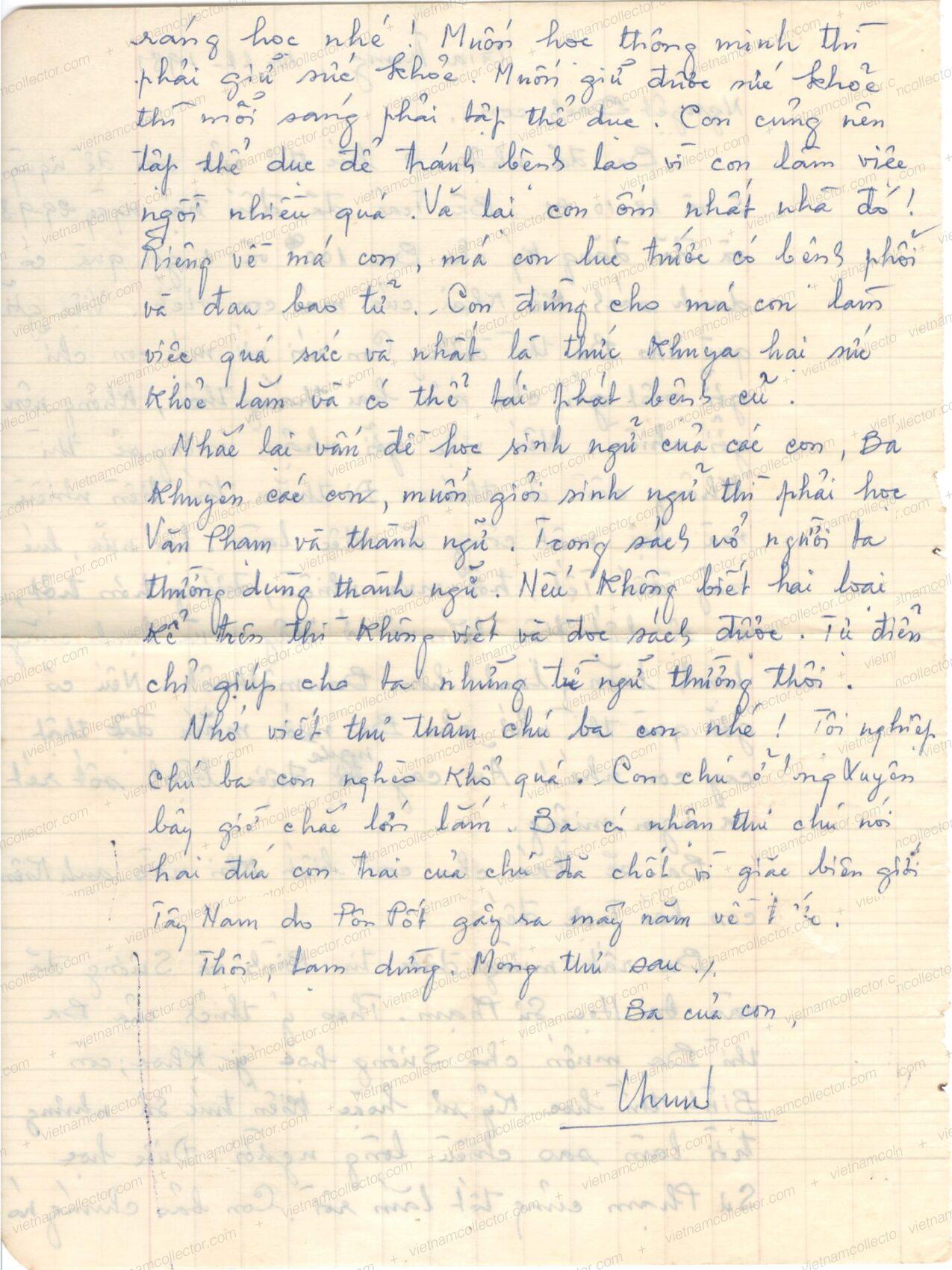
Letter sent by an inmate of Camp K1 to a civilian in HCM City in April of 1983. The camp is associated with Gia Lai Province and Kon Tum. Franked with a 30xu HCM stamp. Cancelled with a 54353 cancel outside of Pleiku. Binh Thanh transit cancel on the reverse. Illegible cancels on front and back
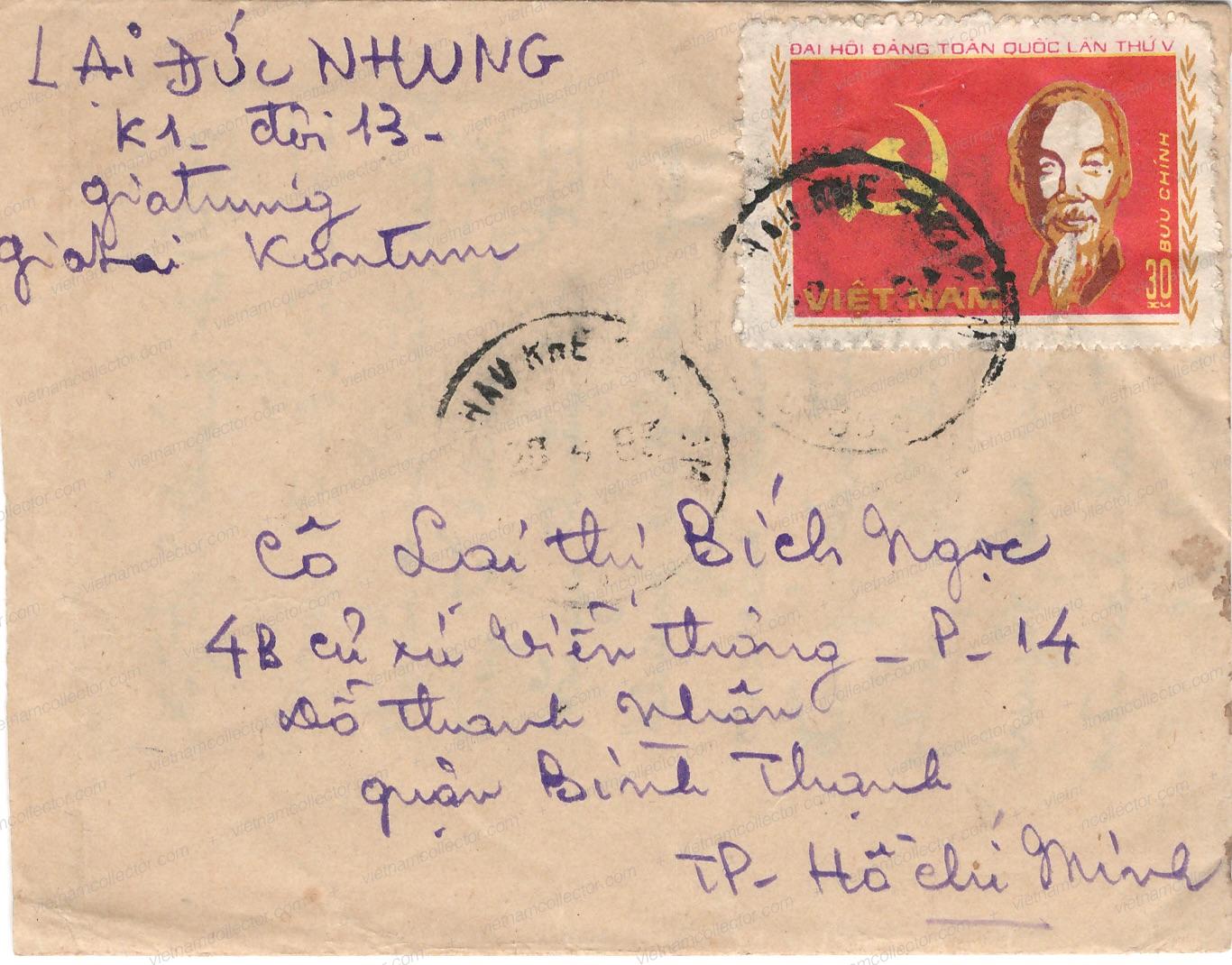
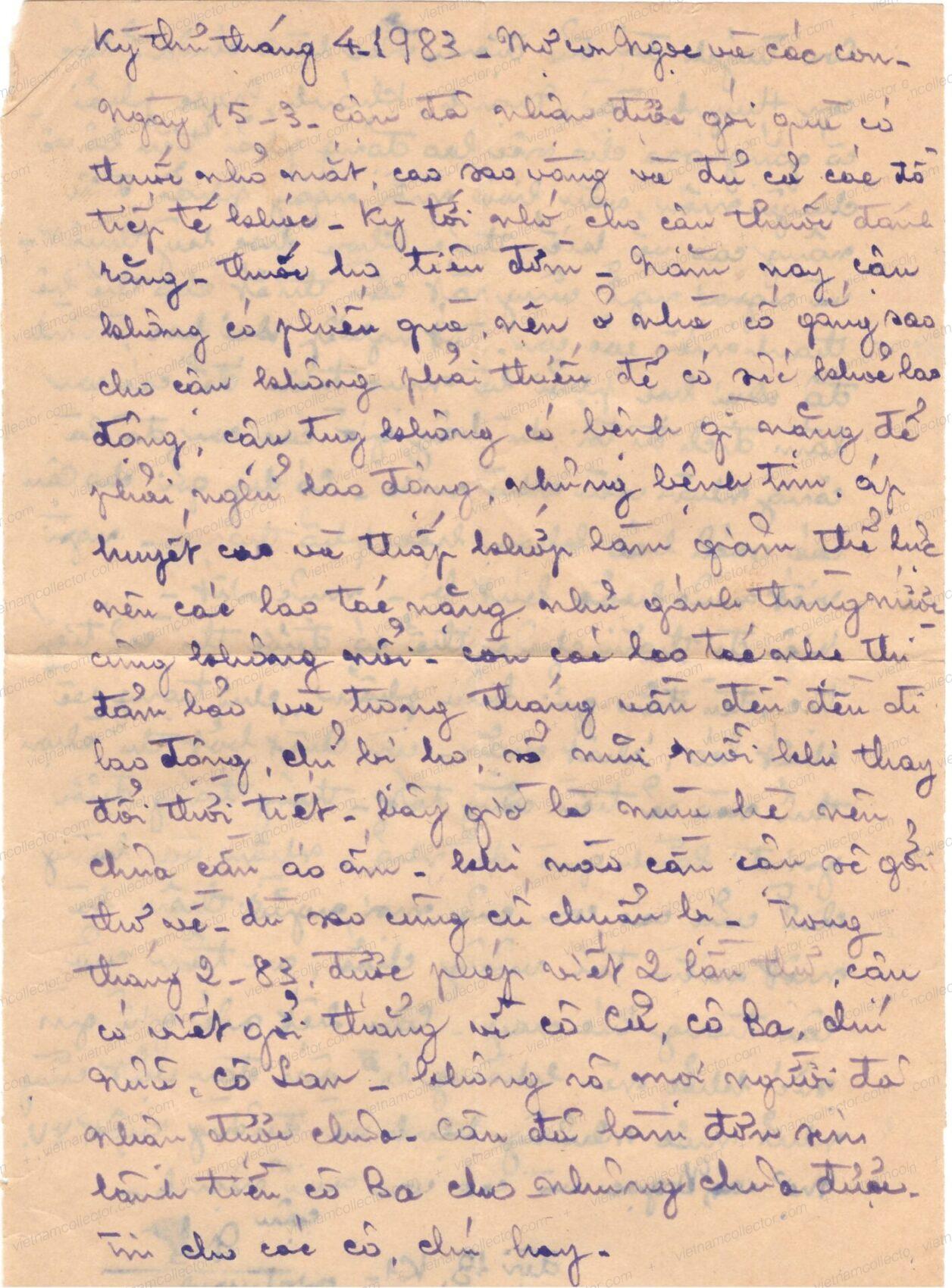
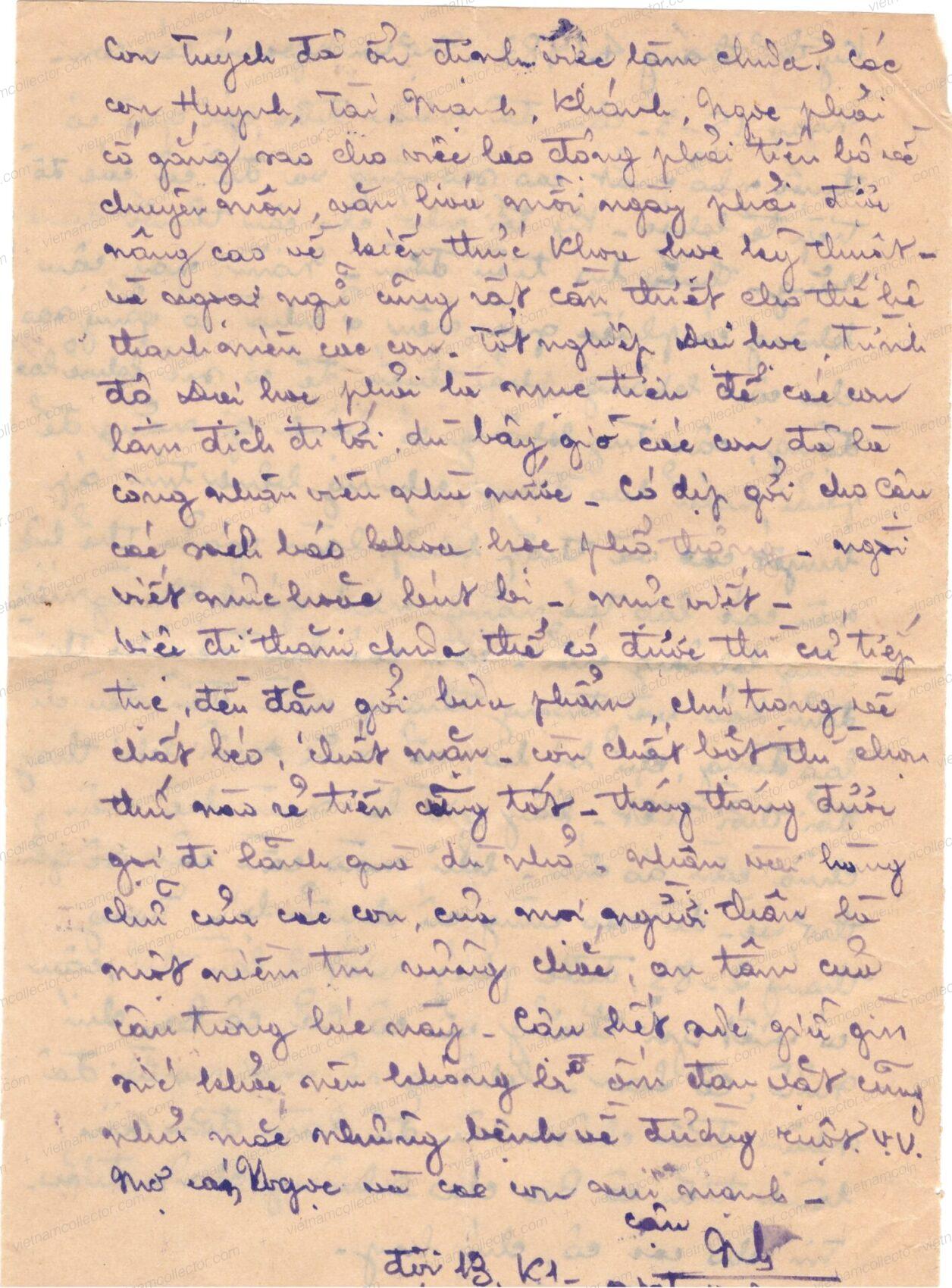
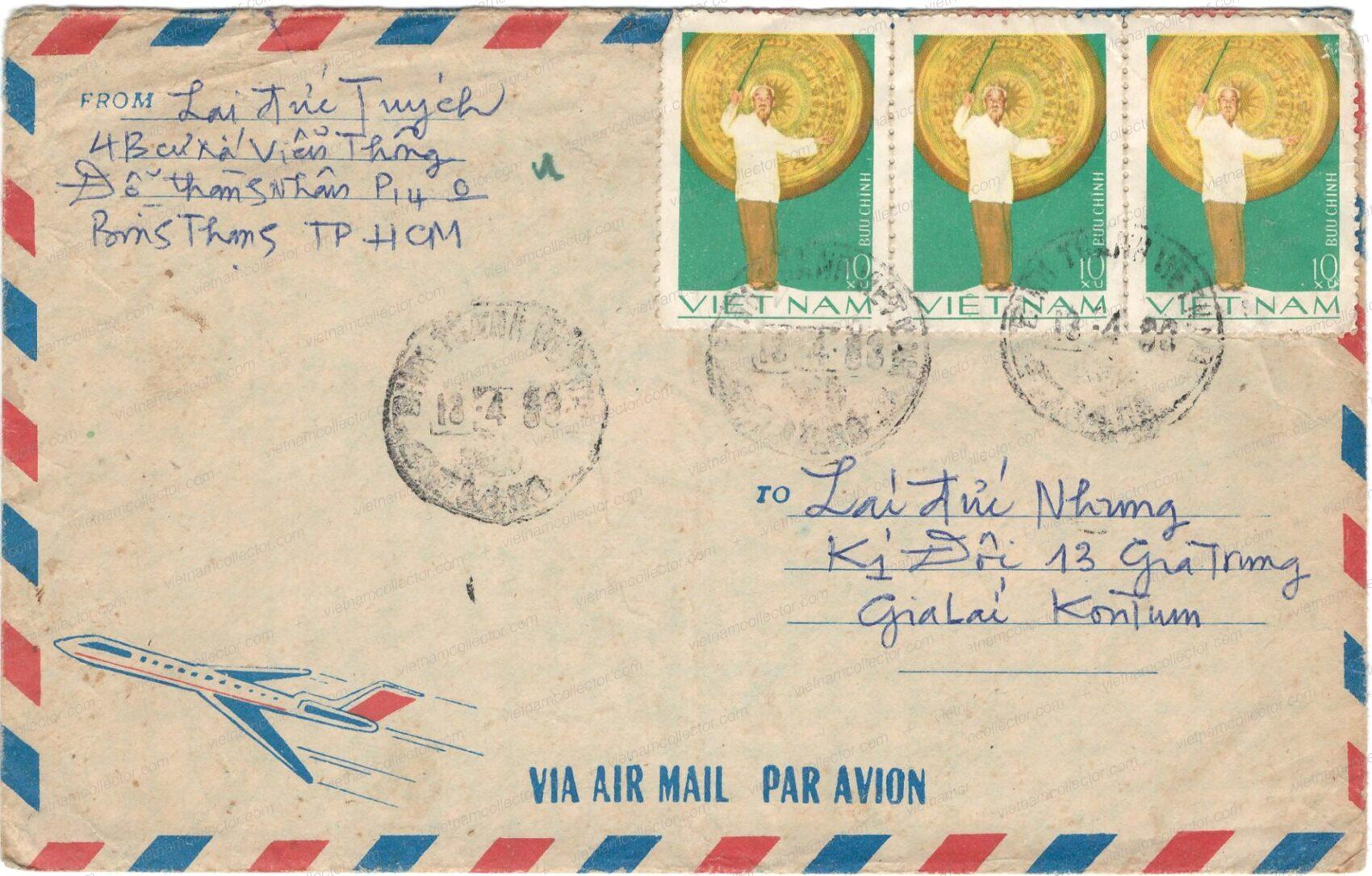
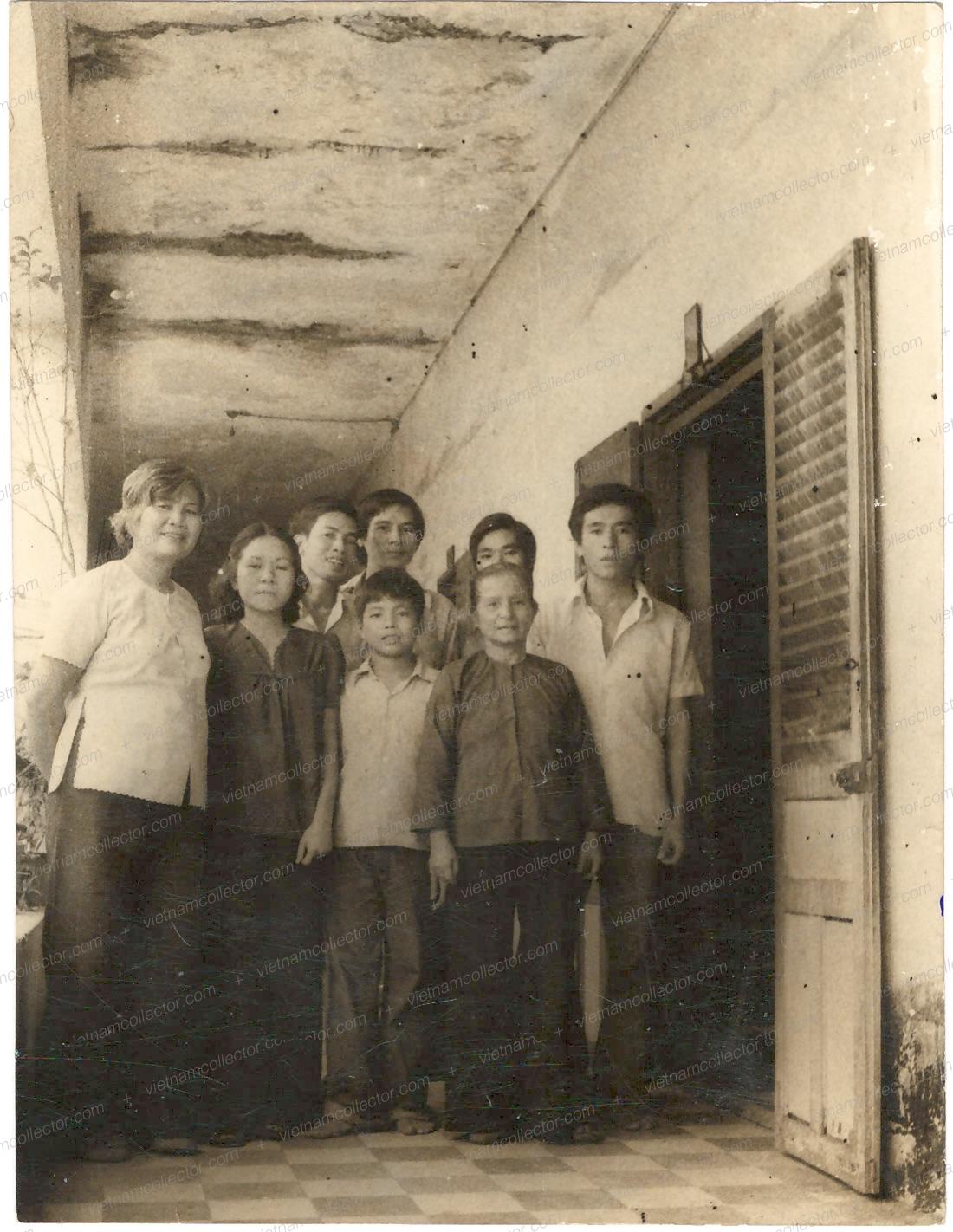
Very rare incoming letter sent by a civilian in HCM City to an inmate of the K1 Camp in April of 1983 . Not many incoming letters have survived due to the harsh conditions in the camps. This envelope only contained an empty page and a family photograph. It was franked with three civilian stamps of 10xu each paying an overall postage of 30xu. Since the address, unusually, contains the location (Gia Lai/Kon Tum) the camp must have been located close by.
Camp K2
This letter was initially sent by a civilian located in Bien Hoa and using a military free frank from 1975 to another civilian in Saigon (HCM City). The letter was initially processed in Tu Doc a Saigon suburb. However upon arrival it was determined that the intended recipient was now located in Cam K2 and the letter was forwarded to there. HCM City machine arrival cancels on the reverse.
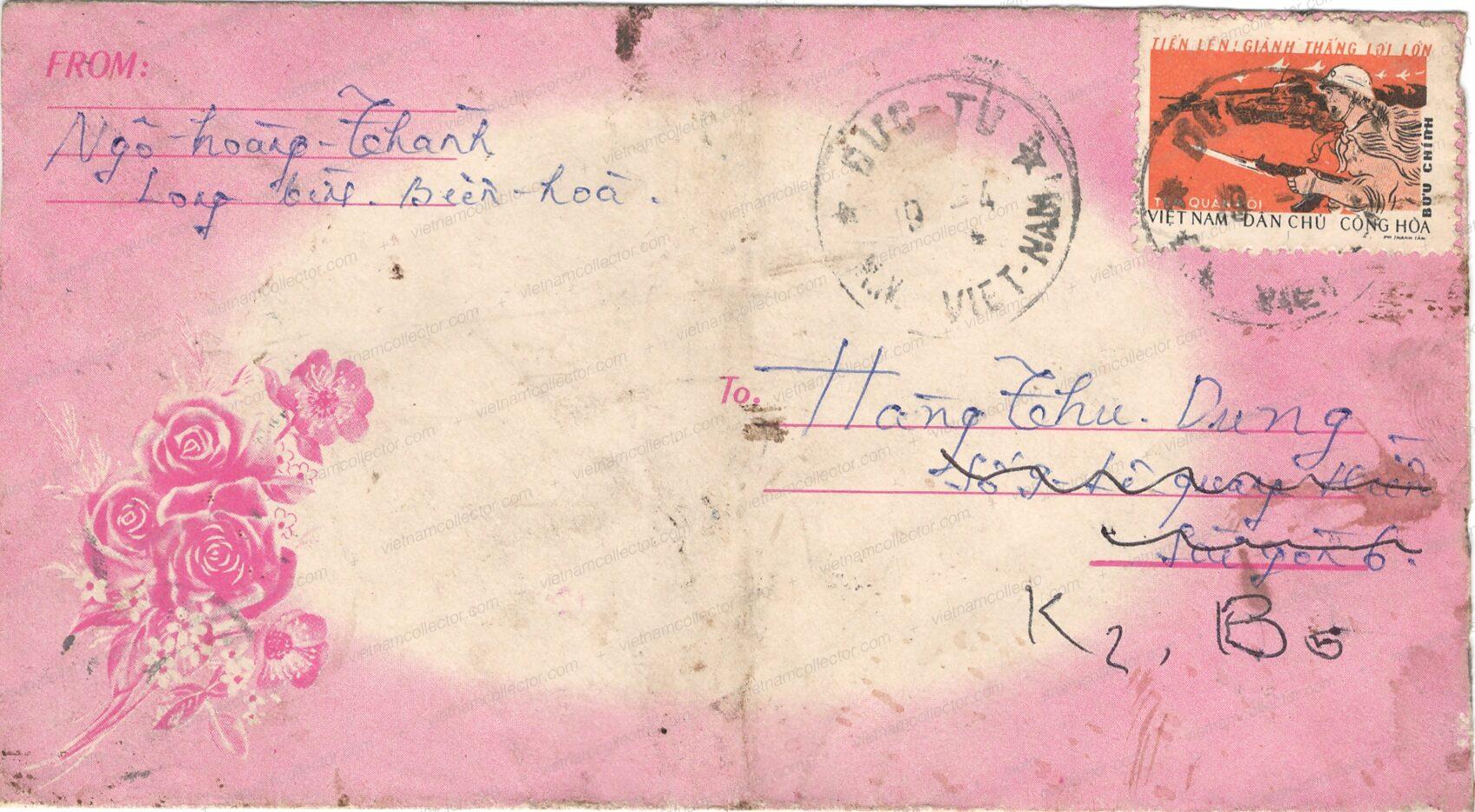
Letter sent in January of 1978 by an inmate of Camp K2 to a civilian in Gia Dinh district. Camp K2 was located in this district and hence the letter only had to be franked with 10xu which represented the intra-city letter rate at the time. Cancelled with the machine HCM City cancel. HCM arrival cancel on the reverse.
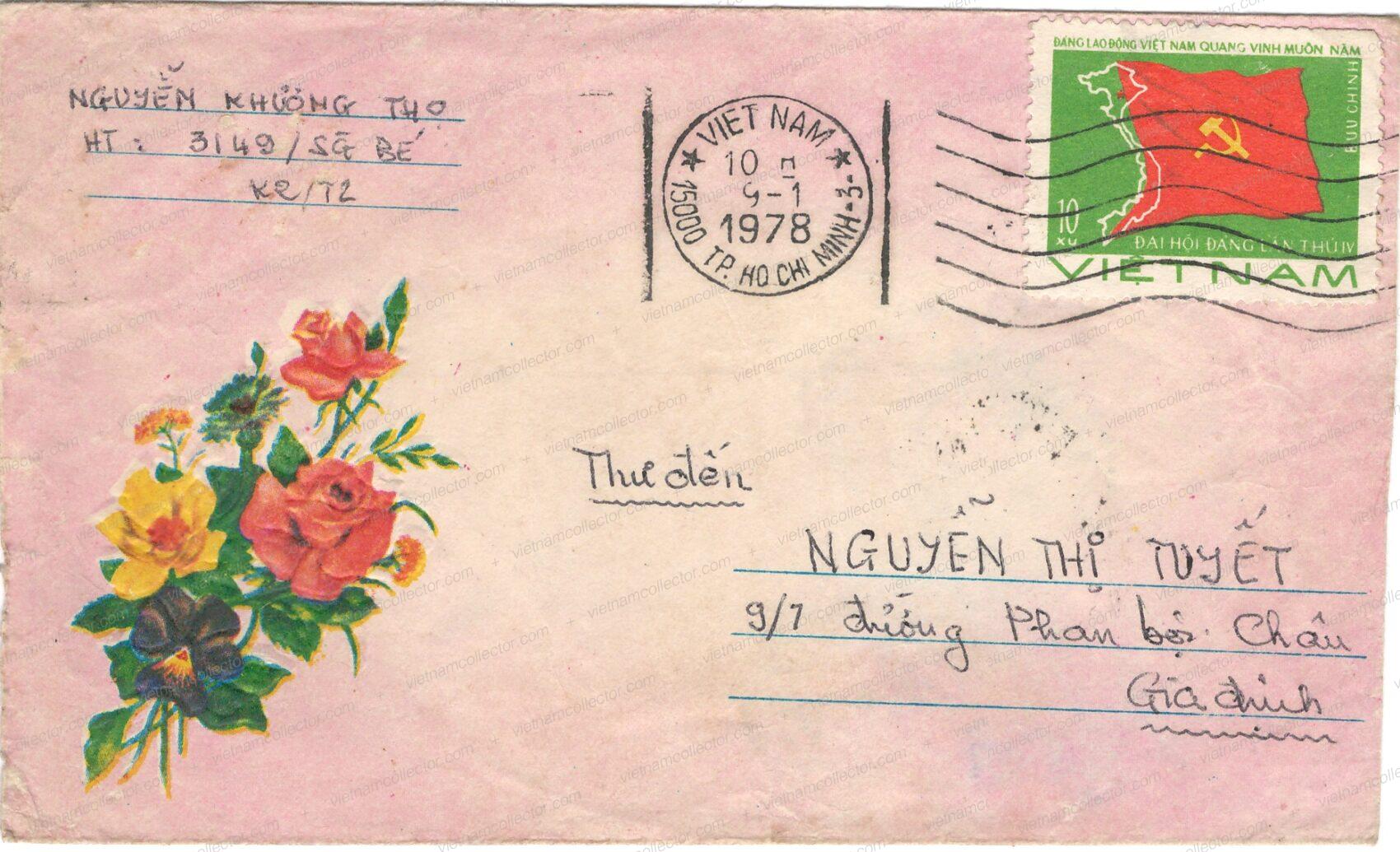
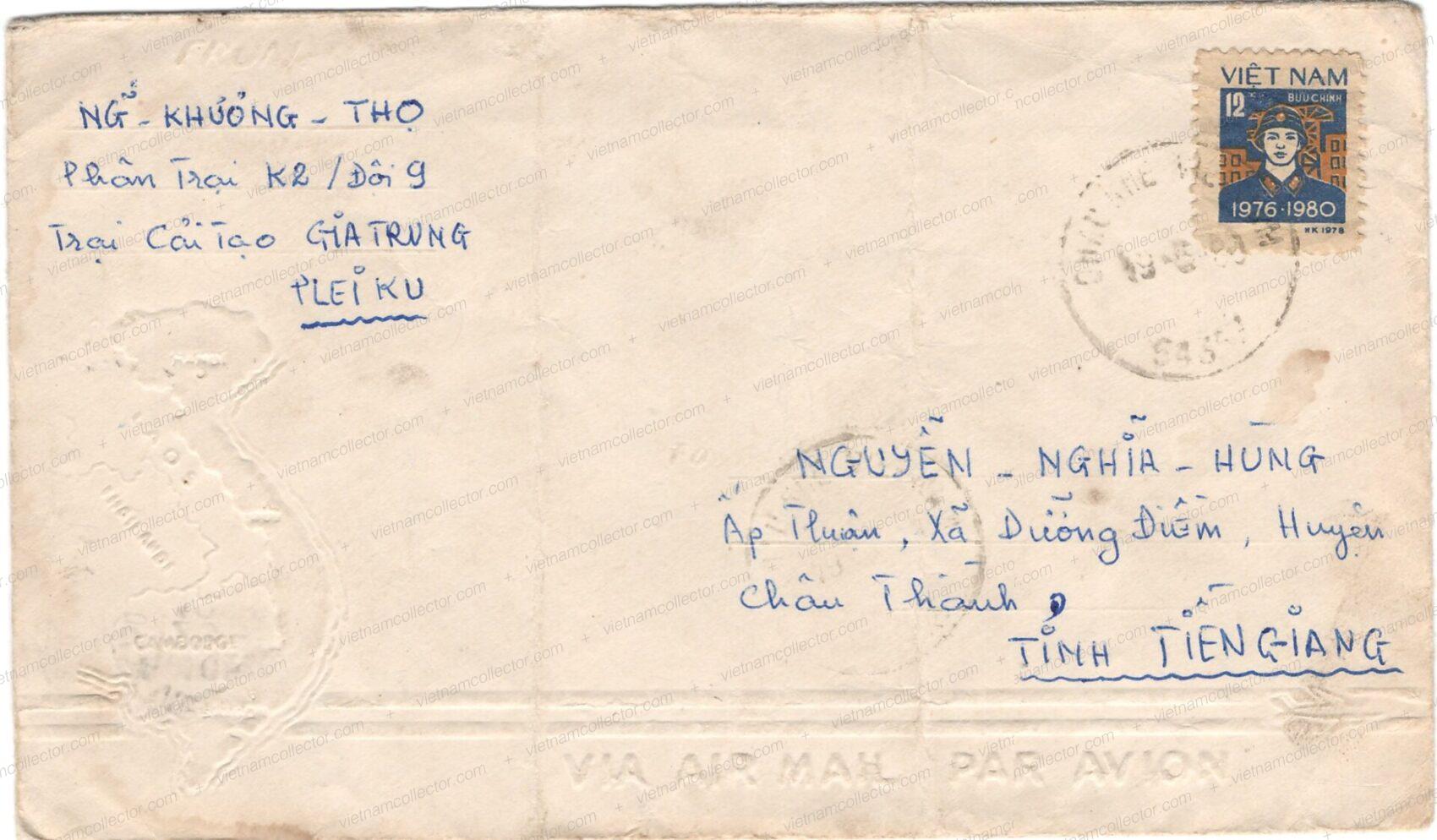
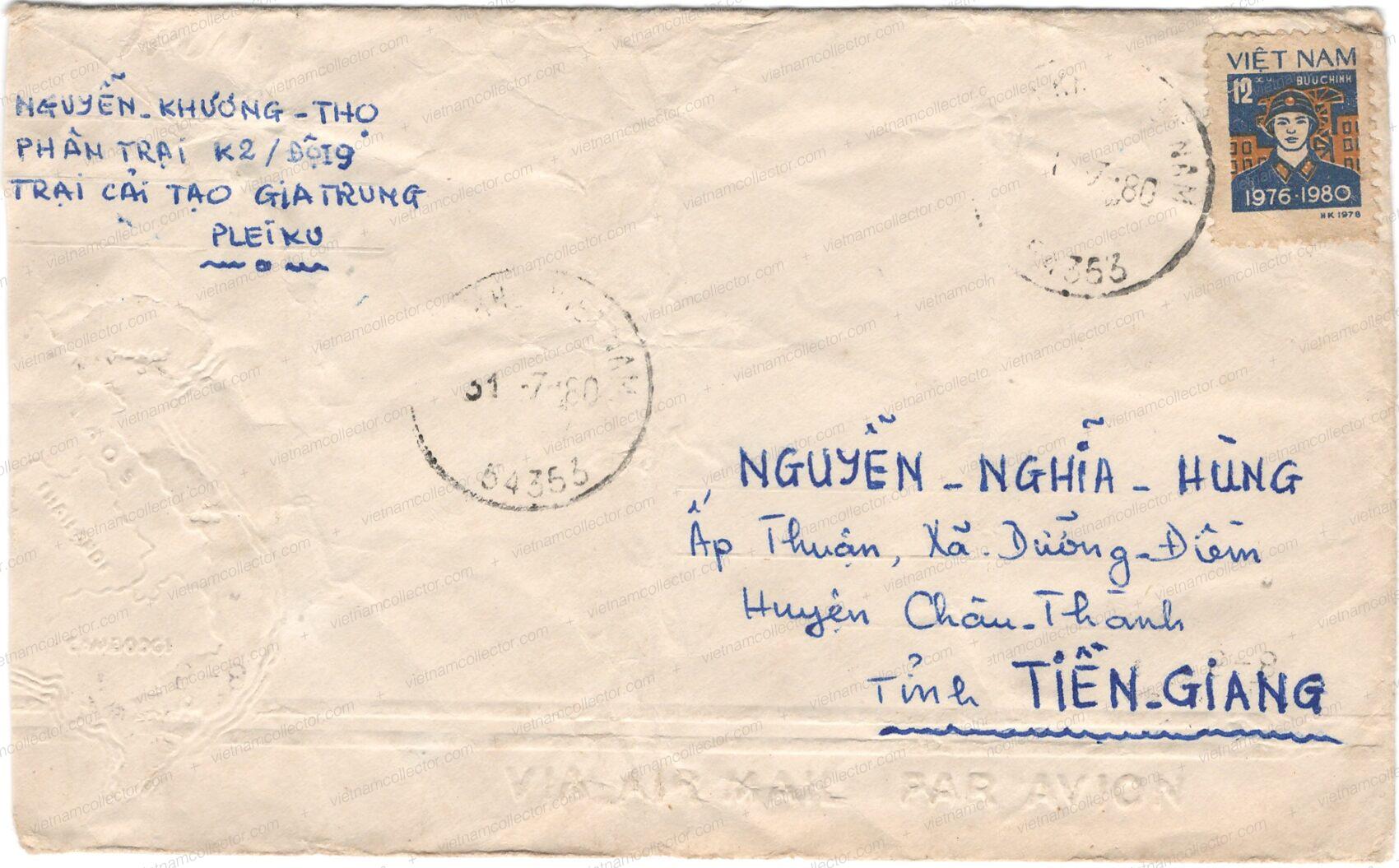
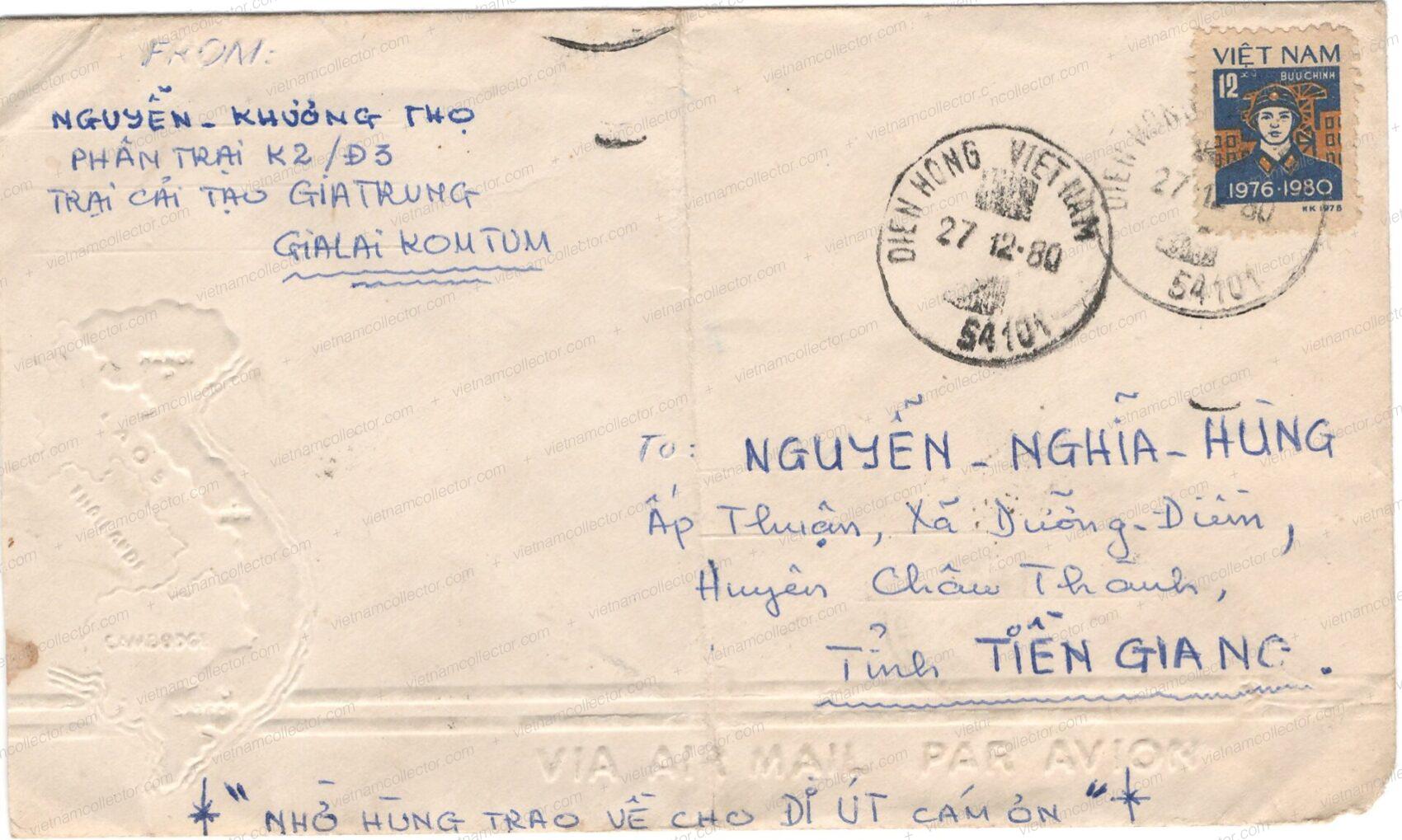
Series of three letters sent by the same inmate of Camp K2 in May, July and December of 1980 to a civilian in Tien Giang. The camp is associated with Trai Cai, Gia Trung and Gia Lai . The letters are franked with a single civilian 12 xu stamp from the 5 Year Plan series of 1979 that were canceled with a cancelers from Dien Hong which is a suburb of Pleiku and other cancelers from Quin Nhon province. This shows that the letter processing center used for a certain camp were not always the same. Various transit/arrival cancels on the reverse.
Camp K3
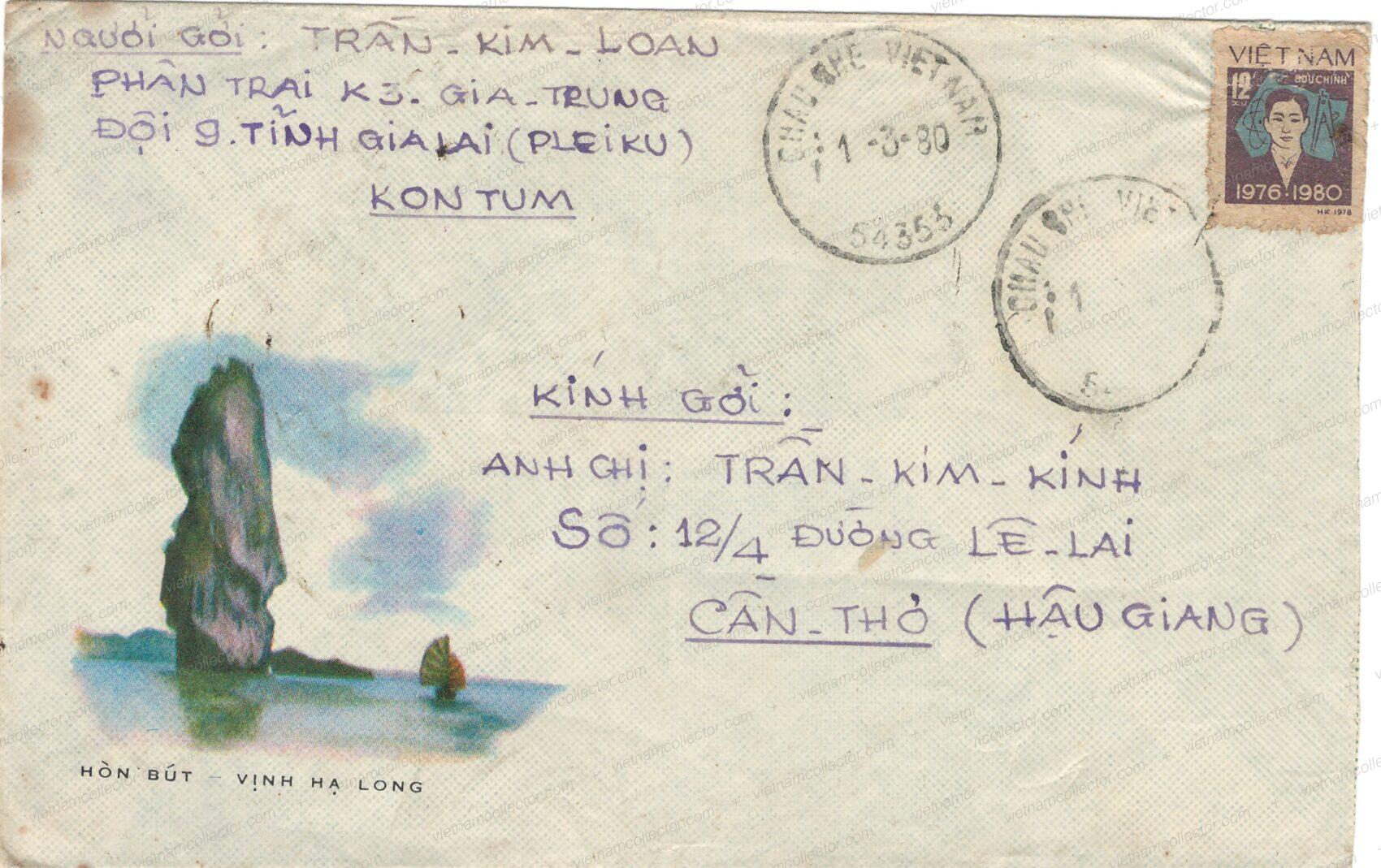
Lettre sent by an inmate of Camp K3 in March of 1980 to a civilian in Canto. K3 is associated with Gia Lai and Kon Tum. The letter was franked correctly with one 12 xu 5 Year Plan and was cancelled with a cancel from the Pleiku district. Illegible transit cancel on the reverse.
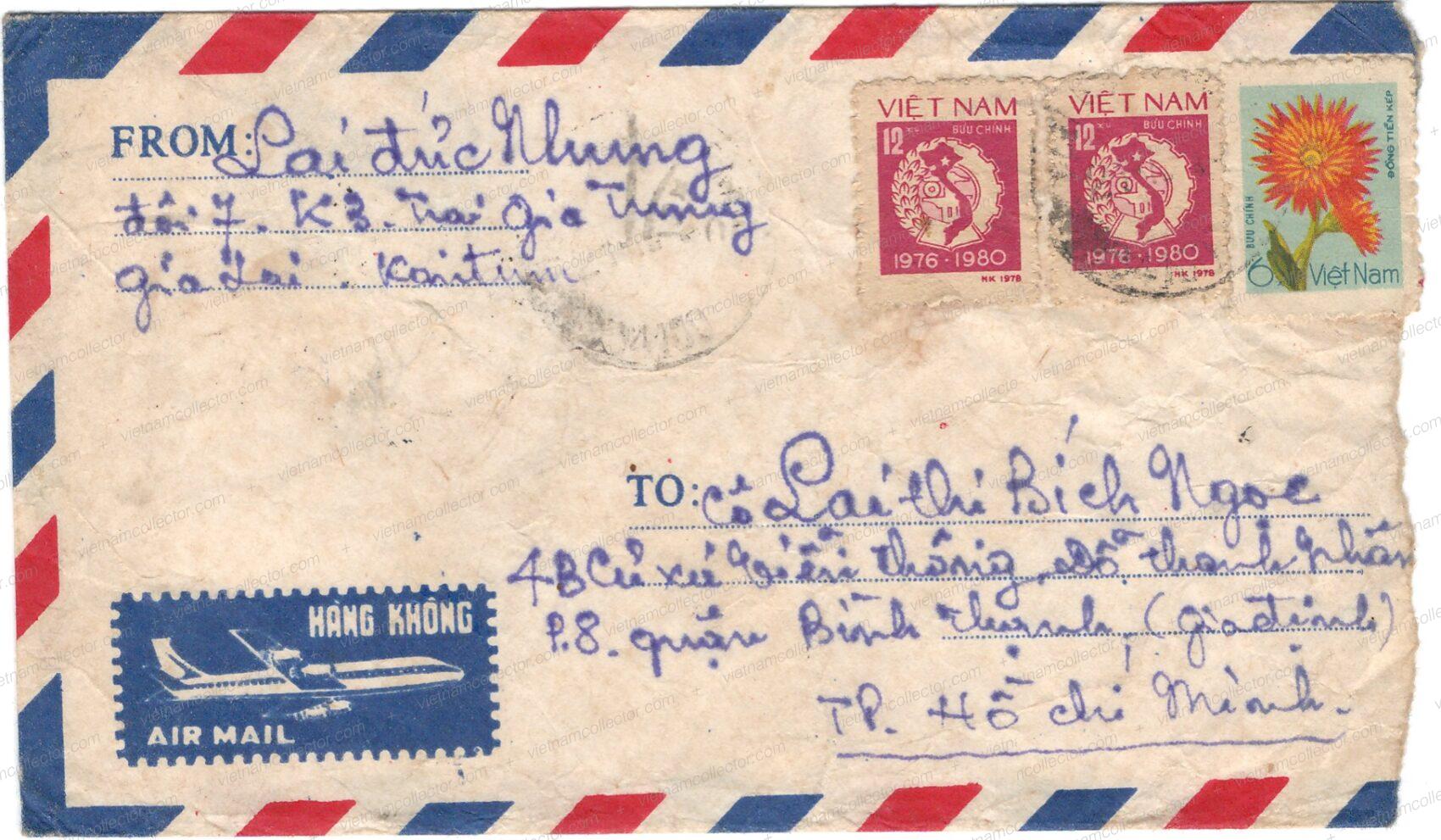
Letter sent by an inmate of Camp K3 in October of 1982 to a civilian in HCM City. K3 is associated with Gia Lai and Kon Tum. The letter was franked with two 12 xu 5 Year Plan and a 6xu Flower stamp paying an overall postage of 30xu. Binh Thanh transit cancel.
Camp K4
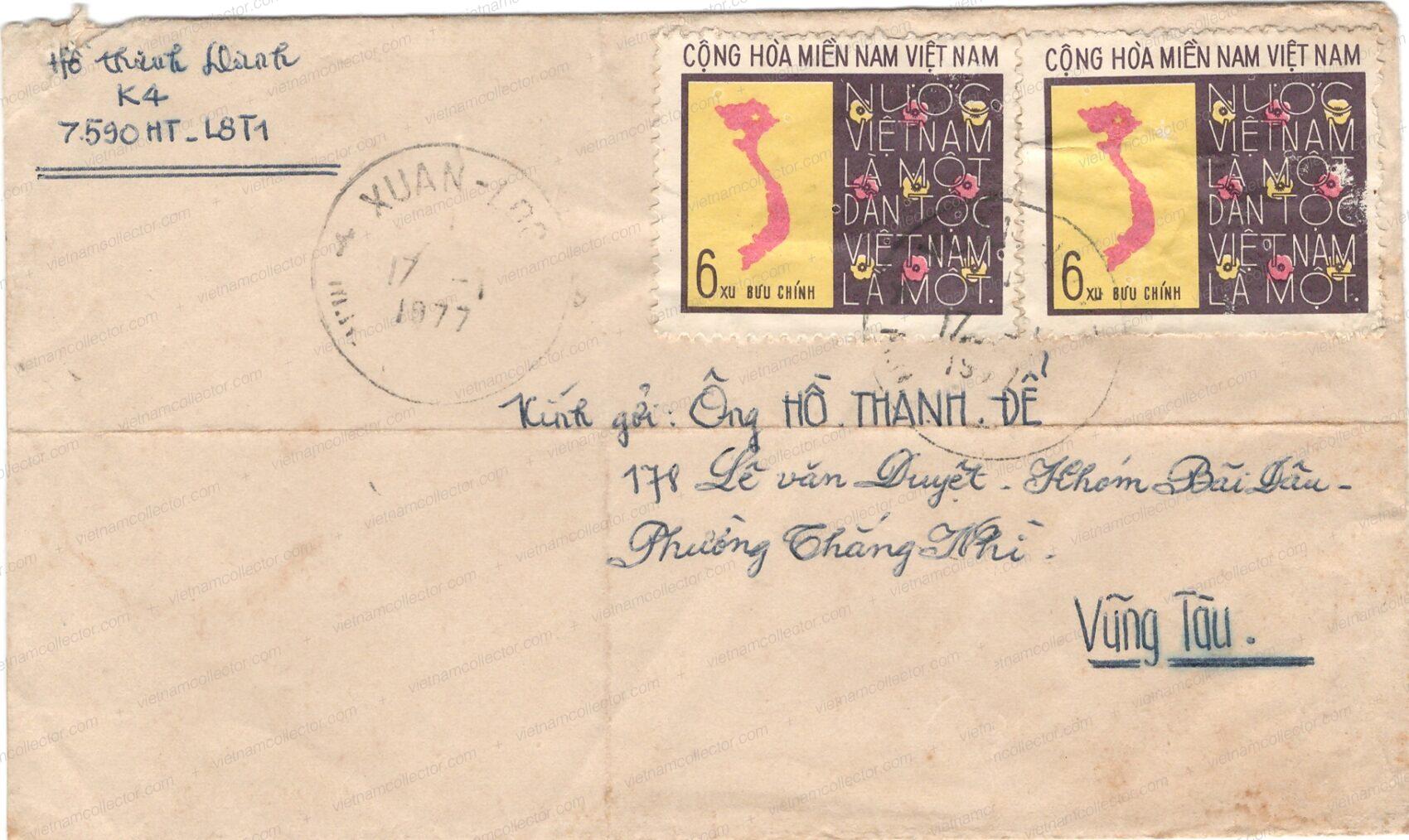
Letter sent by an inmate of Camp K4 to a civilian in Vung Tau. The letter is franked with two 6xu National Liberation stamps paying the correct letter rate of 12xu in January of 1977. The letter was processed in Xuan Loc which may be indication of the camp’s location.
Letter sent by an inmate of Camp K4 postage free in October of 1977 to a civilian in HCM City. This is the latest date of a postage free letter the editor has. Two different HCM City arrival cancels on the reverse.
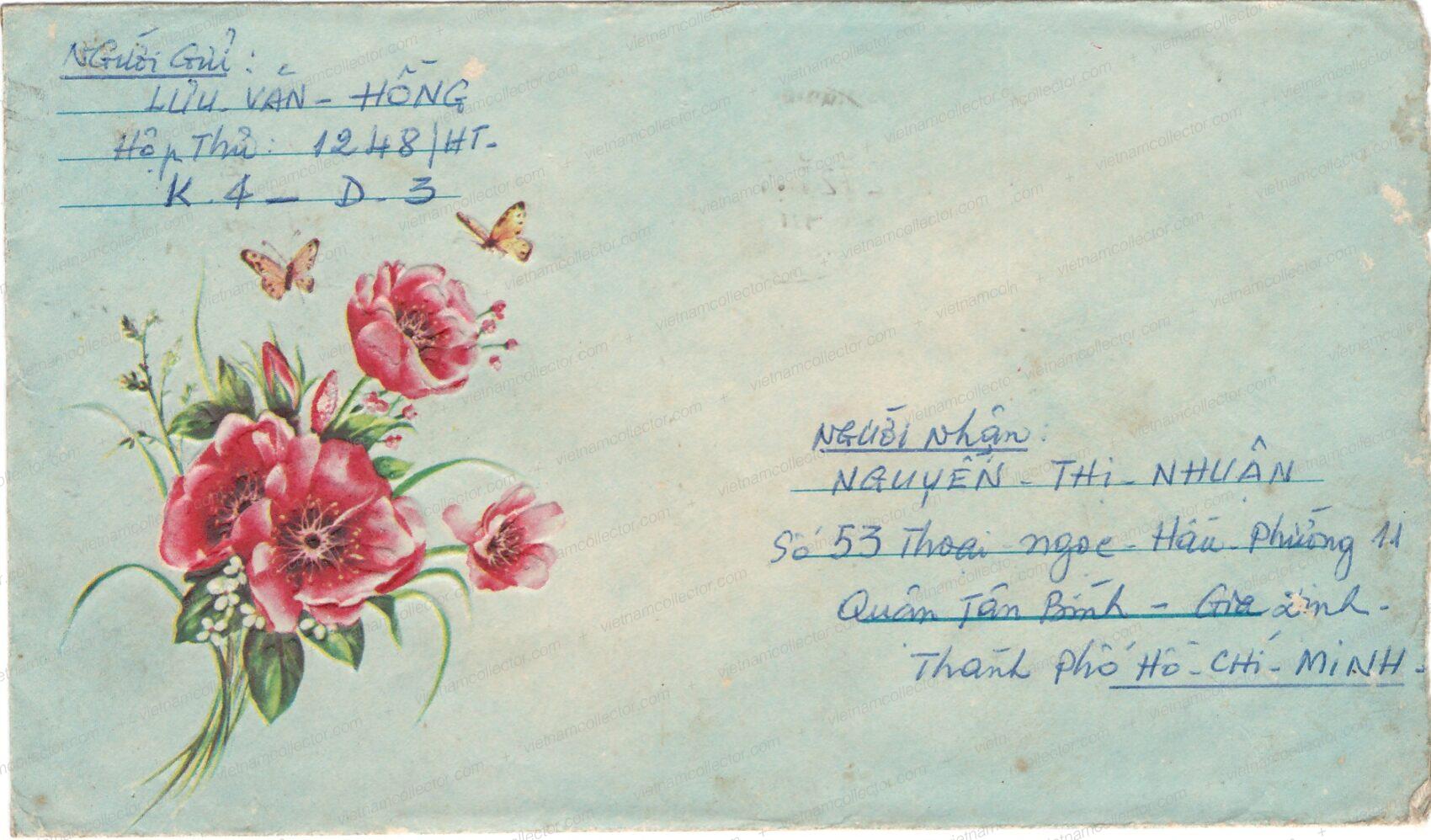
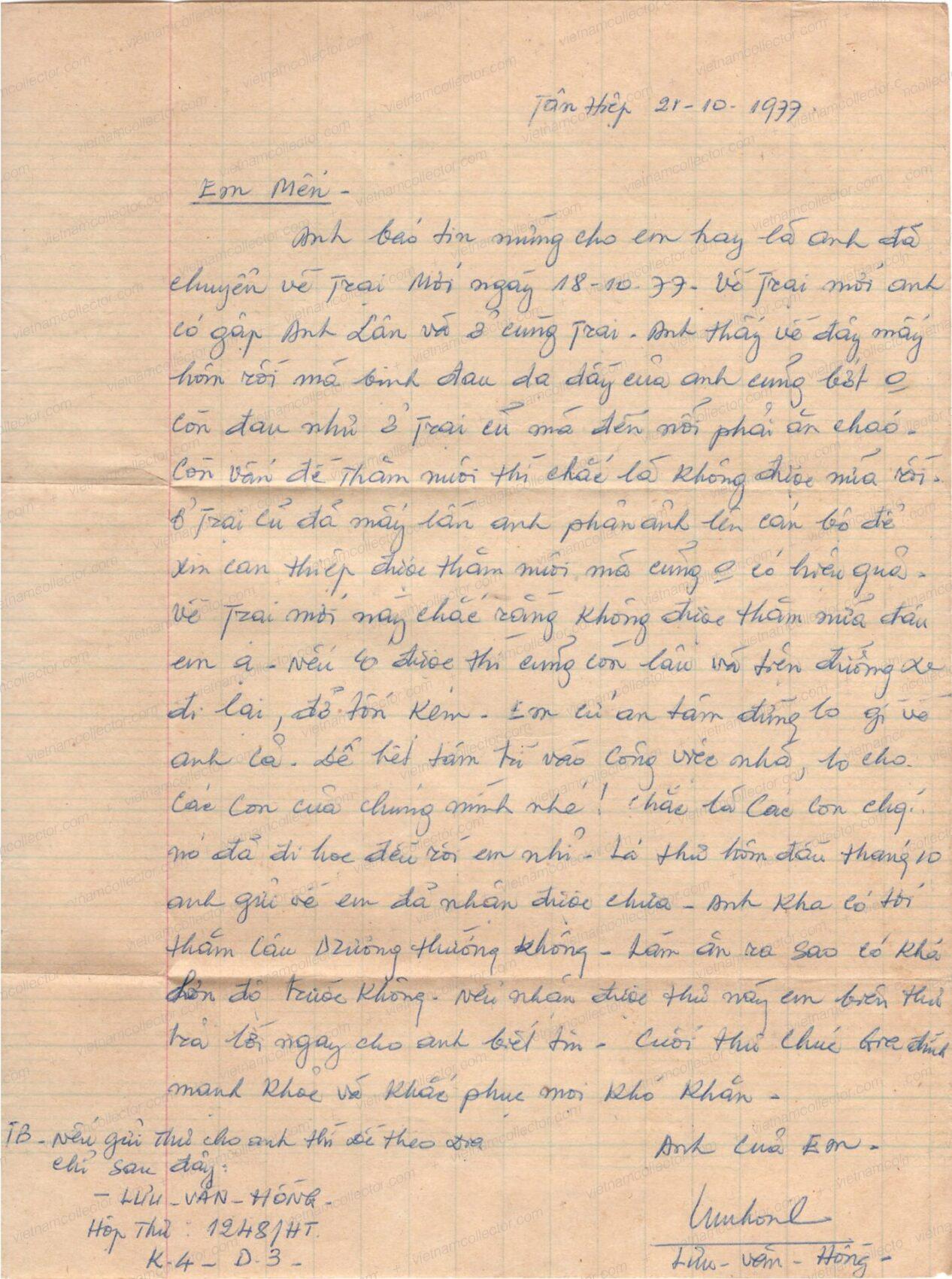
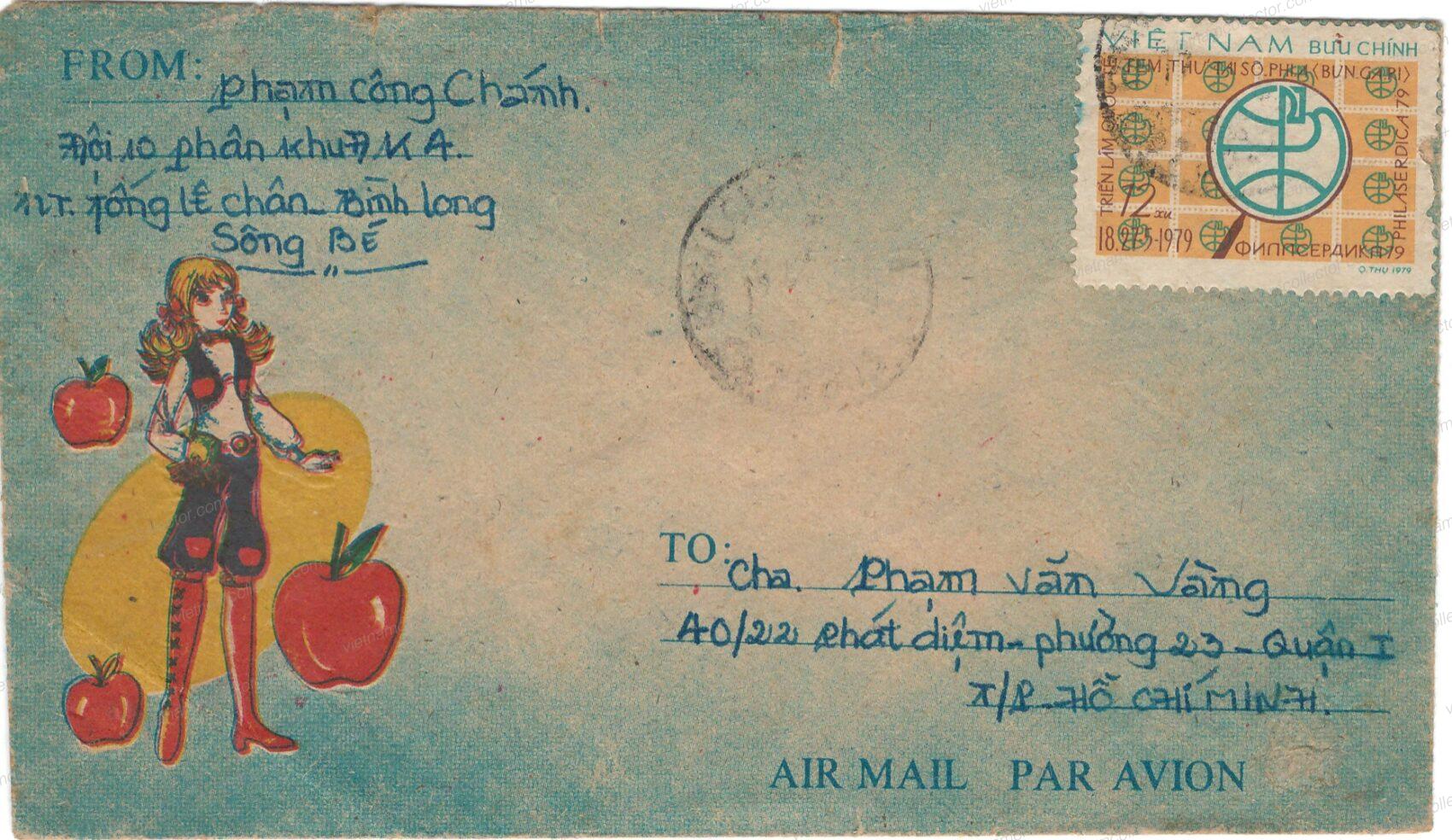
Letter sent by an inmate of Camp K4 to a civilian in HCM City. Camp K4 is associated with the Binh Long/Song Be area. The letter is correctly franked with 12xu Stamp Exhibition Sofia stamp. Cancelled with illegible canceler.
Camp K5
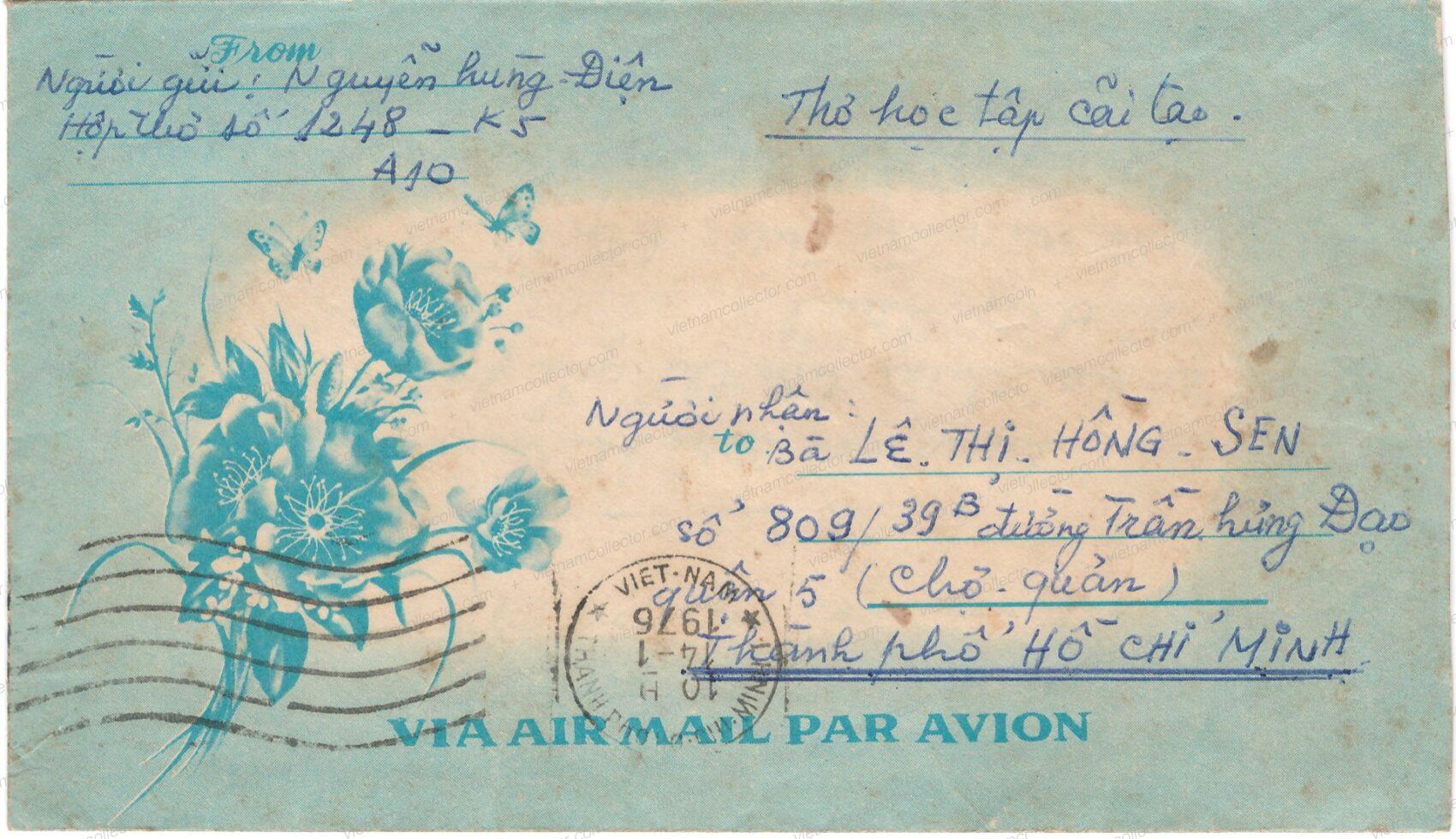
Here is an interesting group of six covers from the same correspondence that were mailed from Camp K5 Sub-Camp A10 to a civilian in Ho Chi Minh City. All of them have their original contents preserved. Also, all of them were cancelled with the HCM City machine cancel which documents that all of the mail coming from this camp was transported by military pouch to the HCM City post office. This camp is associated with the locations of Vi Thanh, Choung Thien and Than Son that are located South East of Rach Gia in the very South of Vietnam. The letters are dated January 9th, 1976, January 12th, 1976, February 29th, 1976, March 27th, 1976, April 27th, 1976 and May 7th, 1976. This suggests that initially inmates could send letters fairly frequently. This changed in the latter years when inmates were only allowed to mail letters every 3-5 months. All the letters were annotated with “Thơ học tập cải tạo” (= letter about reeducation) which indicated that the letter originated in a reeducation camp and also that they could initially be transported free of charge. This free mailing privilege was changed some time in 1977 when inmates and guards either had to use standard postage stamps or military free franks. Since the period of postage free mail ended after only a few months letters without stamps are more rare than letters with stamps.
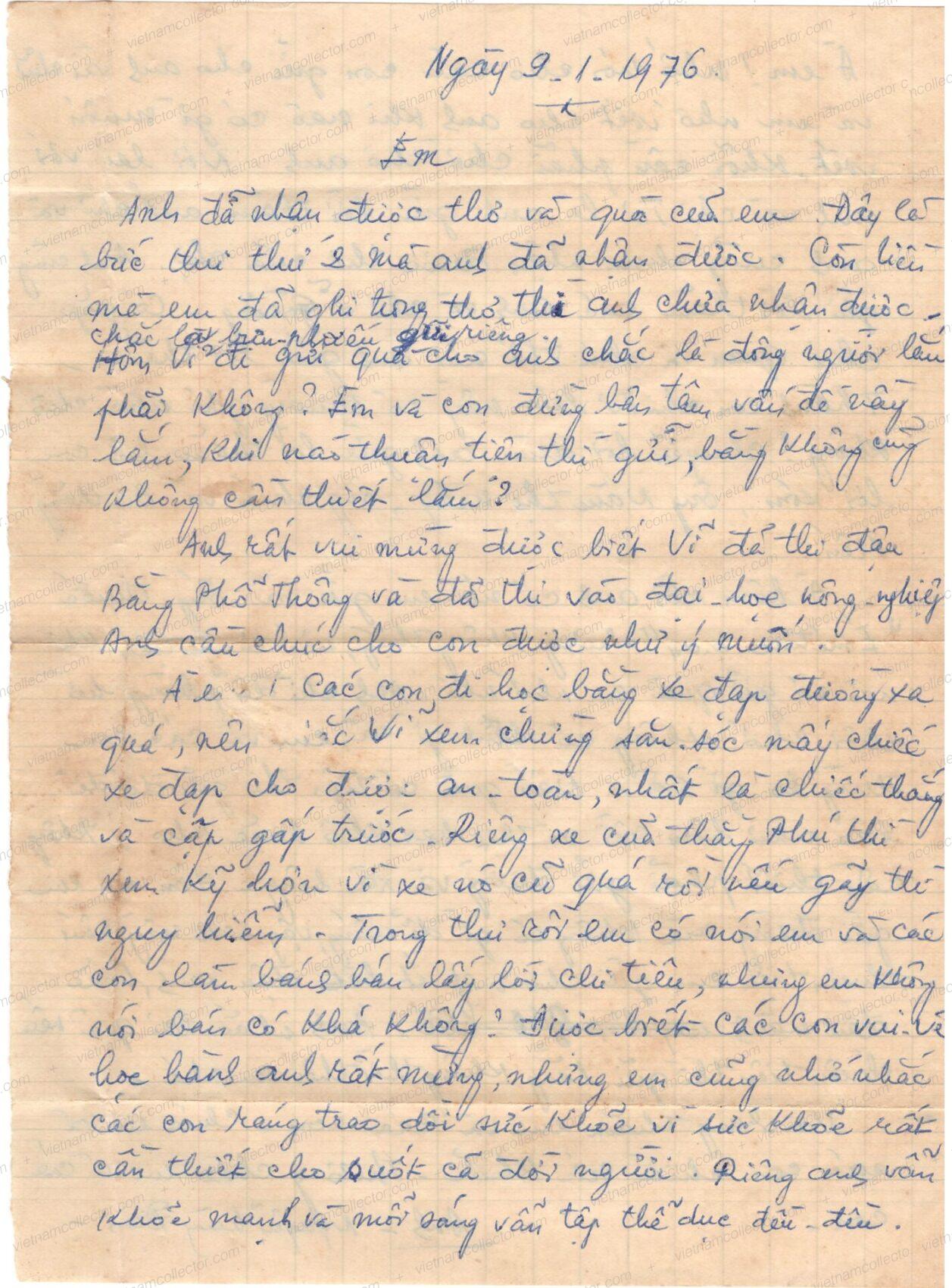
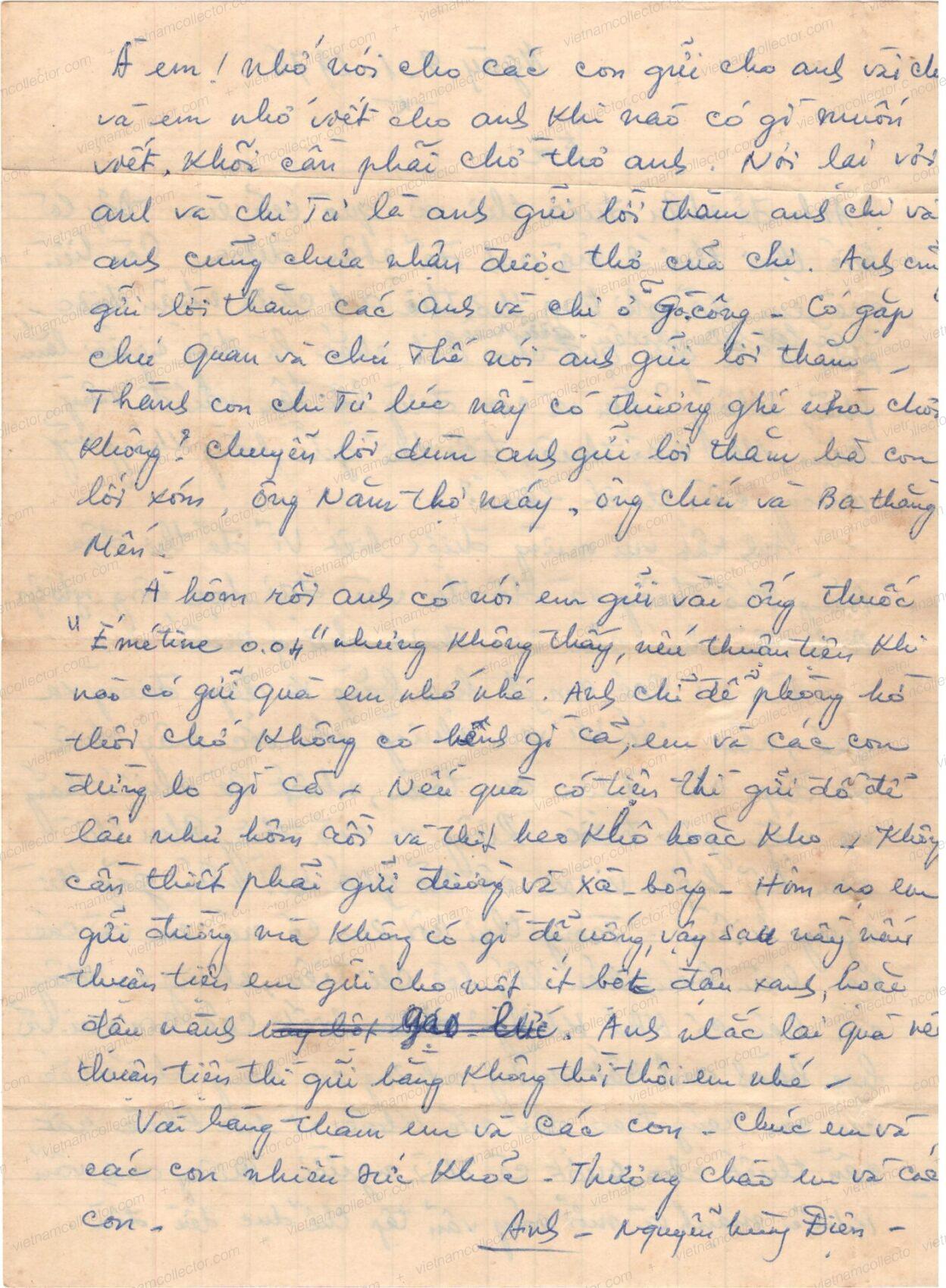
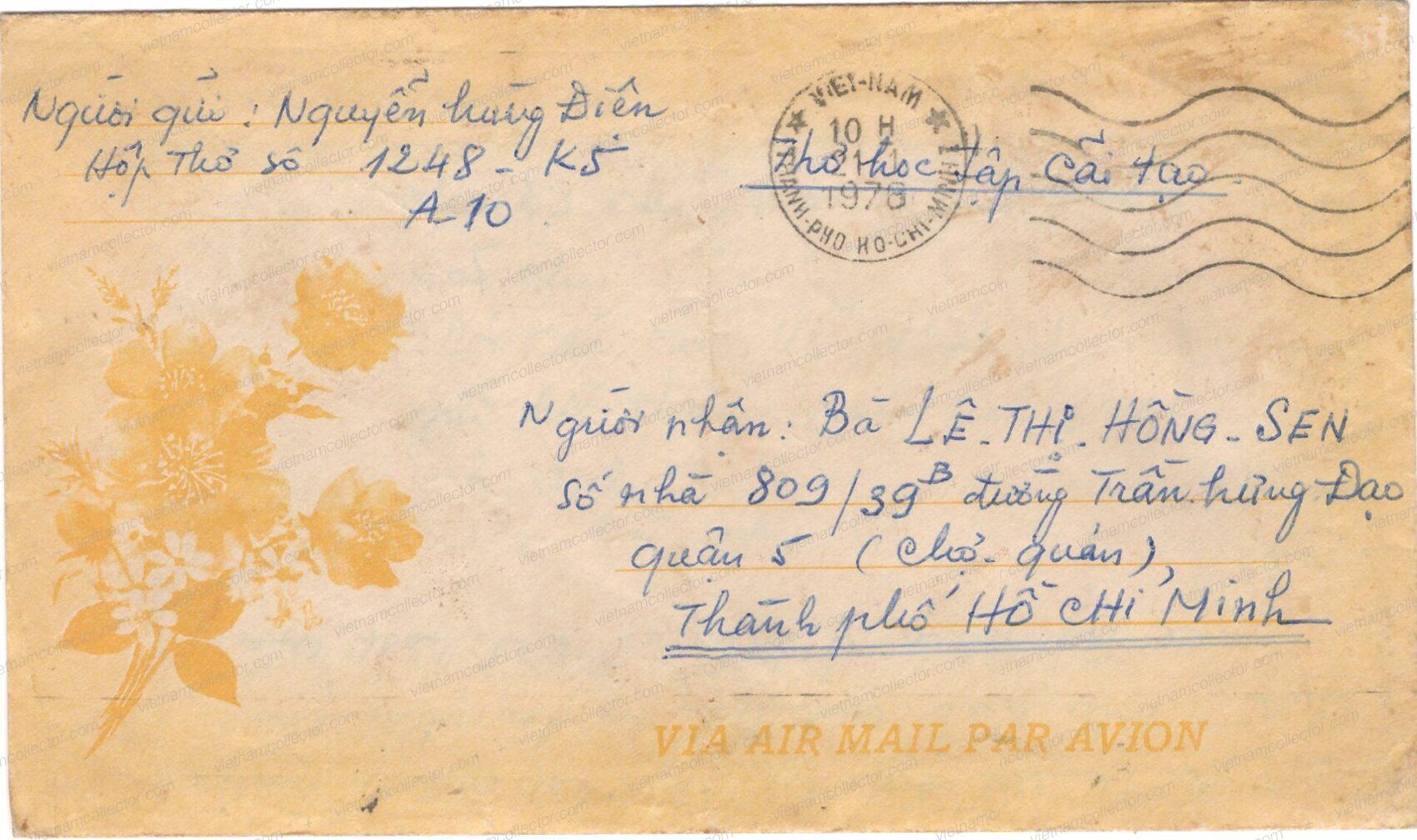
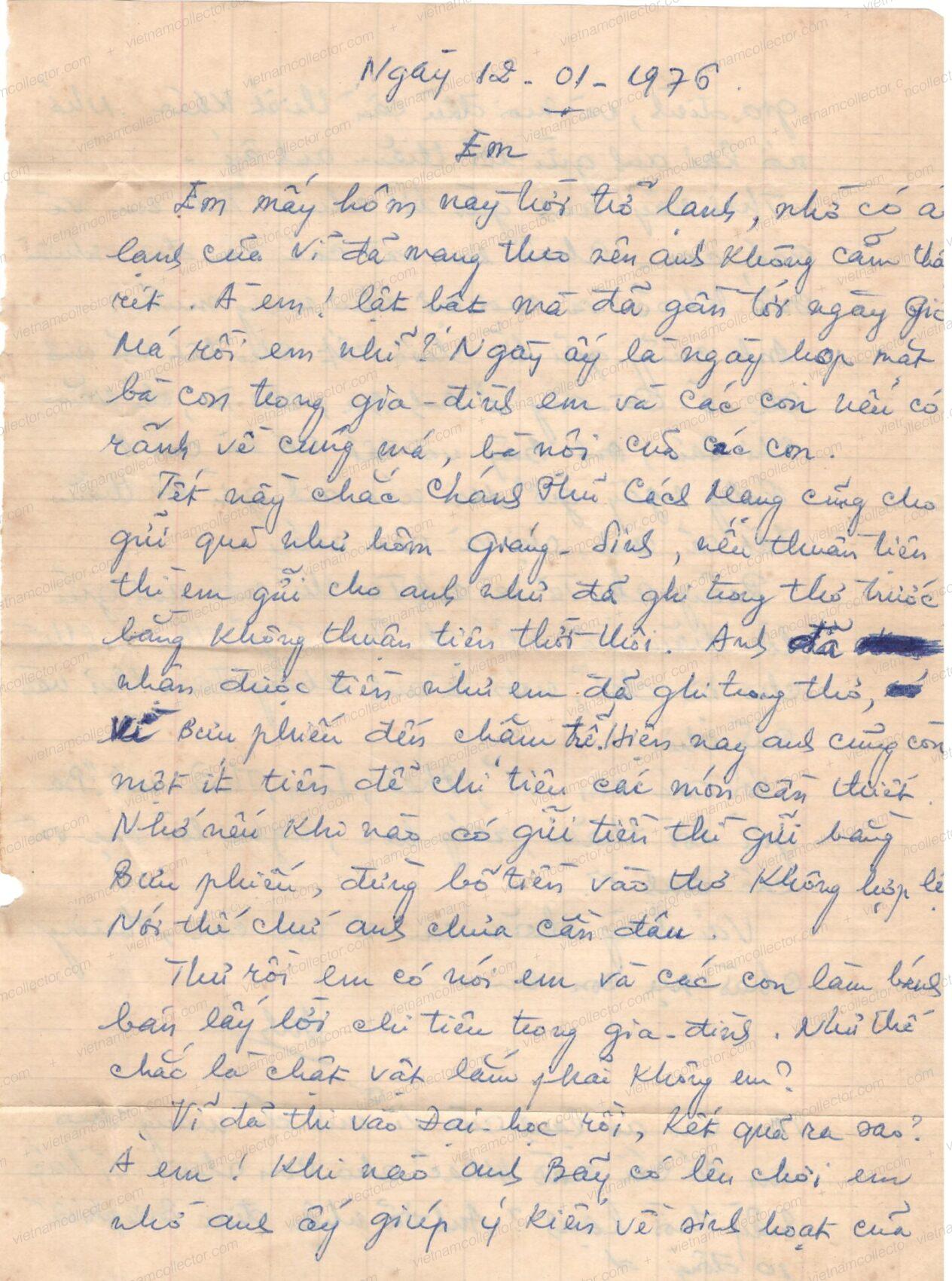
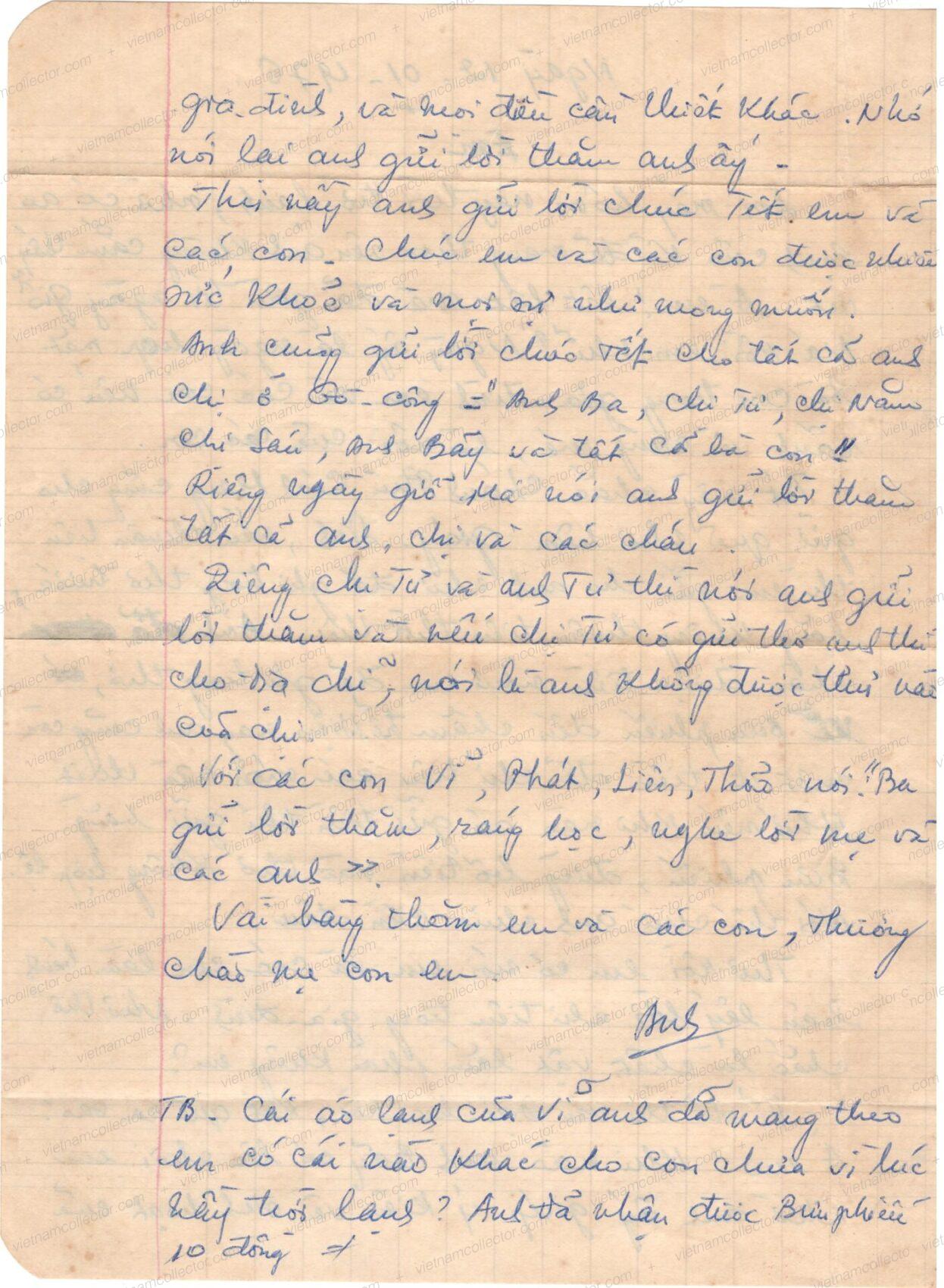
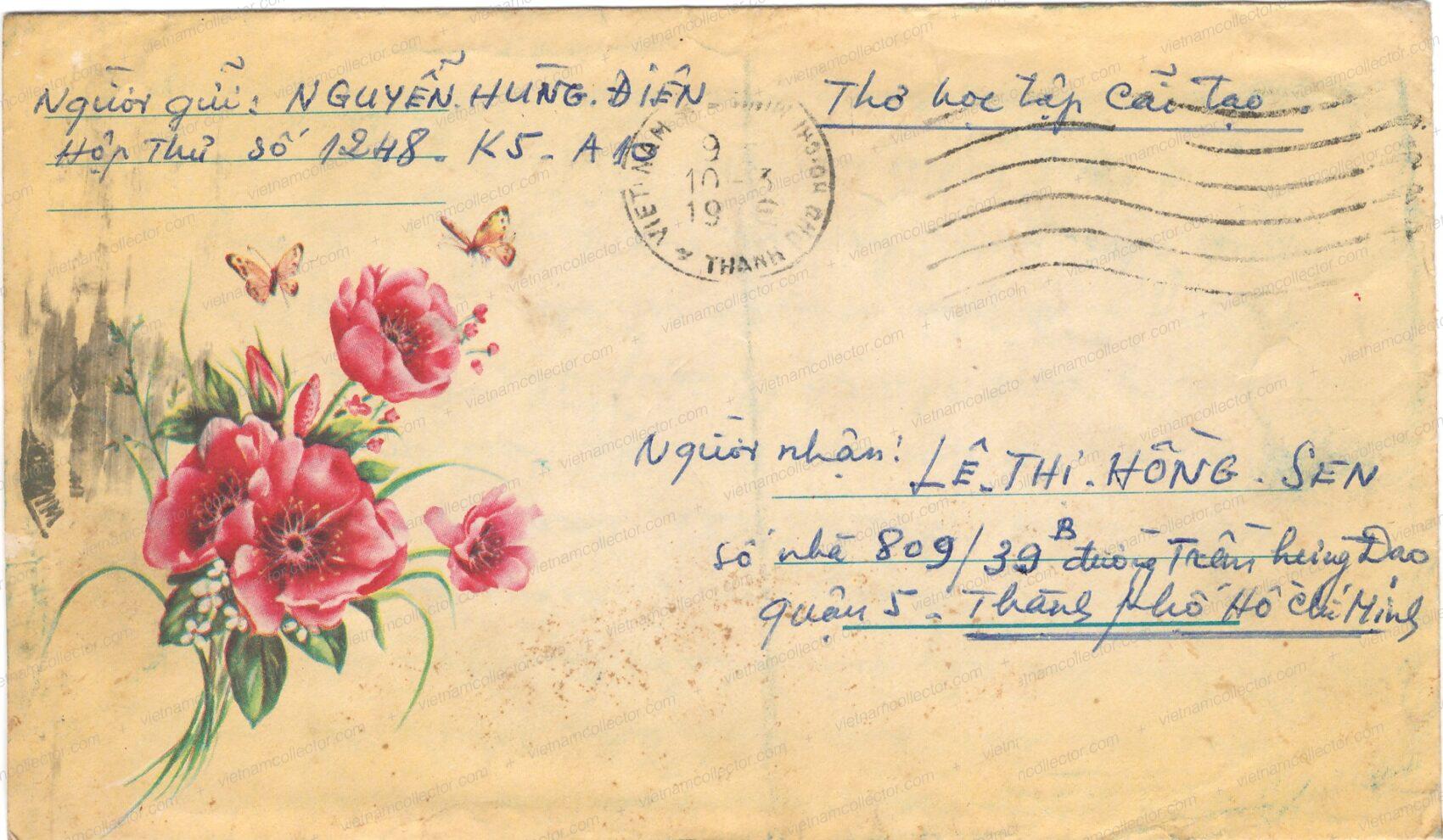
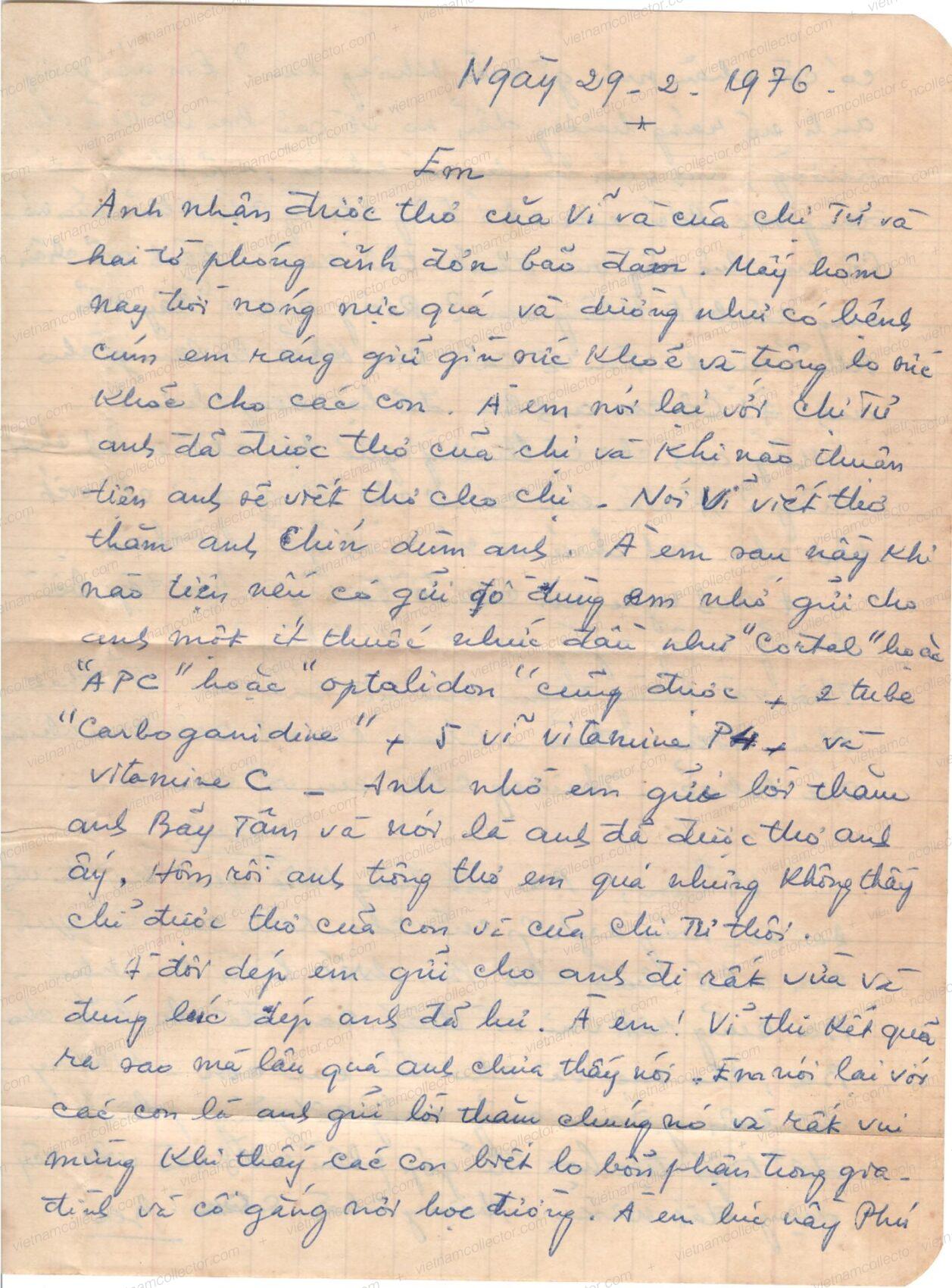
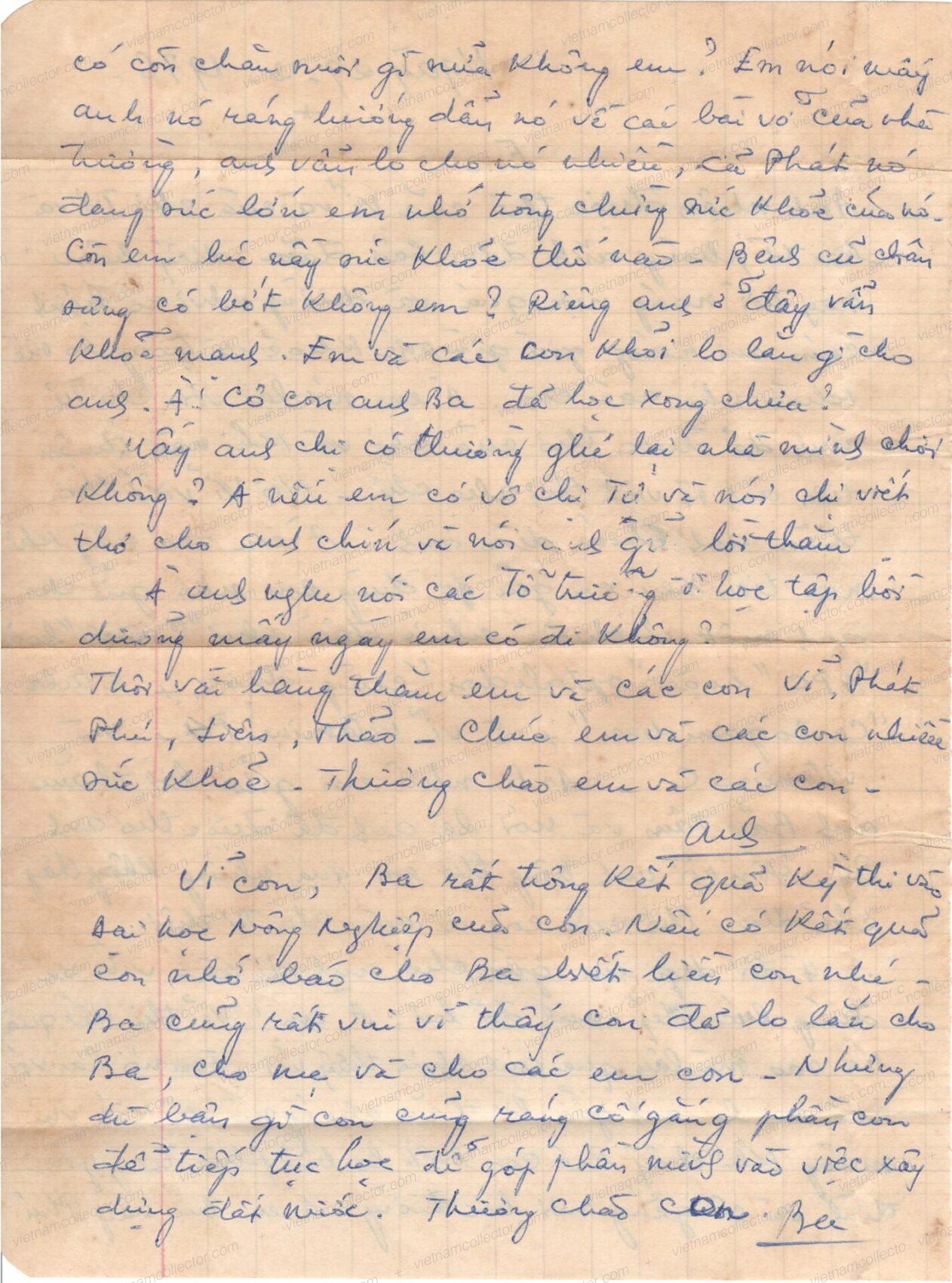
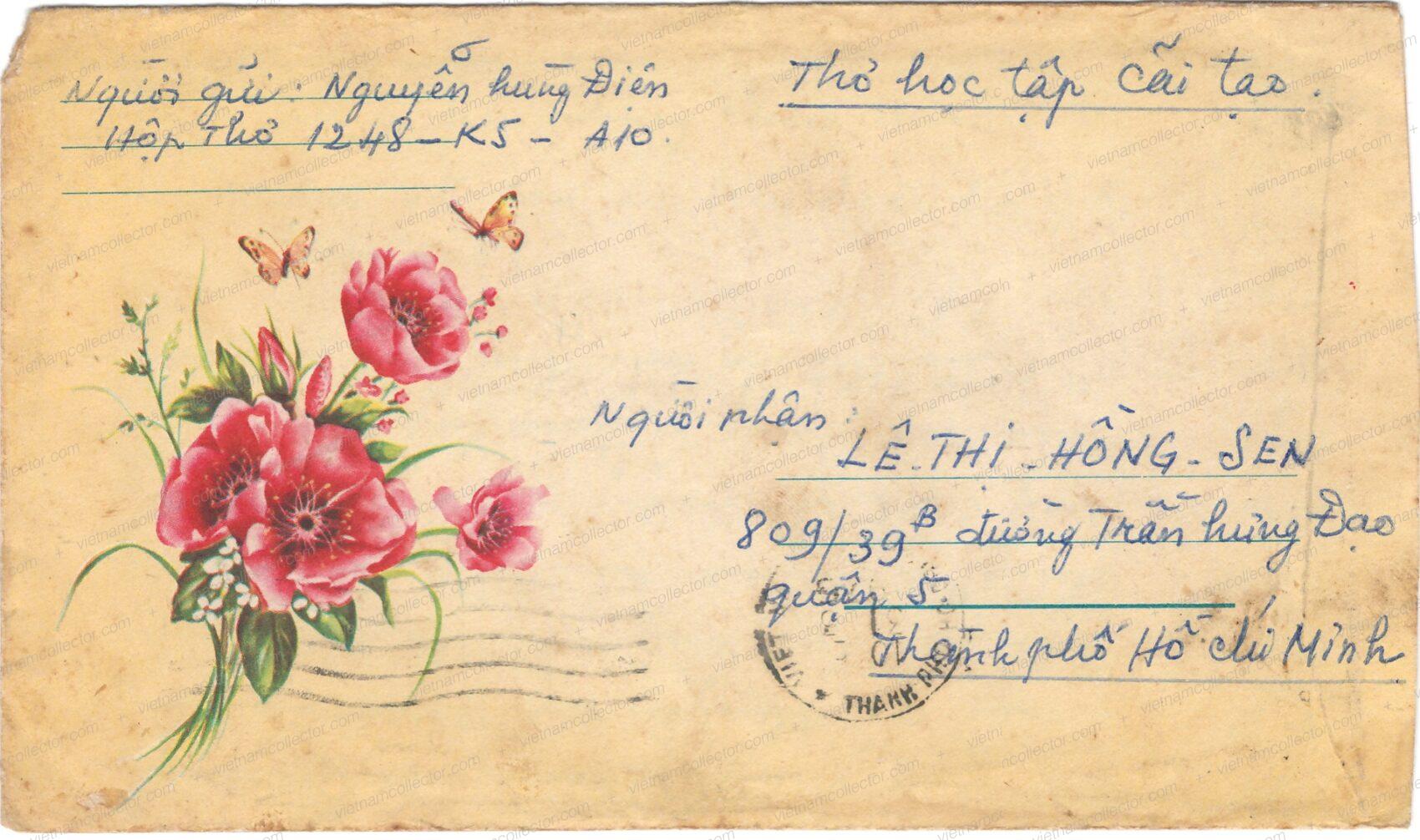
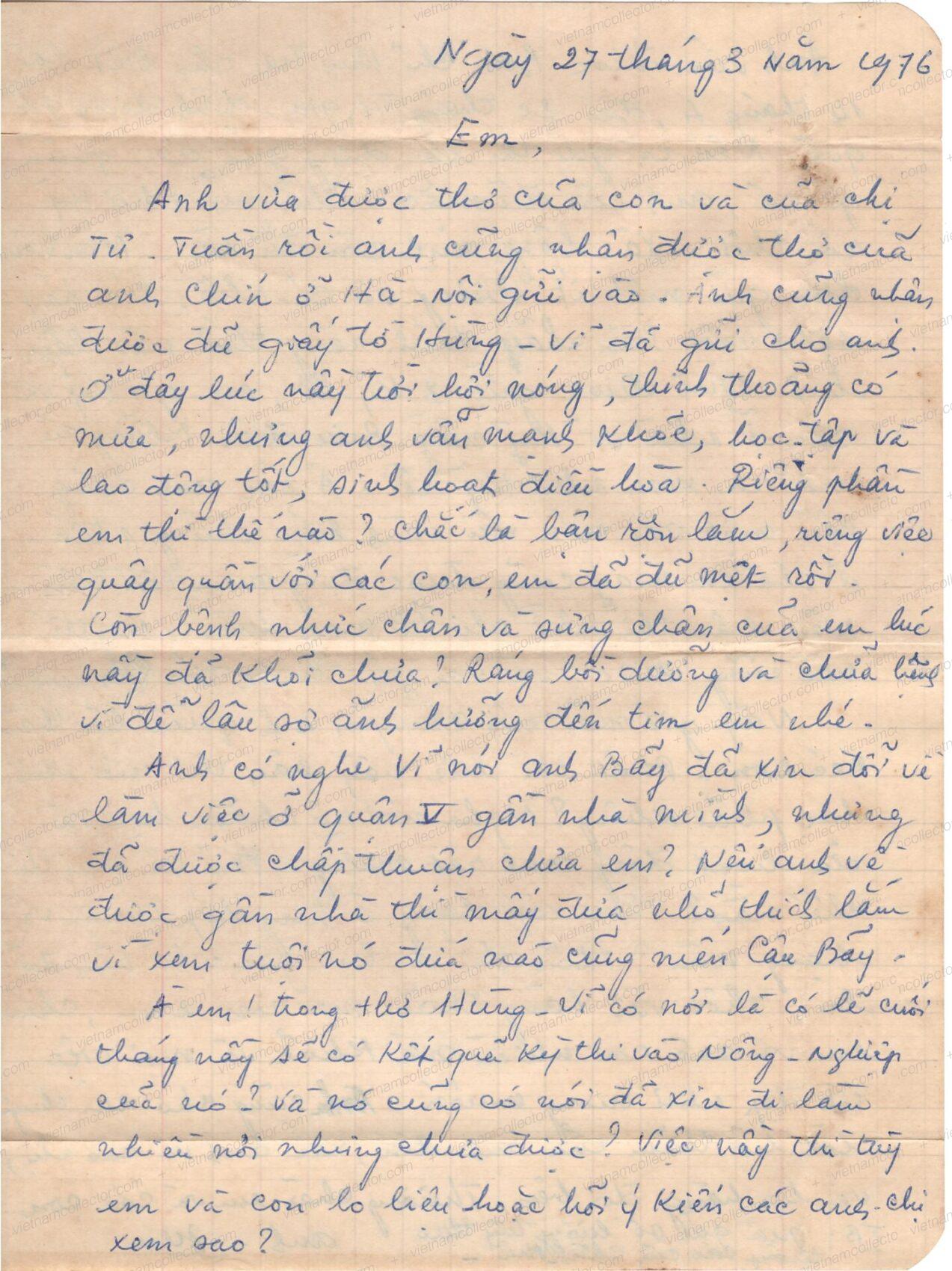
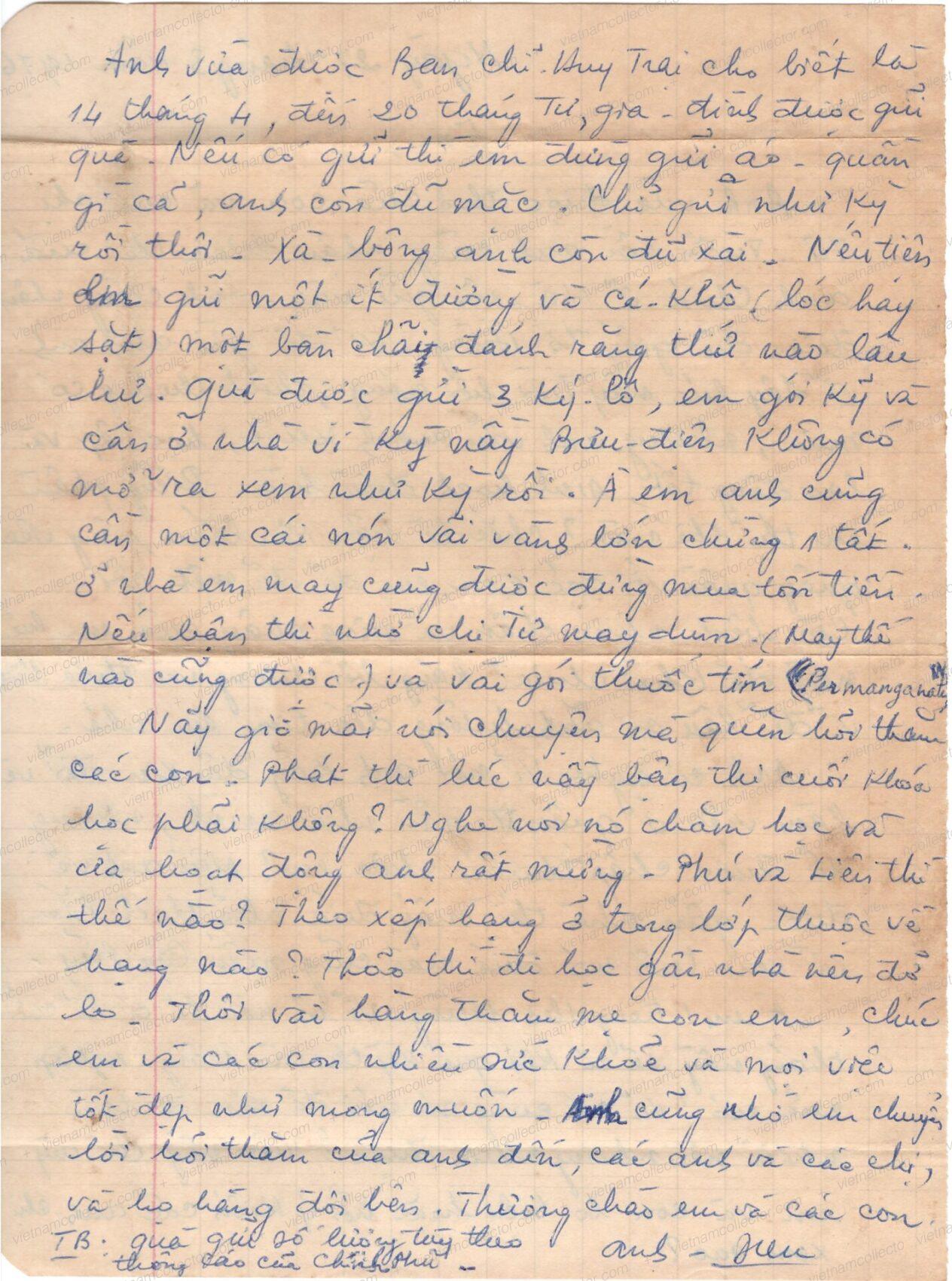
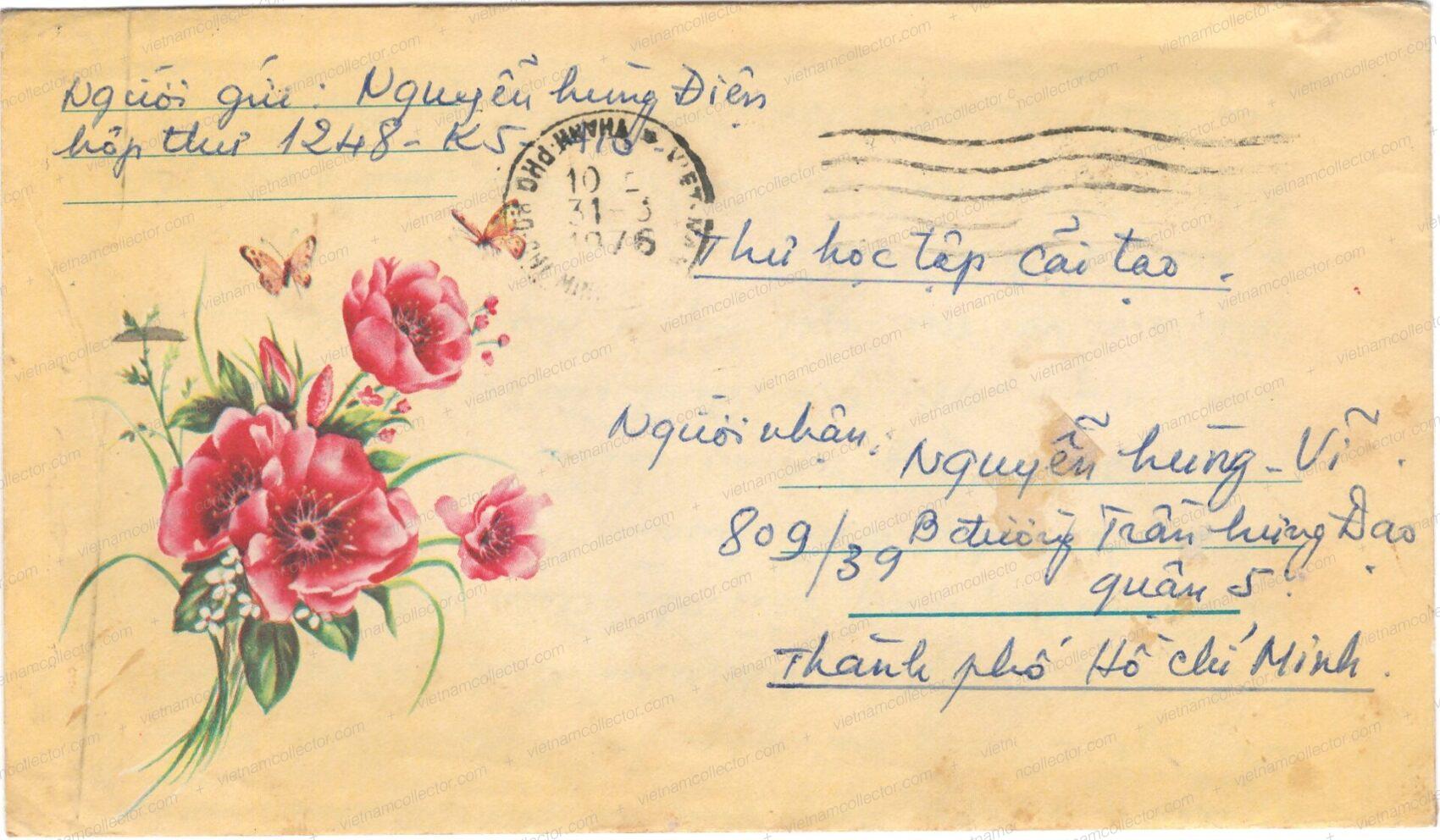
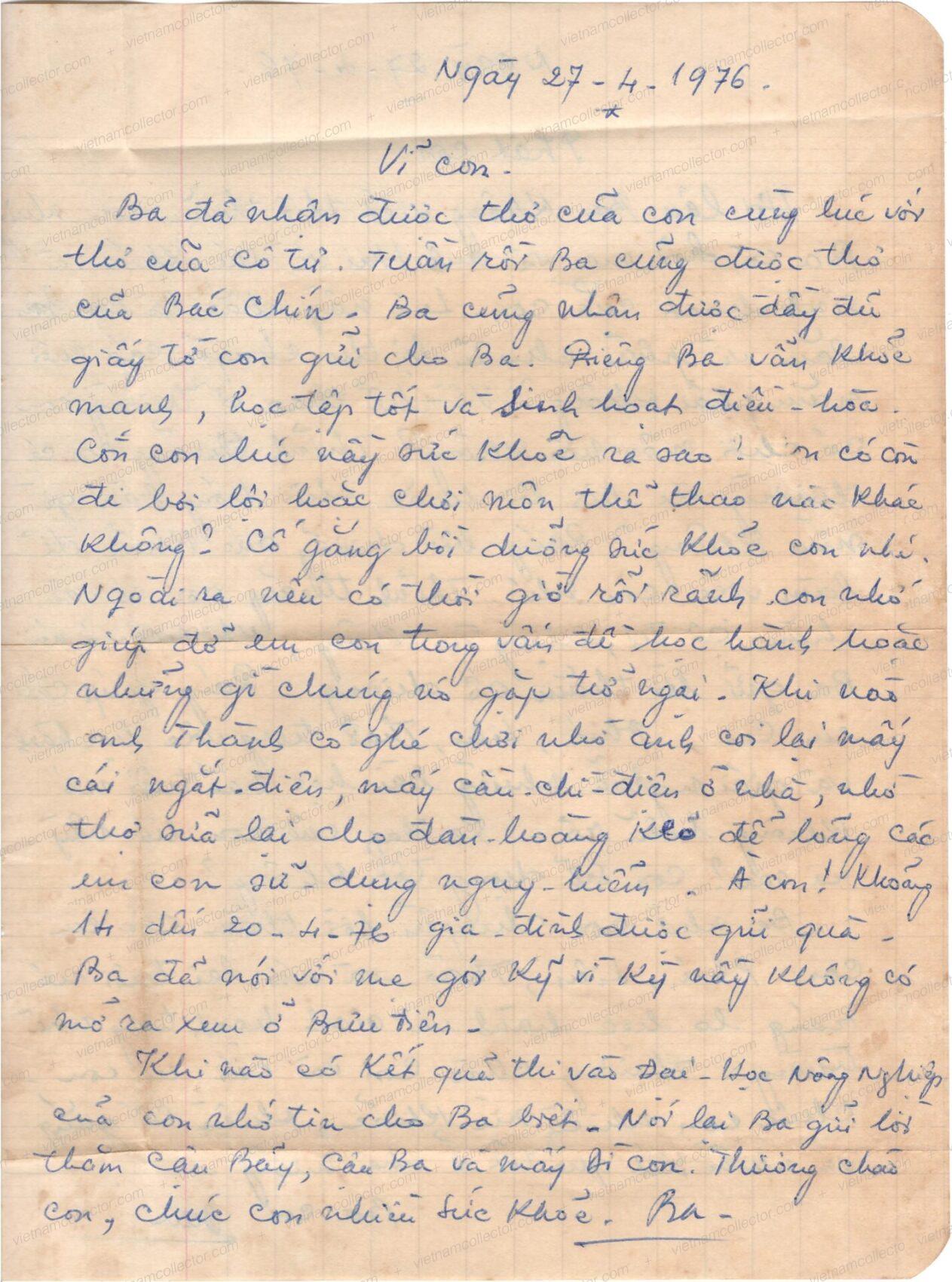
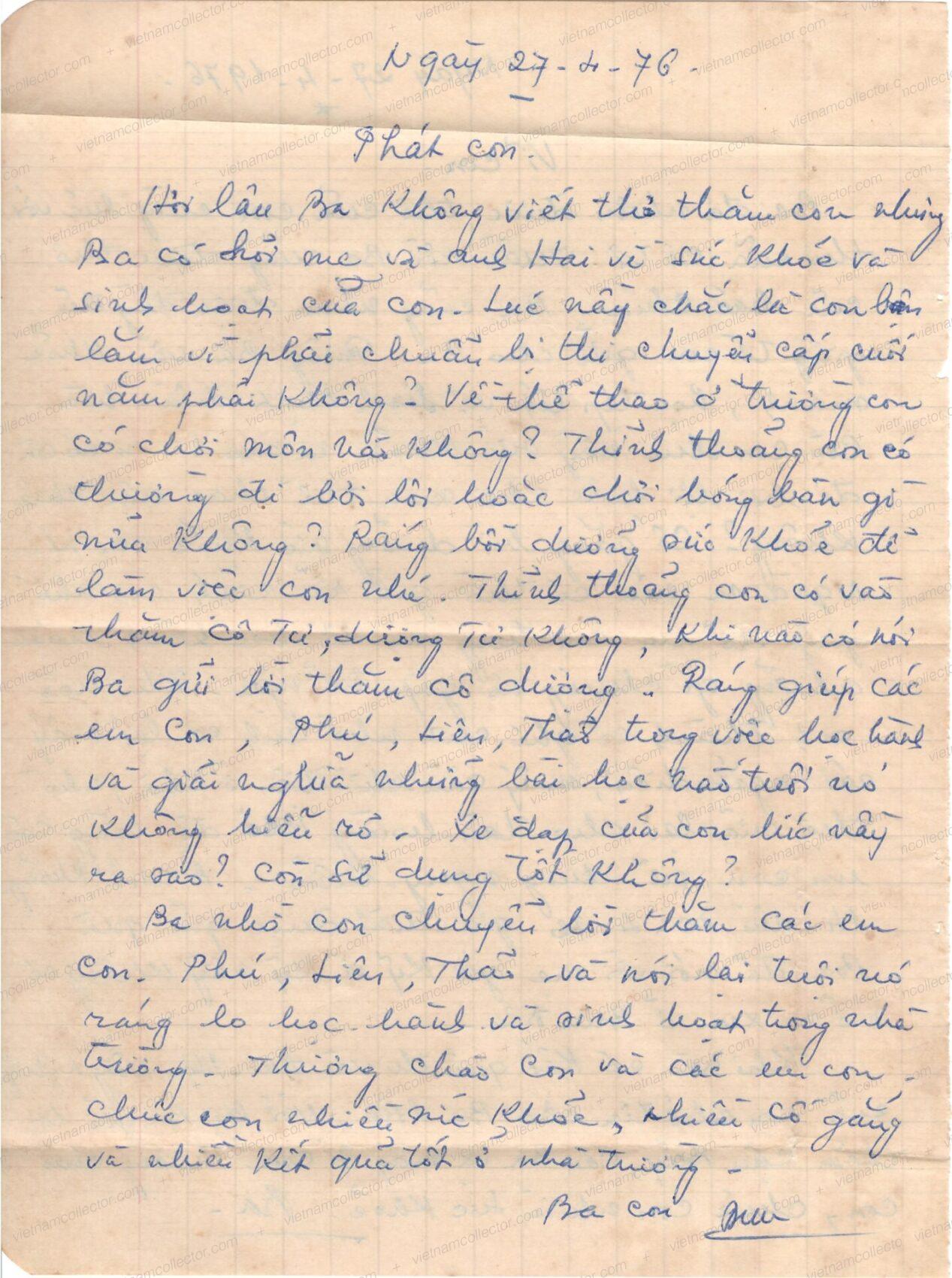
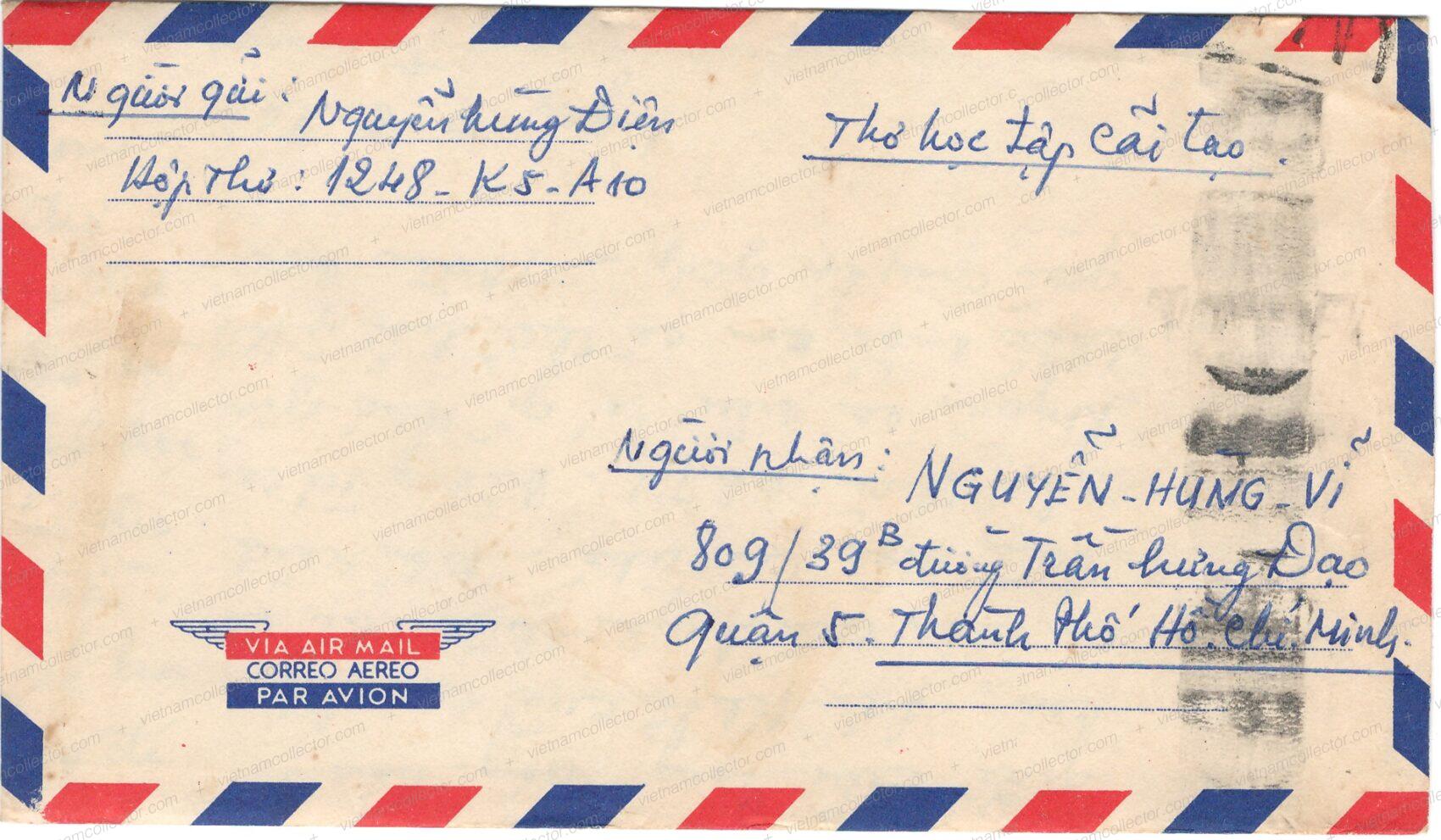
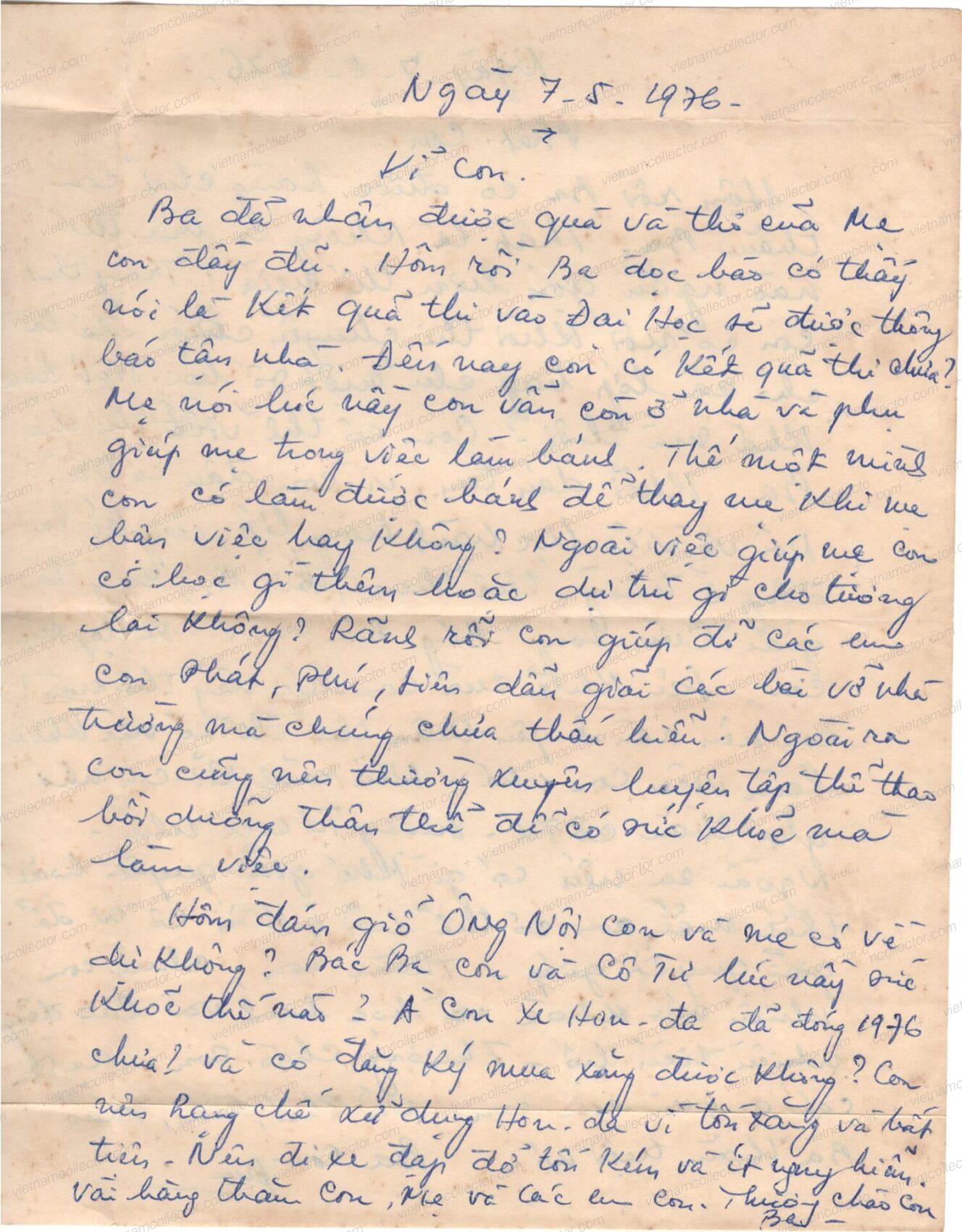
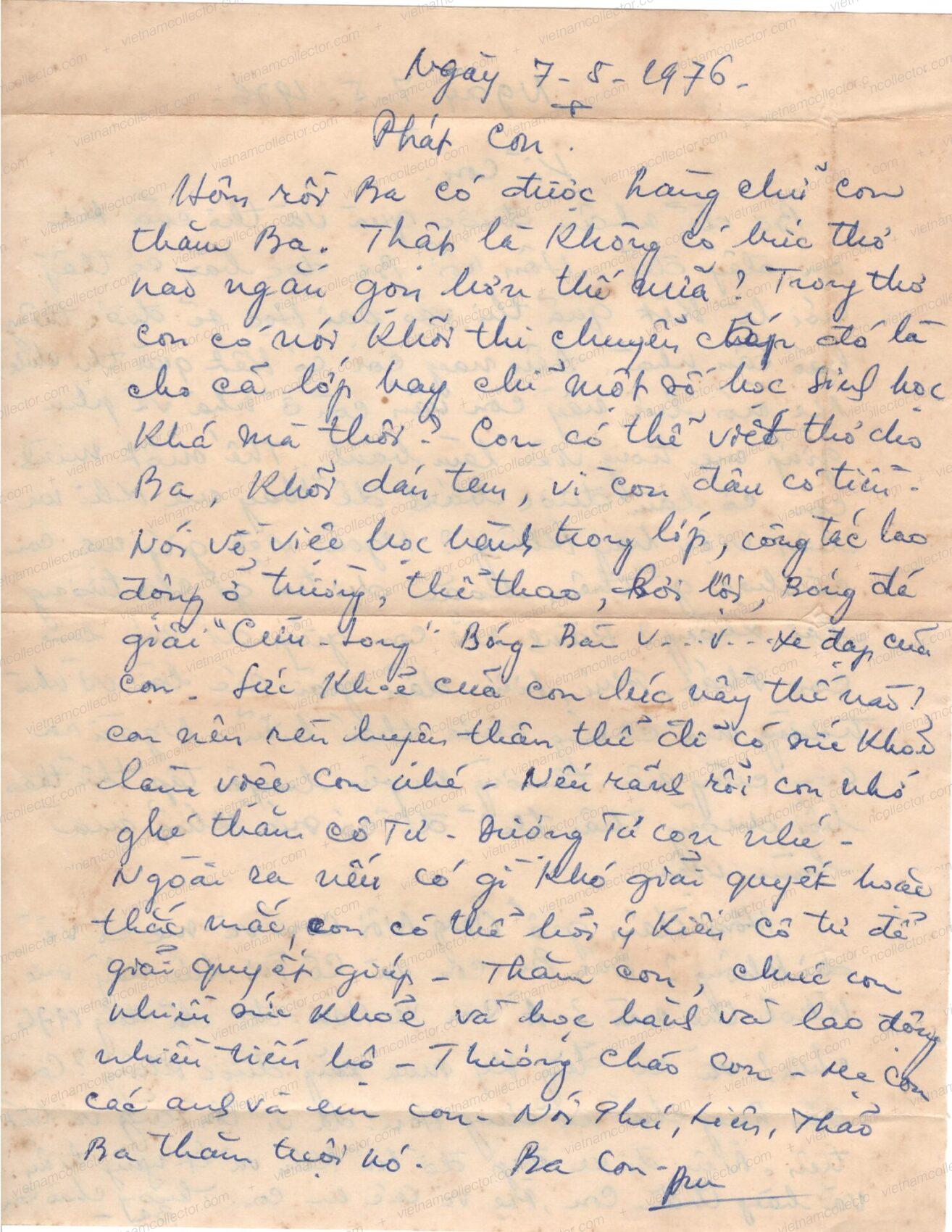
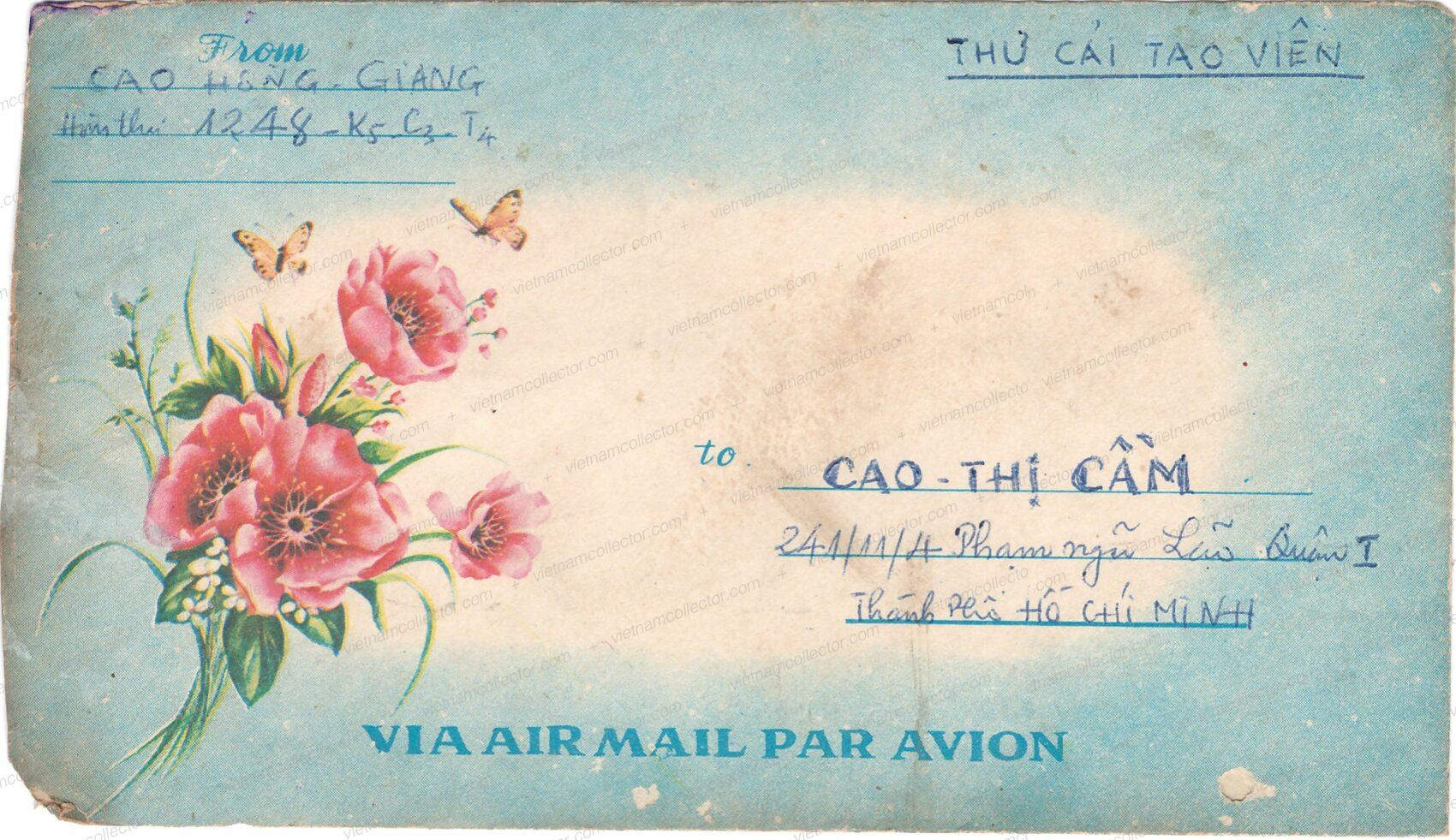
Letter sent by an inmate of Camp K5 to a civilian in HCM City in May of 1977. The letter carries a manuscript remark “Thủ Cải Tạo Viên” which translates to “Rehabilitators”. HCM City machine arrival cancel on the reverse.
Camp K10
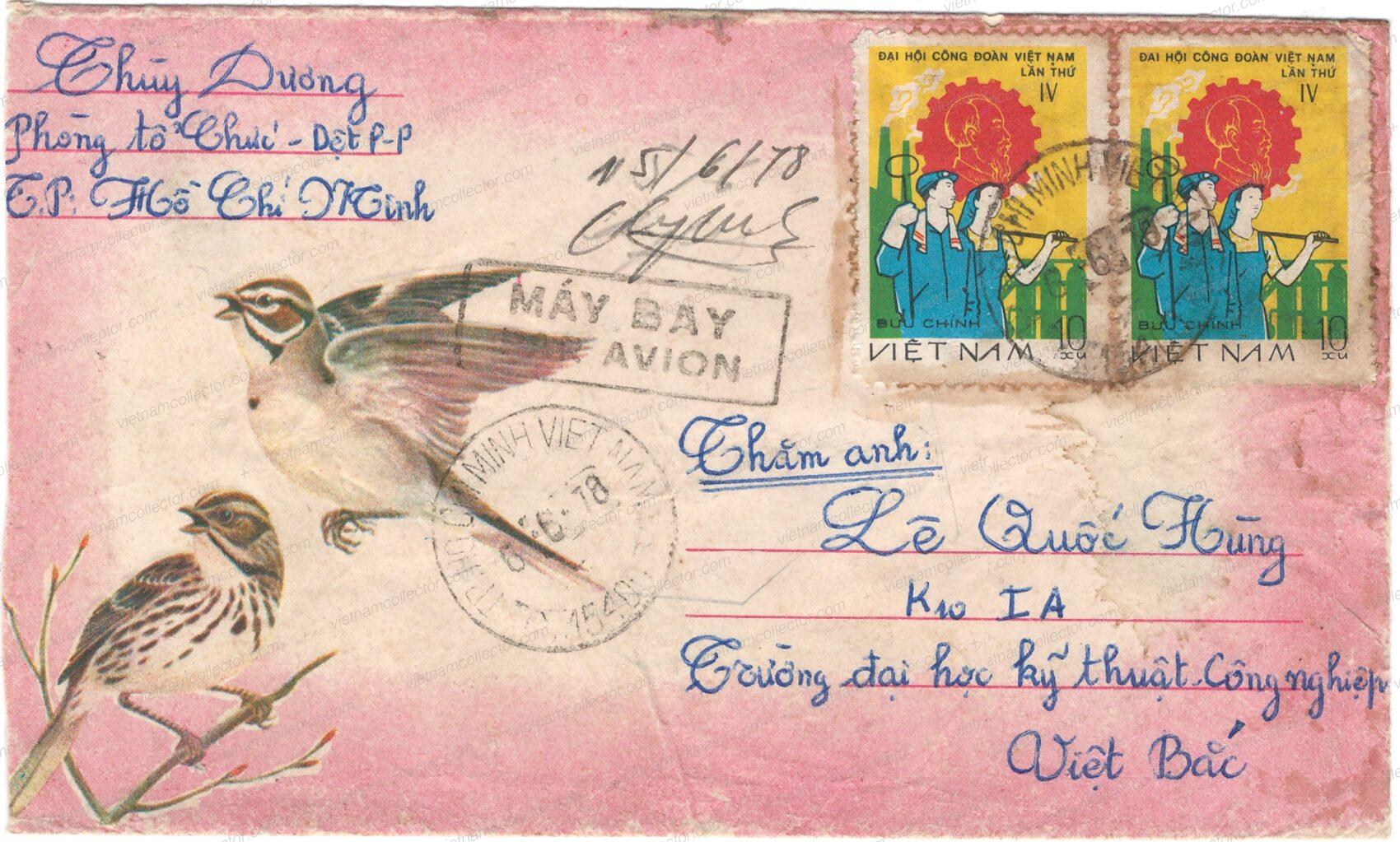
Letter sent by a civilian in HCM City to an inmate located in Camp K10. Franked with two 10xu civilian Union Congress stamps paying an overall postage pf 20xu. The letter was processed in HCM City in June of 1978. The manuscript date and signature indicates that the letter was censored.
Camp K75C
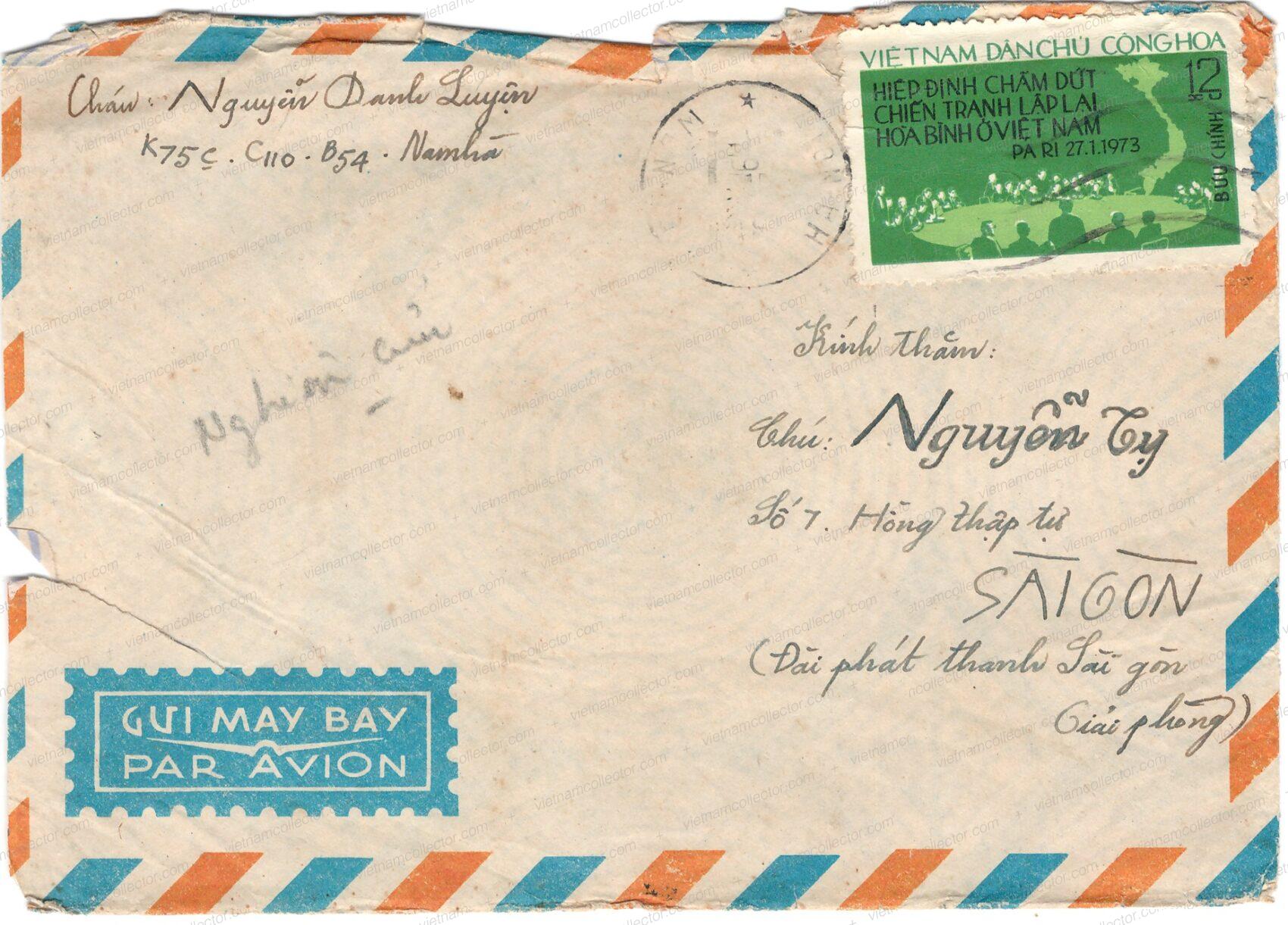
Letter sent in April of 1976 by an inmate of Camp K75C to a civilian in Saigon (HCM City) properly franked with a 12 xu stamp from 1975 (Anniversary of Paris Agreement) Camp 75C was a political prison for high level individuals and located in Hangi (a part of HCM City). HCM City machine arrival cancel on the reverse.
Camp L1
Early letter sent in September of 1975 from Camp L1 to a civilian in Gia Dinh. Camp L1 is associated with Song Ong Doc near Ca Mau. HCM City arrival cancel from September 13th, 1975 on the reverse.
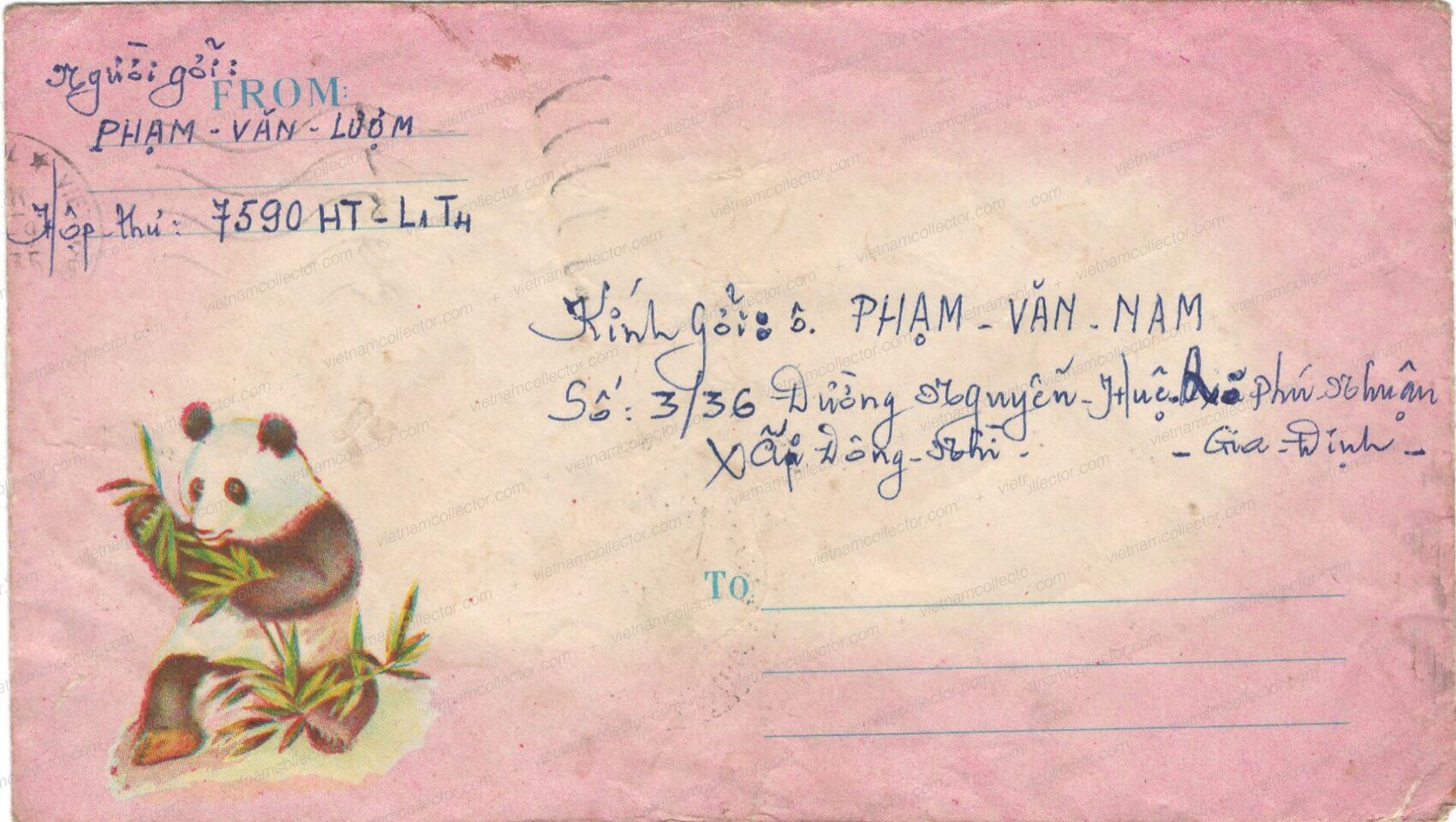
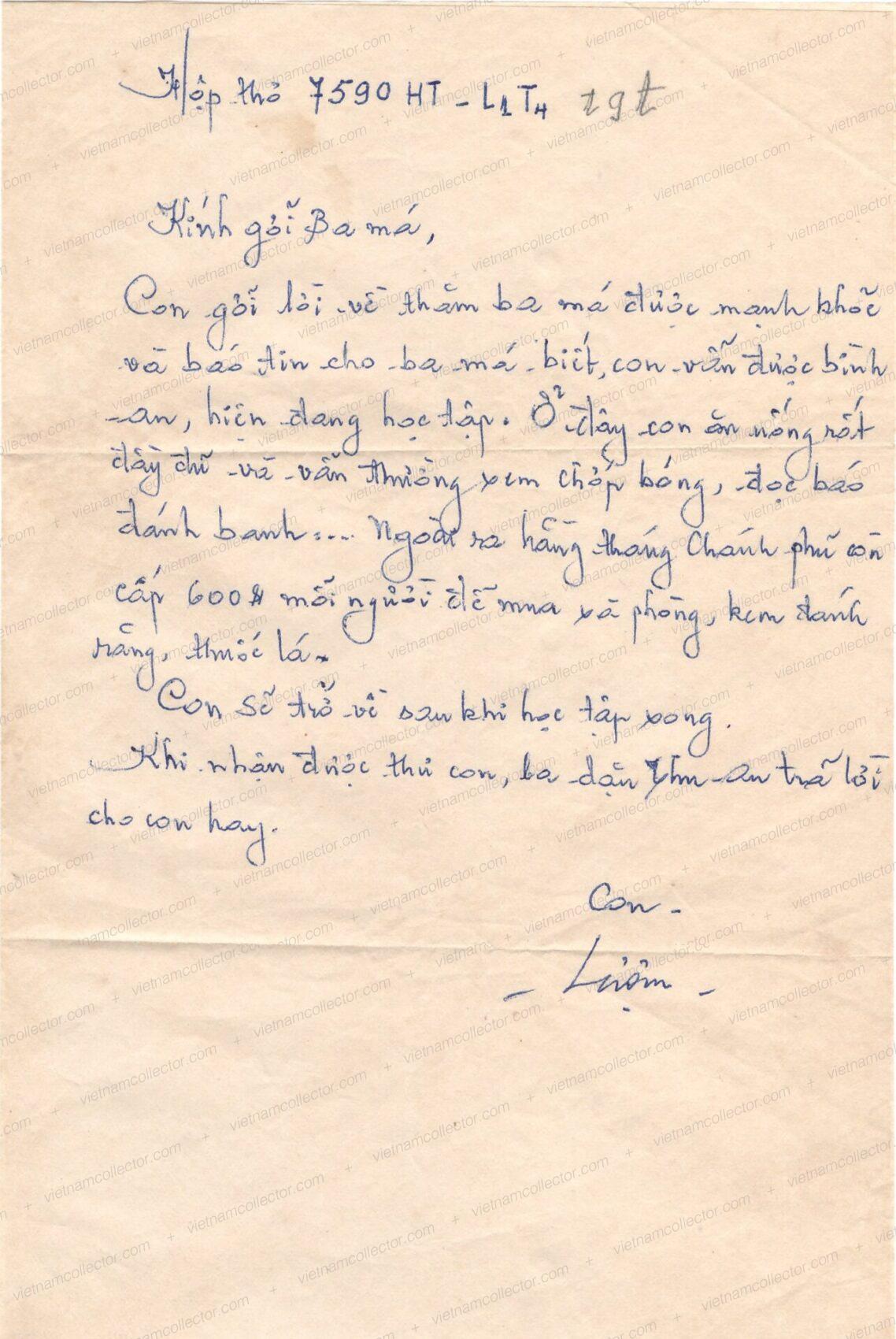
Letter sent by a civilian located in Phú Nhuận (suburb of HCM City) in October of 1975 to what appears to be a prison guard in Camp L1. The letter was franked with a military free frank of 1973 (rare Perf. 12.5) and cancelled with the HCM circular canceler. The envelope was then turned and reused by the guard who had since been transferred to Camp K1. It was sent back to the same civilian August of 1976 in HCM City from whom the cover originated. It is not known why the cover was transported postage free. Unusual item that documents the scarcity of paper right after the end of the war.
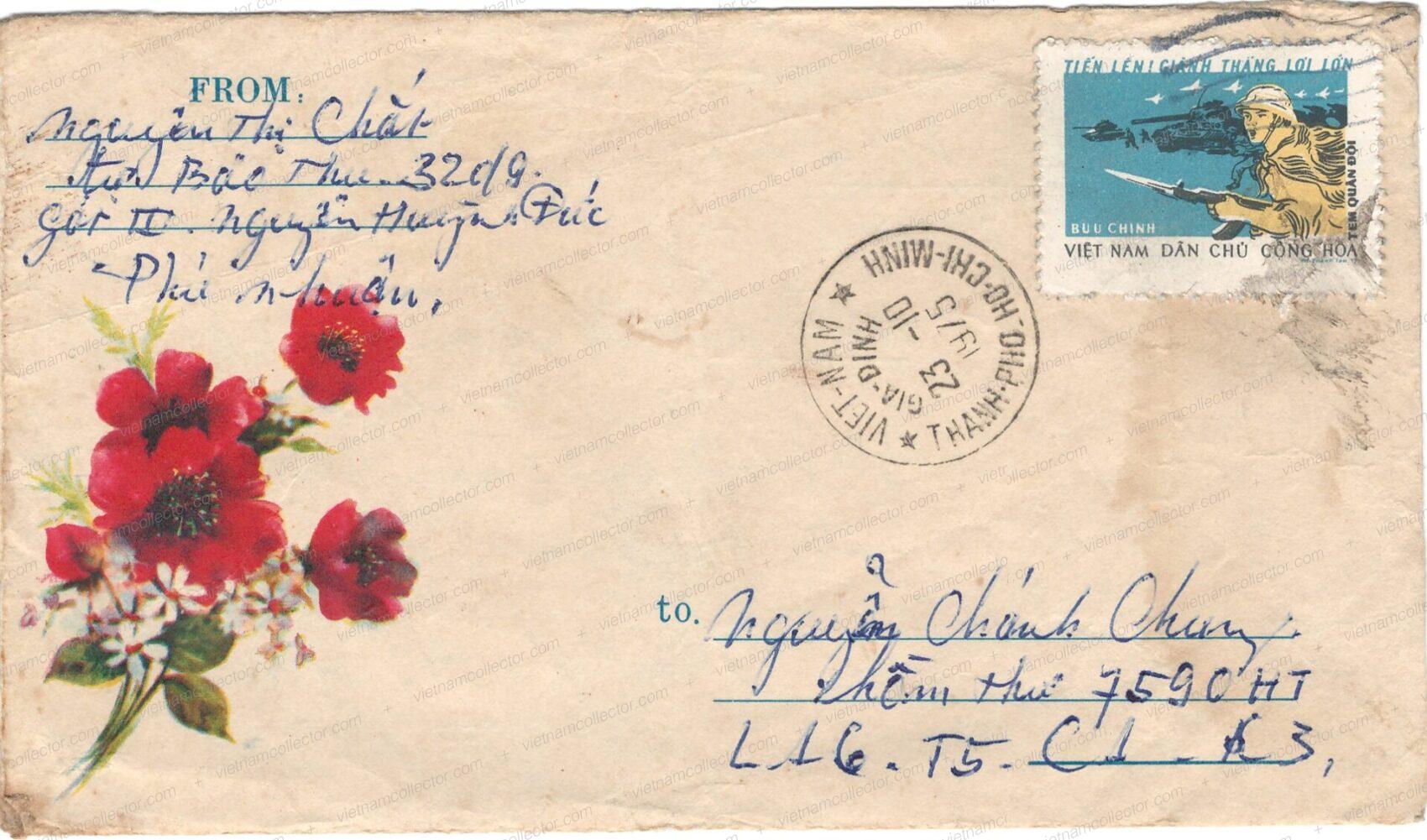
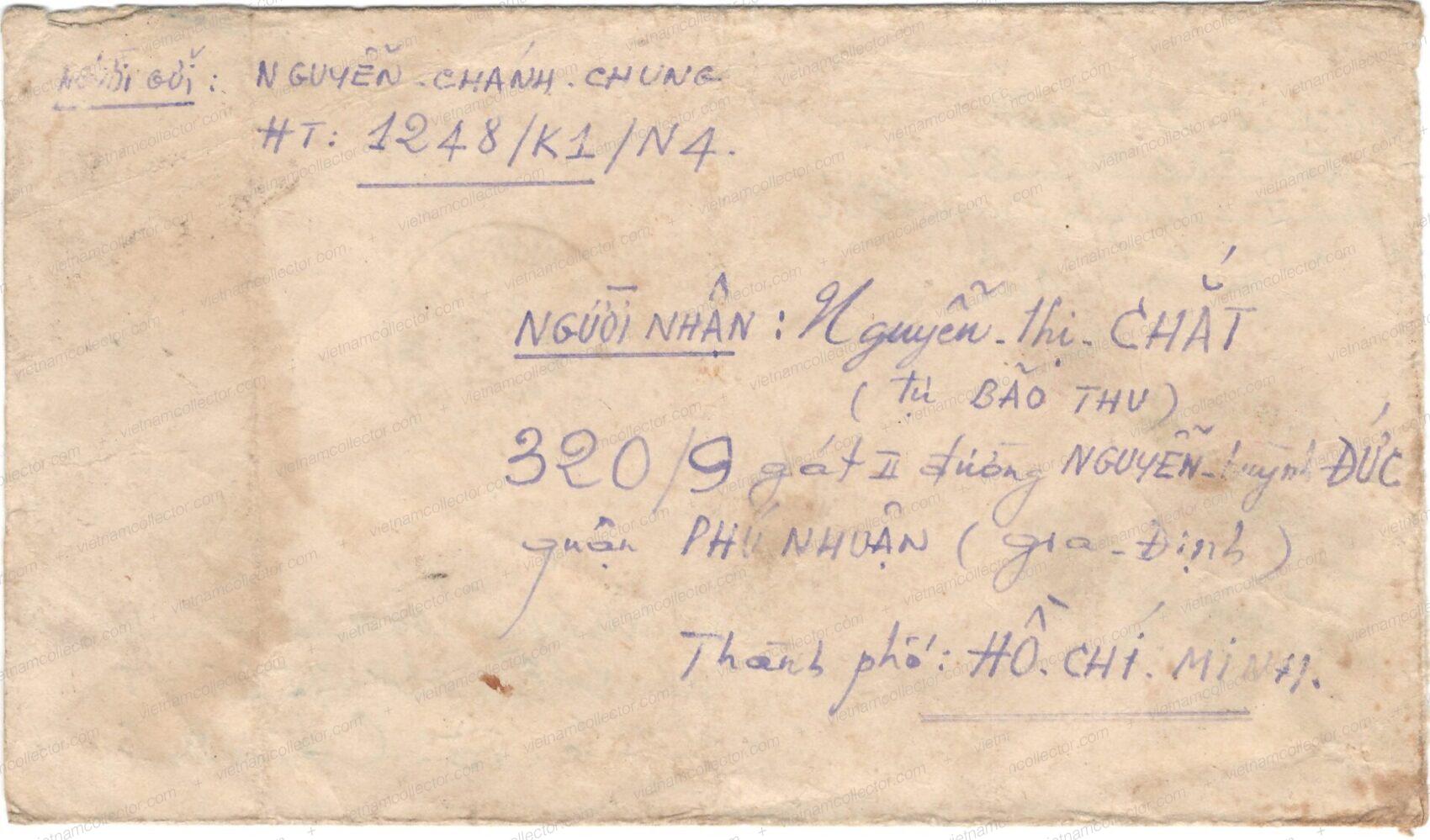
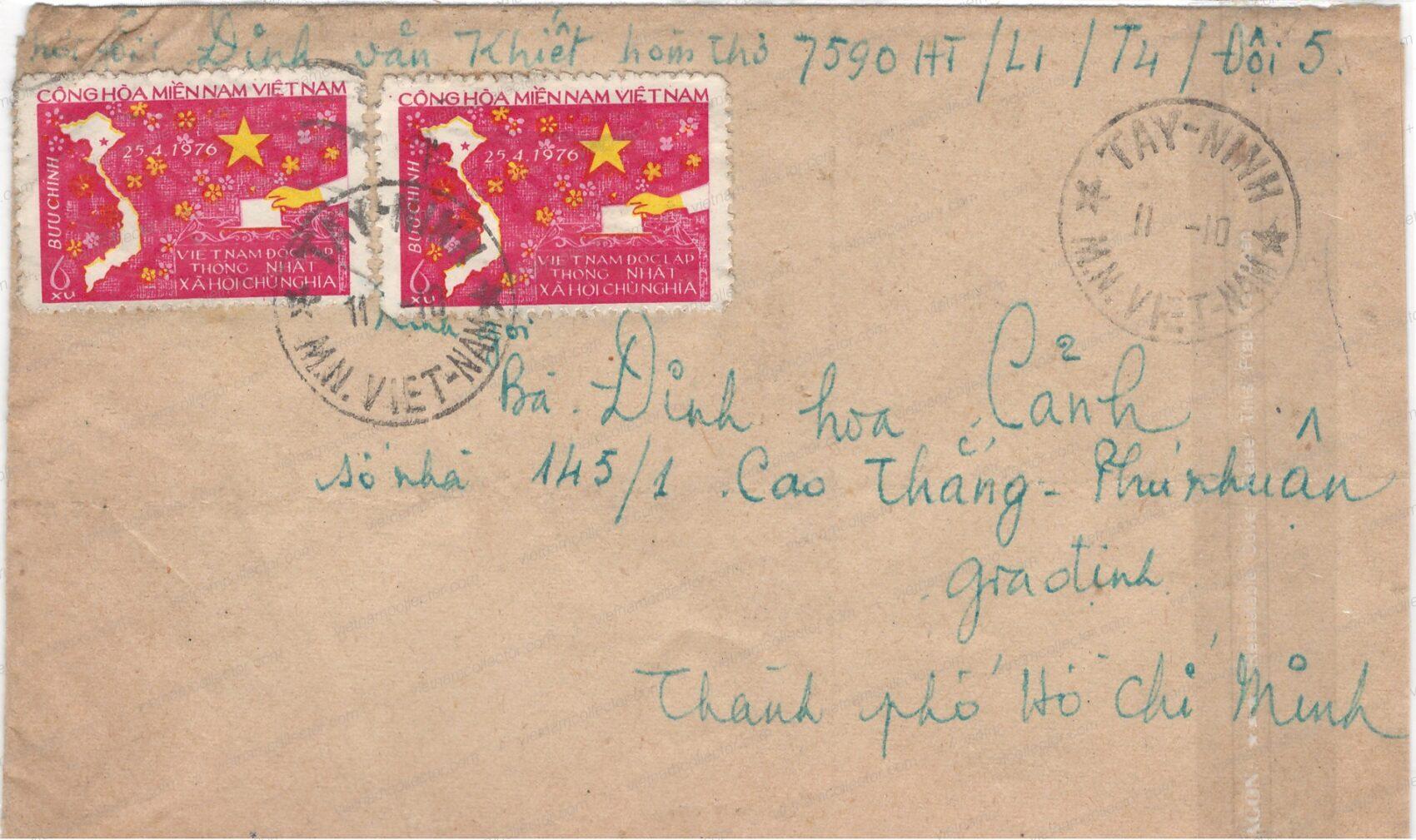
Letter sent in October of 1975 by an inmate of Camp L1 to a civilian located in HCM City. Franked with two 6xu National Liberation stamps paying an overall postage of 12xu. The letter was processed in Tay Ninh. HCM City arrival cancels on the reverse.
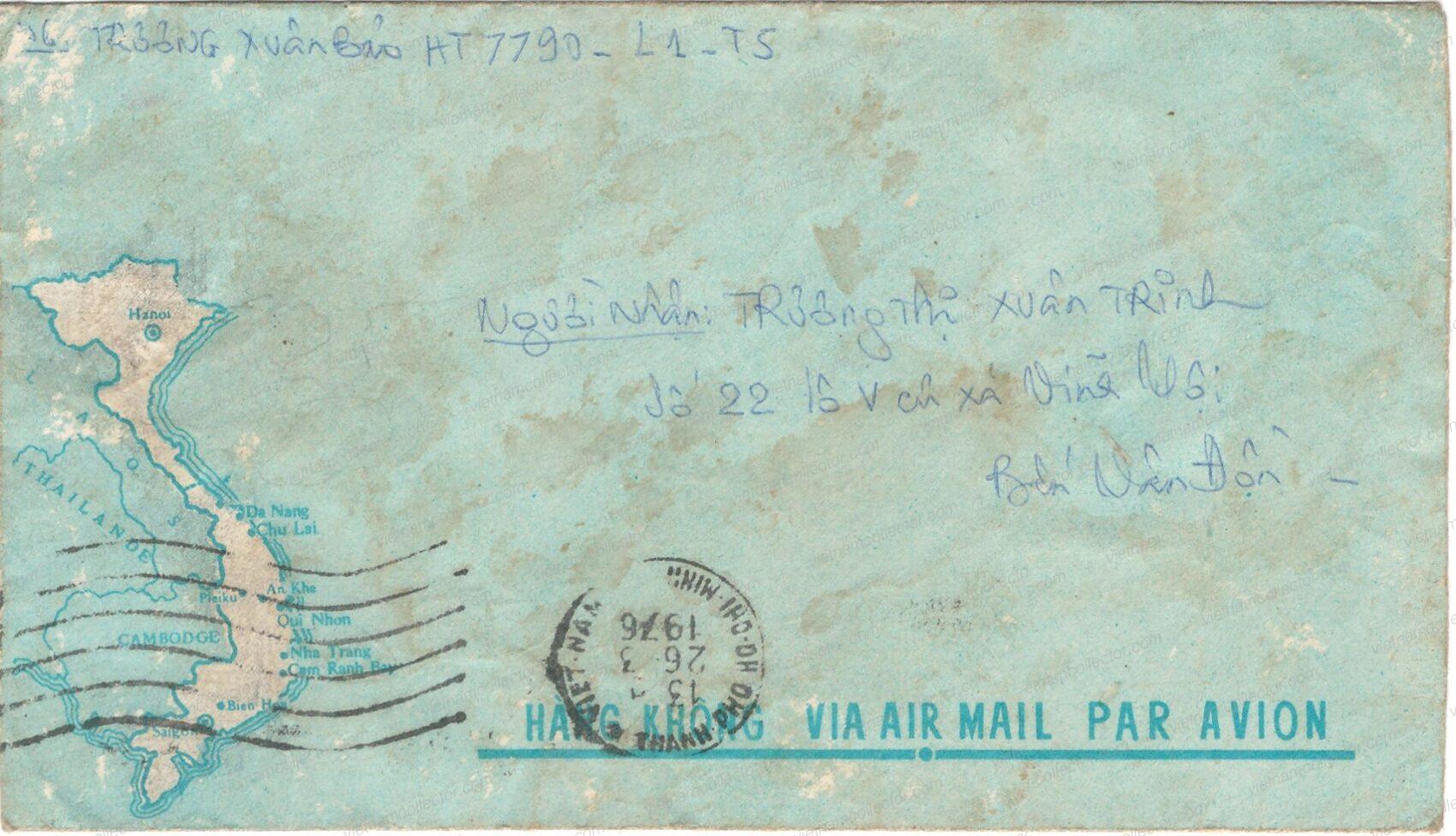
Letter sent in March of 1976 from an inmate of Camp L1 to a civilian in Nam Don. The letter was sent postage free and wass processed in HCM City s indicated b y the machine cancel.
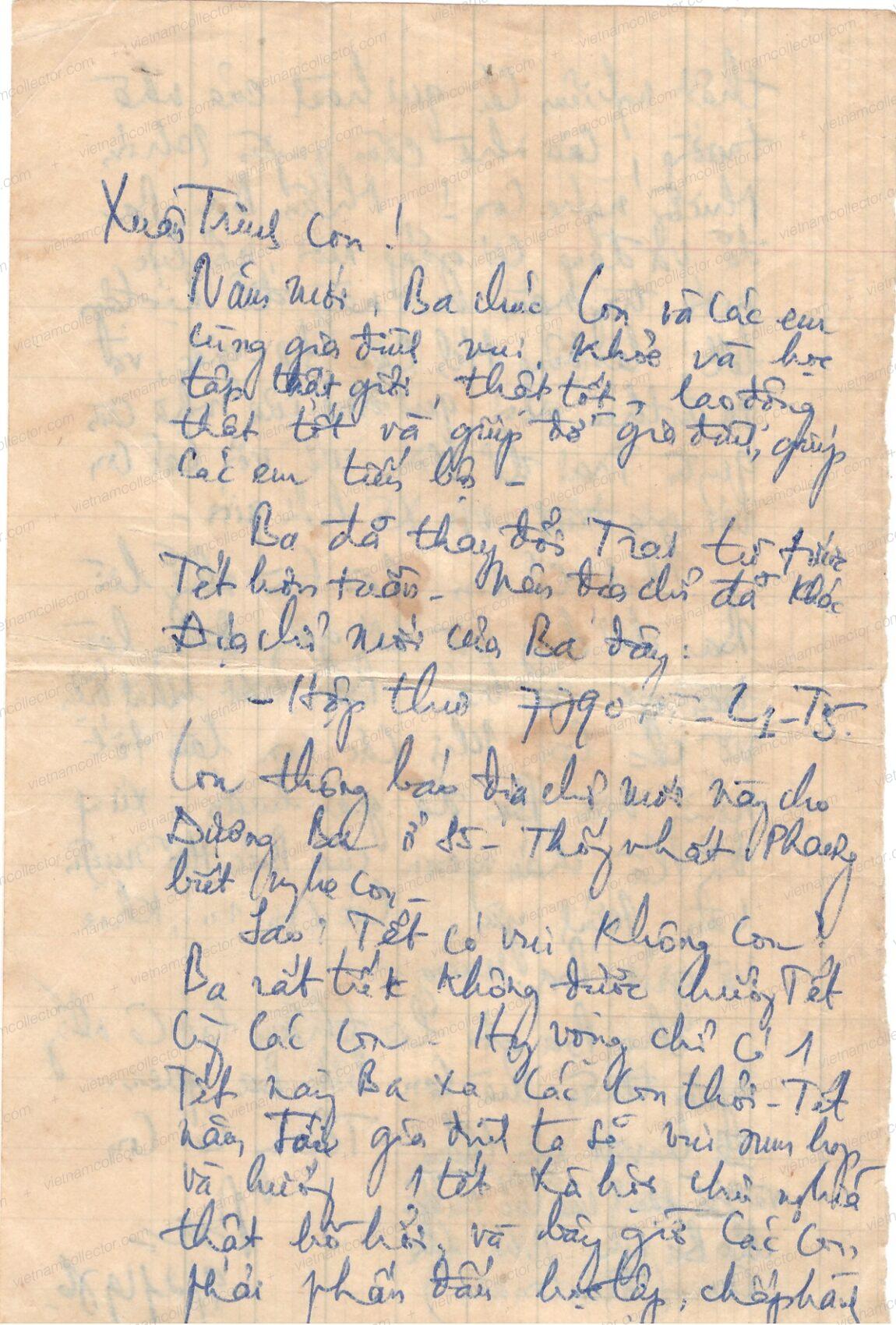
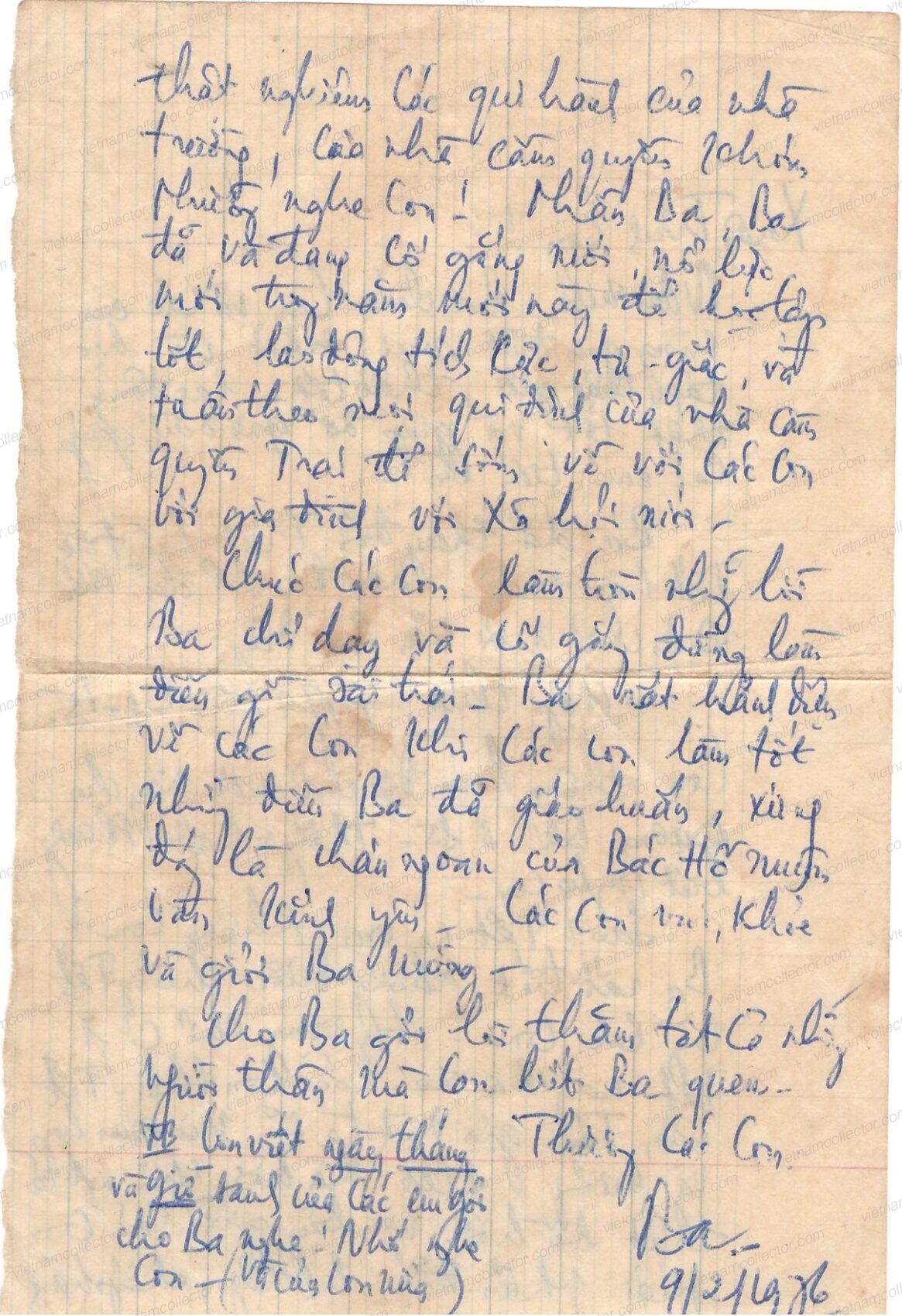
Letter sent by a guard located at Camp L1 to a civilian in Saigon (HCM City) in September of 1976. The letter was franked with a 6xu National Liberation stamp (already in the new unified currency) and processed in Xuan Loc to the East Of HCM City. The 6xu postage indicates that the camp was located within HCM City limits as longer distances required a 12xu stamp. HCM City machine arrival cancel on the reverse.
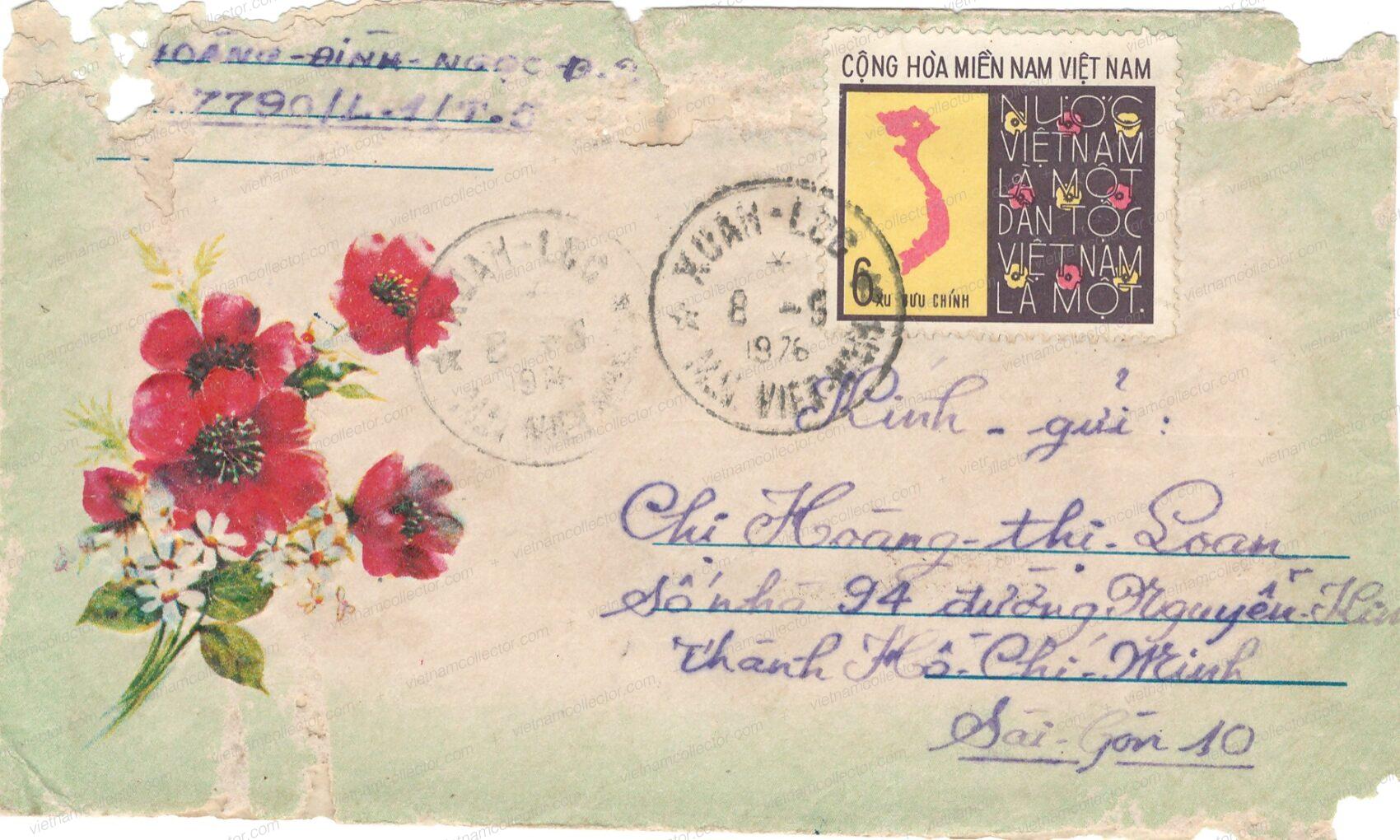
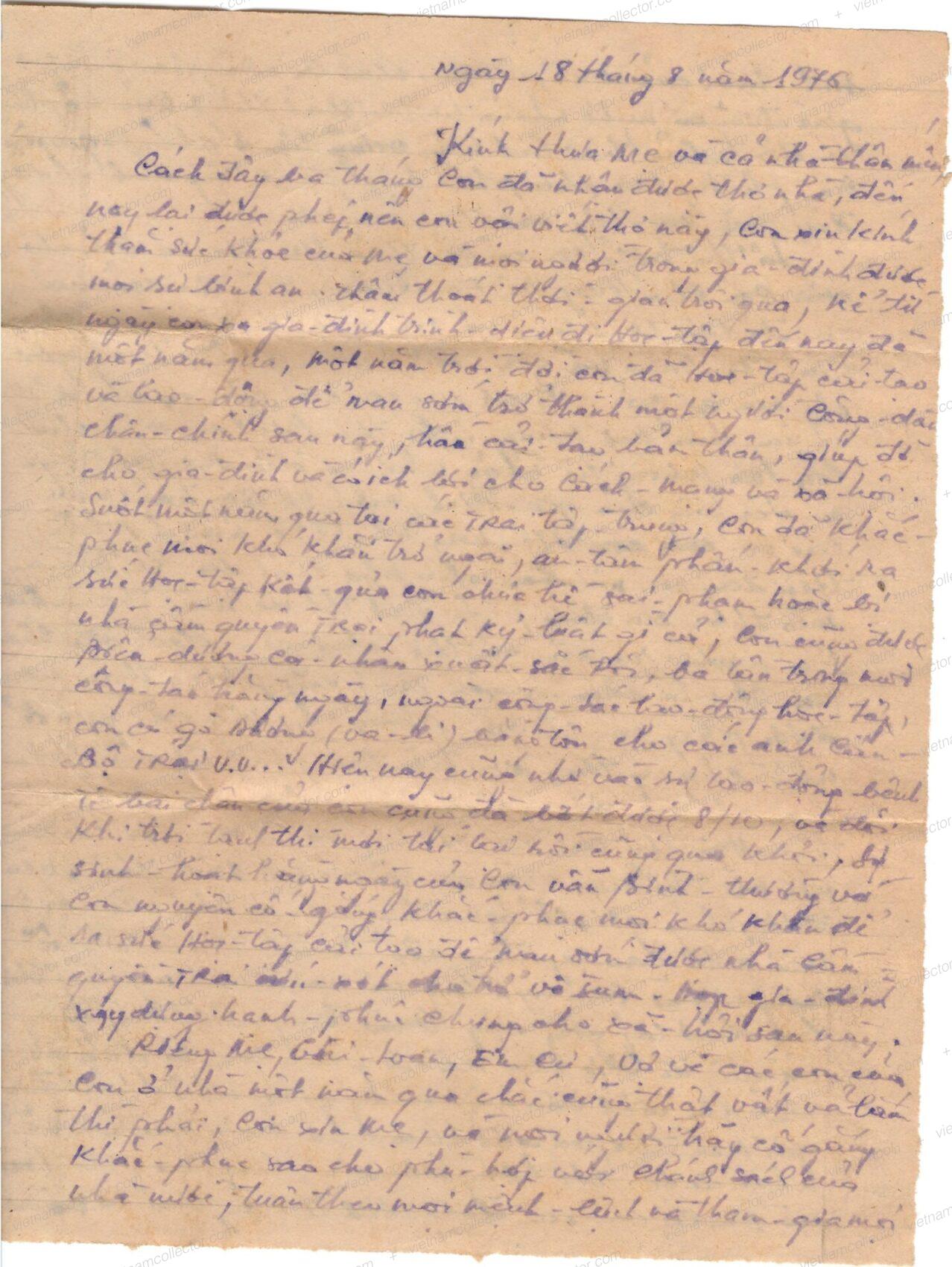
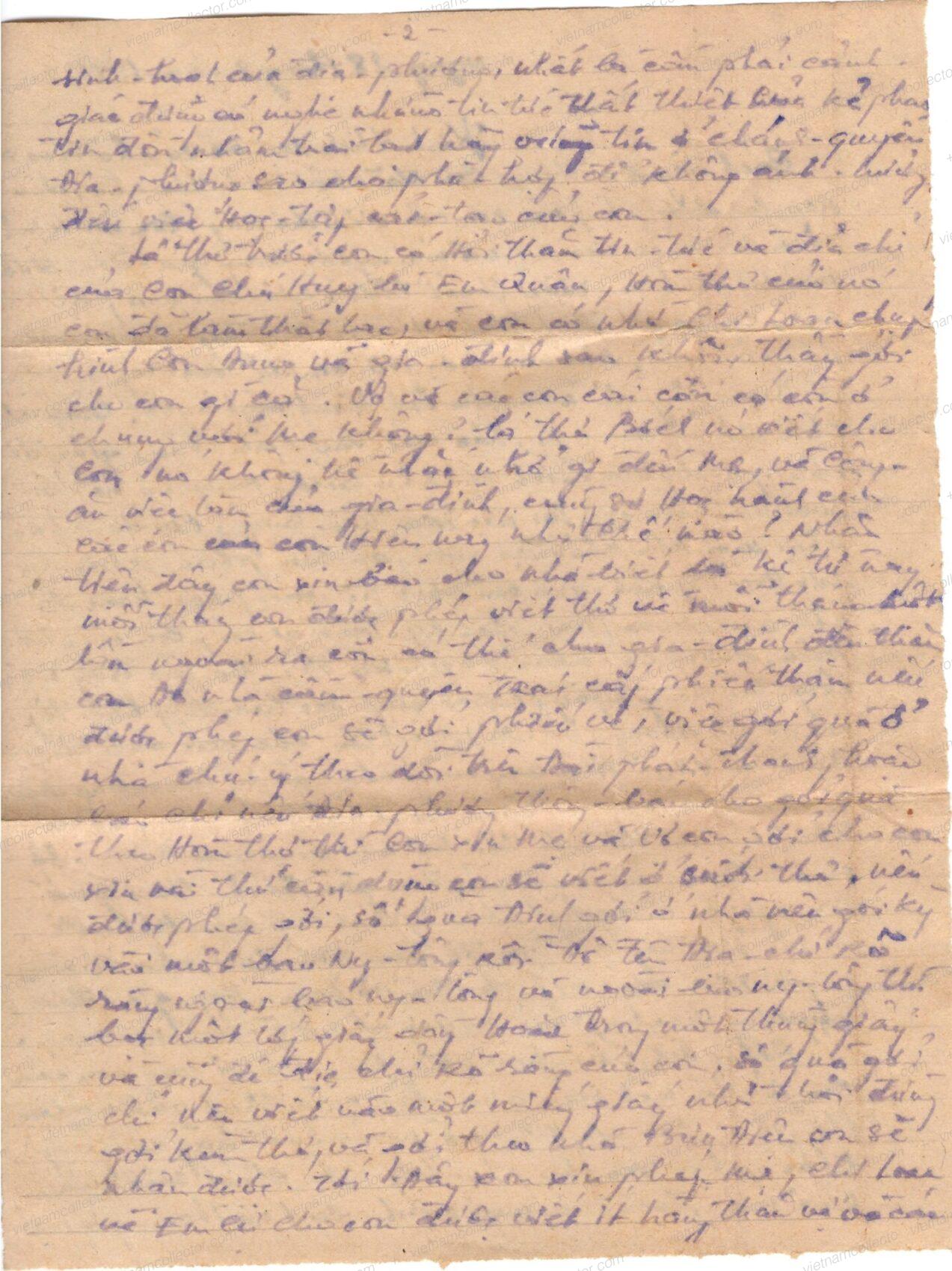
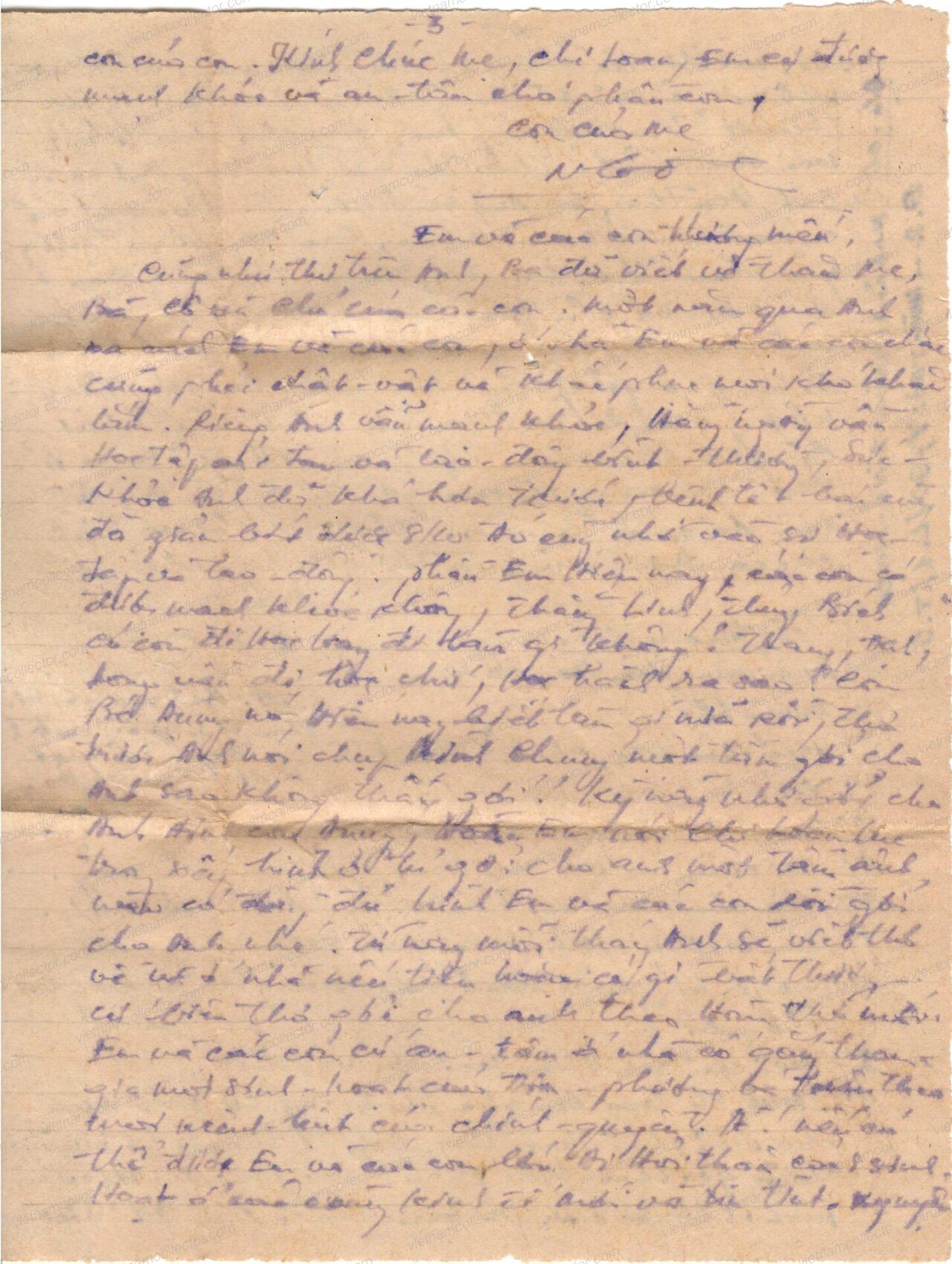
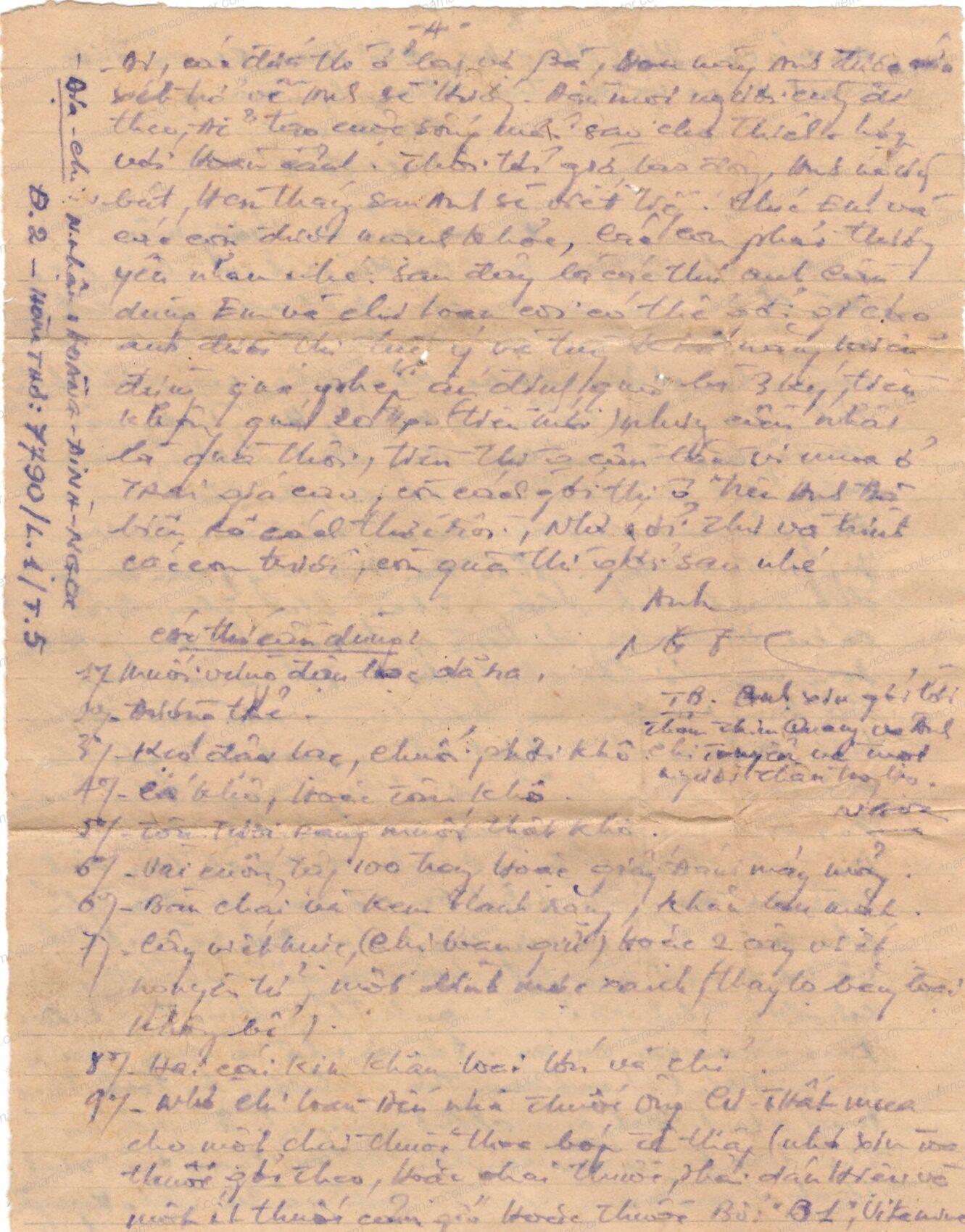
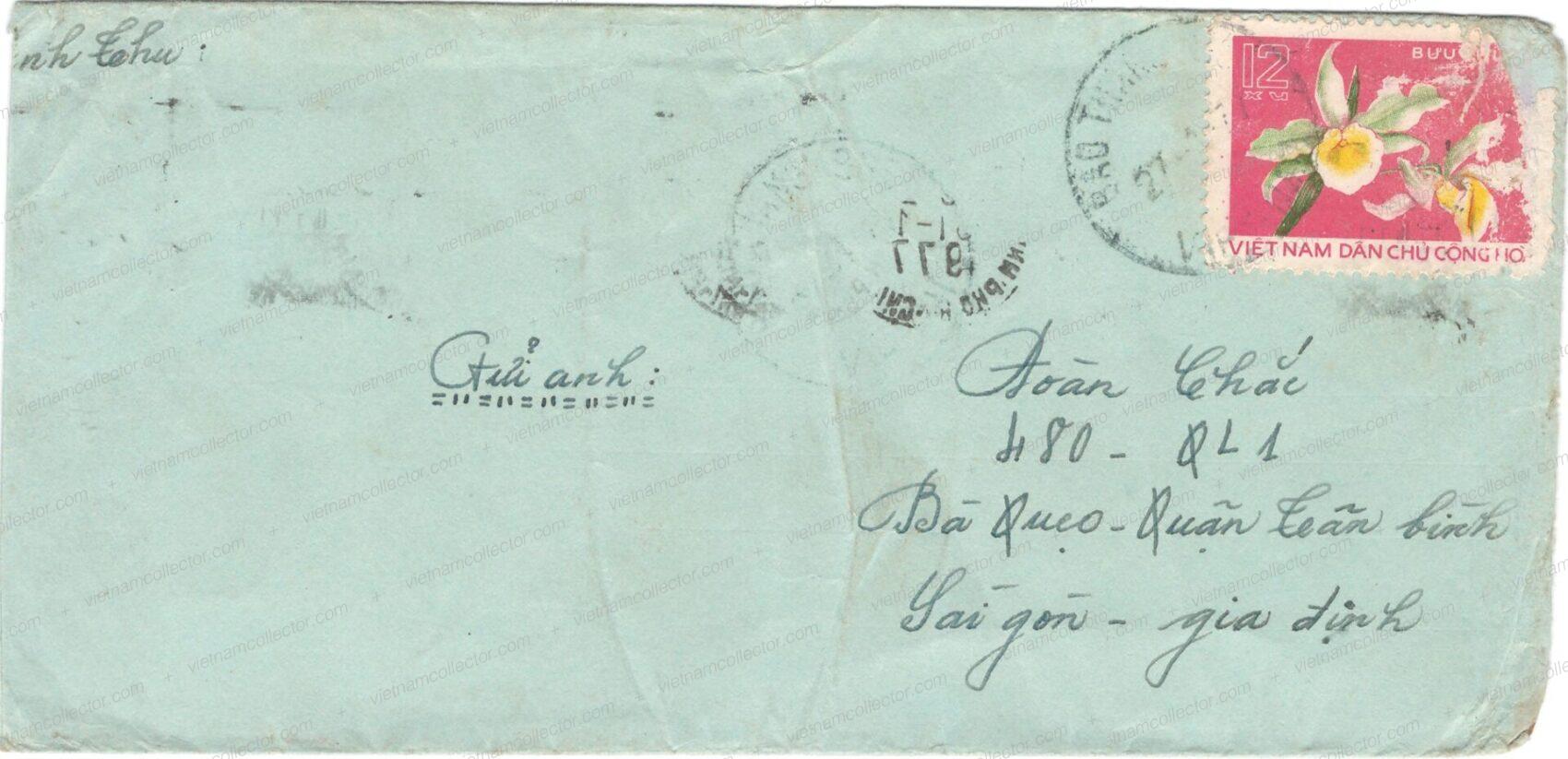
Letter sent by a civilian in January of 1977 to an inmate off Camp L1. The letter was franked with a 12xu Orchid stamp canceled with the circular Bao Thanh cancel. Two HCM City arrival cancels on the reverse.
Camp L2
Interesting cover that was used twice by turning it. It initially was mailed postage free by a civilian in October of 1975 from Gia Dinh to an inmate at Camp L2 in October of 1975. The cover was then returned in January of 1976 (again postage free) from Camp L23 to the same sender. Gia Dinh arrival cancel on the reverse.
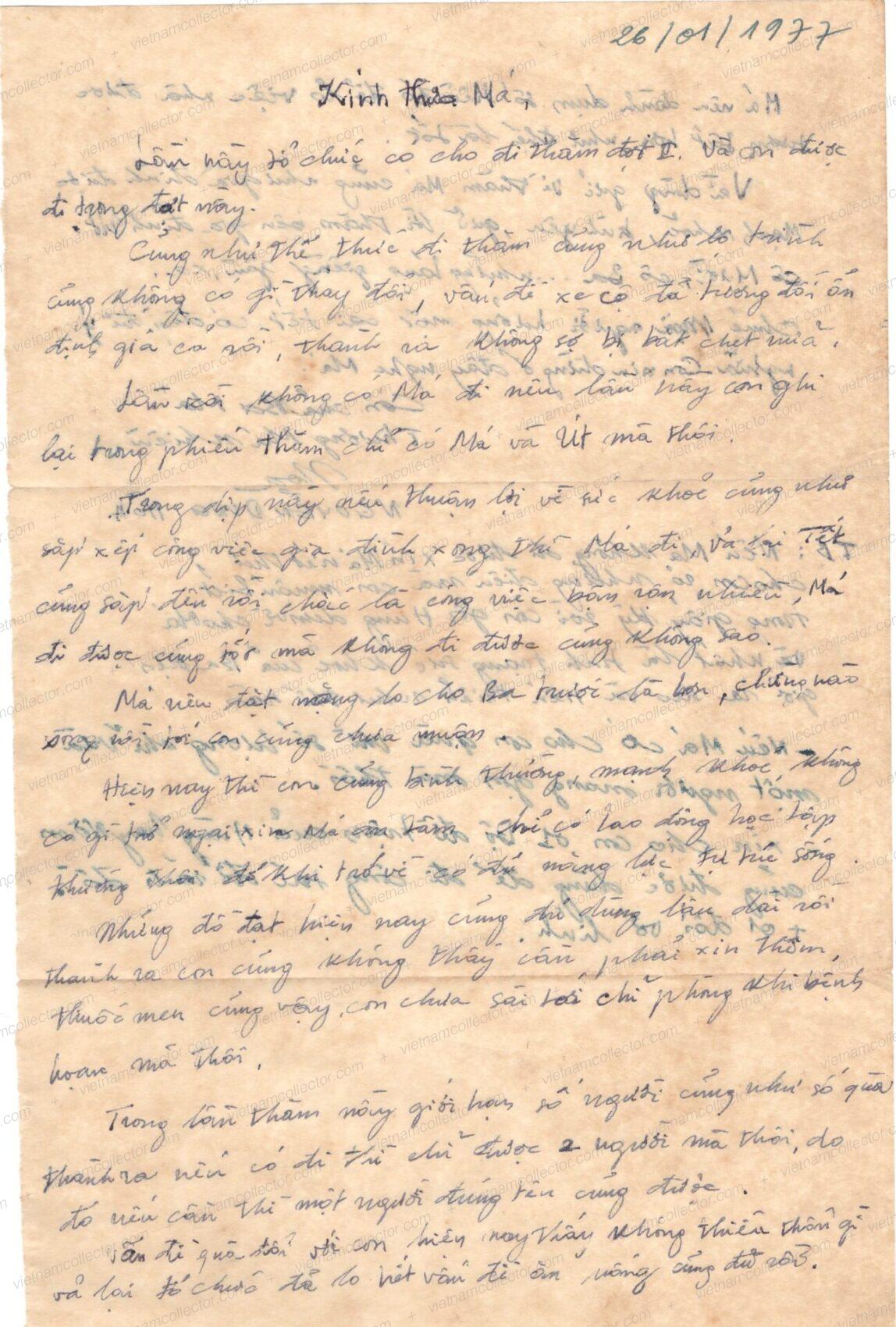
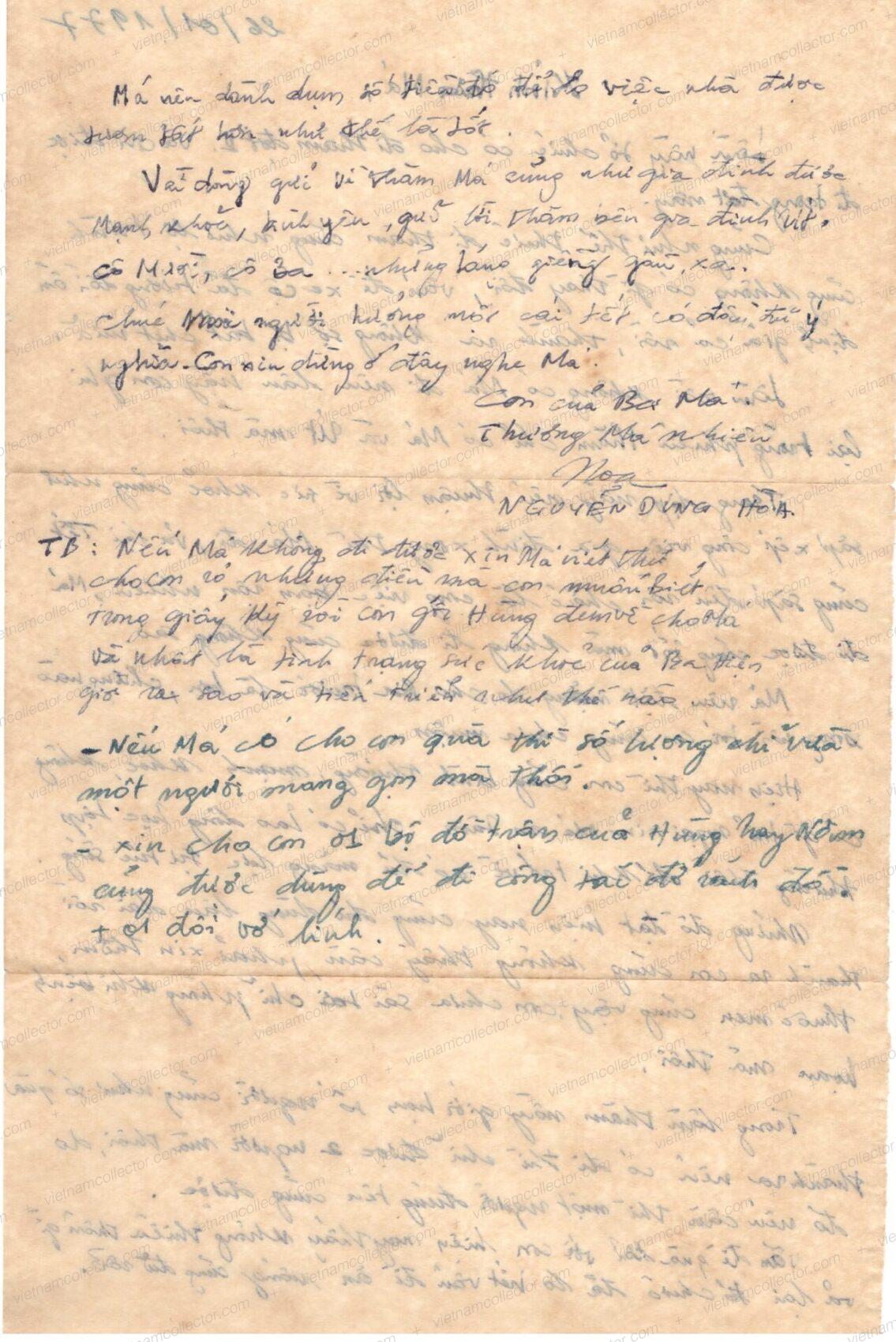
Letter sent by an inmate of Camp L2 to a civilian located in HCM City in August of 1977. The letter was transported postage free and was processed in HCM City as indicated by the machine canceler. HCM City arrival cancel on the reverse.
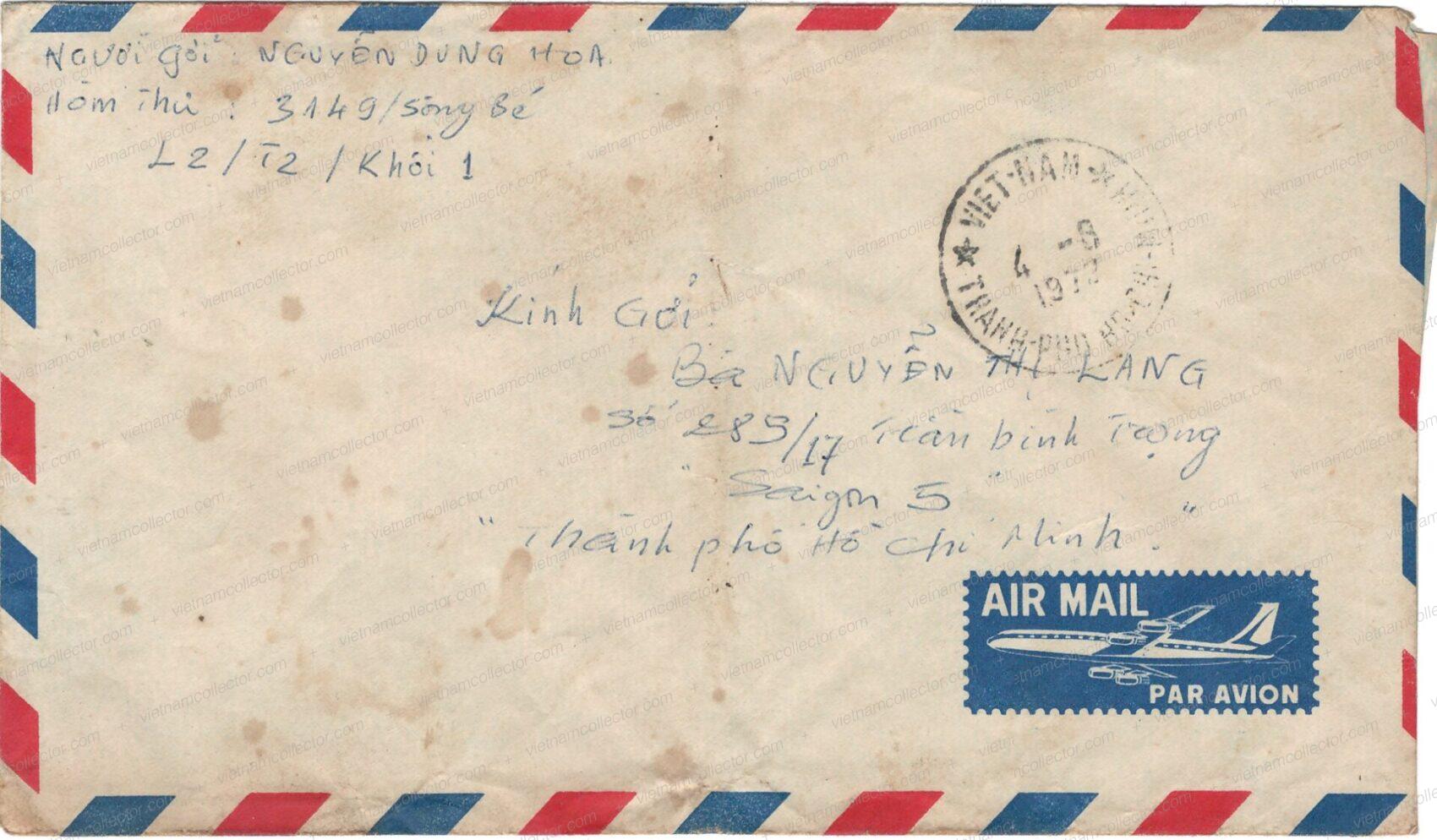
Camp L3
Letter sent by a civilian located in Saigon (HCM City) to an inmate of Camp L3. The letter was processed in HCM City in February of 1976 as indicated by the HCM machine cancel.
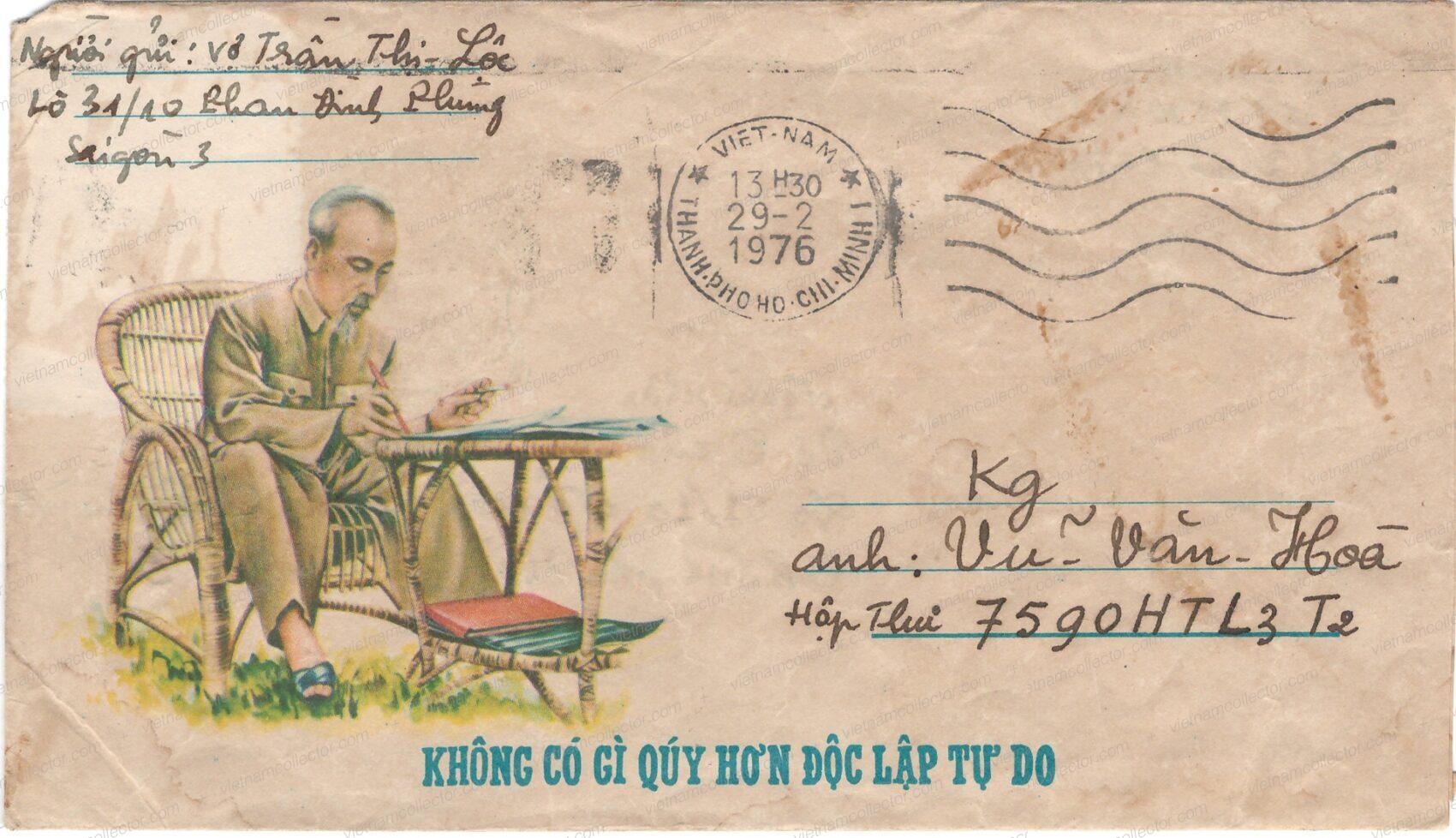
Letter sent by an inmate of Camp L3 to a civilian in HCM City in August of 1976. This camp is associated with Tran Phu South East of HCM City. The letter is franked with a 30D National Liberation Front stamp and was cancelled with the M.N. Xuan Loc canceler.
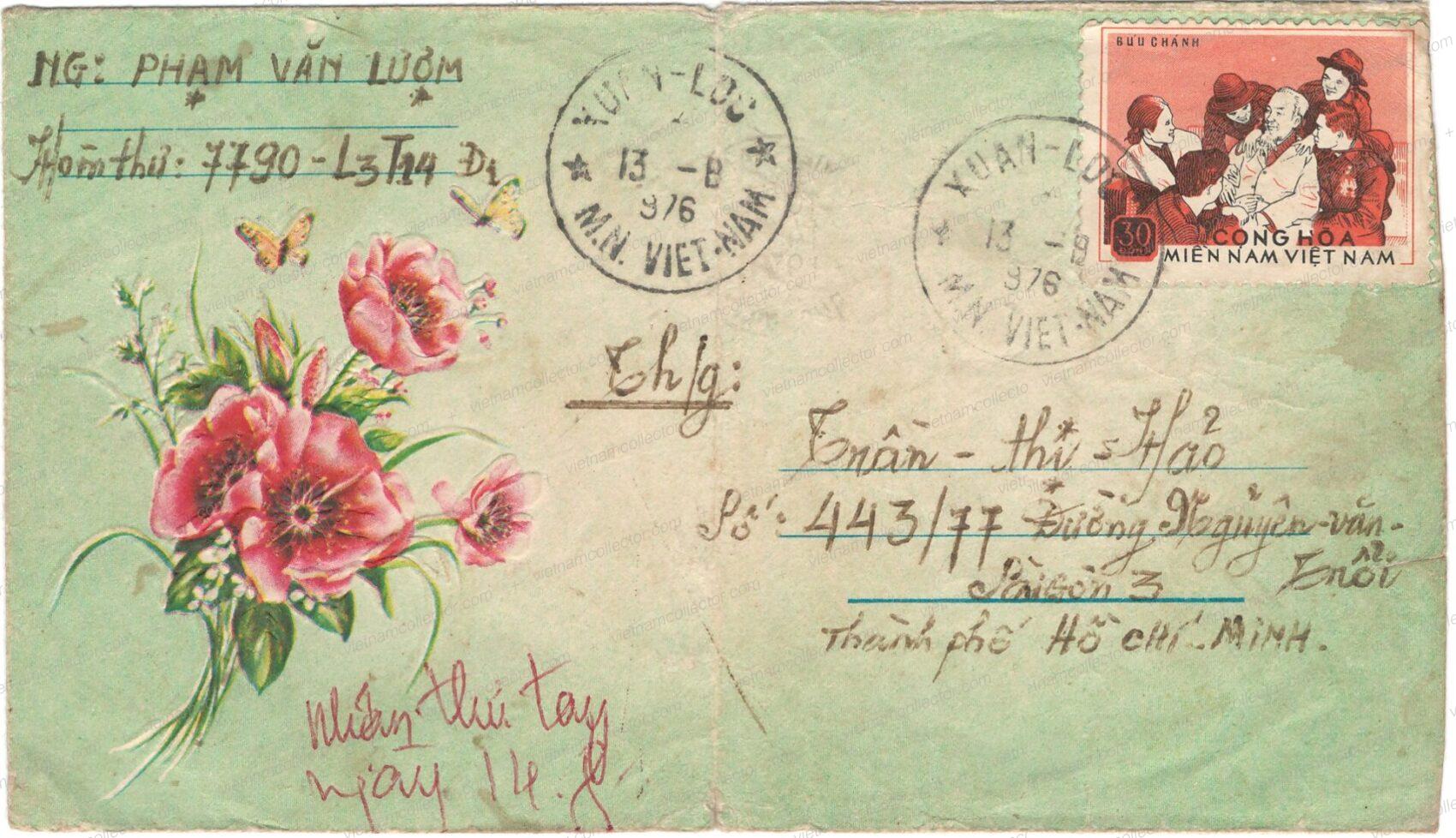
Letter sent in November of 1976 by a civilian in Tay Ninh to a guard or inmate located in Camp L3. Franked with a civilian 12 xu Red Cross stamp from 1976. HCM City arrival cancel on the reverse. Red boxed propaganda cachet on front “nhiệt liệt chào mừng hai hội đảng lần thứ IV” which translates to “welcome the two party associations for the fourth time”.
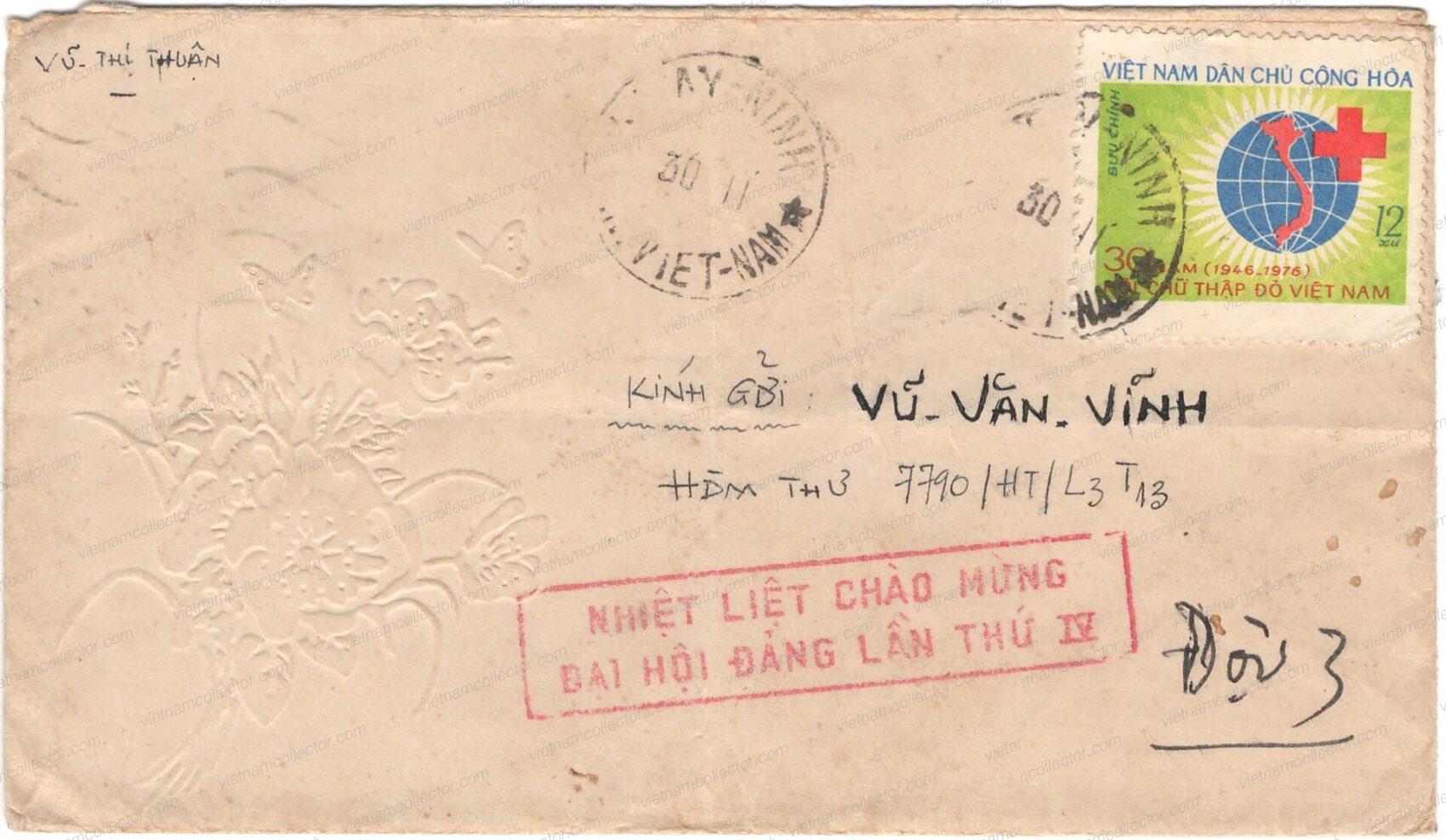
Letter sent by an inmate or guard from Camp L3 to a civilian in HCM City in September of 1977. The letter is only franked with a 6xu stamp which was the intra-city tariff at the time suggesting that the letter was sent within the HCM City limits. Cancelled with the circular Xuan Loc canceler through which the letter was apparently processed. Two HCM City arrival cancels on the reverse.
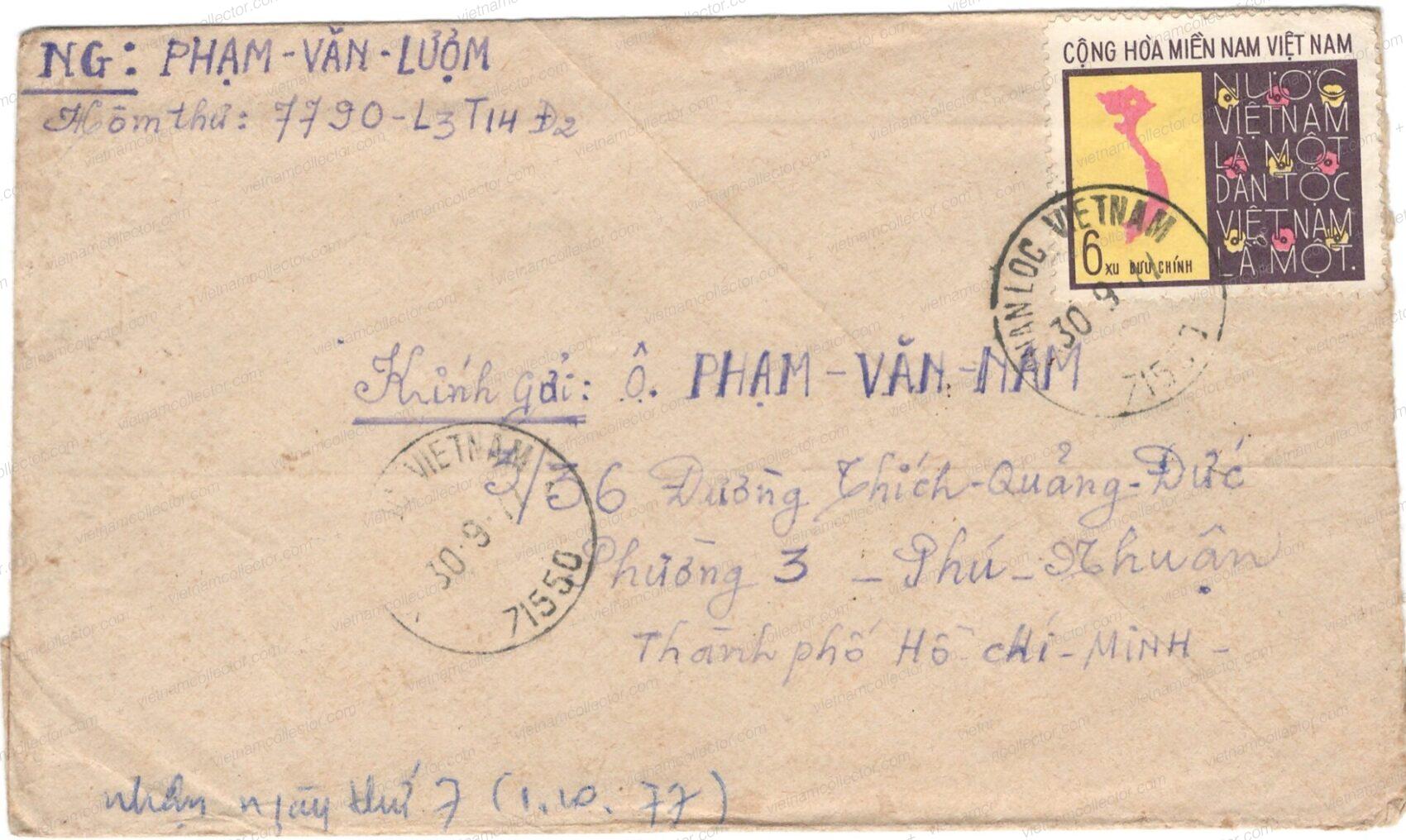
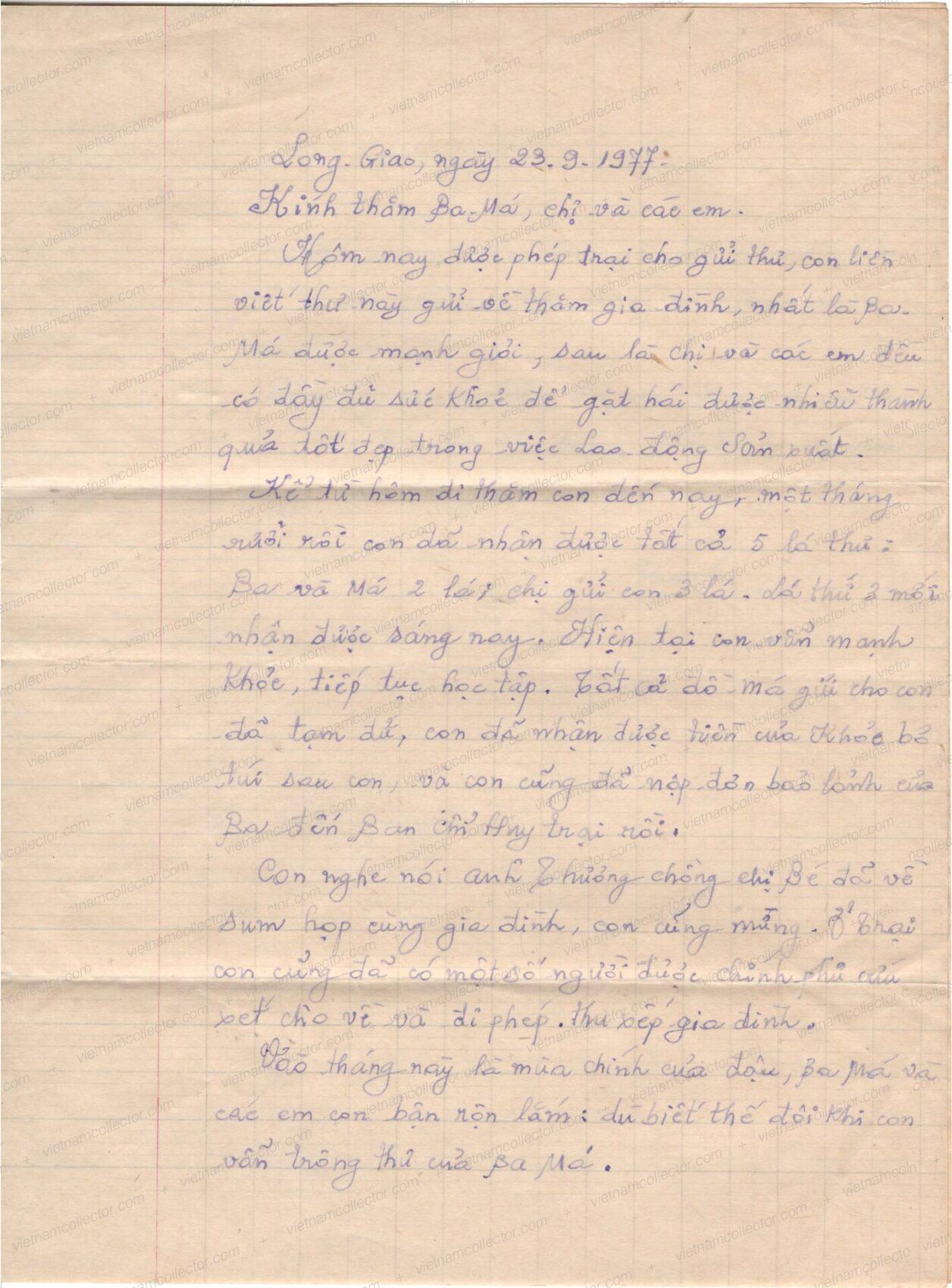
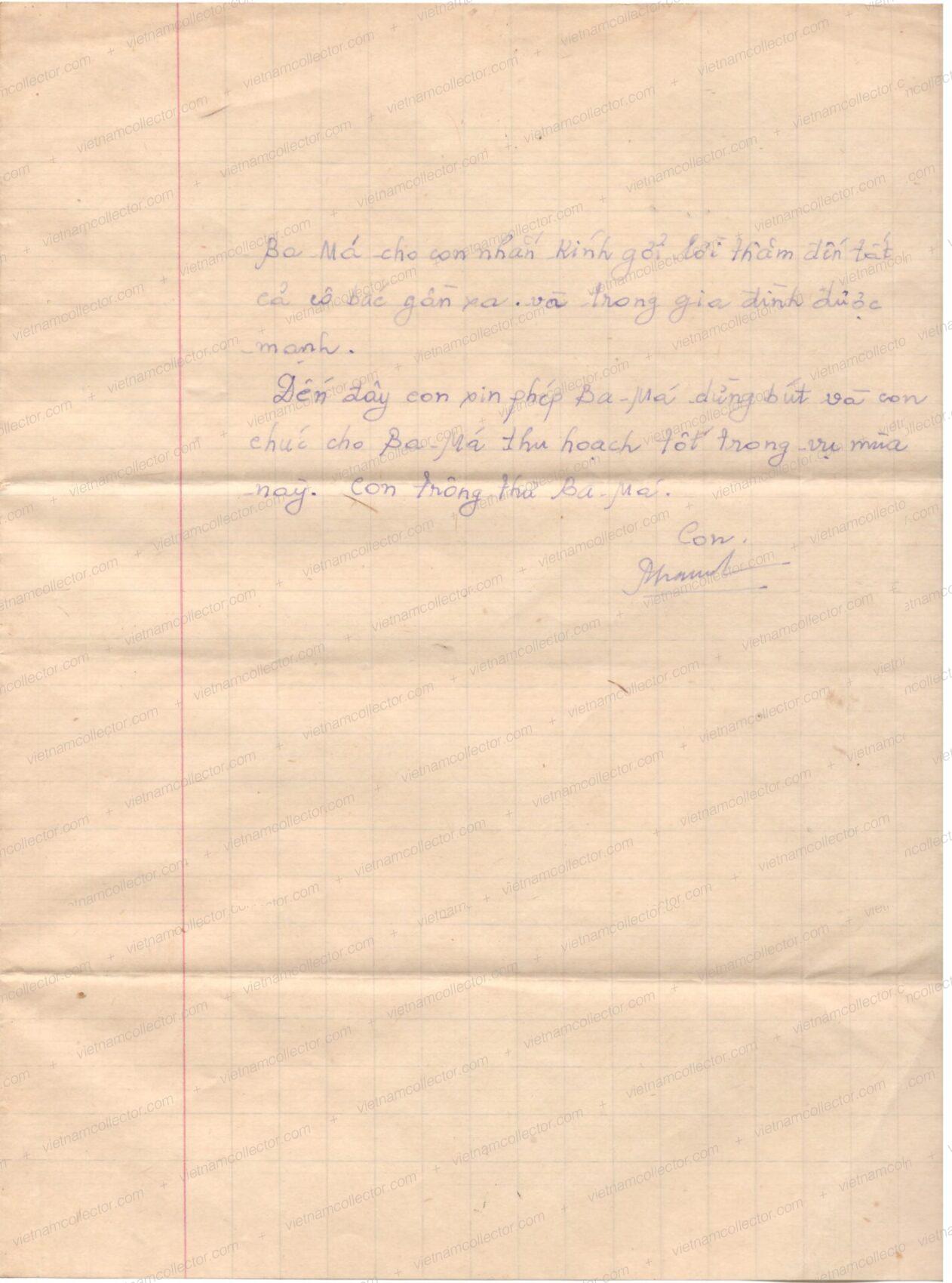
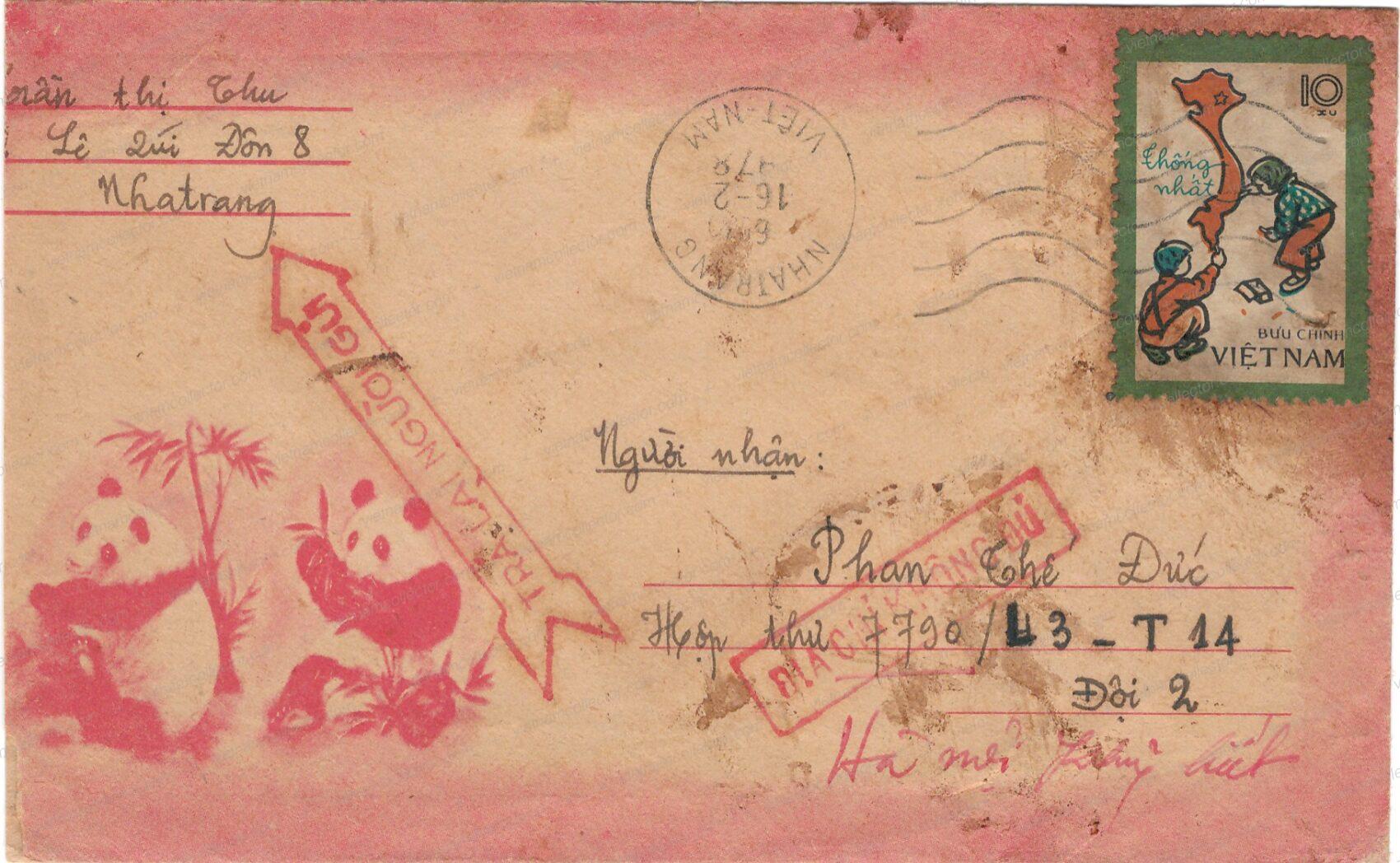
Letter sent by a civilian located in Nha Trang to an inmate in Camp L3 in February of 1978. Franked with a 10xu civilian stamp. Apparently the inmate was no longer located at the facility and hence the letter was returned to the sender as indicated by the red boxed cachets.
Camp L4
Rare incoming letter sent by a civilian to an inmate in Camp L4 in June of 1976. Franked with two 30D National Liberation stamps paying an overall postage of 60D. Since the South Vietnamese Dong had been devalued by 500:1 in 1975 that was worth 12xu. Transported by military pouch to HCM City and cancelled there. HCM City machine arrival cancel on the reverse.
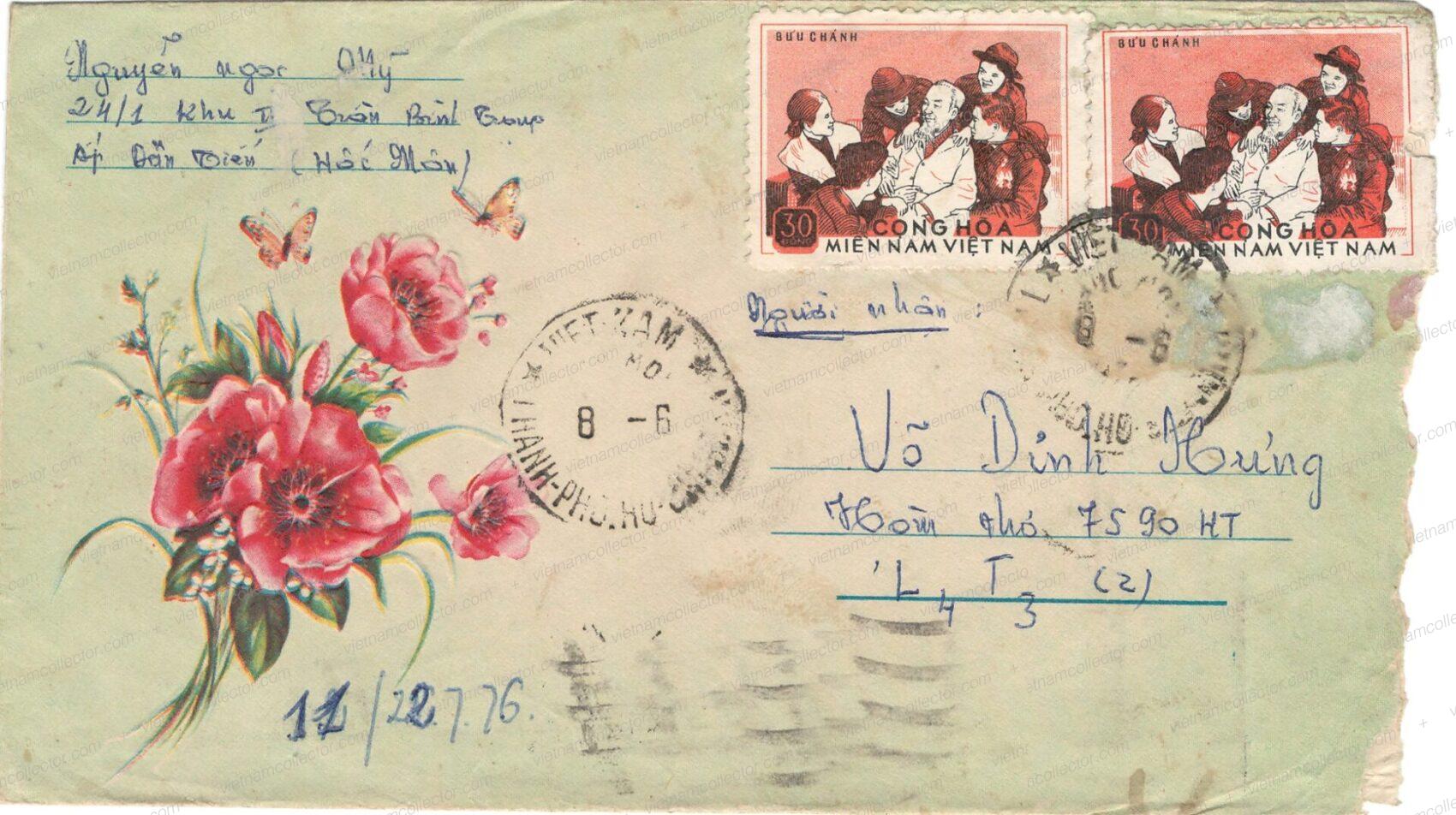
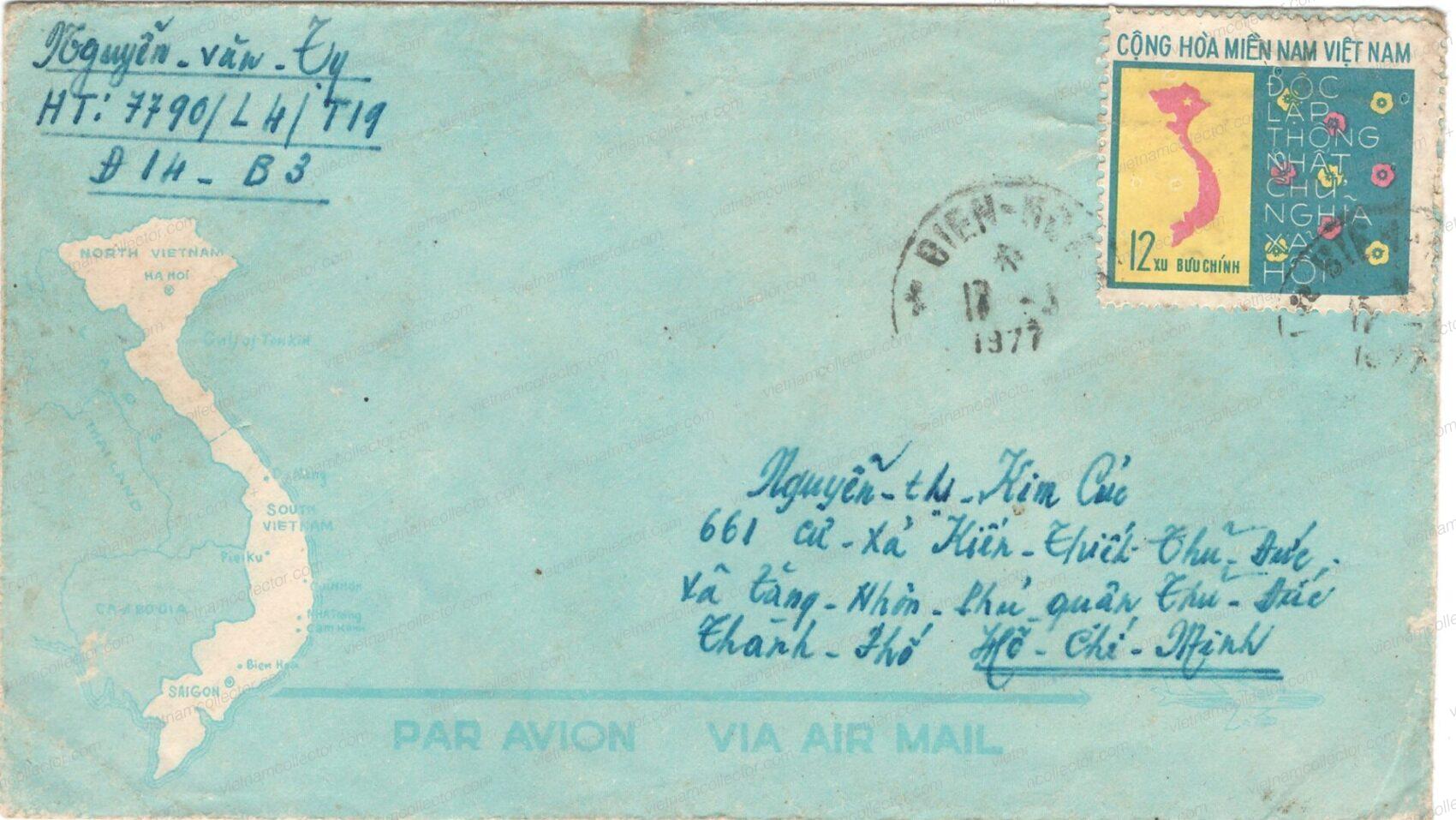
Letter sent by an inmate of Camp L4 to a civilian in HCM City in March of 1977. Franked with a 12xu civilian stamp paying the correct postage of 12xu. Cancelled with the Bien Hoa canceler. HCM City machine arrival canceler on the reverse.
Camp L6
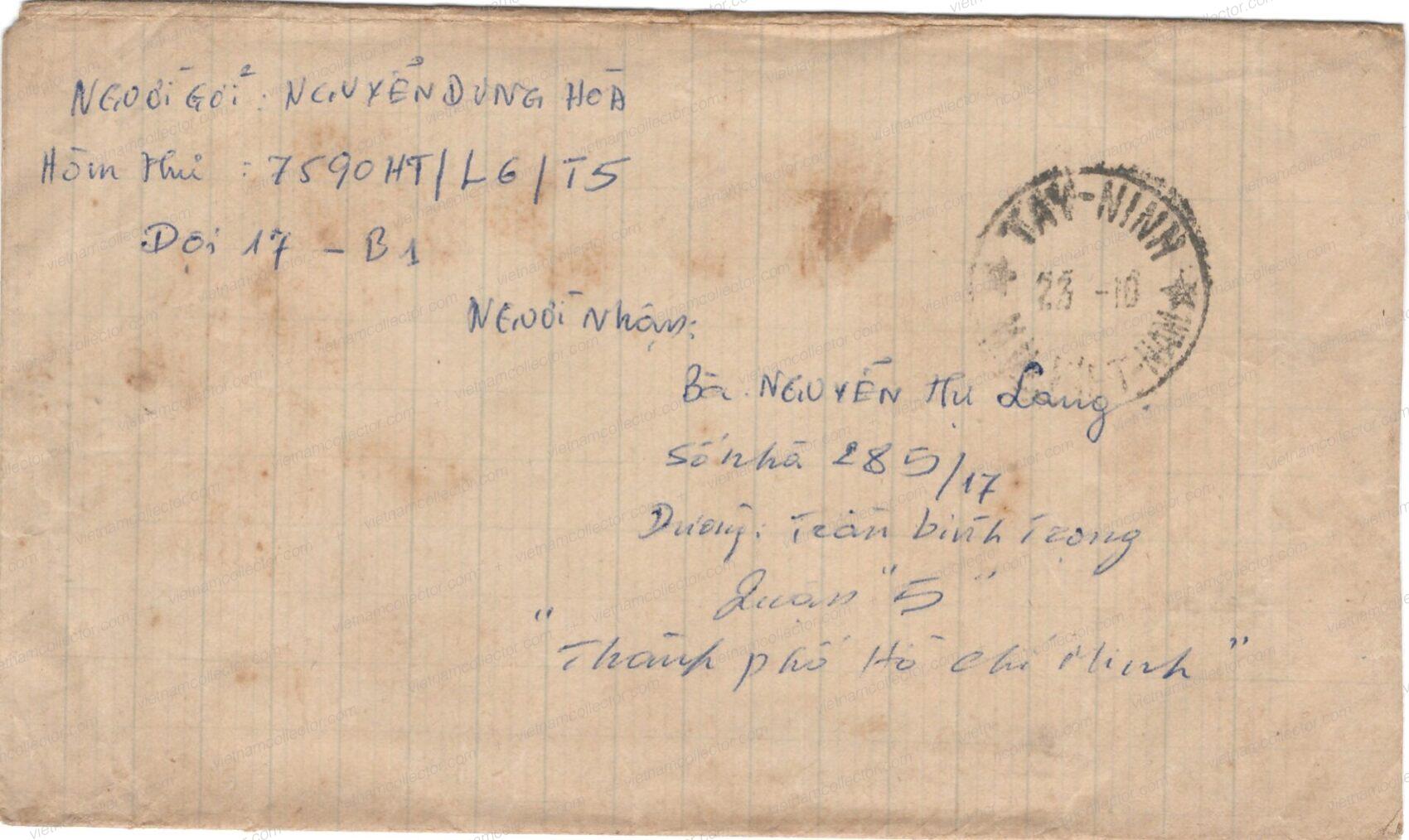
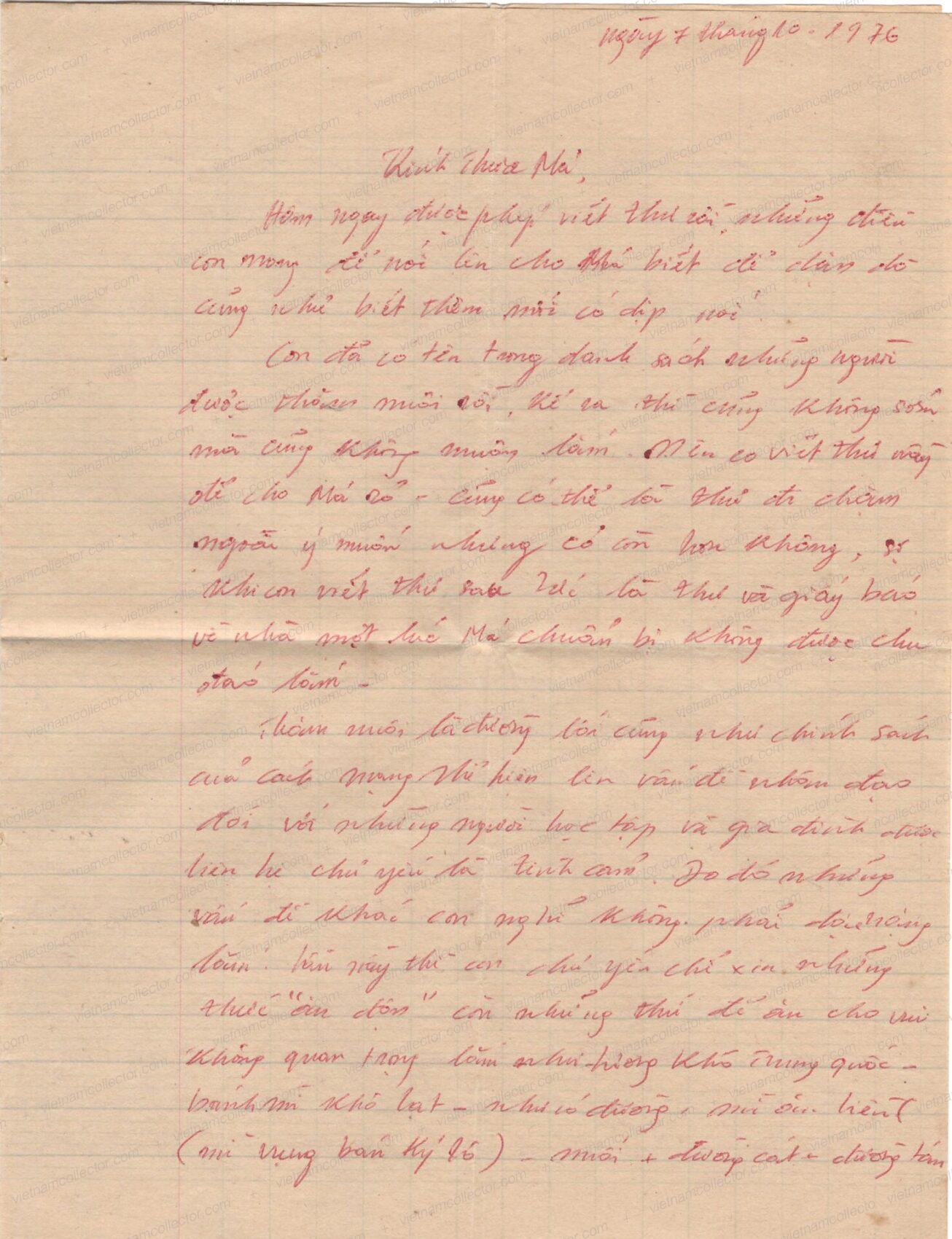
Two letters from the same correspondence. Both were sent by an inmate of Camp L6 to the same civilian in October and November of 1976. Both letters were transported postage free and both were processed in the Tay Ninh post office. This may our may not indicate that the camp was located within the vicinity of Tay Ninh. Both letters show HCM machine arrival cancels.
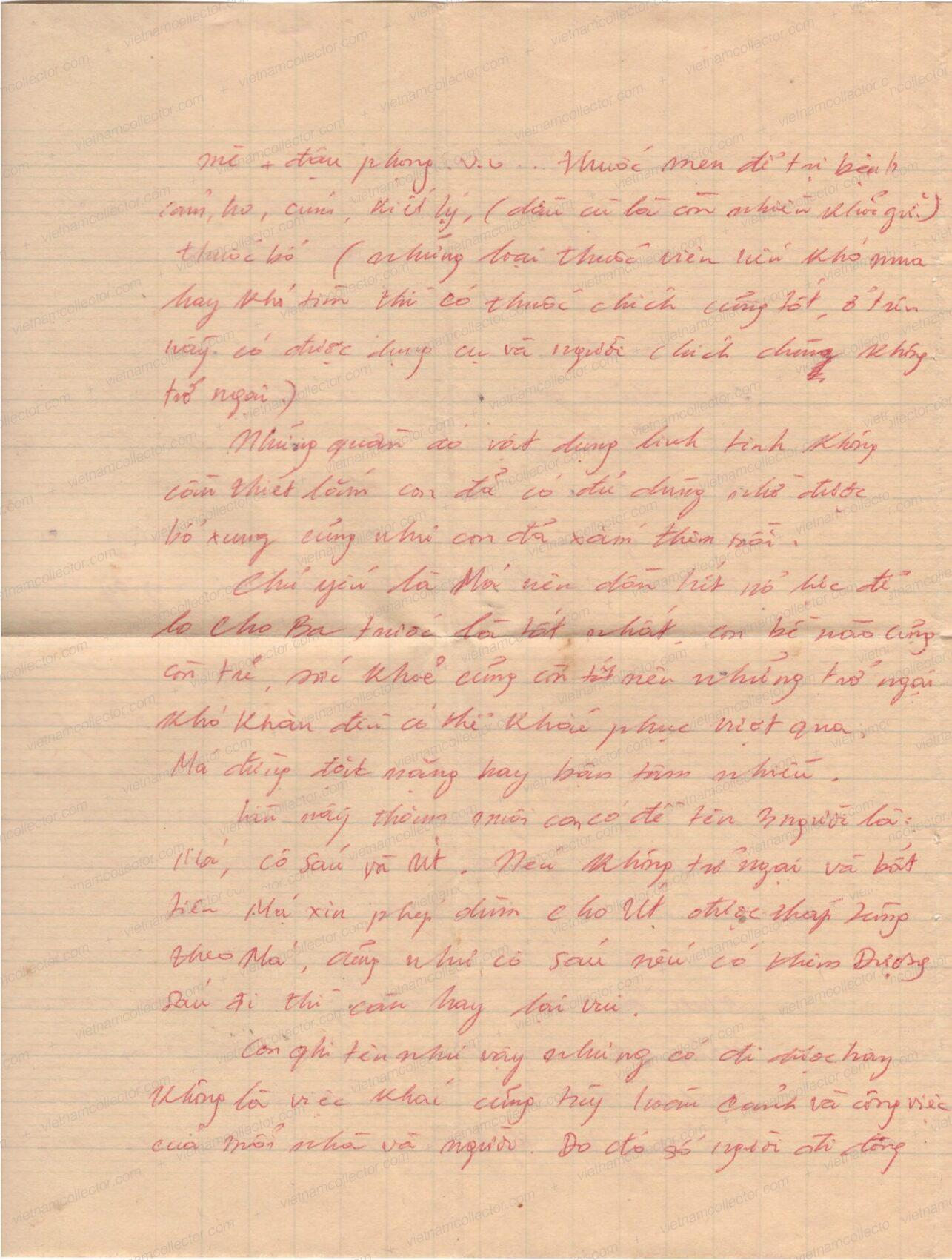
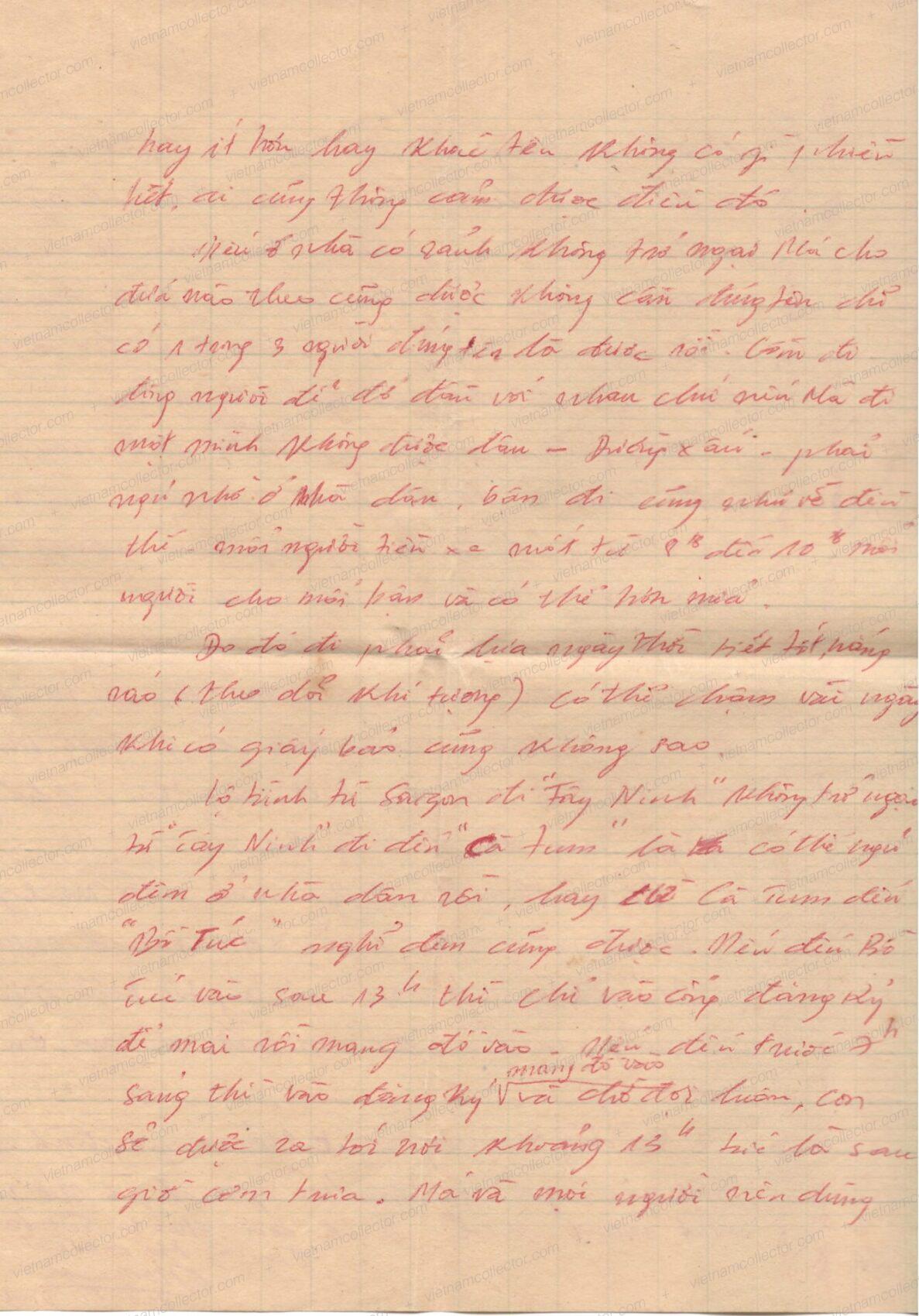
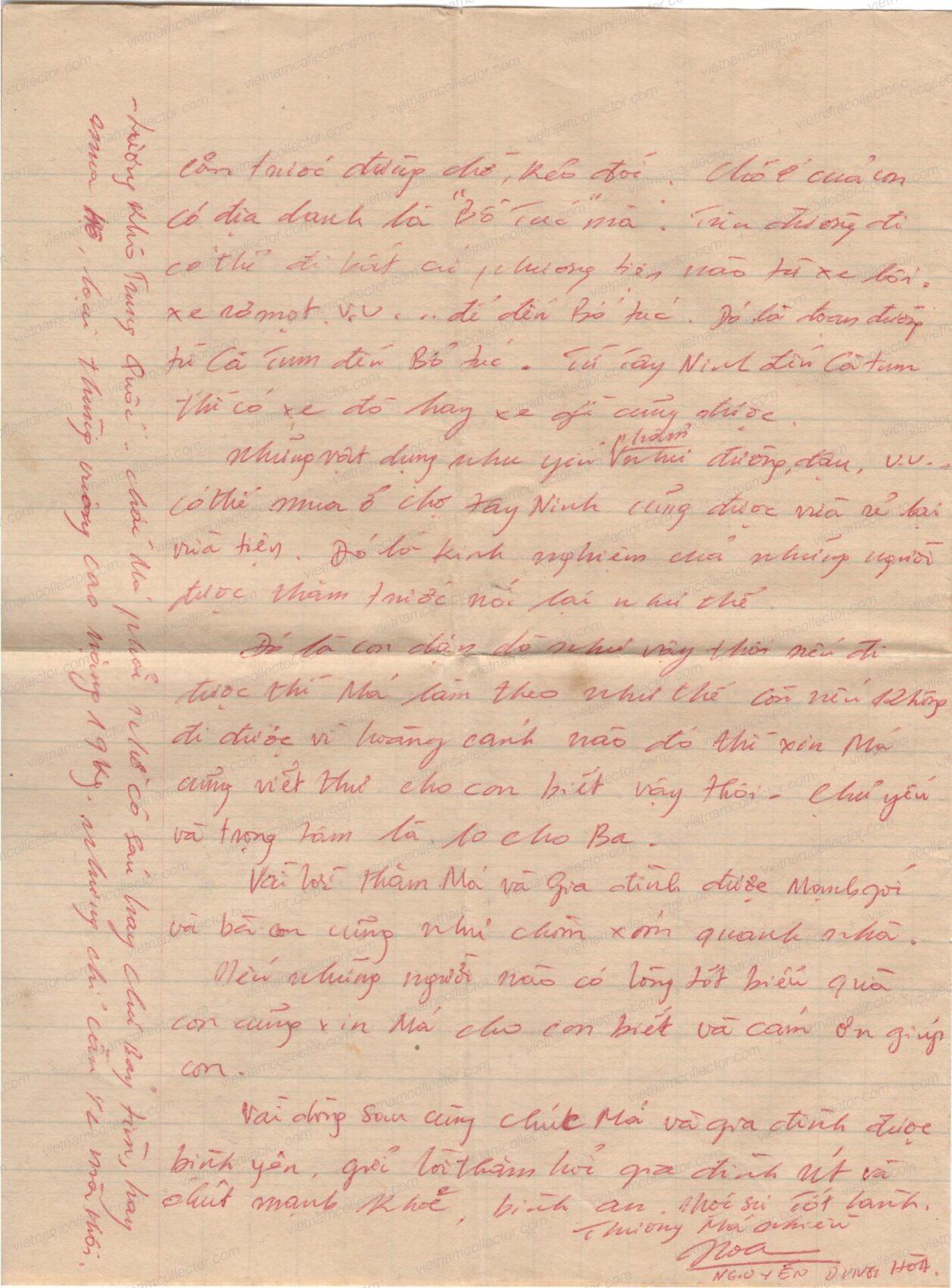
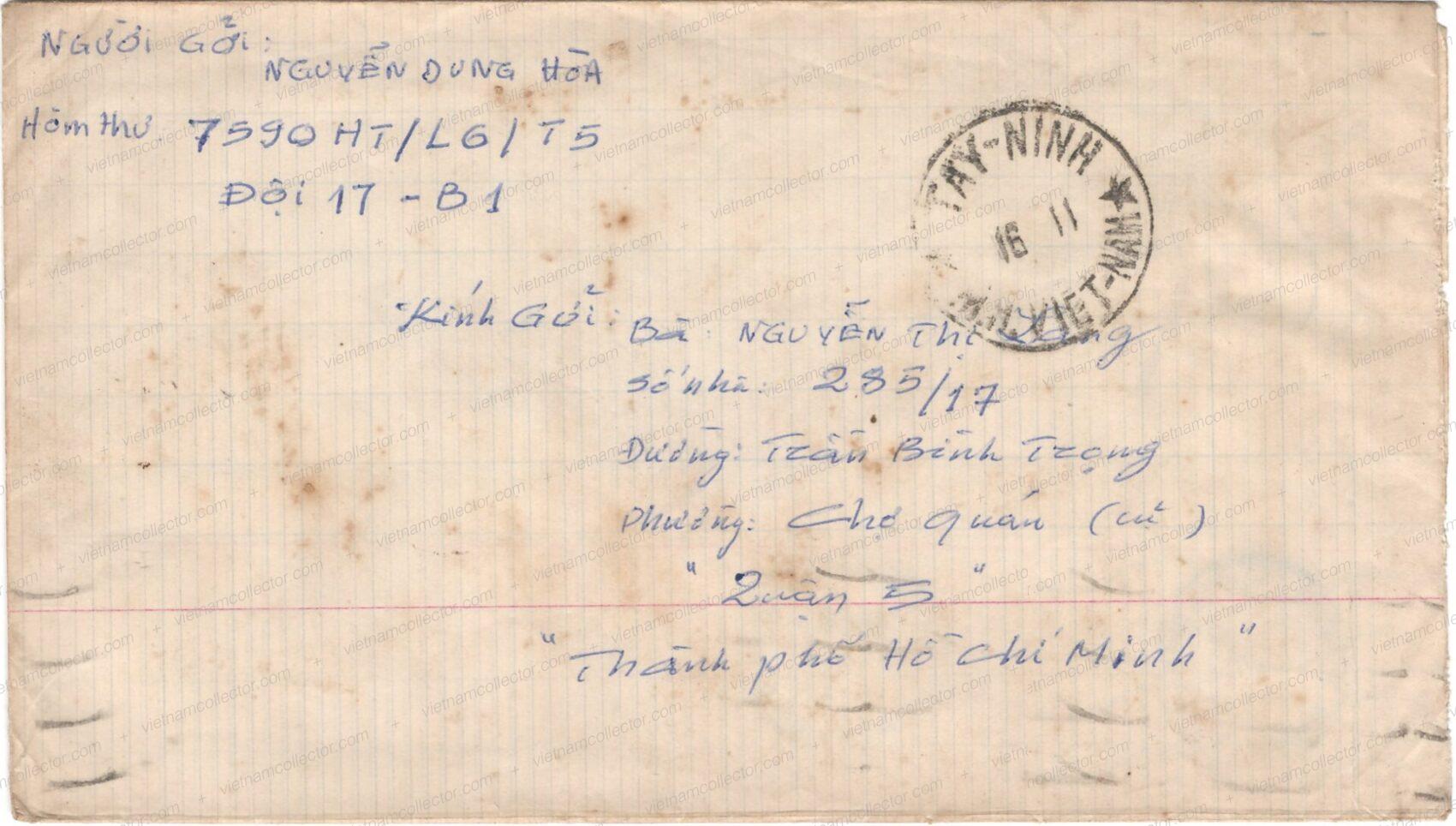
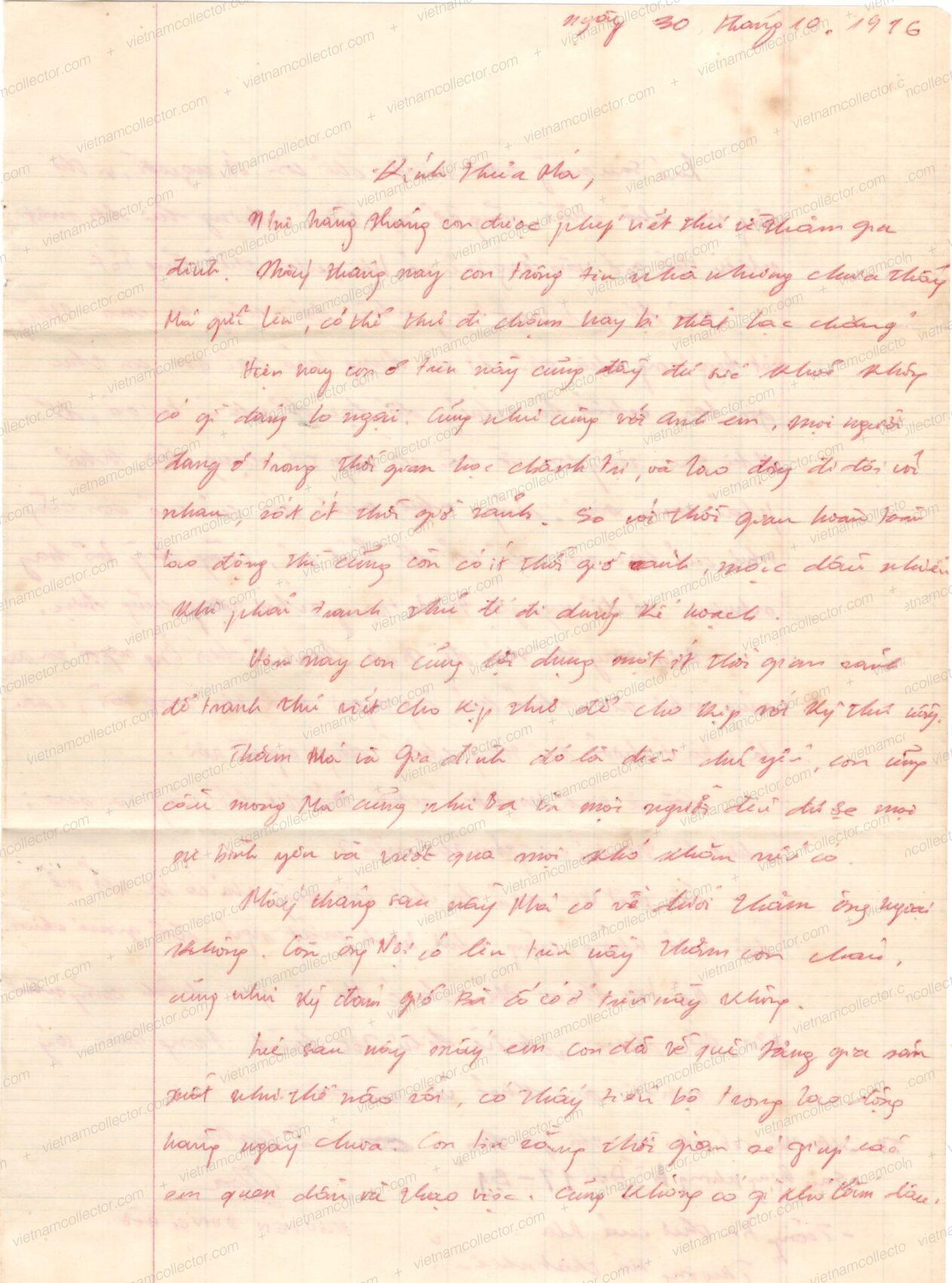
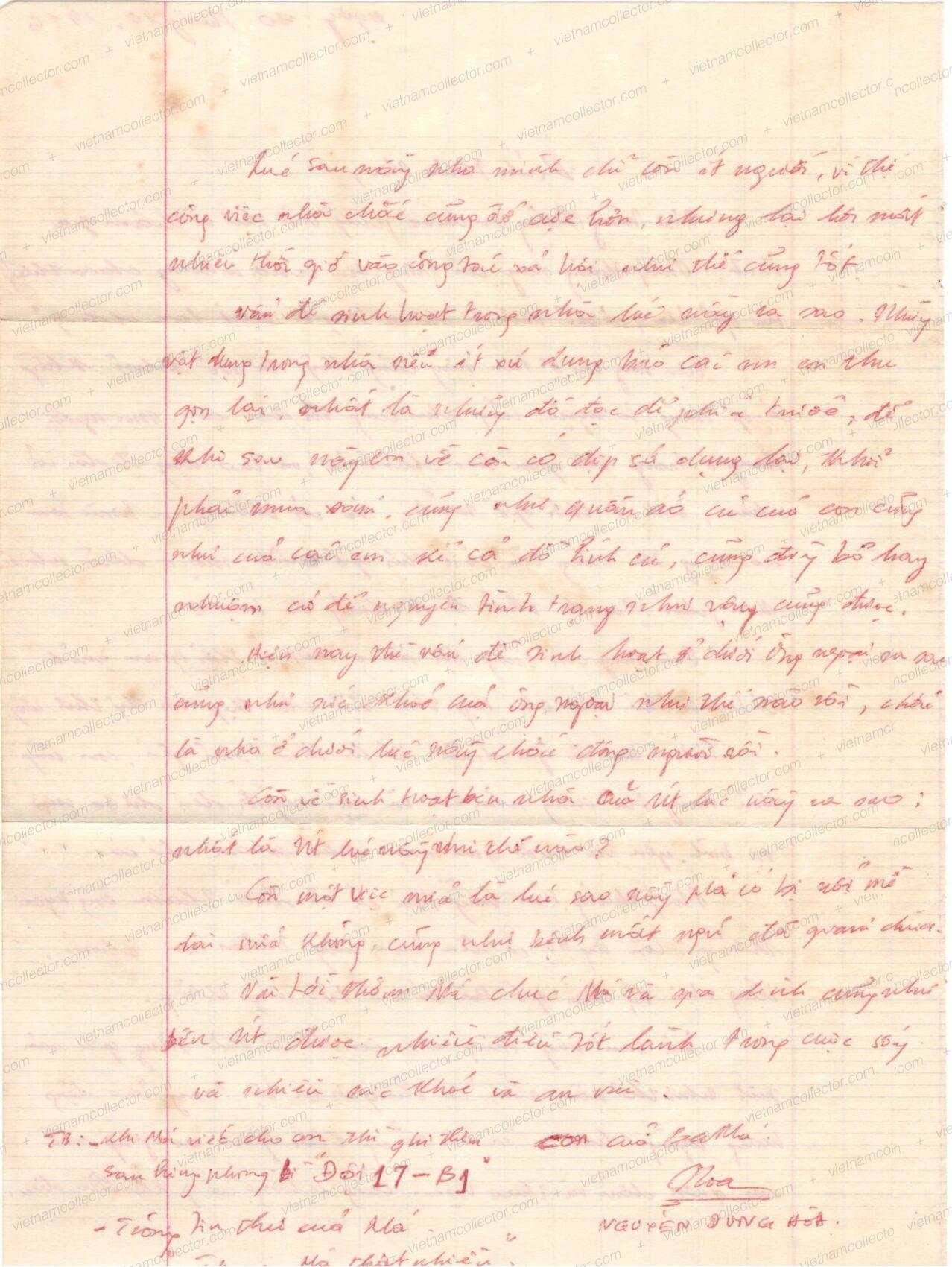
Camp L9
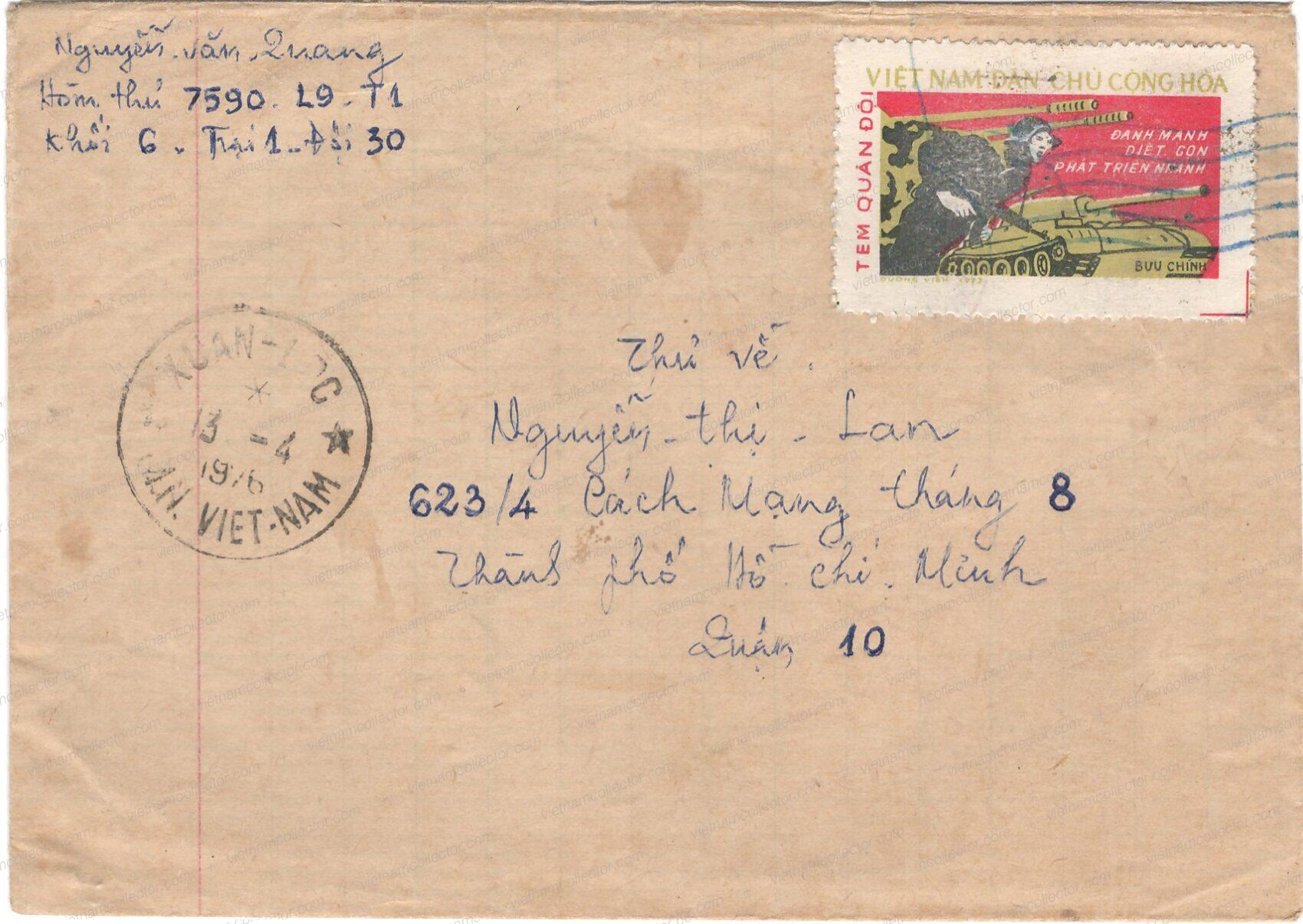
Here is a military cover that was mailed by a guard from Camp L9 to a civilian in Ho Chi Minh City in April of 1976. Camp L9 was located in Dong Nai Province to the East of HCM City. SICP member Bob Munshower speculated that L9 was a sub camp of the Hoc Mon prison in HCM City. The cover is franked with the military free frank from 1973 (Perforation 12.5, Michel Nr. M24C) which indicates that less than a year after the end of the war (April 30th, 1975) guards already had to use military free franks to mail items. The letter has a civilian cancel from Xuan Loc but the stamp was cancelled with the machine cancel from HCM City. There is also the same machine arrival cancel on the reverse.
Camp L19
Rare incoming letter sent in August of 1975 by a civilian in Phang Rang to a person located in Camp L19. The letter is franked with a 6xu National Liberation stamp (already in the new unified currency). 6xu was the intracity rate at the time so it is likely that the camp, of which little is known, is located in the proximity of Phan Rang or was even located in Phang Rang prison. On the other hand the writer indicated in the letter that his location was Rach Gia which is to the South West of HCM City. Since camp mail was often processed centralized in larger post offices the location of the canceler may or may not be an indication where a camp was located.
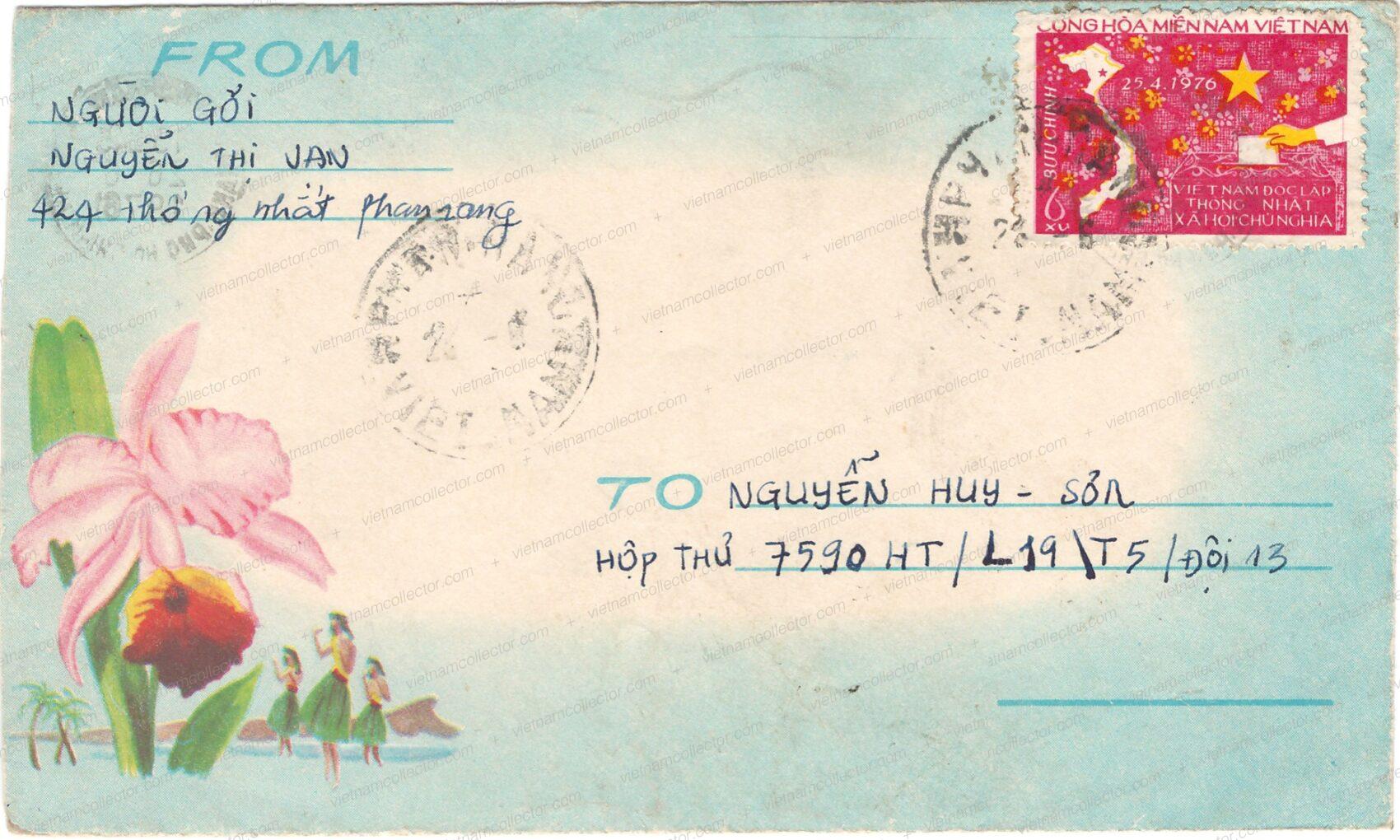
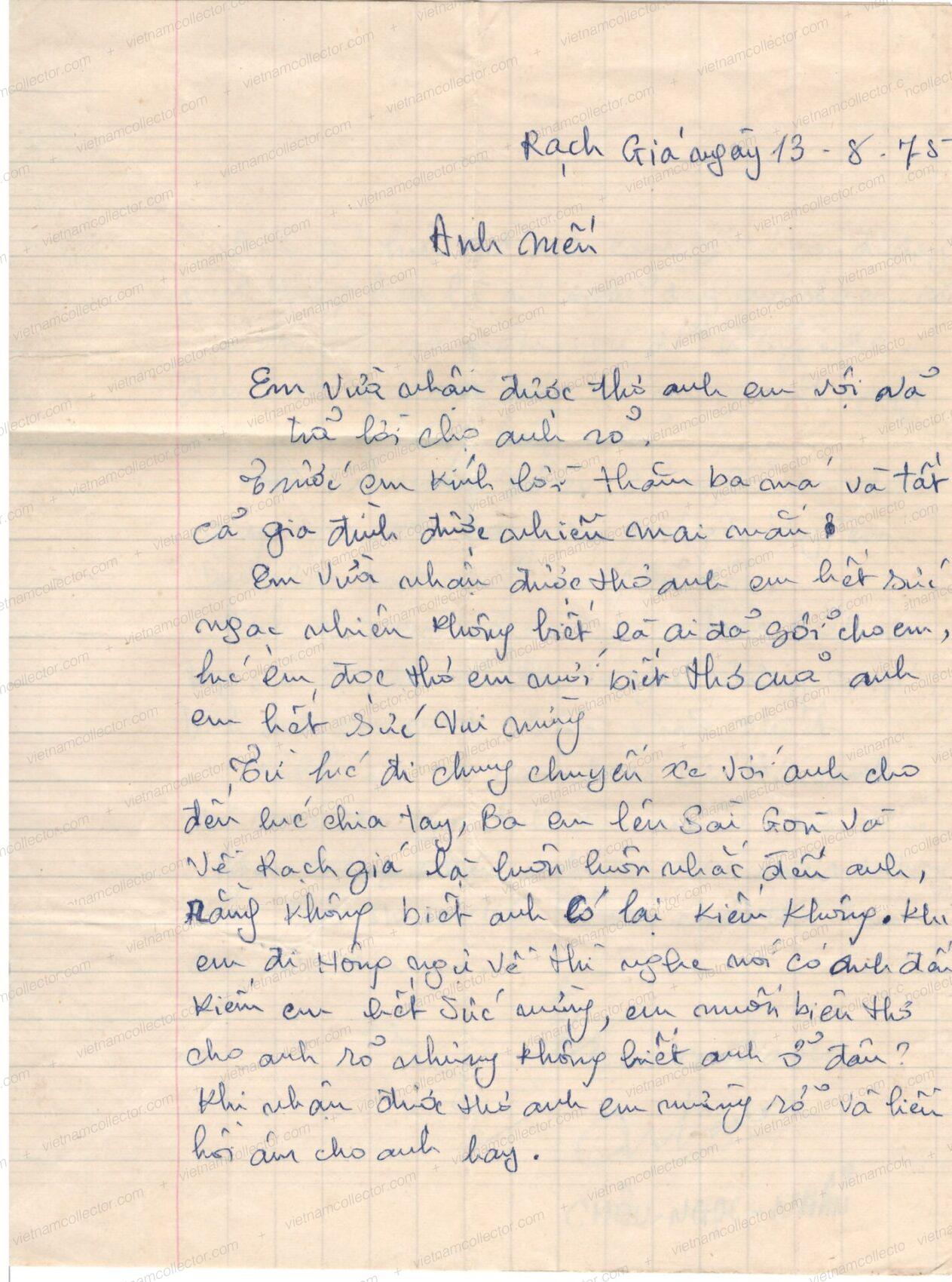
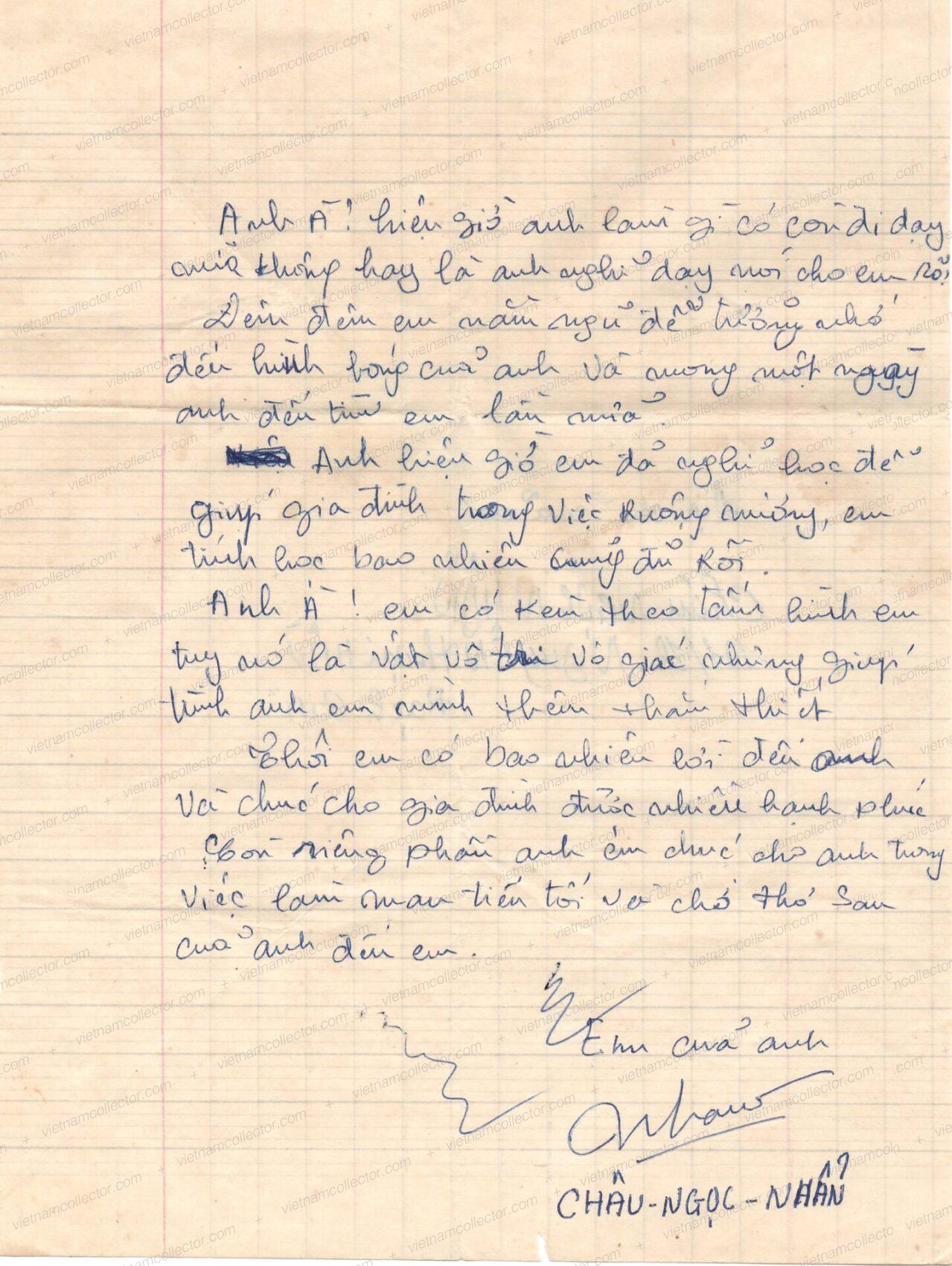
Letter sent by the administrative officer at Camp L19 to a civilian located in HCM City. The letter was again only franked with a single 6xu National Liberation Front stamp which indicates that the camp was in the vicinity of HMC City.
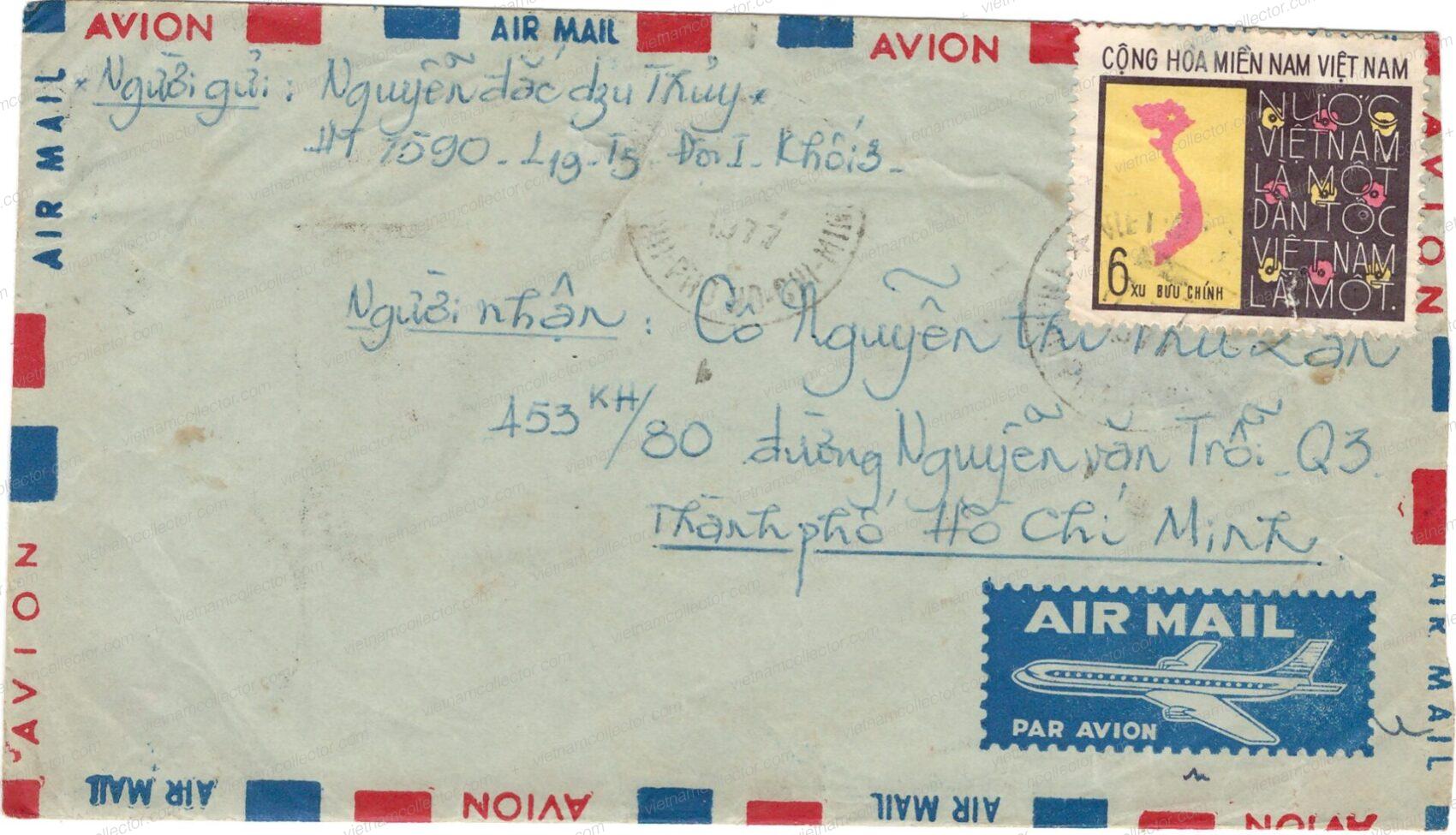
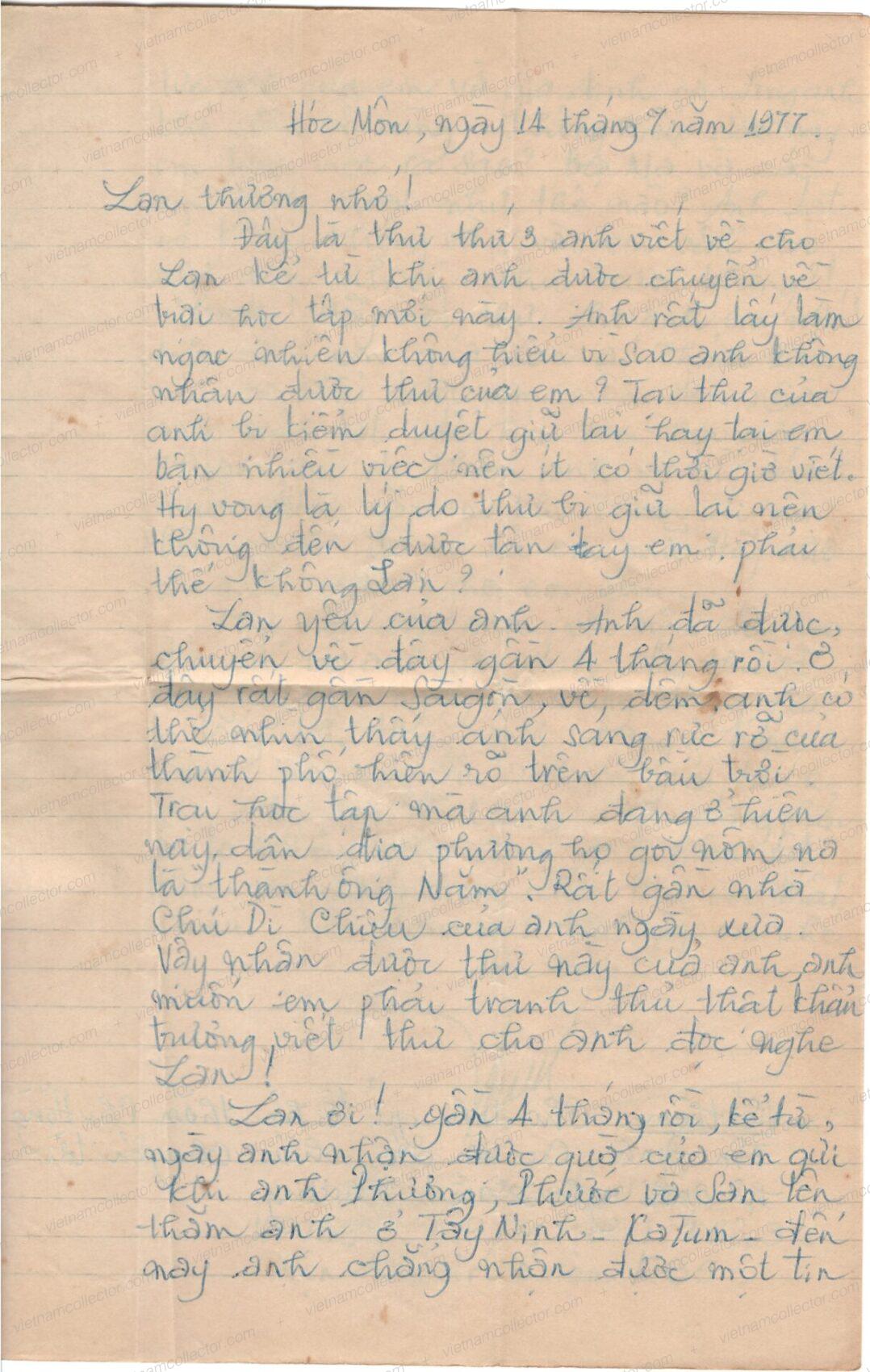
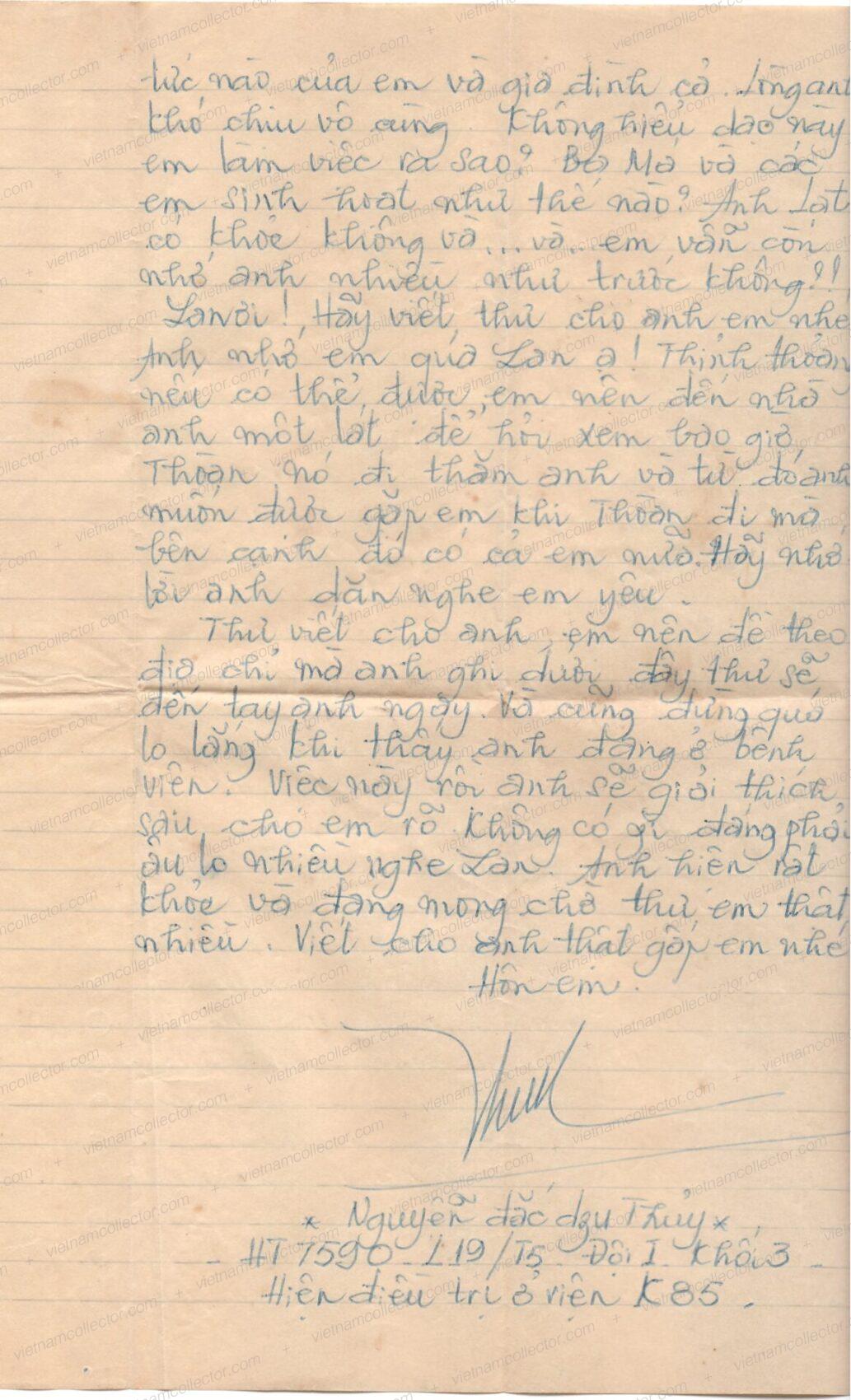
 Camp N765
Letter sent by an inmate of Camp N765 that is associated with the Long Thanh Region East of HCM City. The letter was sent by an inmate to a civilian in HCM City in June of 1976. Long Thanh transit cancel from August 8th and HCM City machine arrival cancel on the reverse.
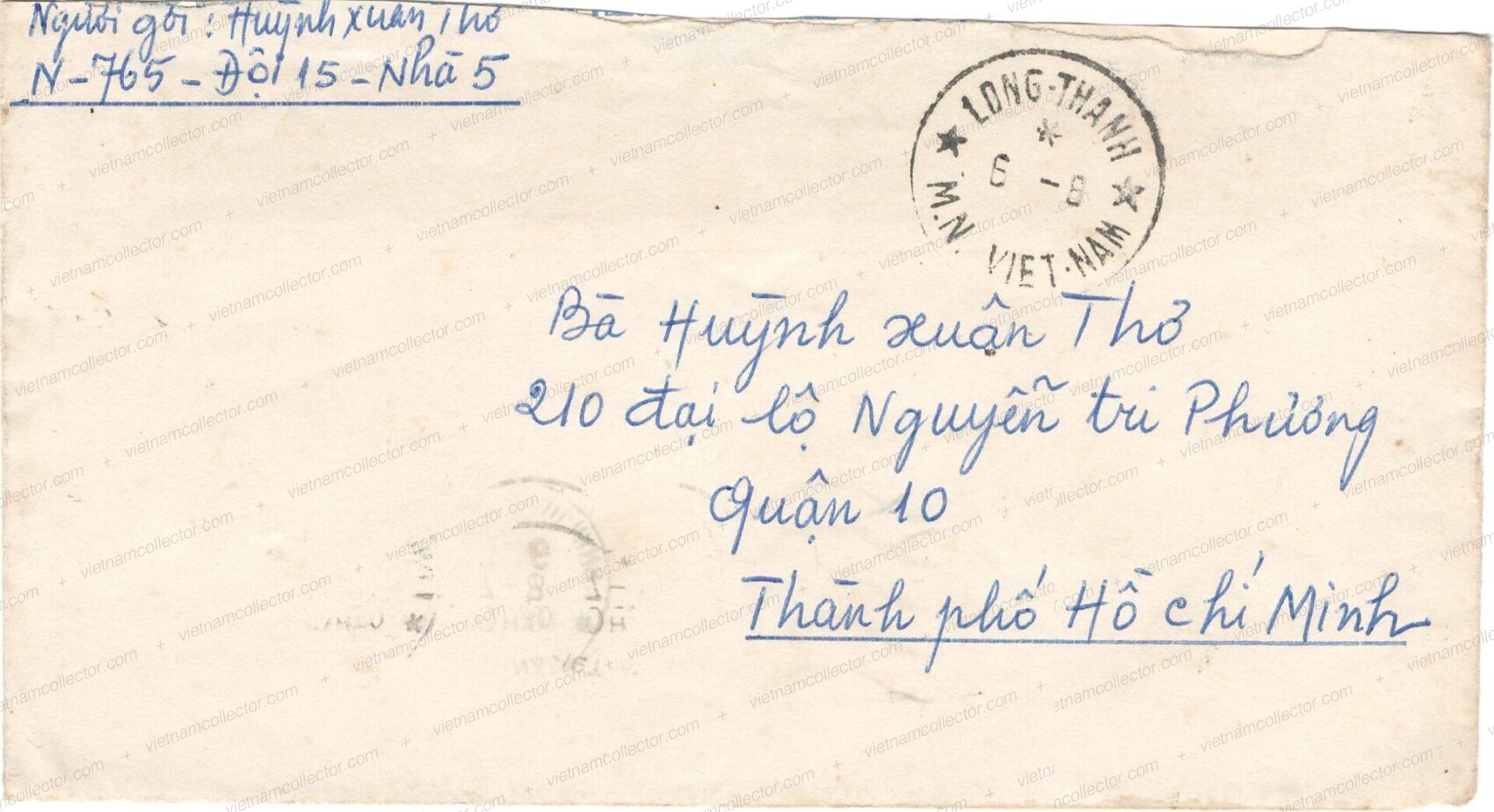
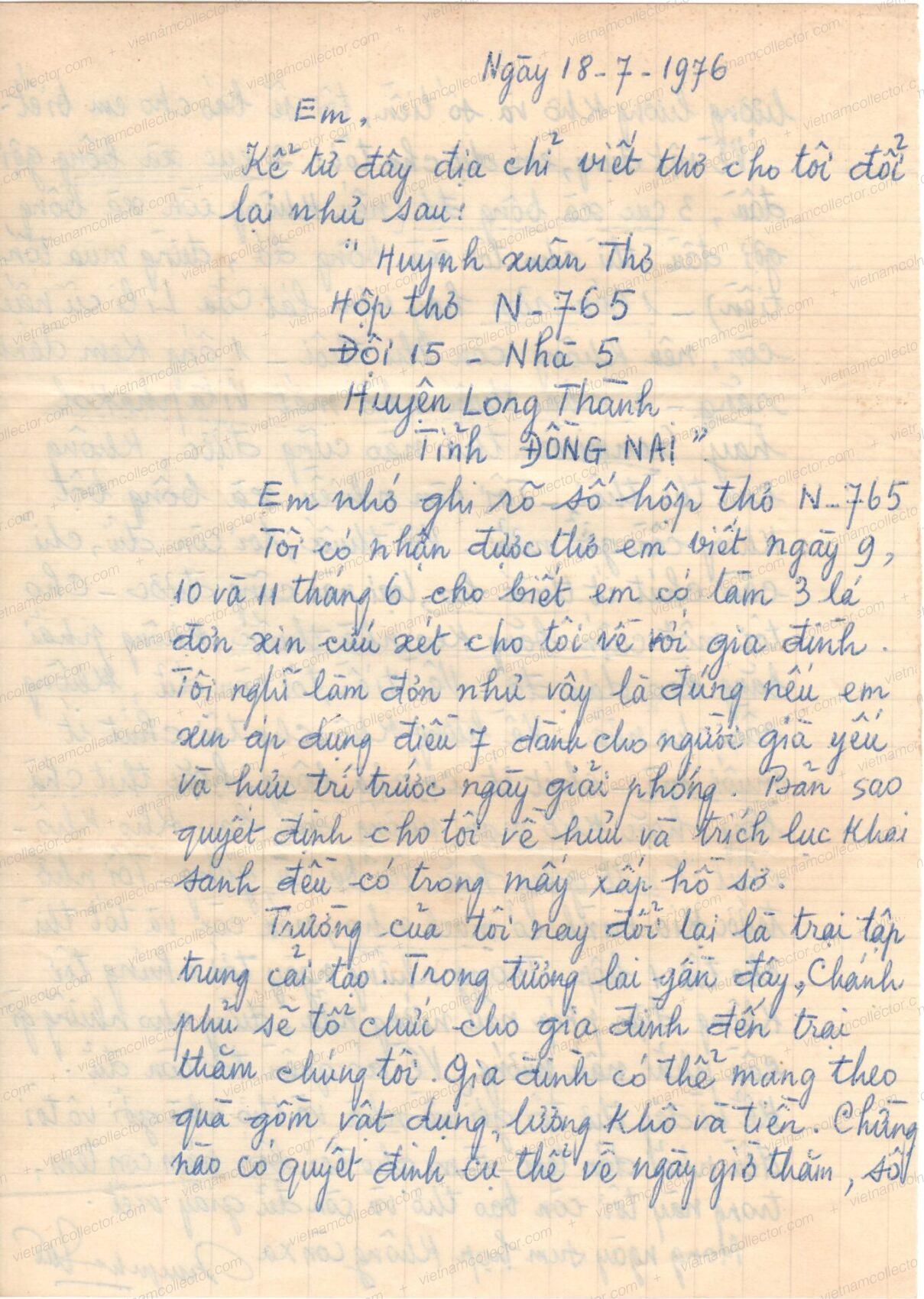
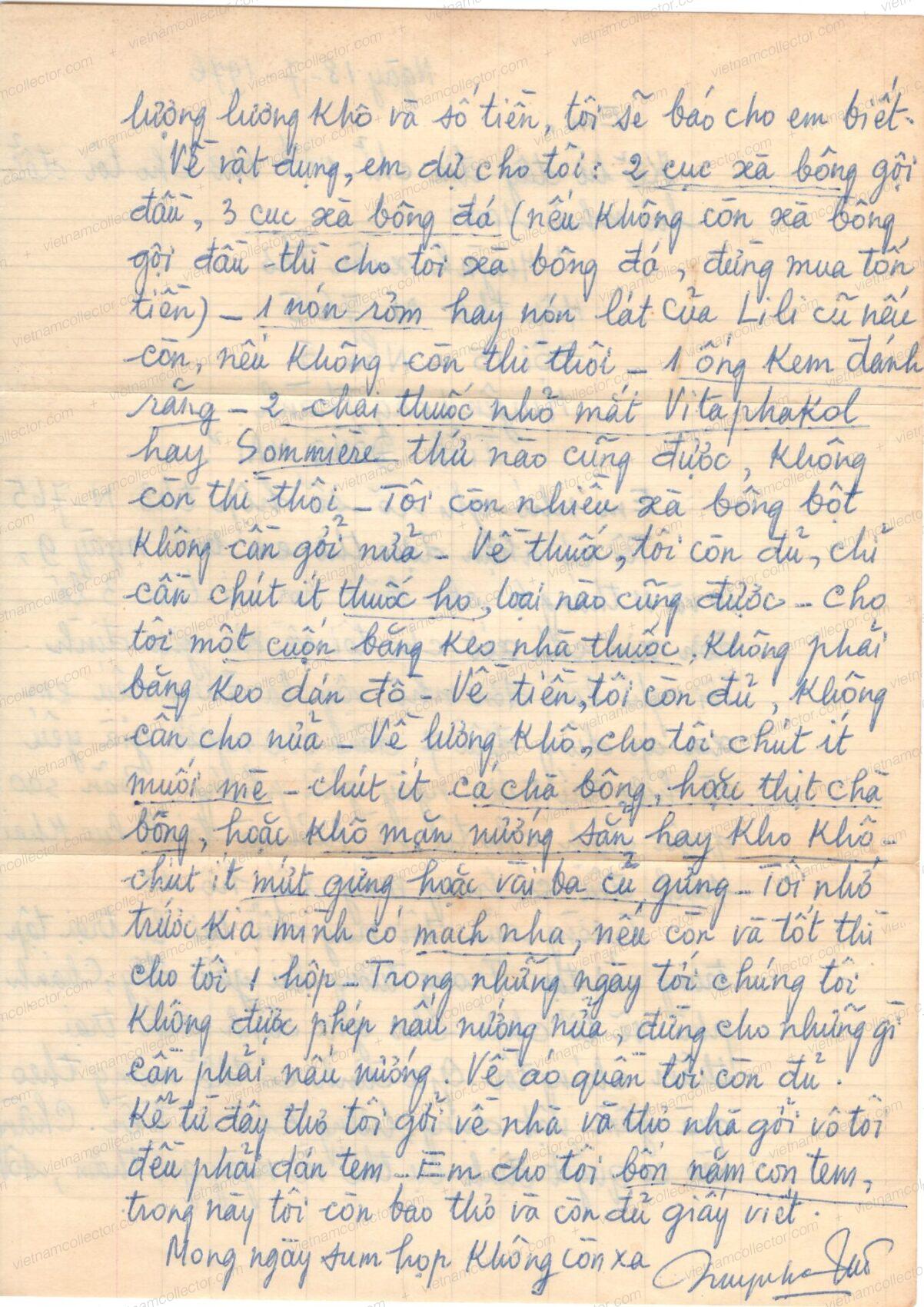
Camp T1
Letter sent by an inmate or guard located in Camp T1 in Vung Tau and dent to a civilian in HCM City. The letter was franked with a civilian 12xu National Assembly stamp from 1977. The letter was processed in Vung tau in May of 1970. HCM City machine arrival cancel on the reverse.
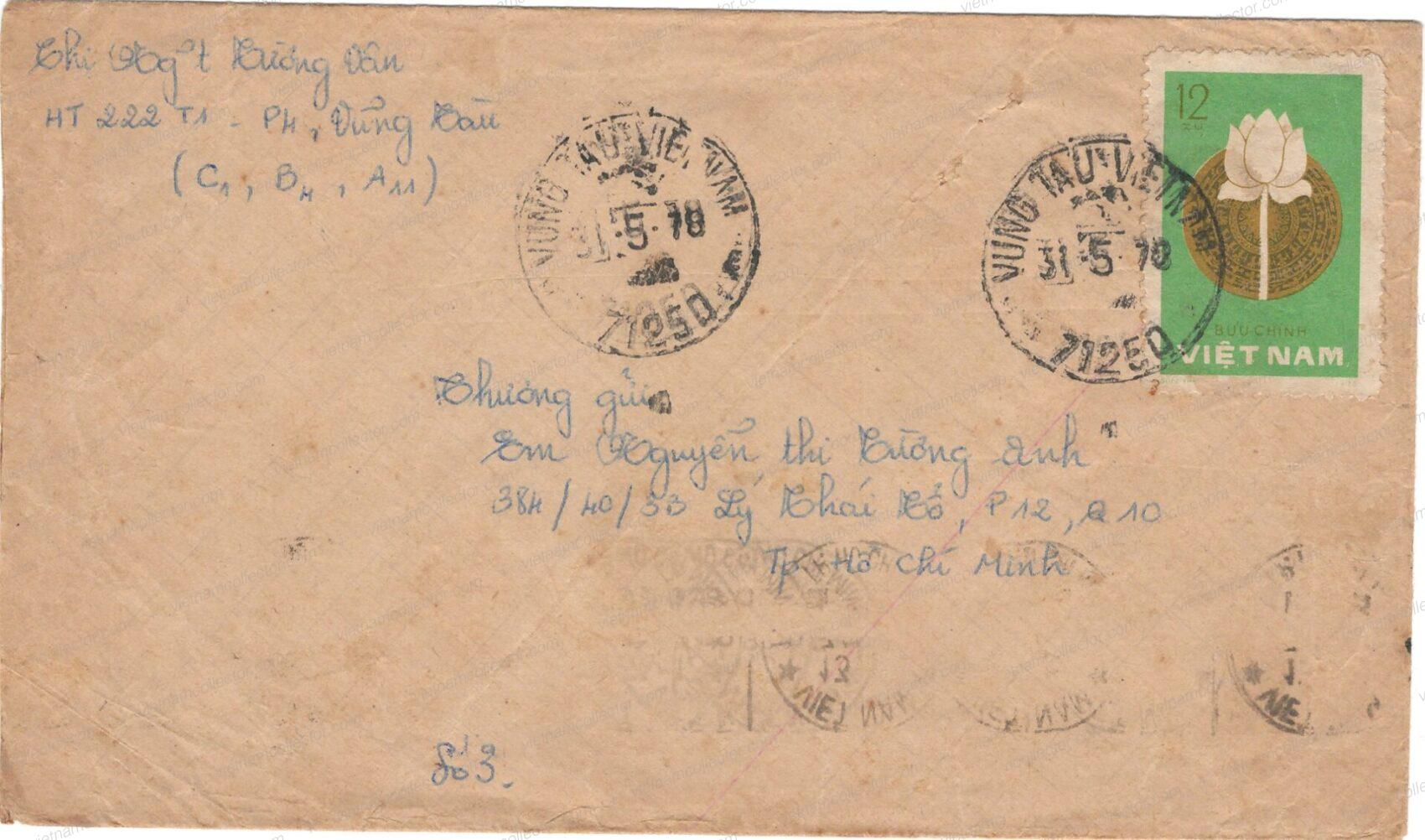
Camp TD63
Rare incoming letter sent in November of 1979 from a civilian in HCM City to an inmate in Camp TD63. The letter is franked with a 12xu civilian stamp. from 1977. The letter was cancelled in unusual blue color in a small post office outside of HCM City.
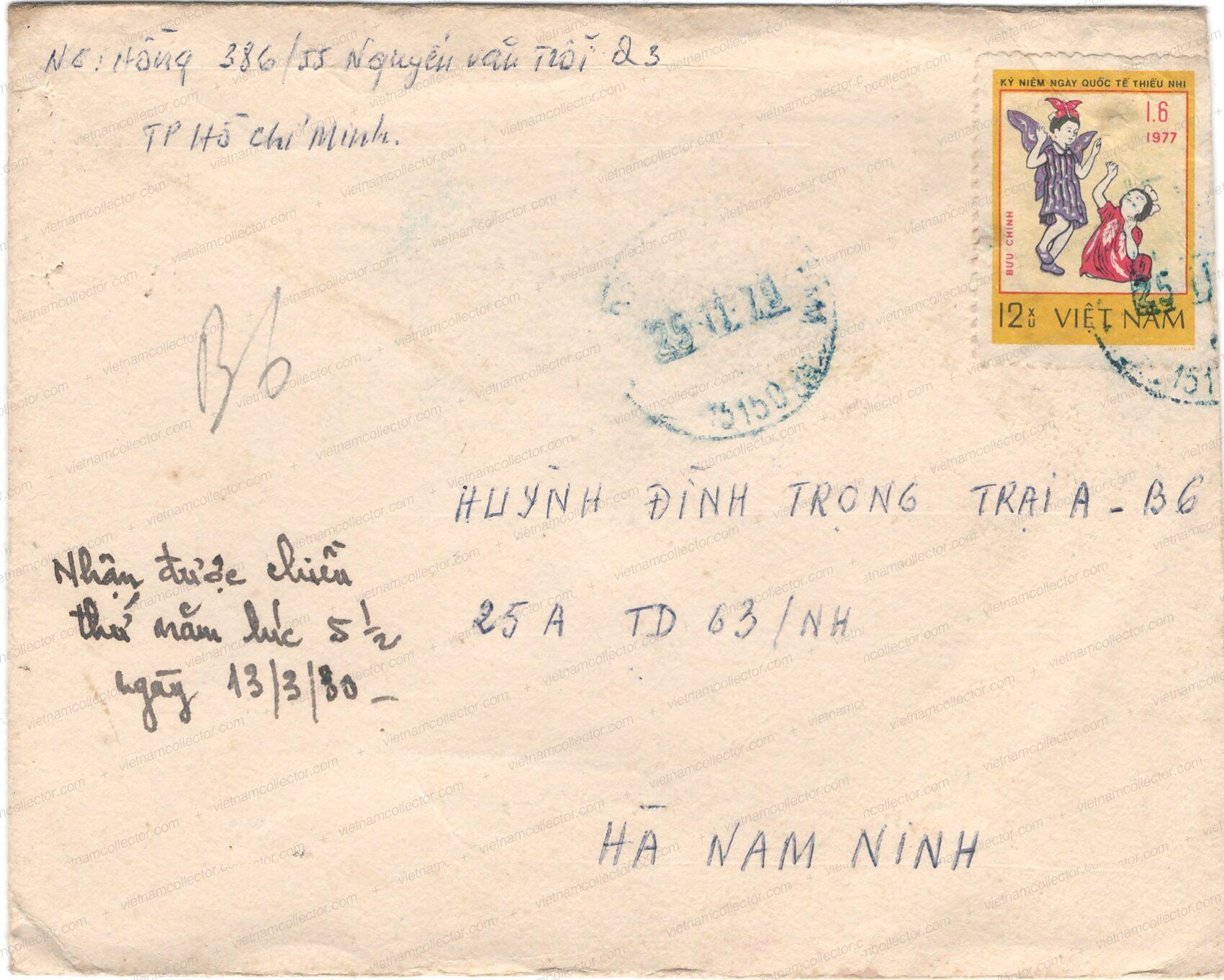
Letter sent by an inmate of Camp TD63 written in October of 1982 to a civilian in HCM City. The letter is franked with a 12xu HCM stamp from 1982 and it was mailed on November 3rd, 1982 from Post Office 71100 (which is a suburb of Bien Hoa). Bien Hoa transit and machine HCM City arrival cancel on the reverse.
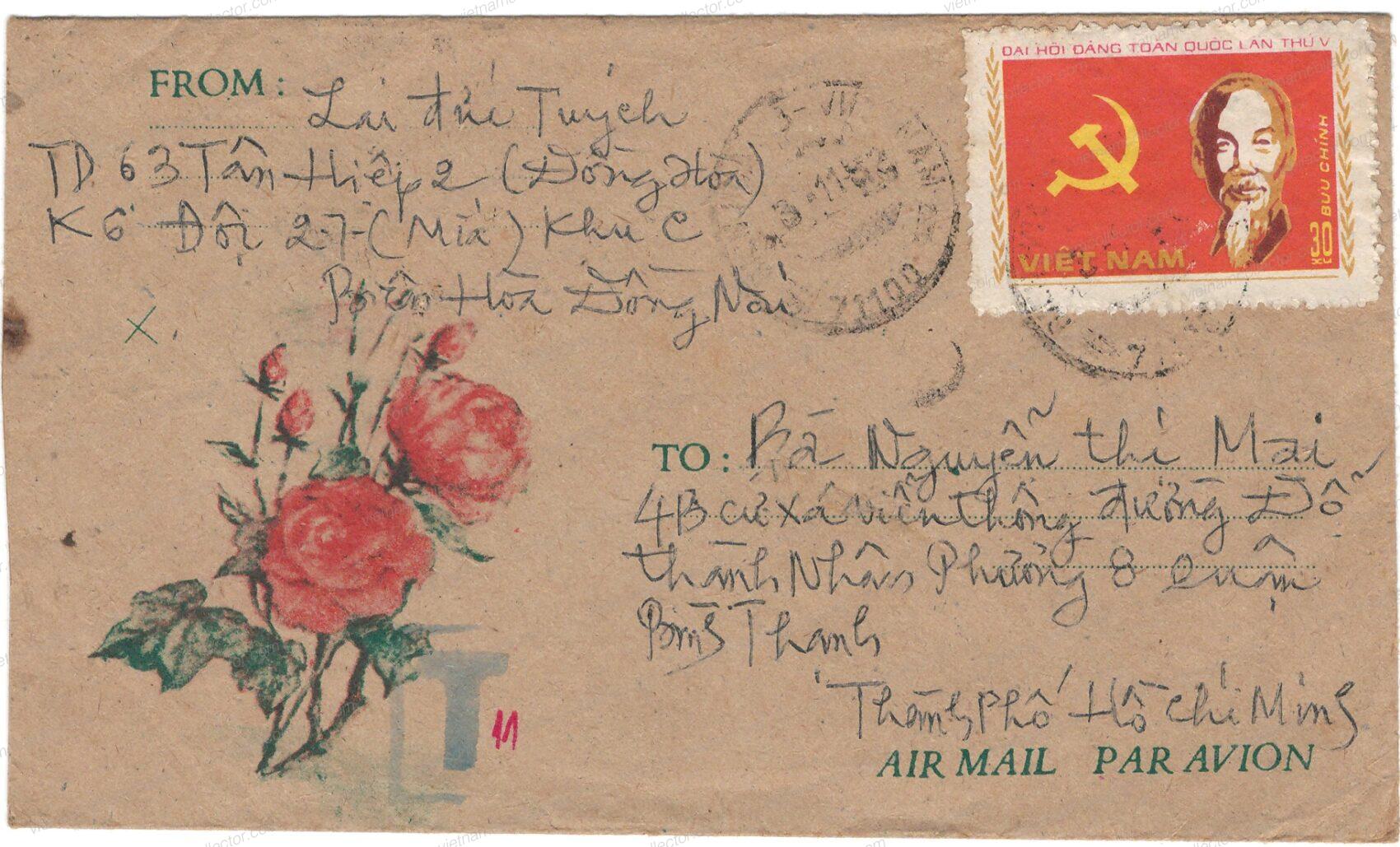
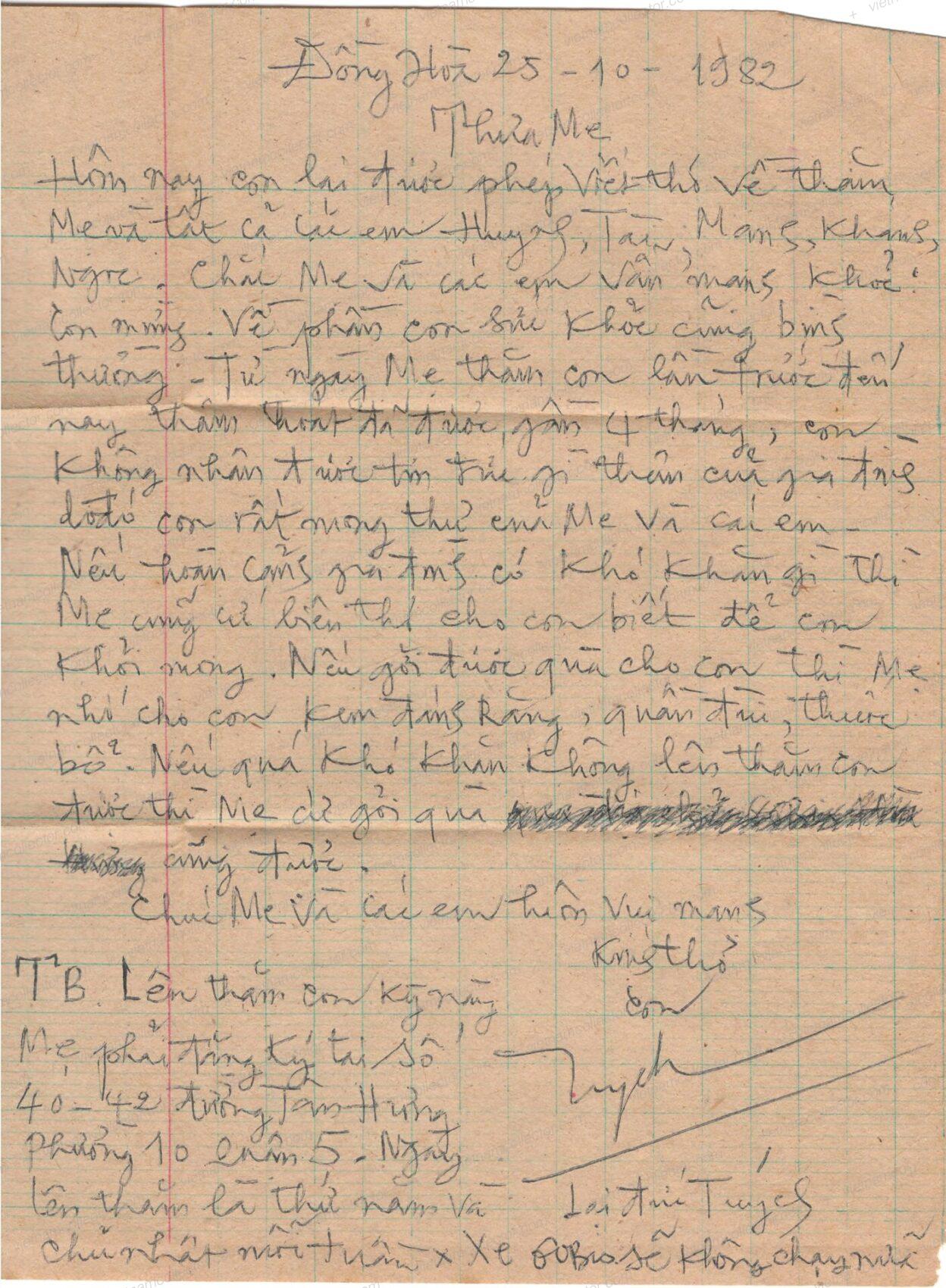
Camp Z30A
Letter sent by an inmate from Camp Z30A in July of 1979 to a civilian in HCM City. Franked with two 30D National Liberation Front stamps paying an overall postage of 60D (which equated after the currency devaluation in the South to 12xu). Cancelled with circular Gia Rai canceler. This may have been a sub camp of the Xuan Loc main camp.
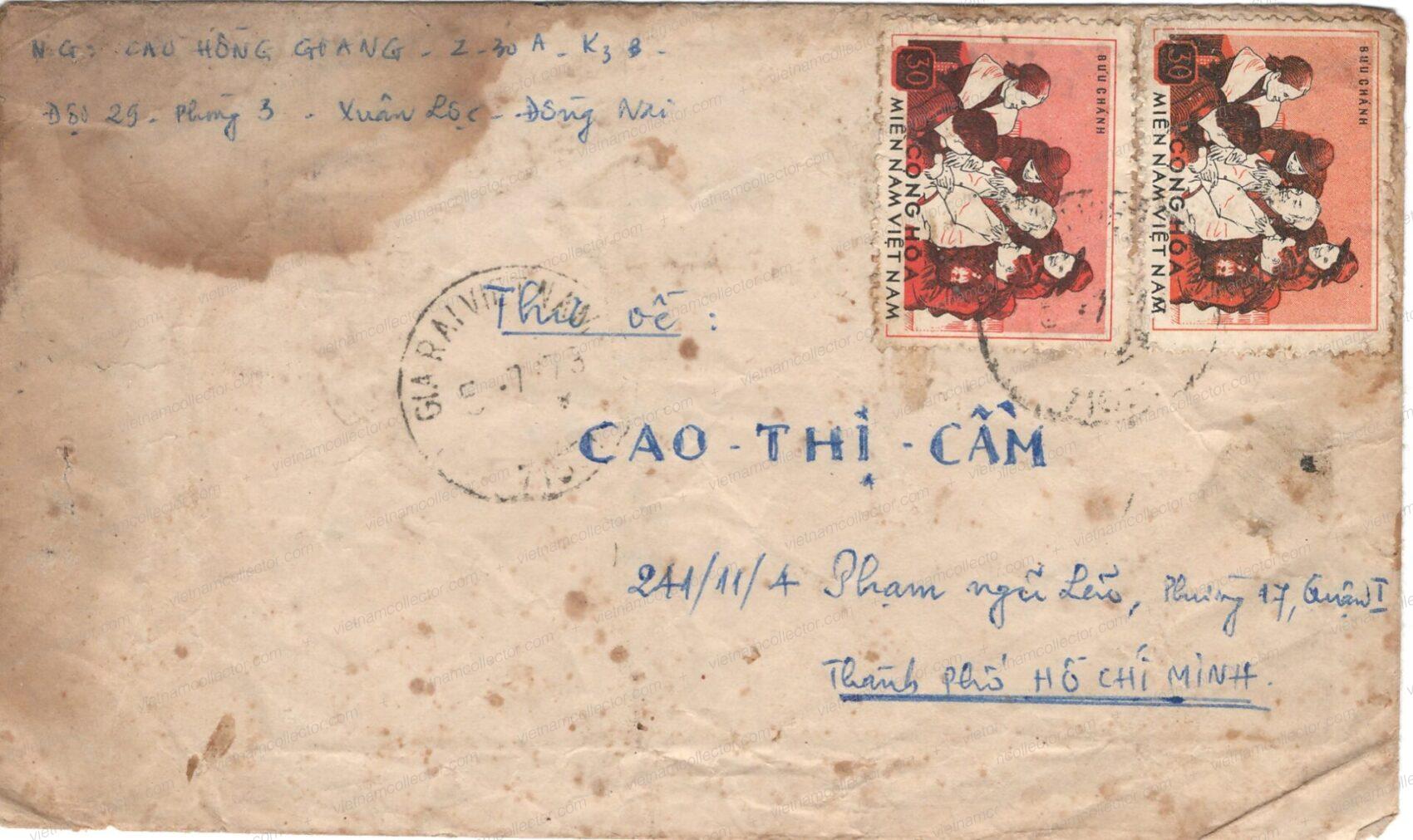
Letter sent by an inmate of Camp Z30A that is associated with the Xuan Loc region to the East of HCM City to a civilian in HCM City in September of 1979. Franked with two 30D Liberation Front stamps paying an overall postage of 60D. The South Vietnamese Doing was devalued 500:1 in 1975 so the 60D equated exactly the 12xu postage due in 1979. HCM City machine arrival canceler on the reverse.
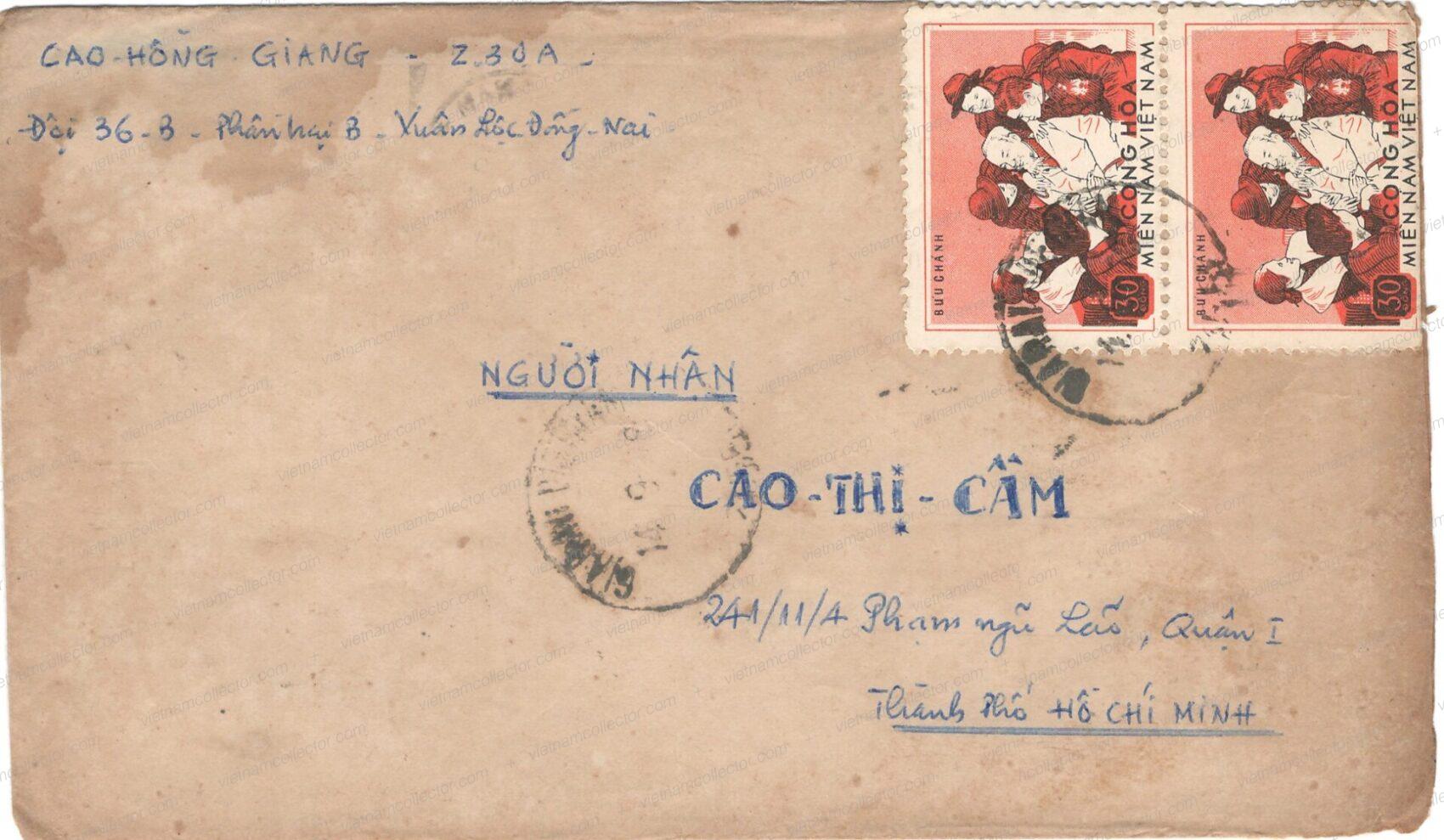
Letter sent by an inmate of Camp Z30A located in Xuan Loc, Dong Nai Province to a civilian in Go Lap, a suburb of HCM City. Franked with a 12 xu civilian stamp. HCM City machine arrival cancel on the reverse.
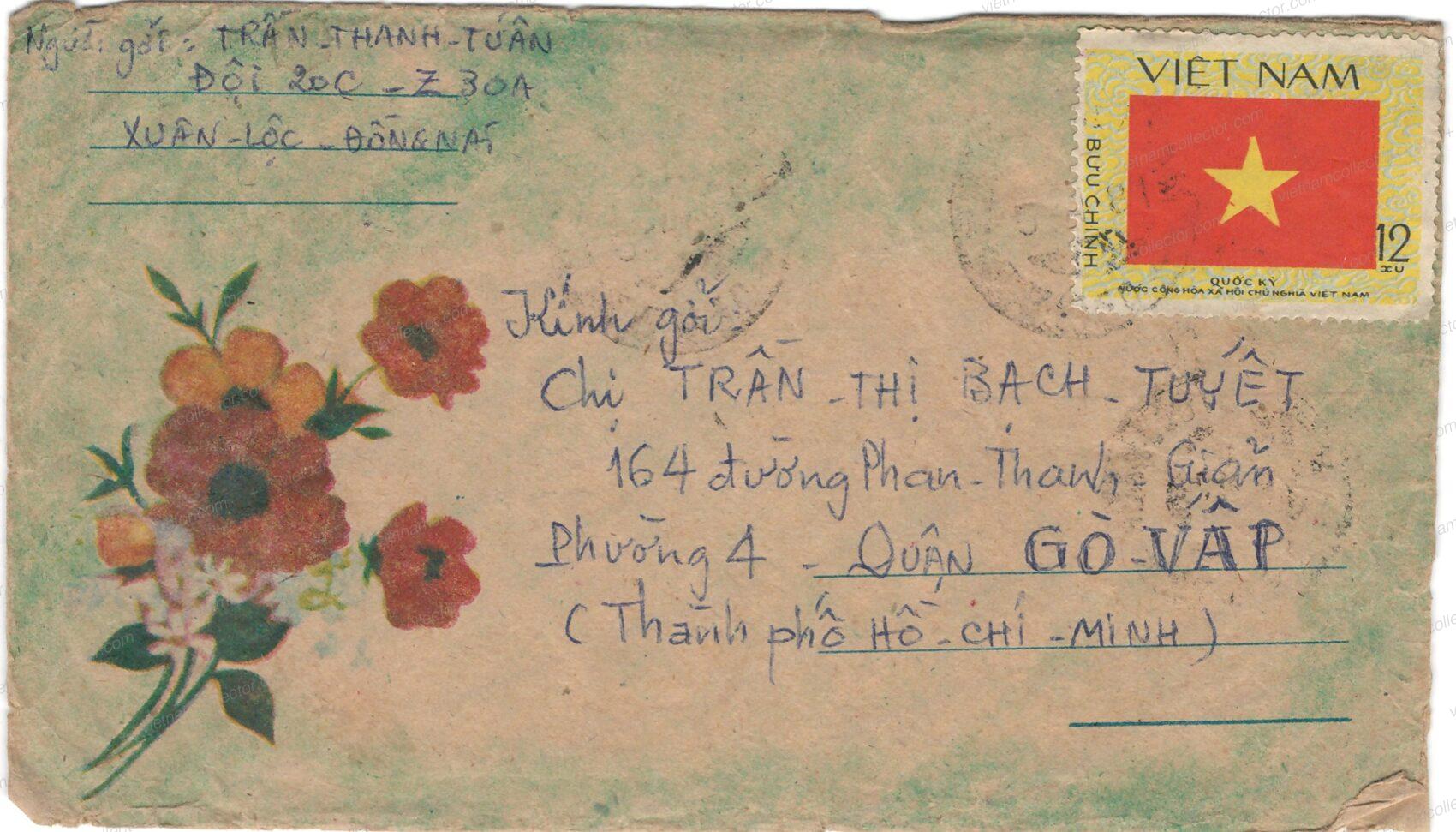
Rare incoming letters sent in August and September of 1983 by a civilian to an inmate located in Camp Z30A. Franked with two 30xu HCM stamps paying an overall postage of 60xu. Xuan Loc transit canceler on the reverse.
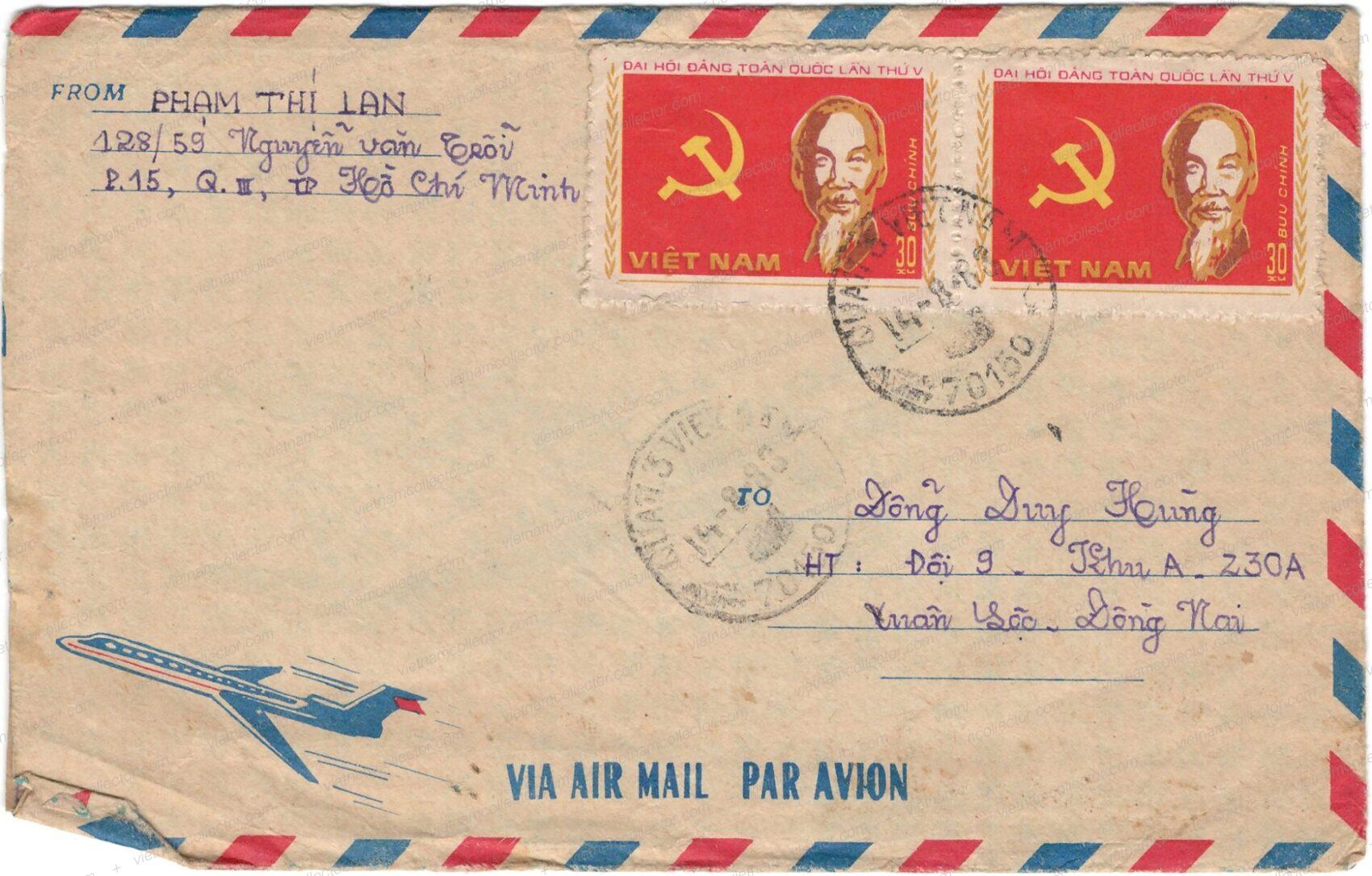
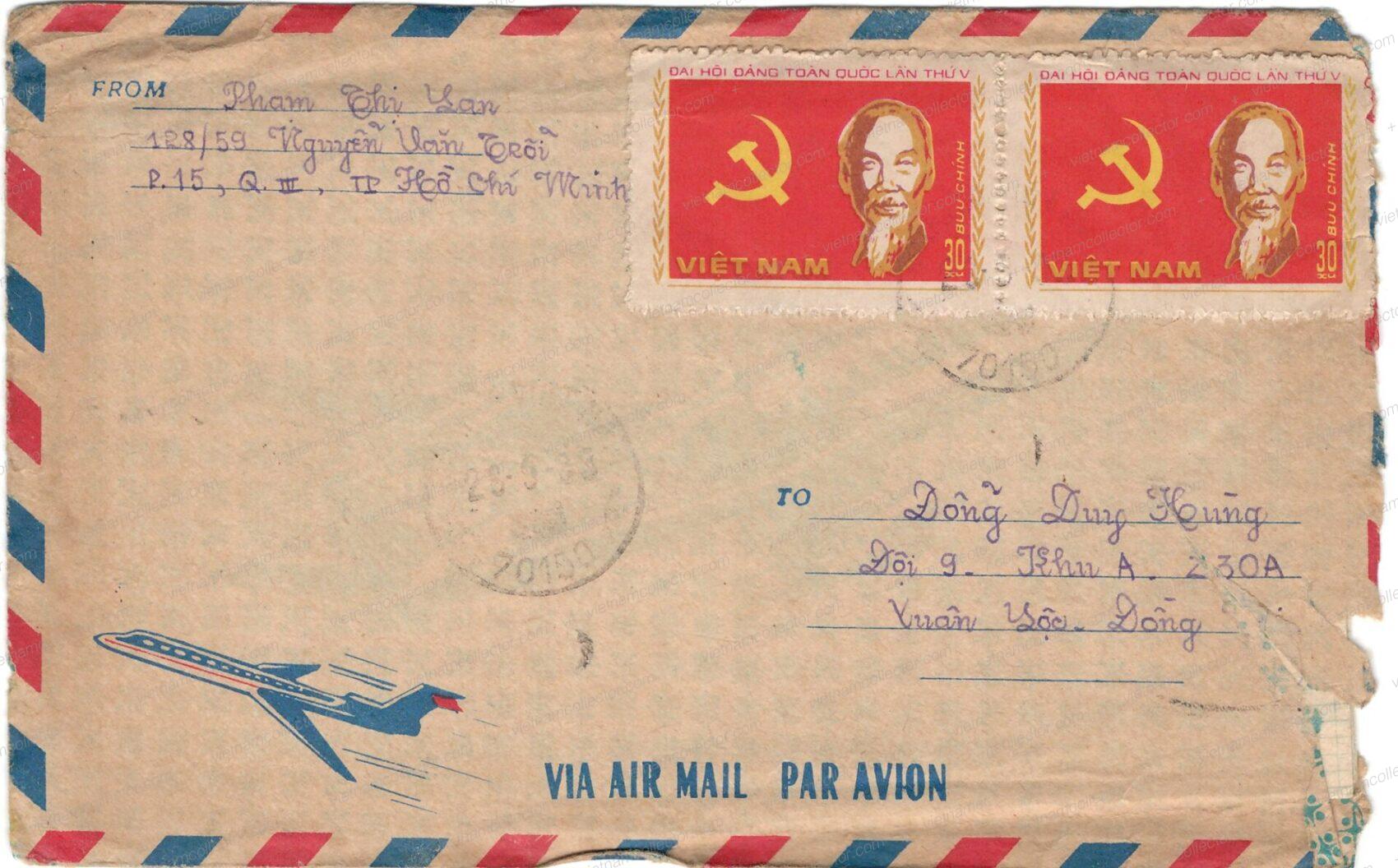
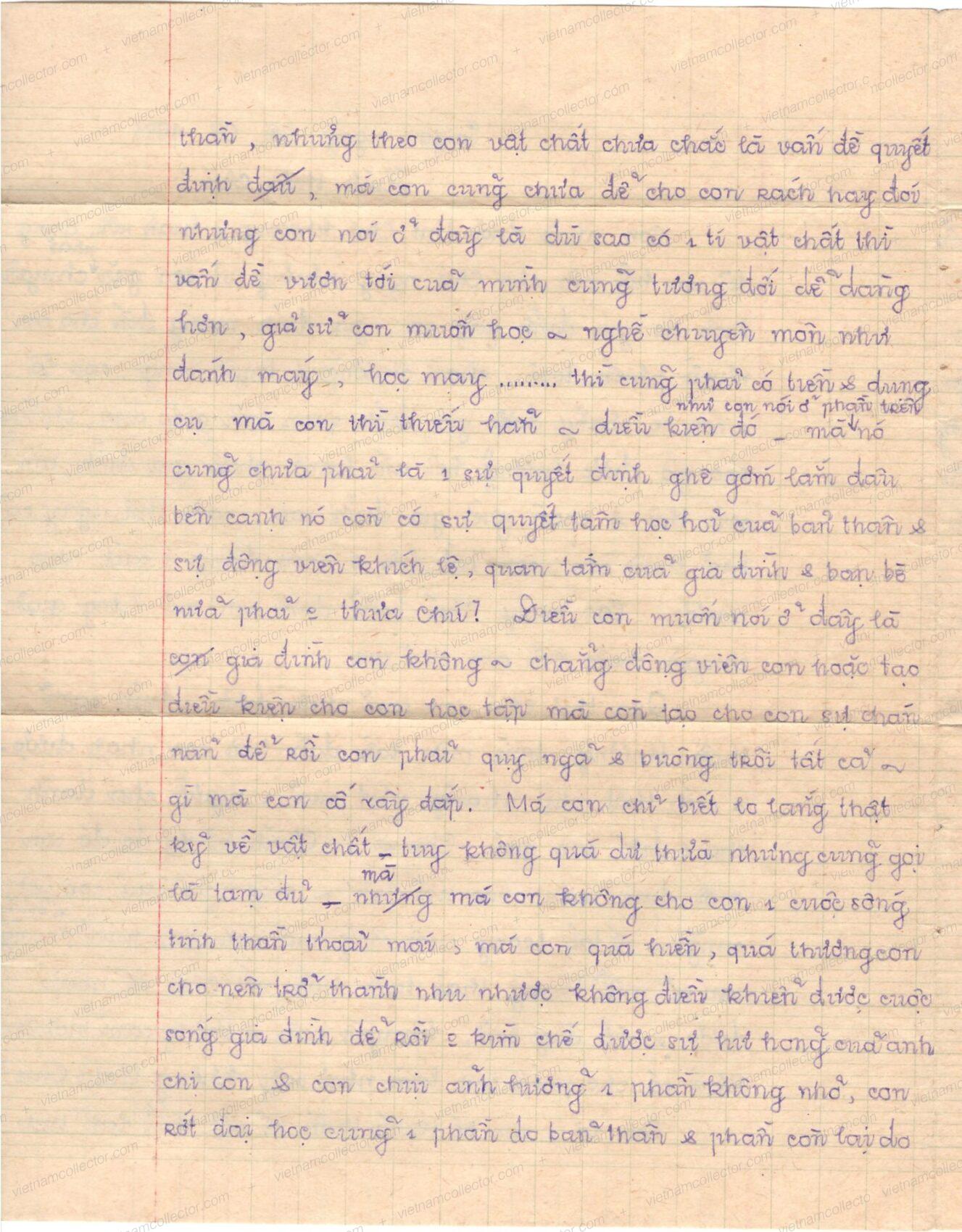
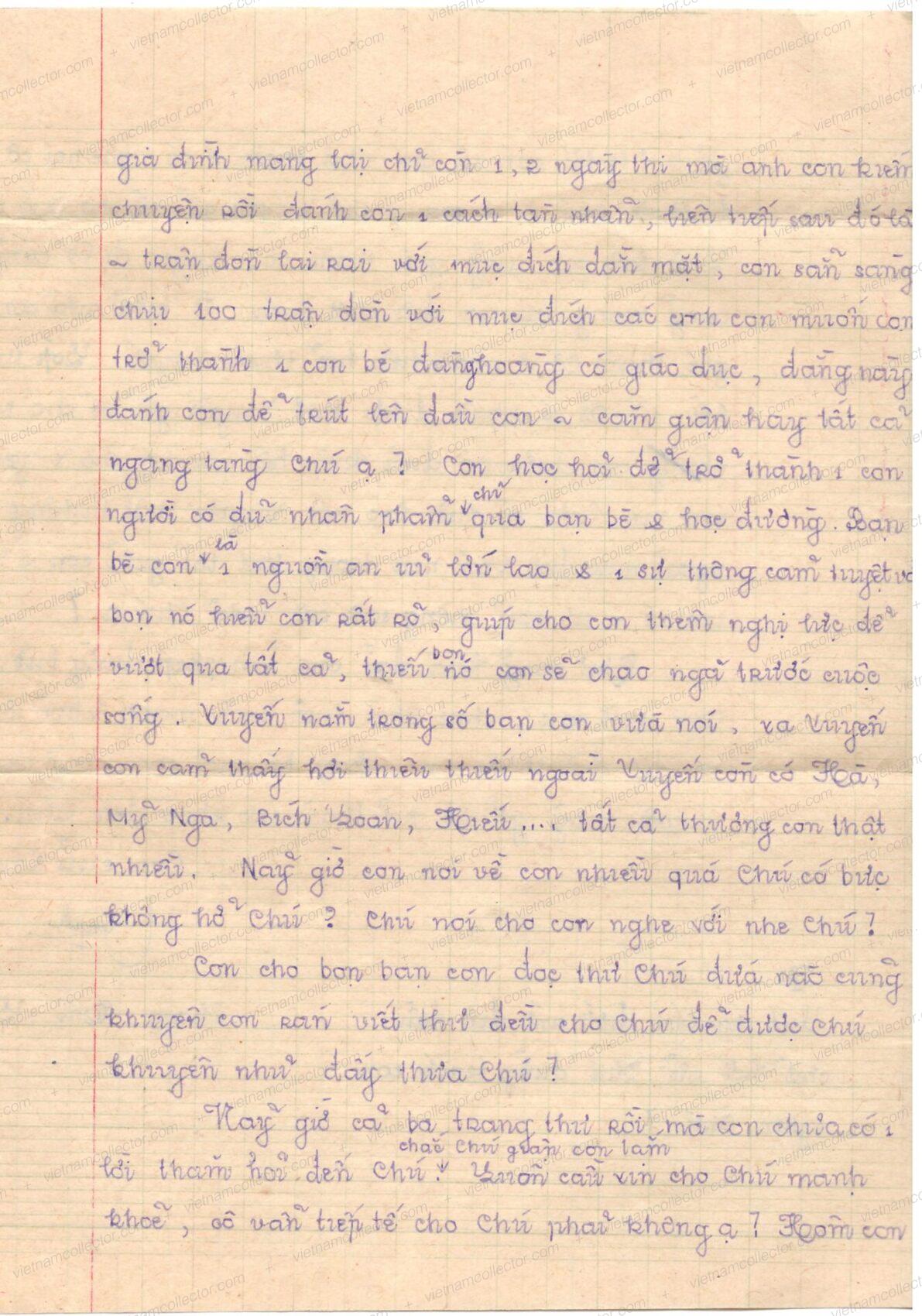
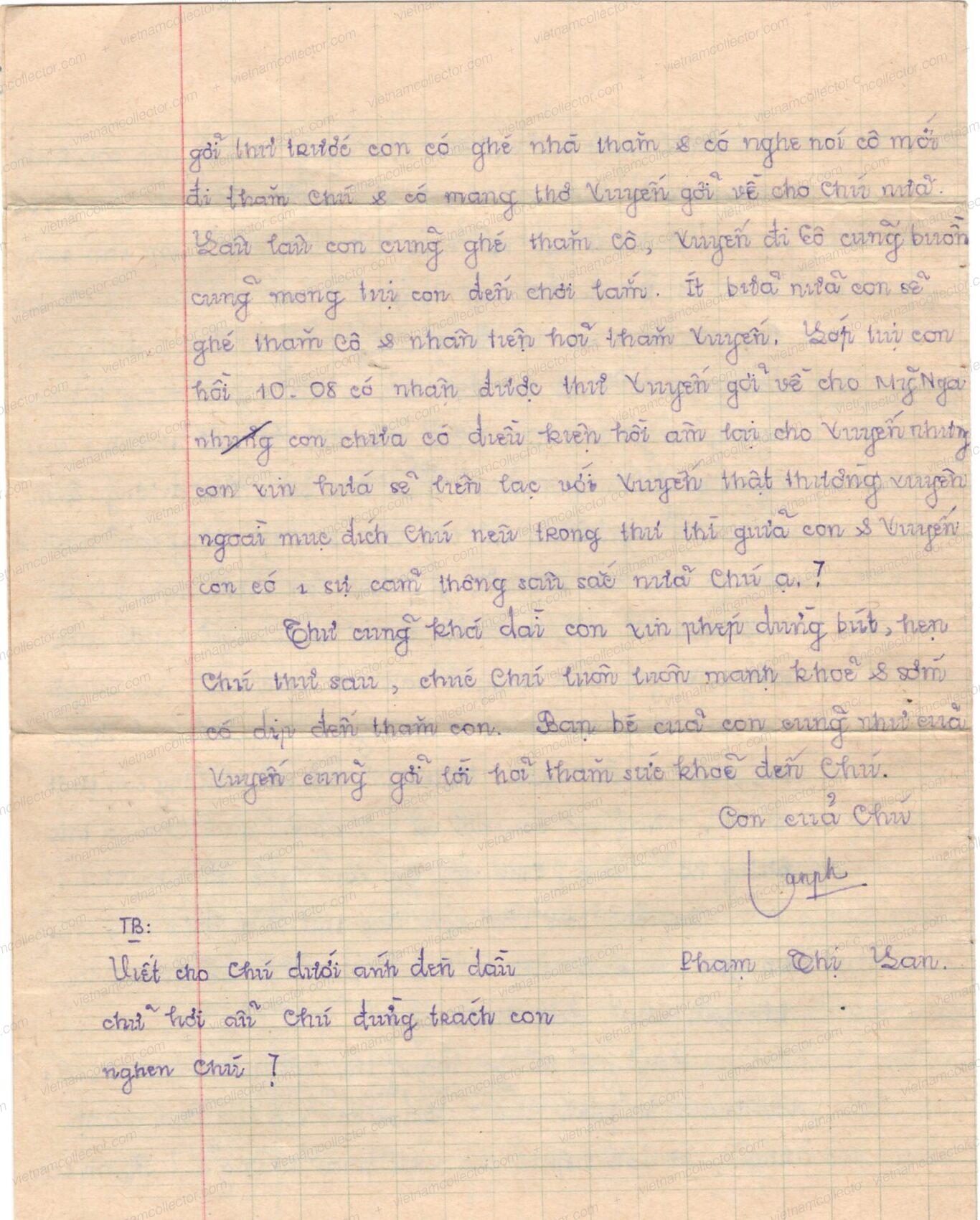
Camp Z30D
Letter sent by a prison guard in March of 1979 from Camp Z30D to a civilian in Quan 10. The letter is franked with a civilian 12xu stamp paying the correct tariff at the time. Illegible cancel on front. HCM City arrival cancel on the reverse.
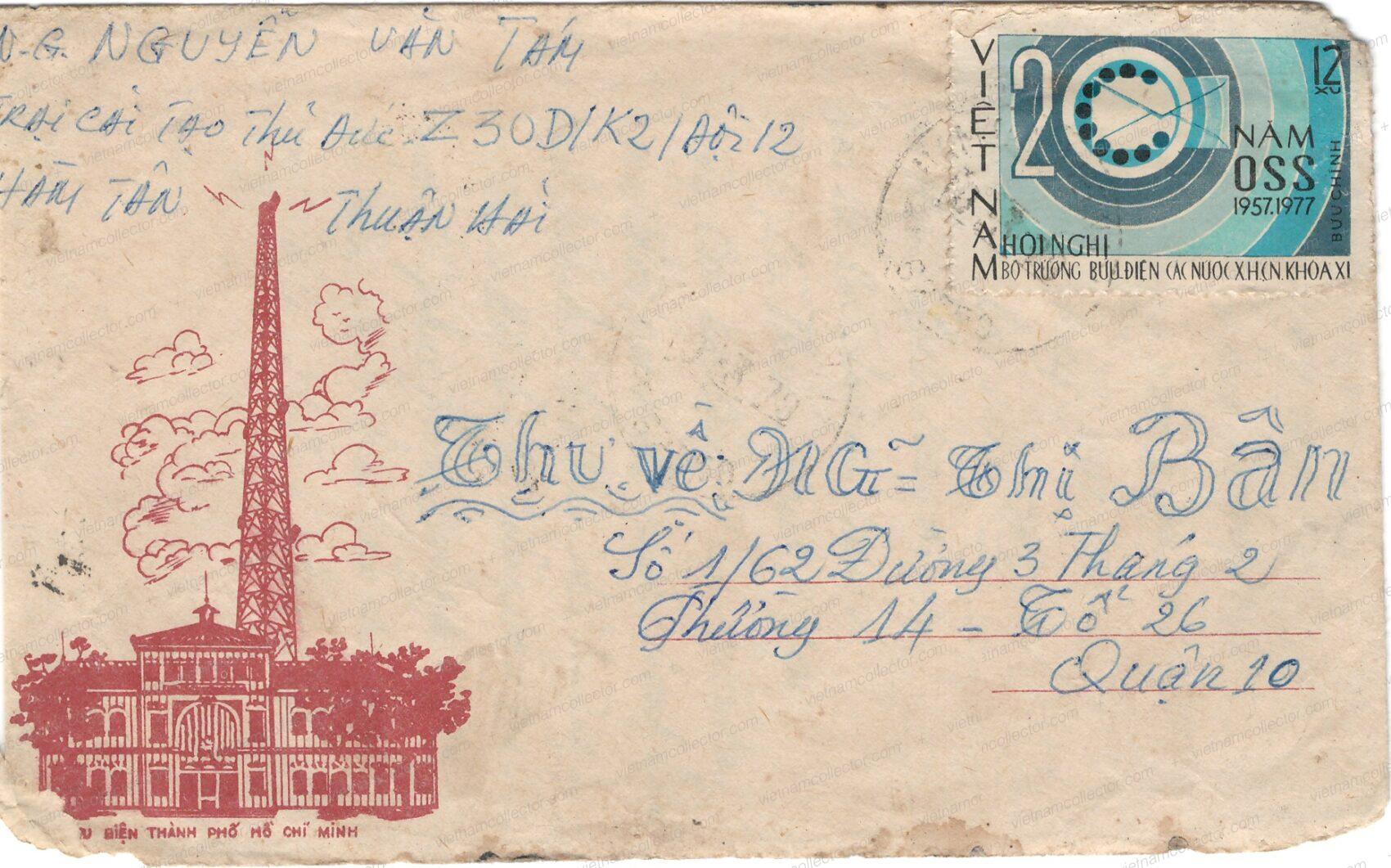
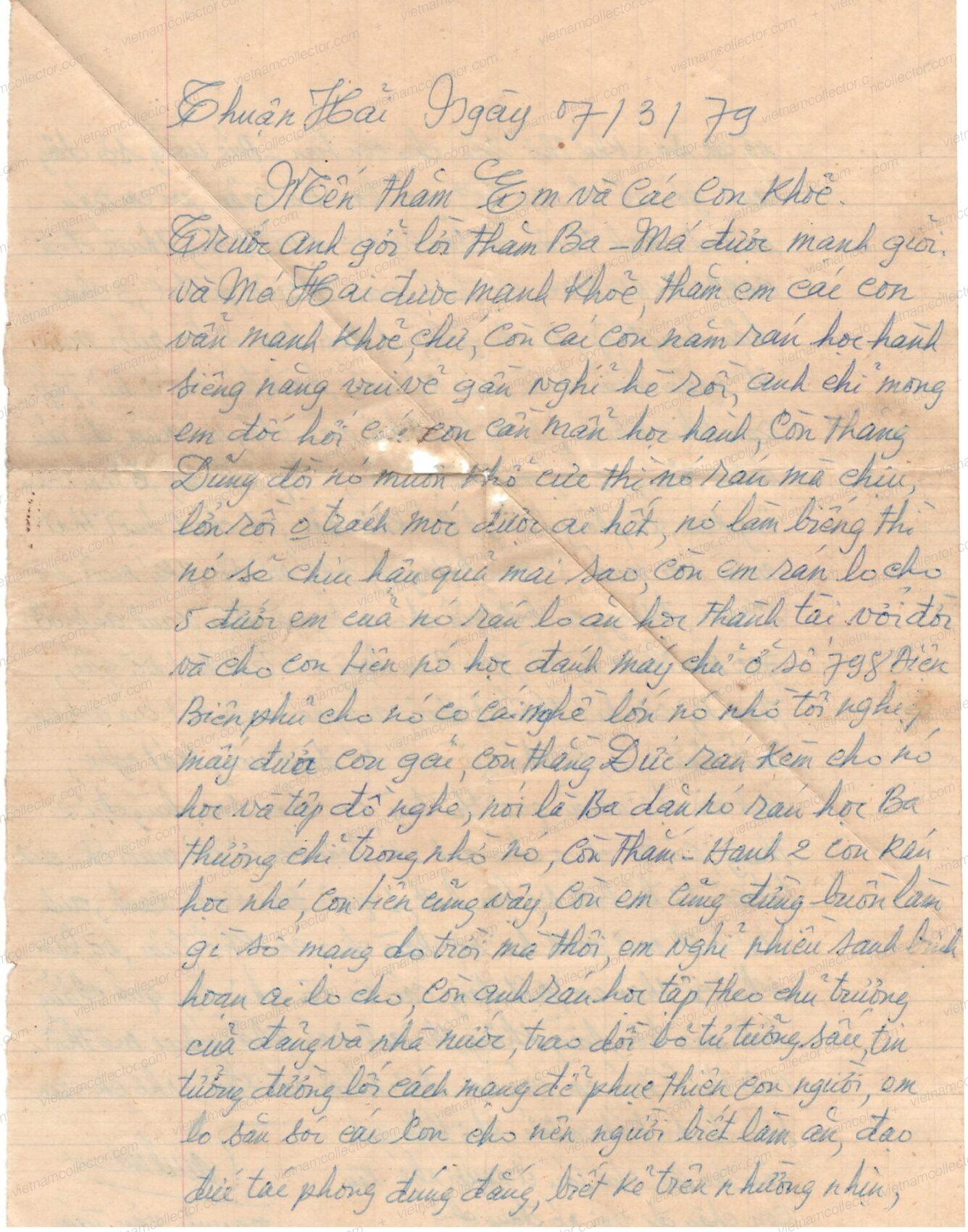
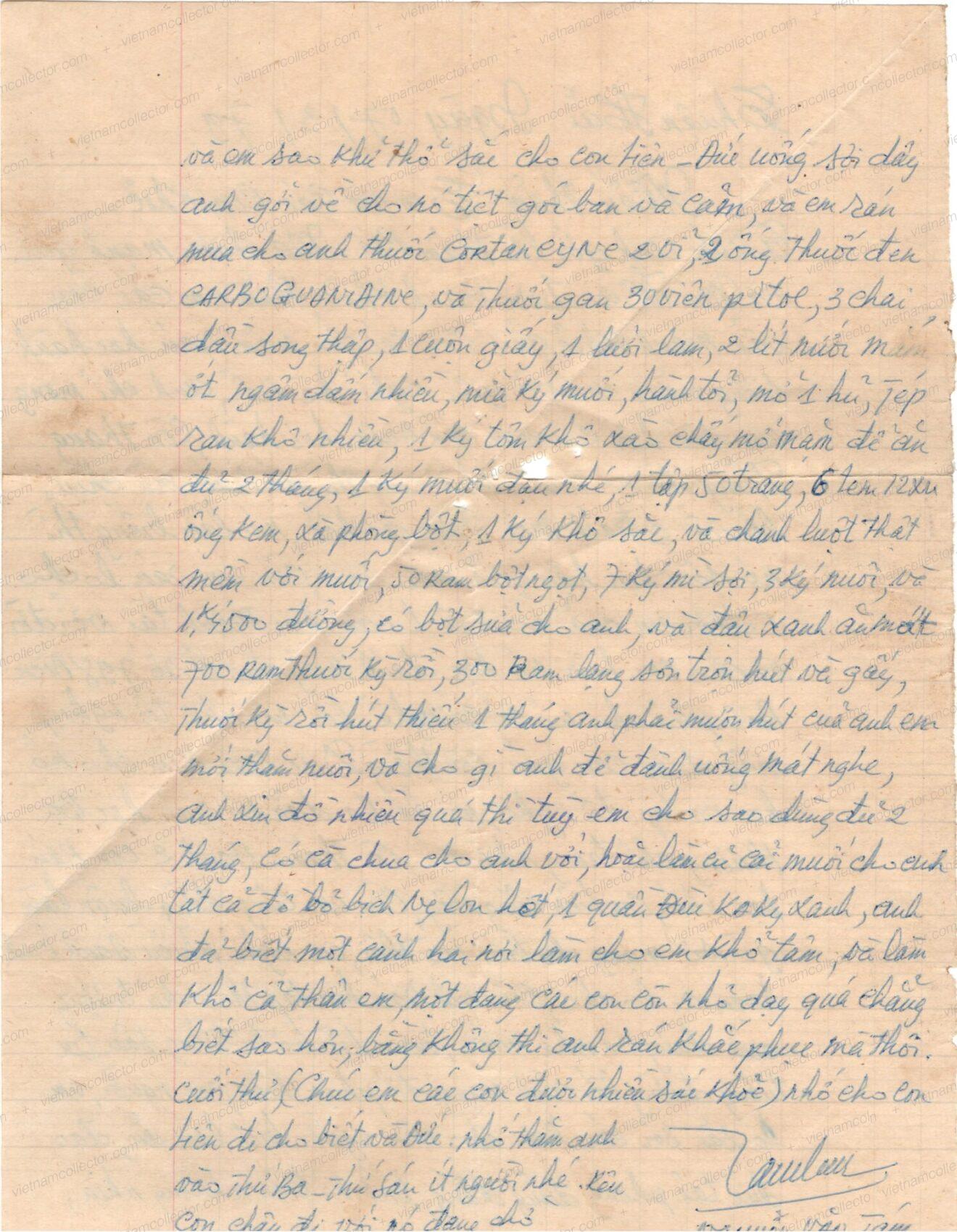
Another letter from the same individual in Camp Z30D sent in July of 1979 to a civilian in HCM City. The letter is franked with a 12xu civilian stamp. Two HCM City arrival cancels on the reverse.
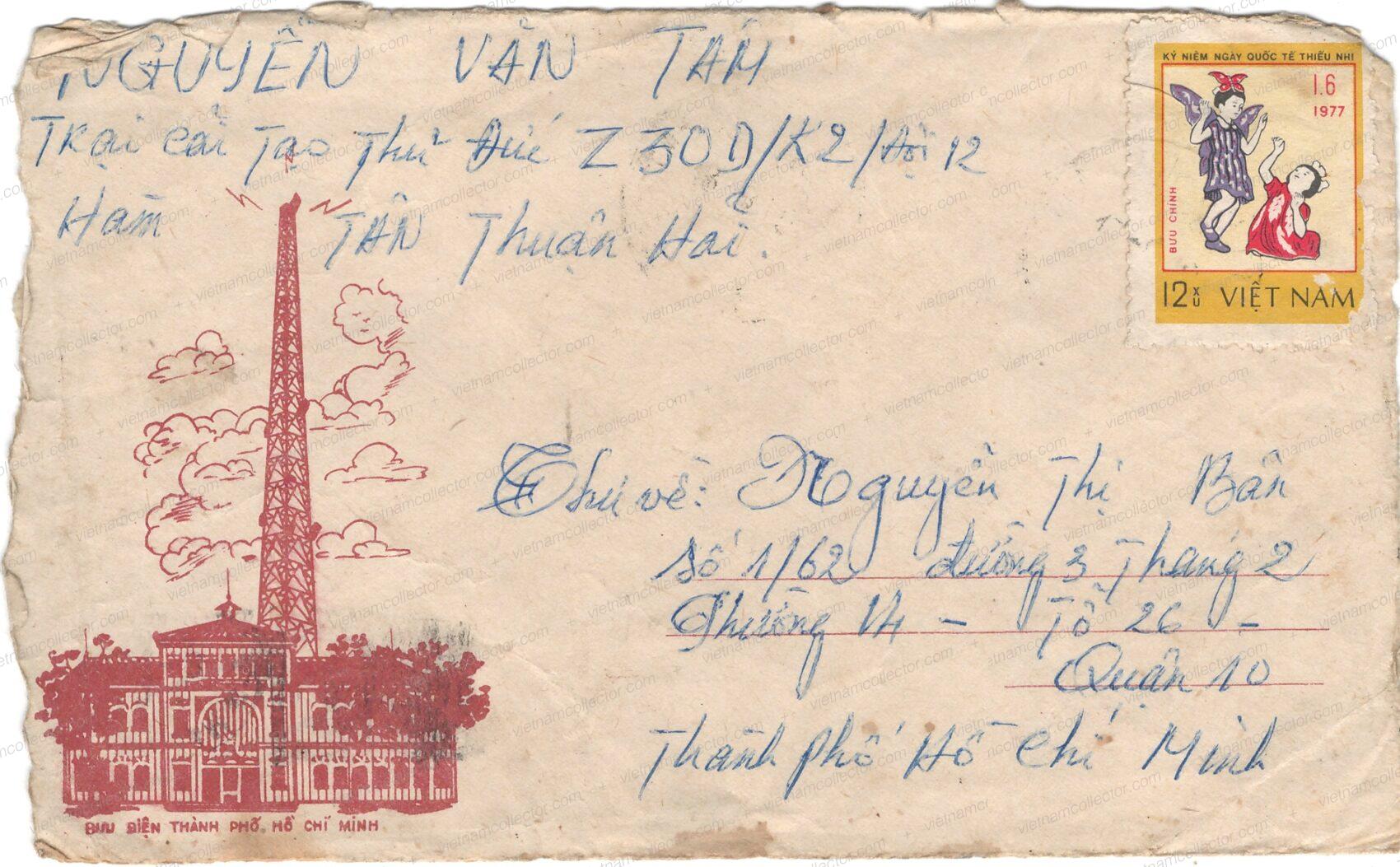
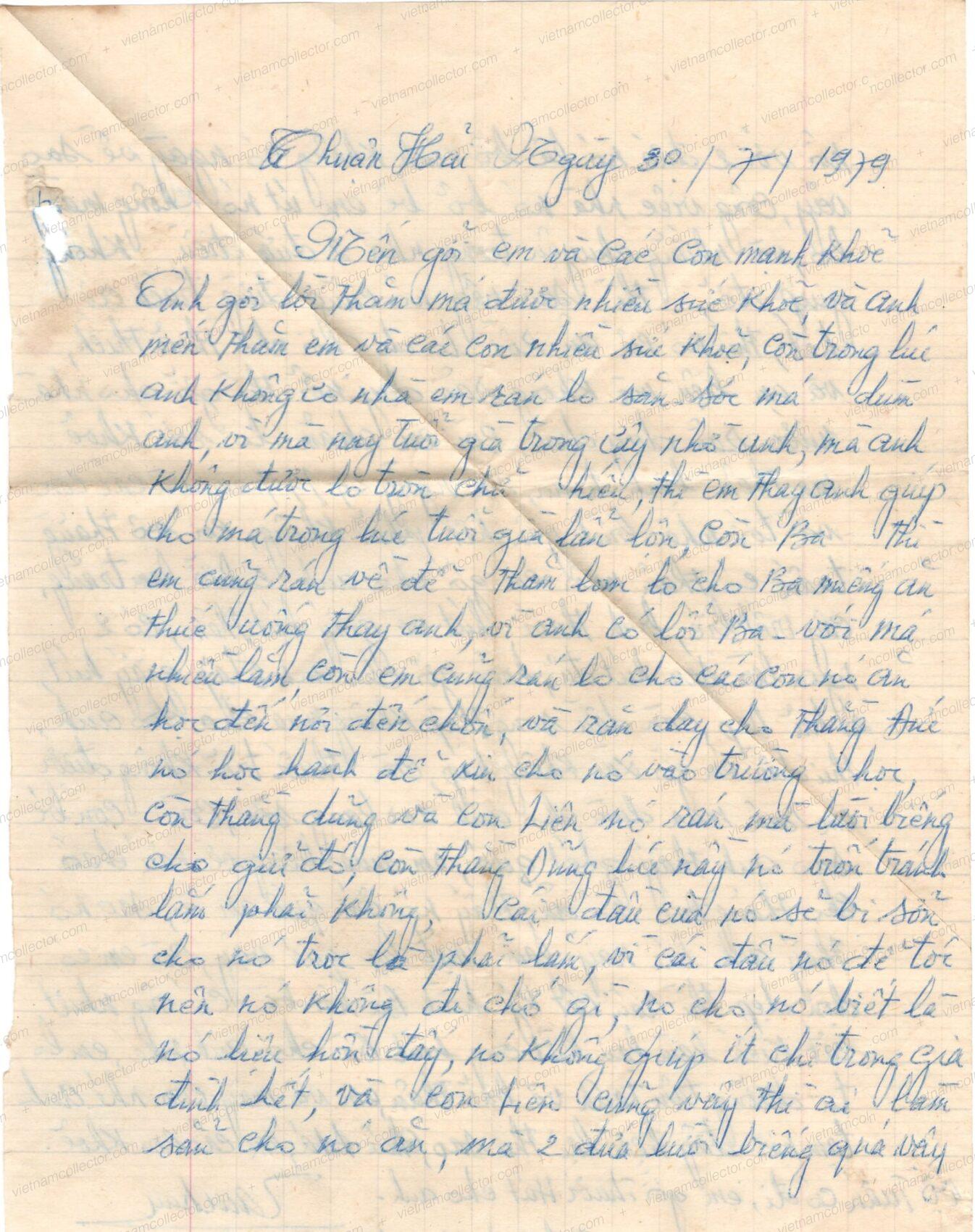
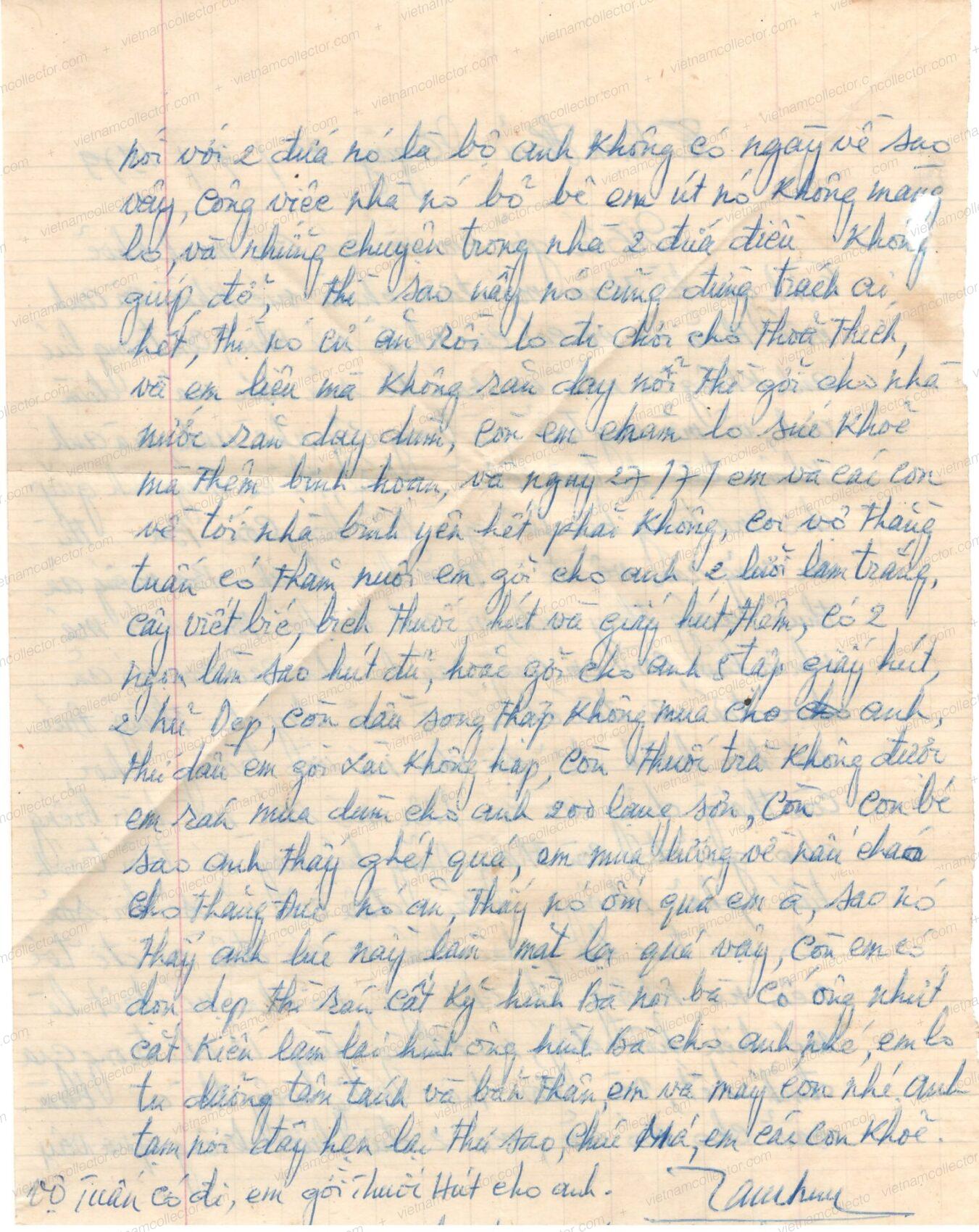
A third letter from October of 1979 of the same individual located in Camp Z30D to the same civilian in HCM City. This time the letter was franked with the Military Free Frank of 1976 (red-carmine color) indicating that the sender was a guard on military duty. HCM City machine arrival cancel on the reverse.
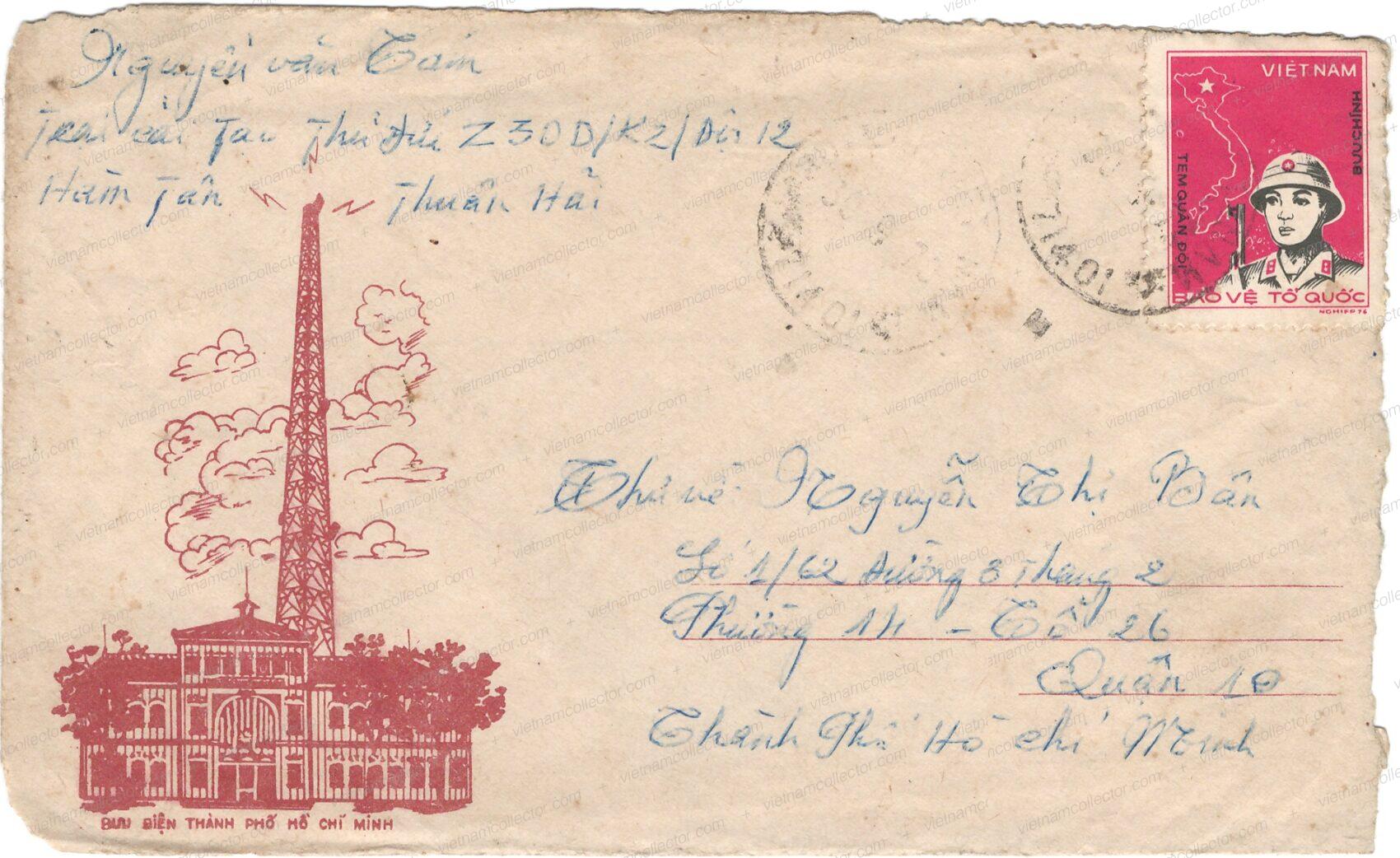
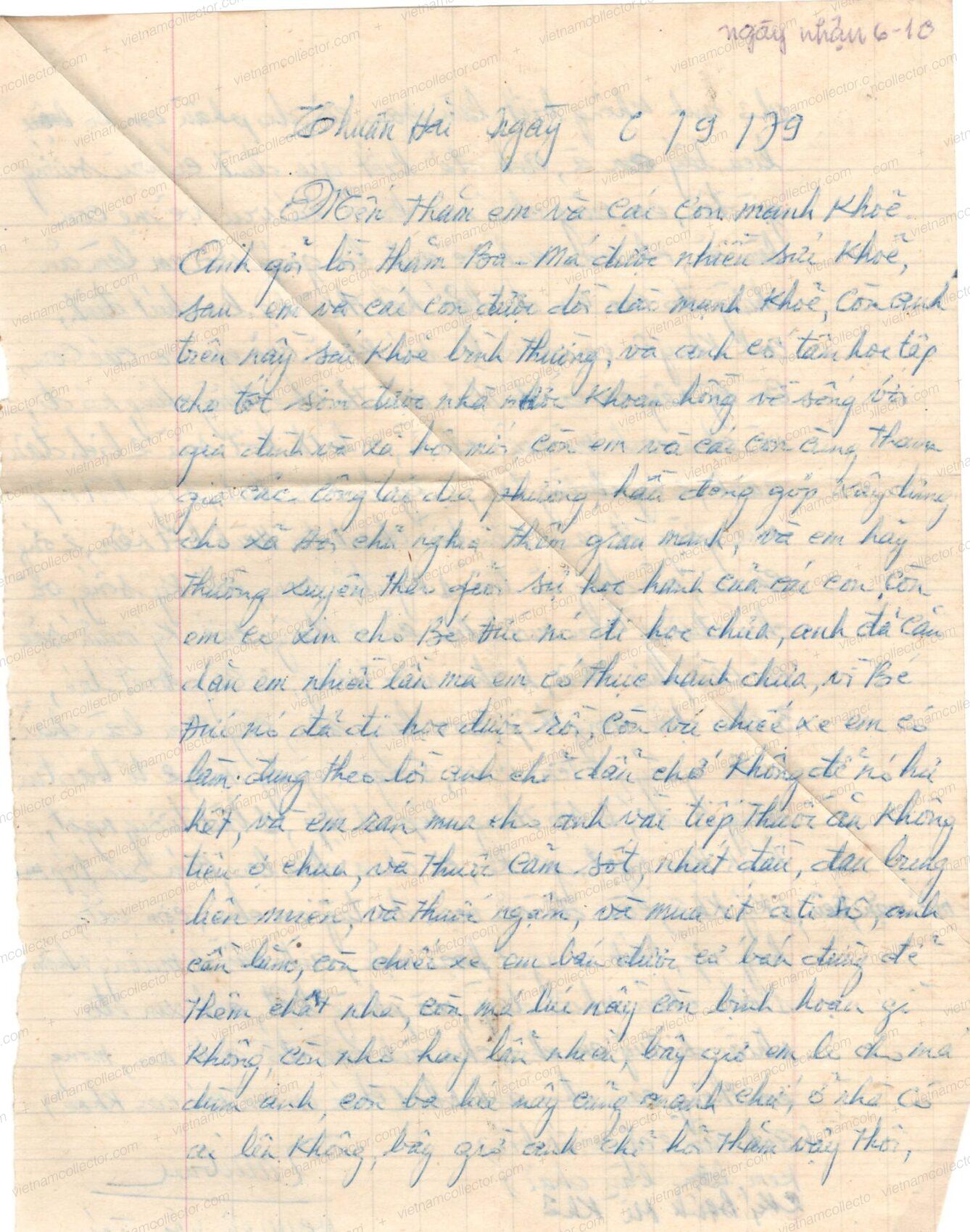
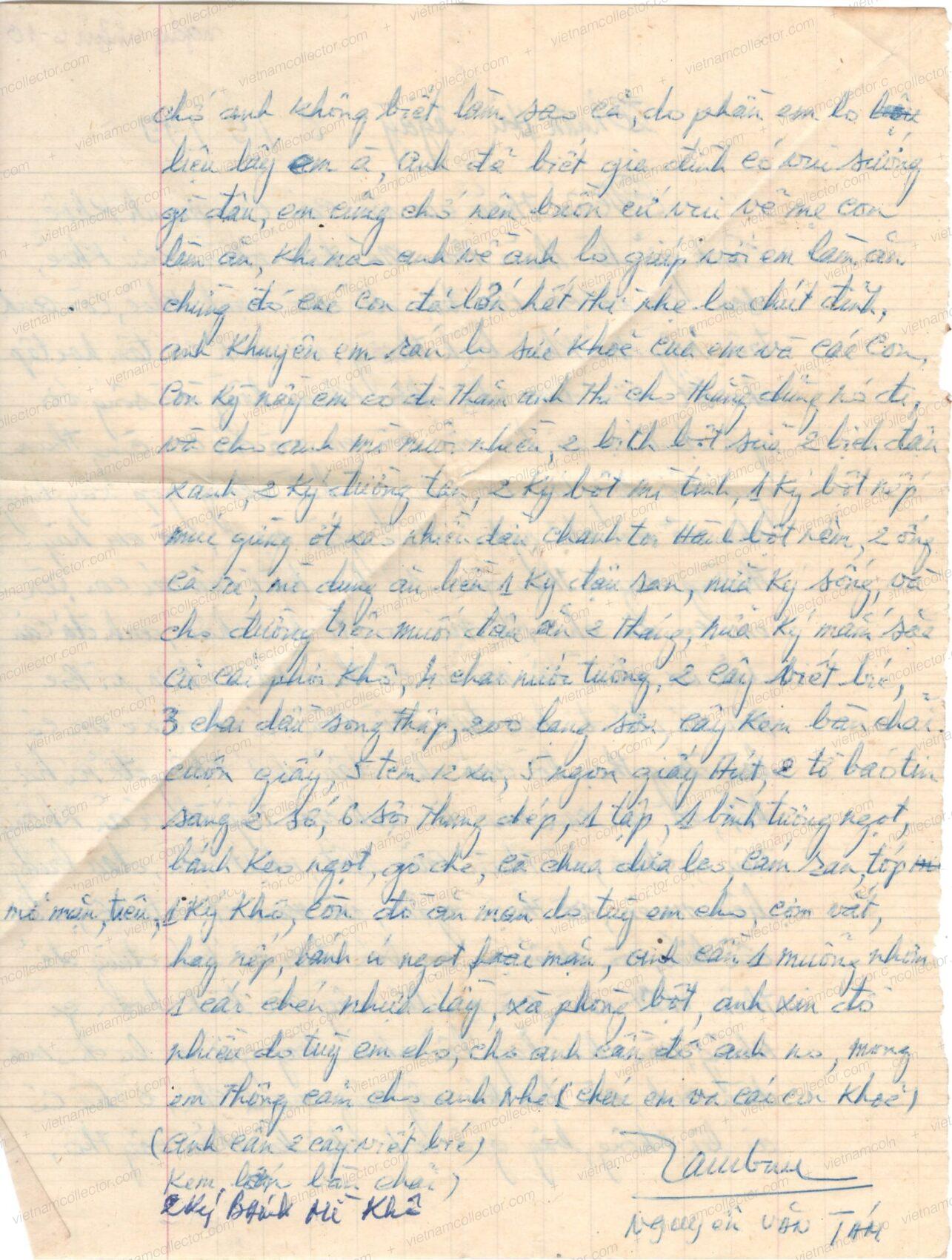
Letter from the same correspondence, again sent to the same civilian in HCM City in November of 1980. Franked with a 12 xu civilian National Assembly stamp. The letter was processed in Phan Thiet. HCM City arrival cancels on the reverse.
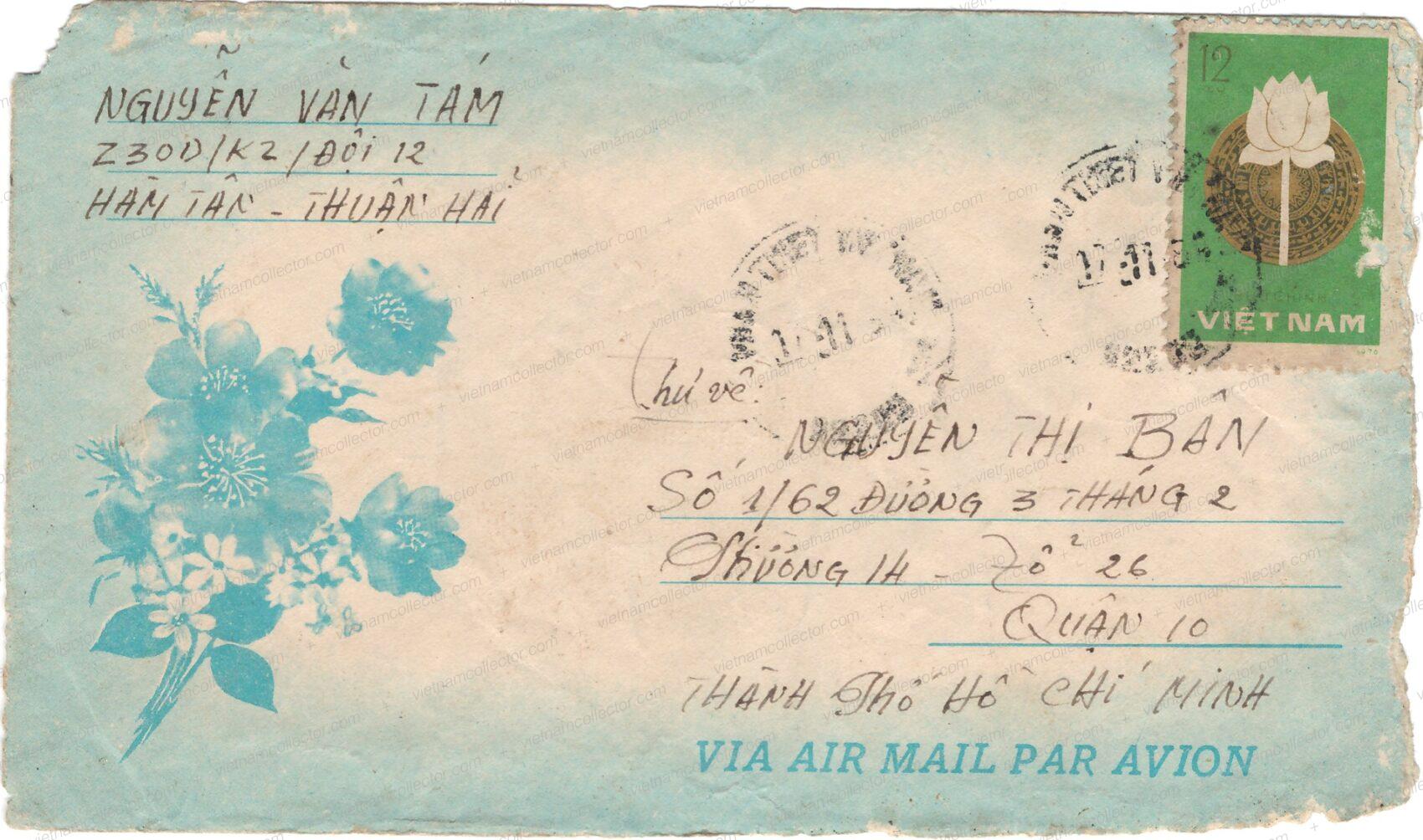
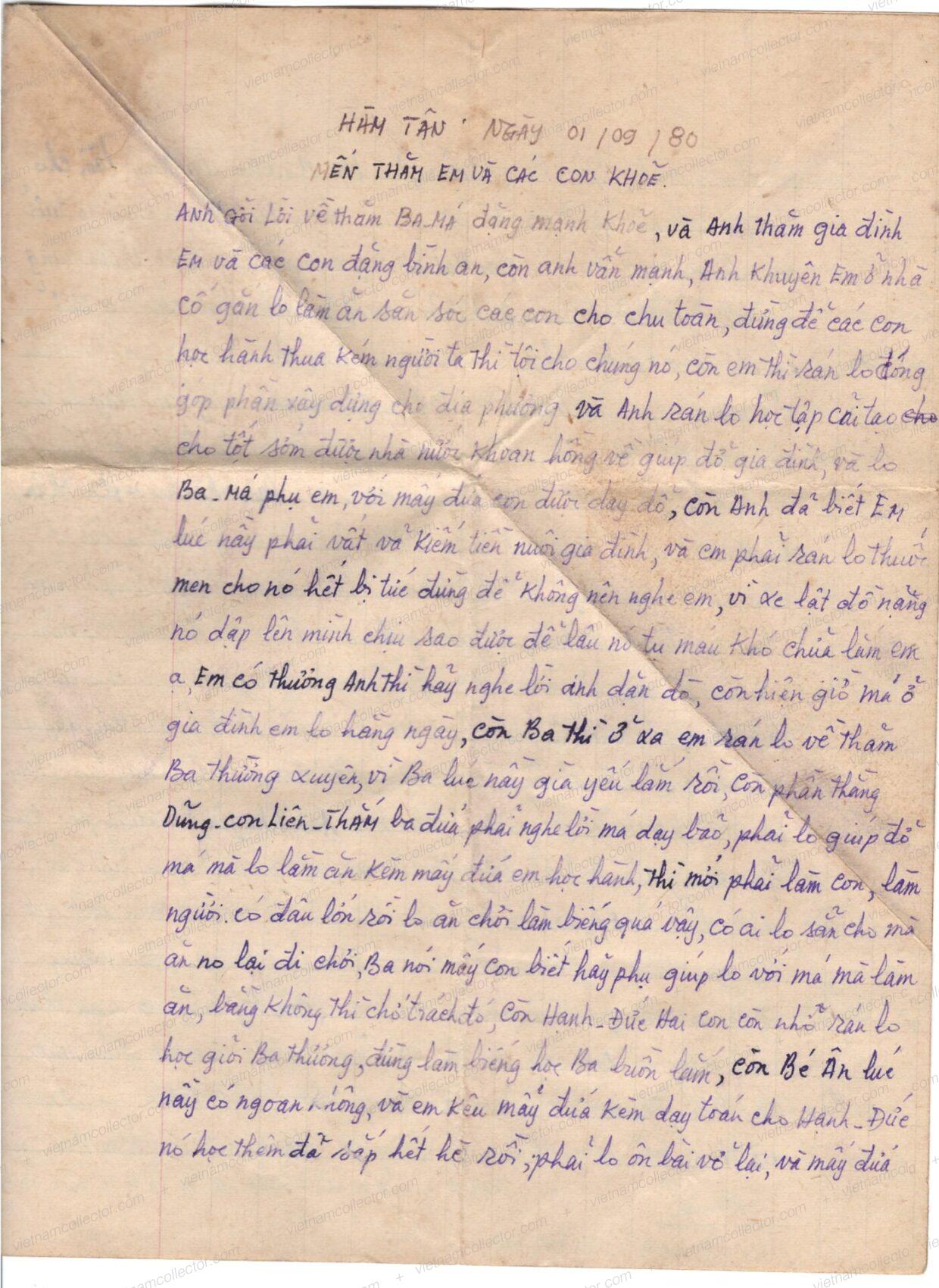
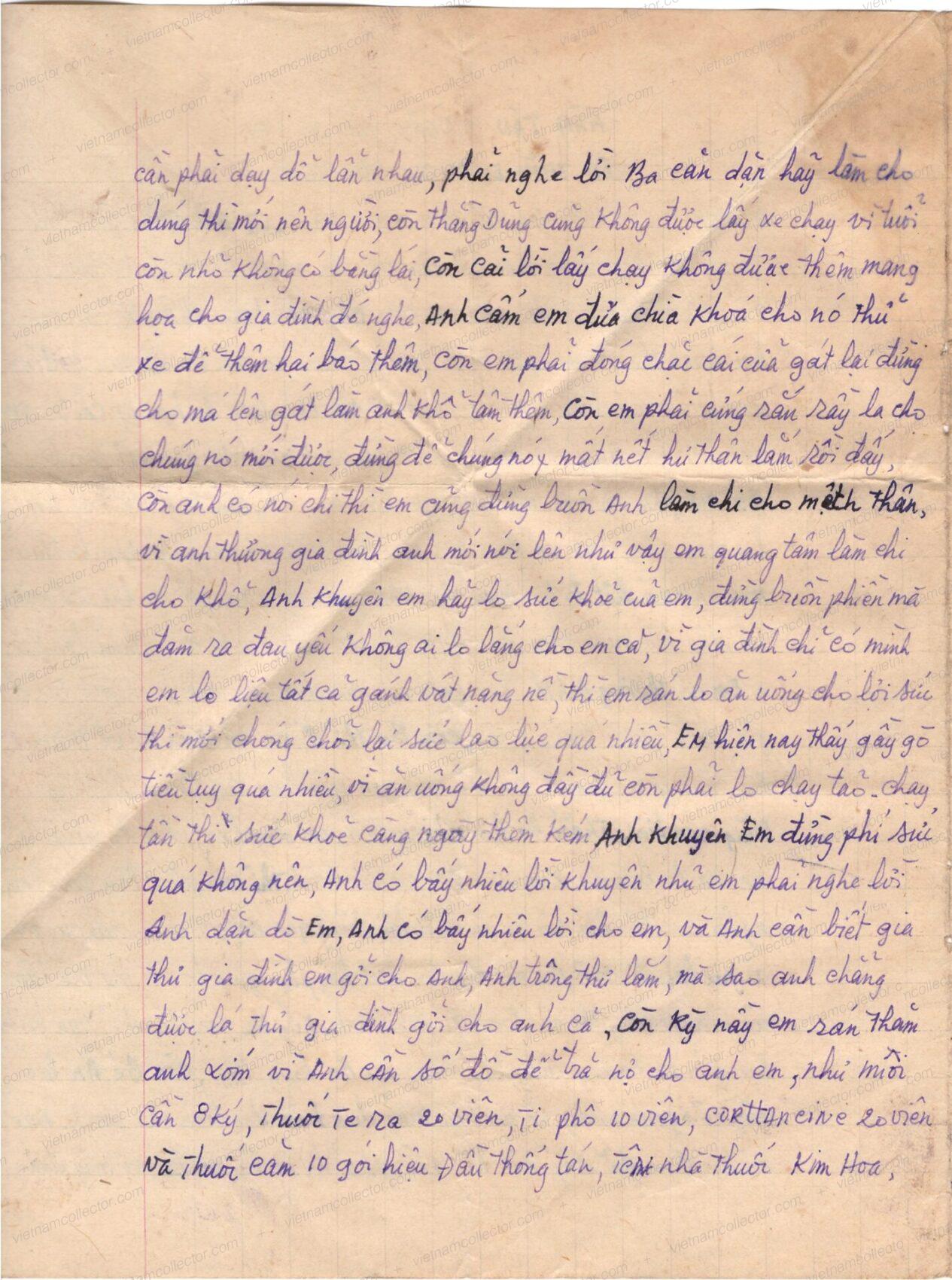
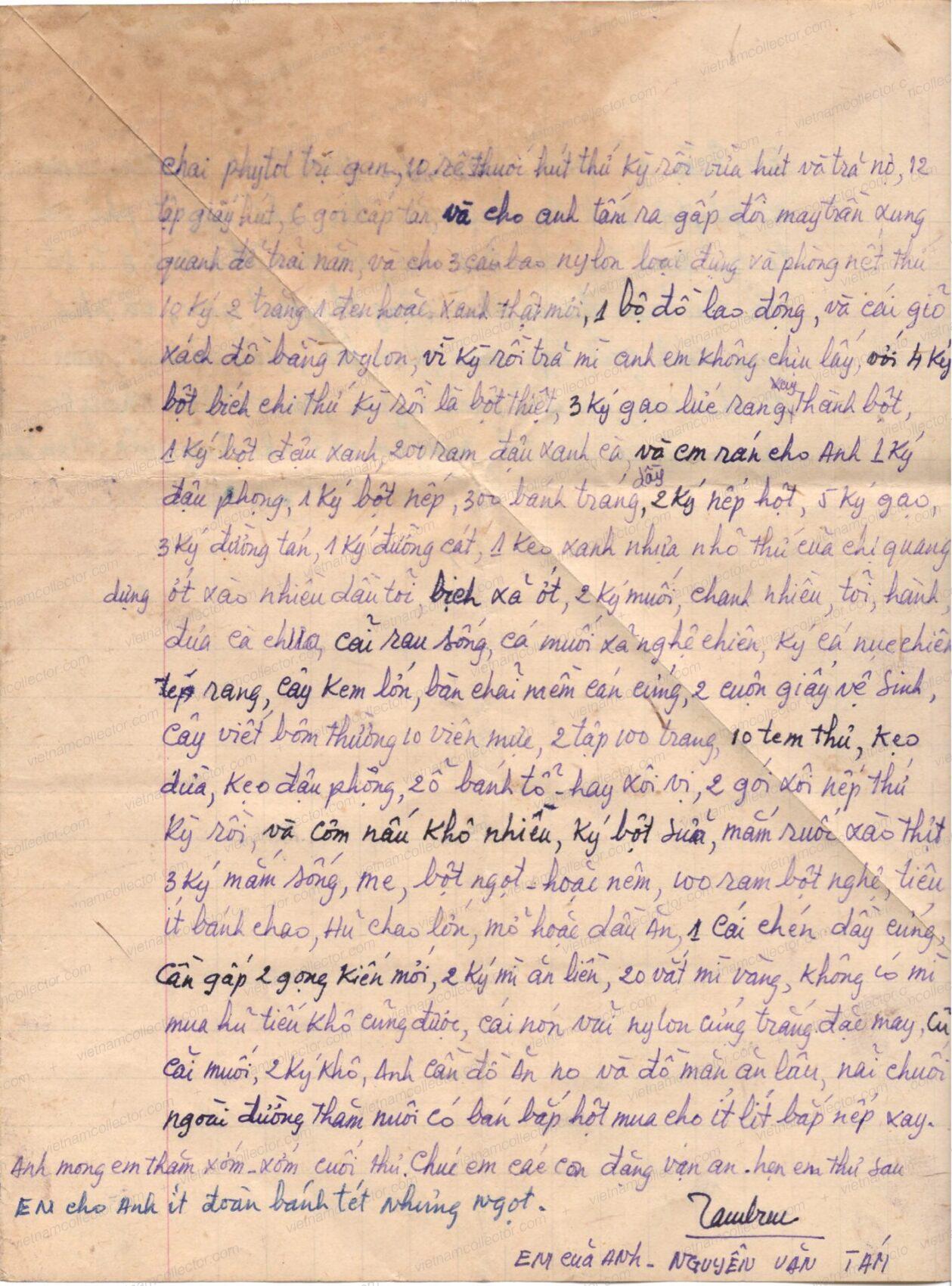
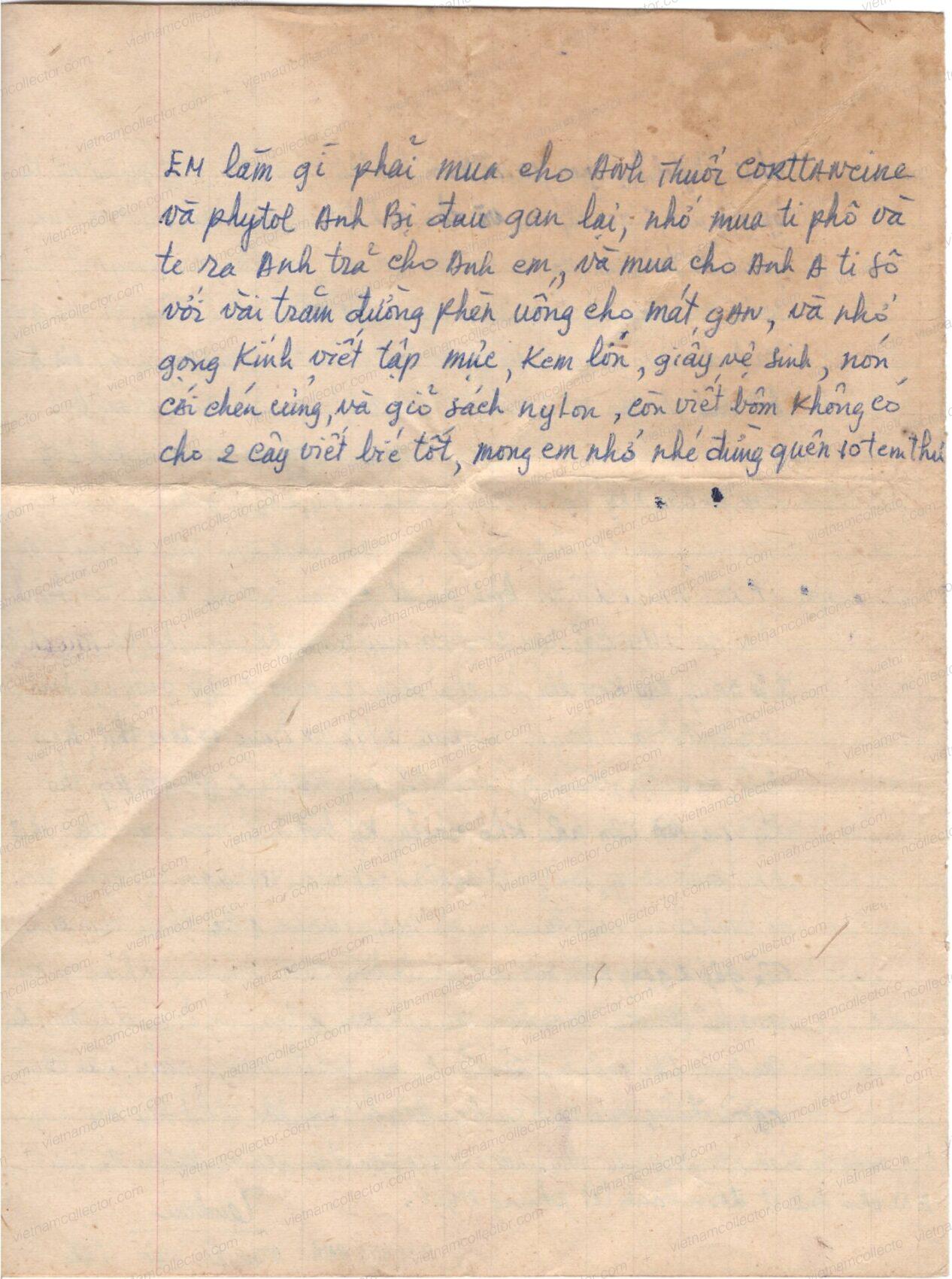
Another letter from the same correspondence in December of 1981 originating in Camp Z30D and franked with two 10xu civilian postage stamps paying an overall postage of 20xu. The stamps are canceled with the circular HCM City canceler. Quan 1o transit cancel on the reverse.
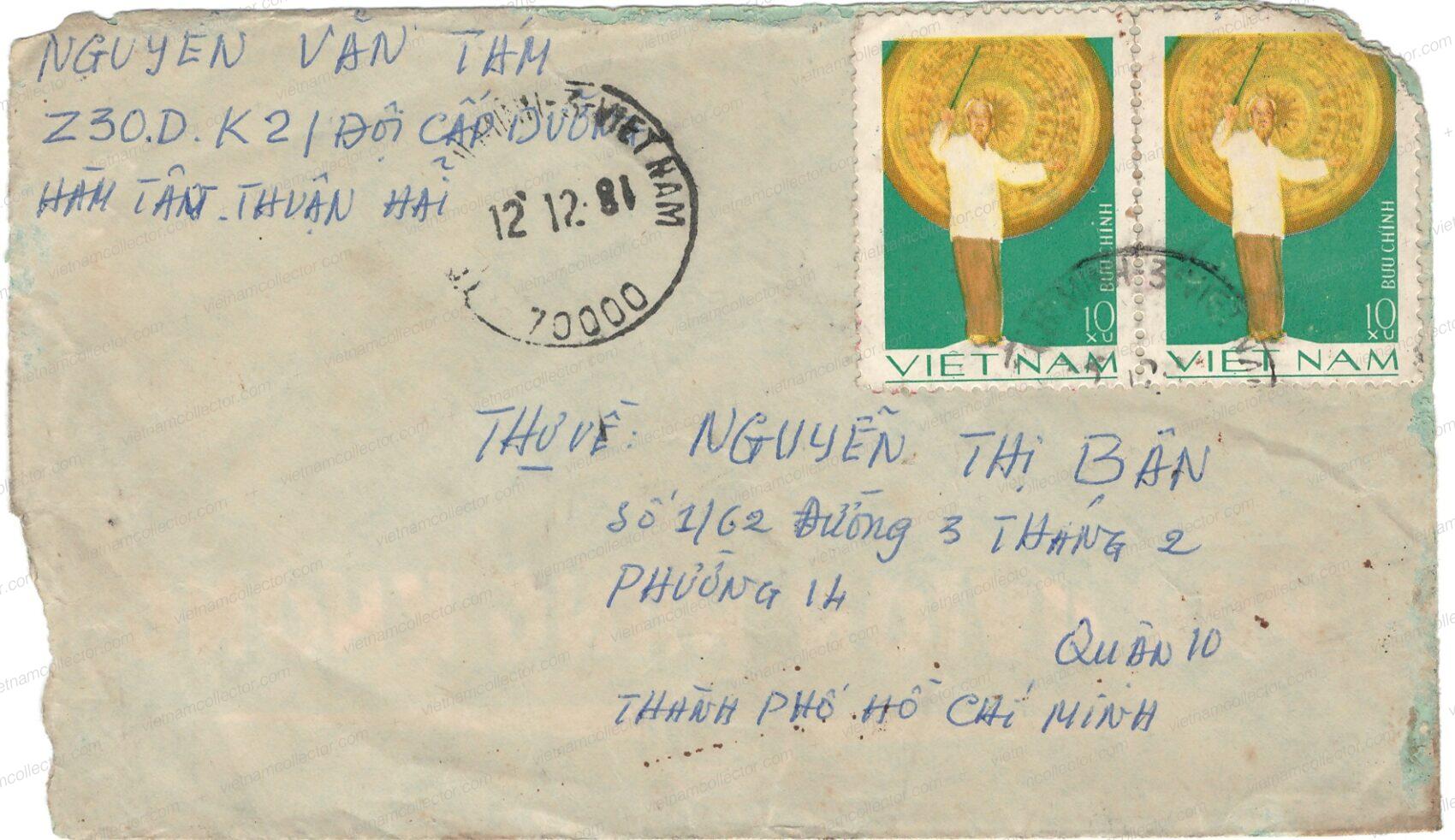
Letter sent by an inmate of Camp Z30D to a civilian in HCM City. Franked with a 12xu National Liberation stamp (that was already in the new unified currency) and used from Ham Tan to the East of HCM City in December of 1979. HCM City machine arrival cancel on the reverse.
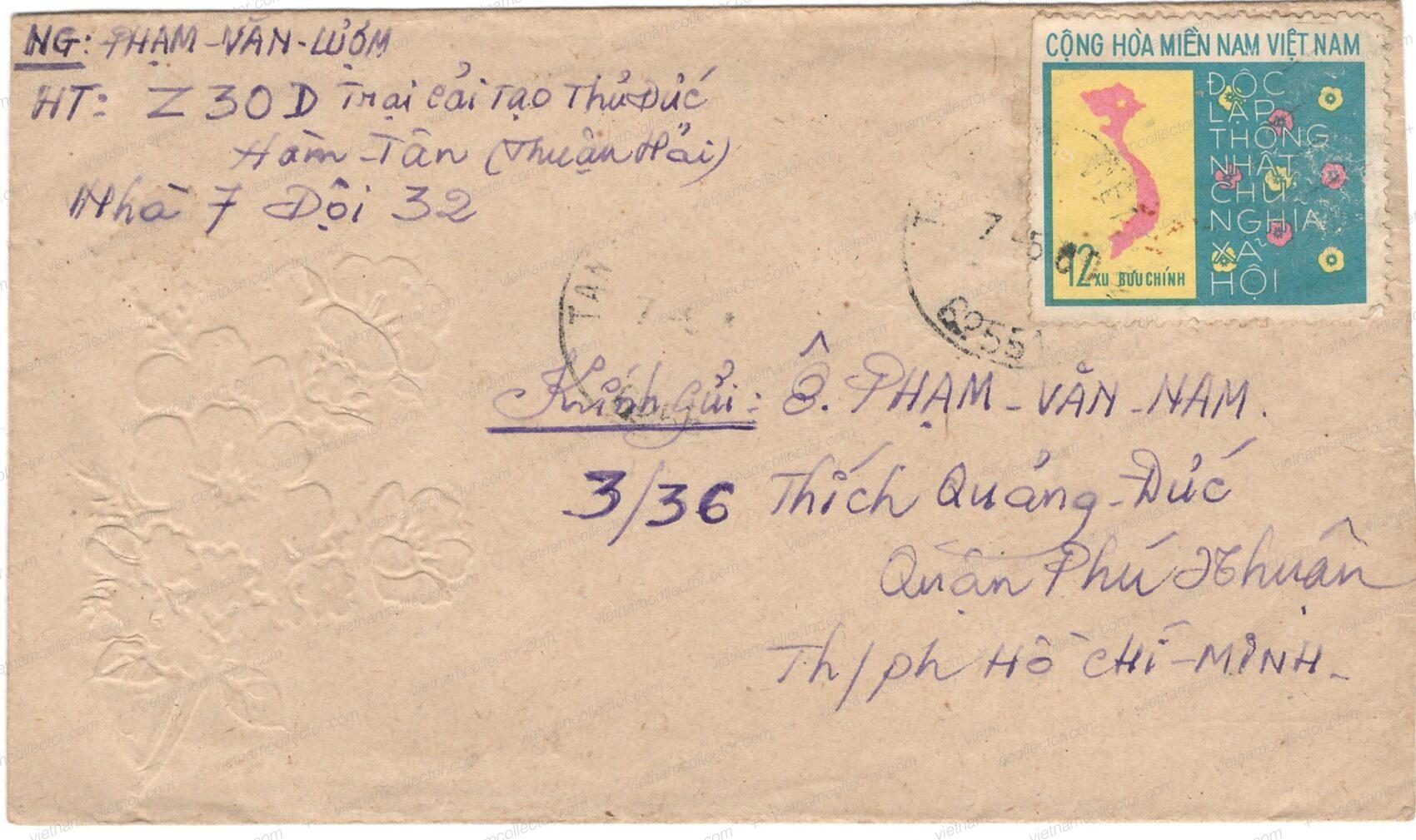
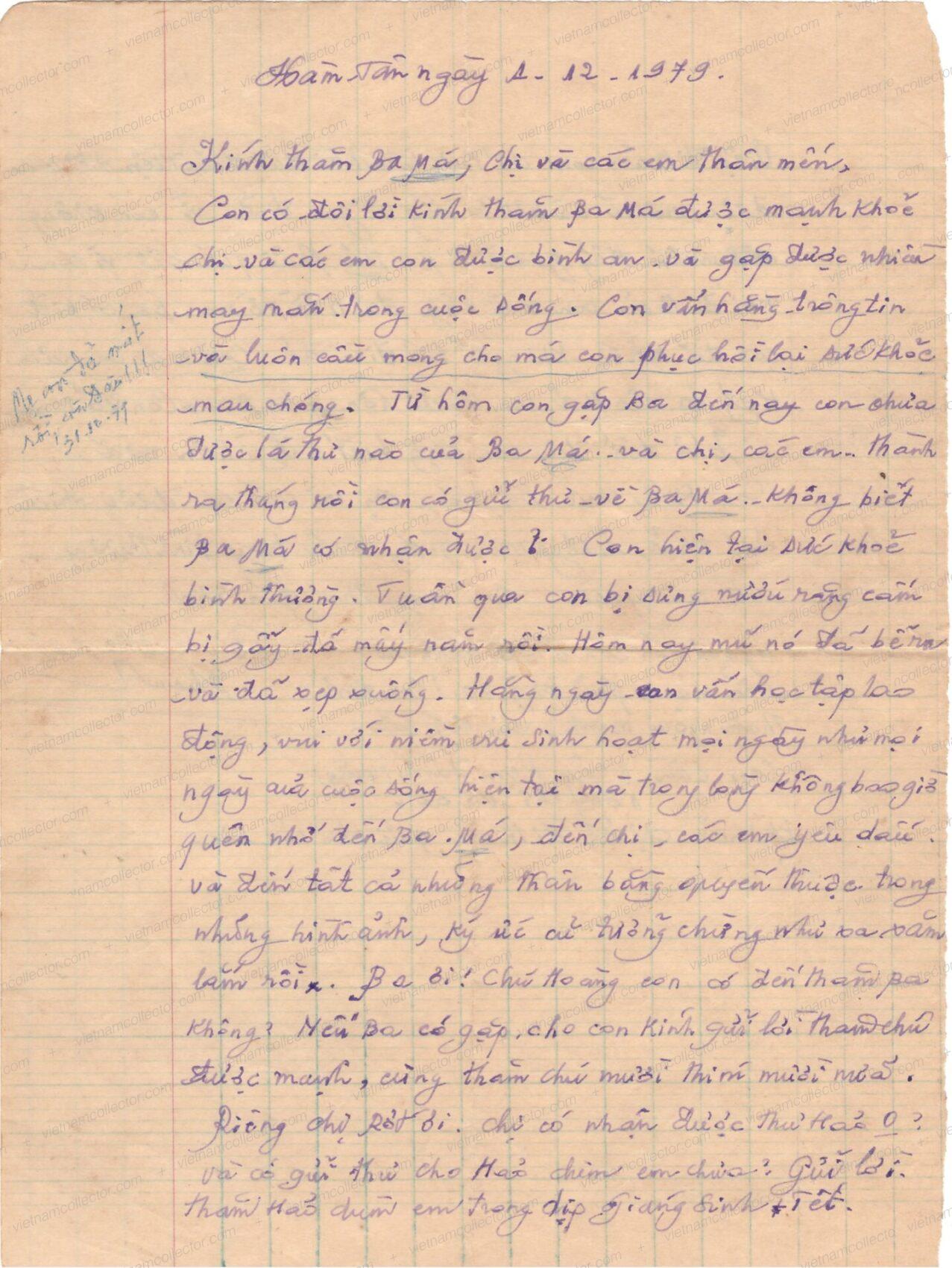
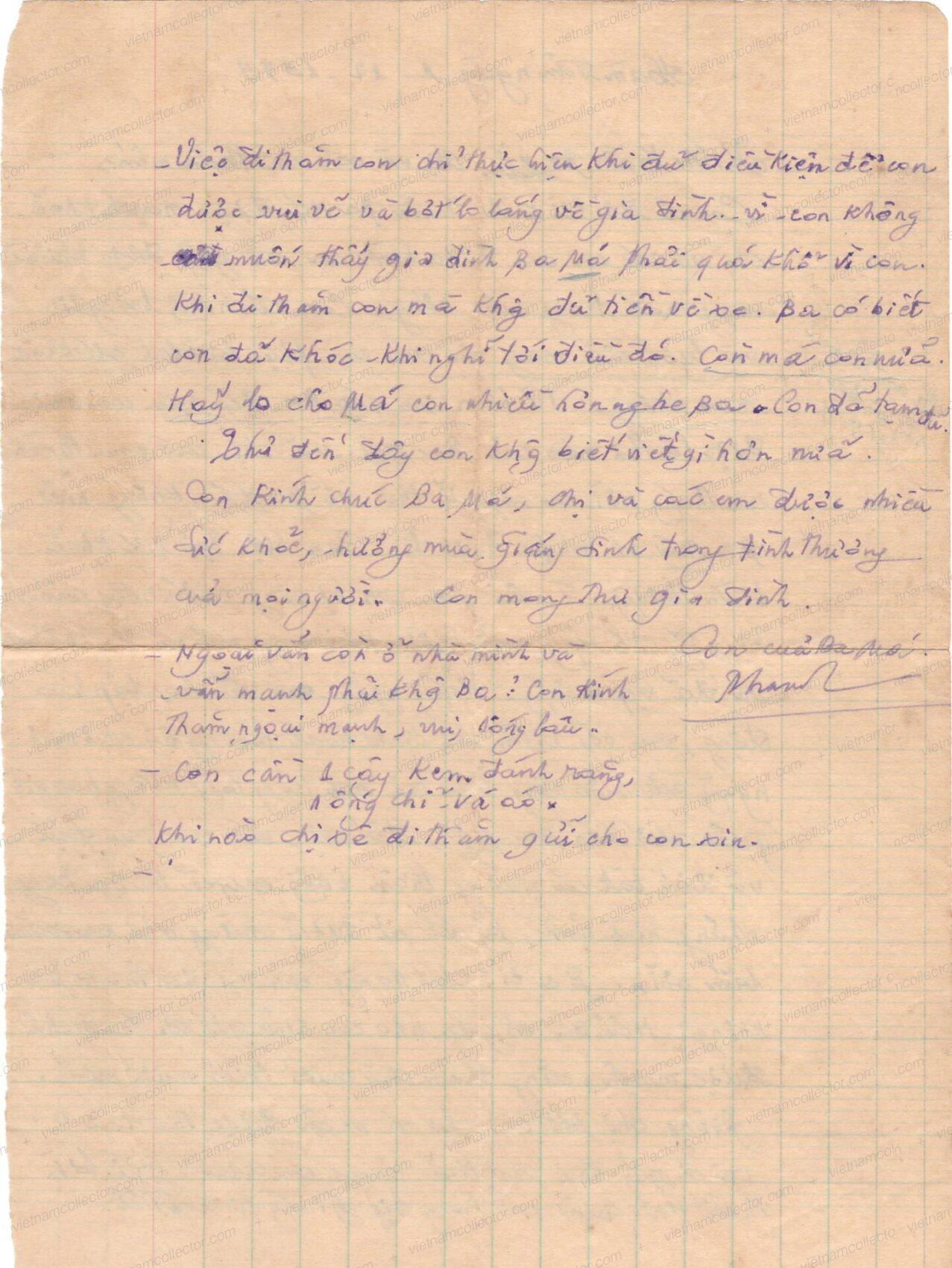
Letter sent by an inmate of Camp Z30D to a civilian in HCM City. The camp is associated with Ham Tan, Thuan Hai Province, near Da Mai village. The letter was sent in March of 1980 and franked with a civilian stamp of 12 xu Five Year Plan stamp from 1979 that was cancelled with a machine HCM City canceler. HCM arrival cancel on their reverse.
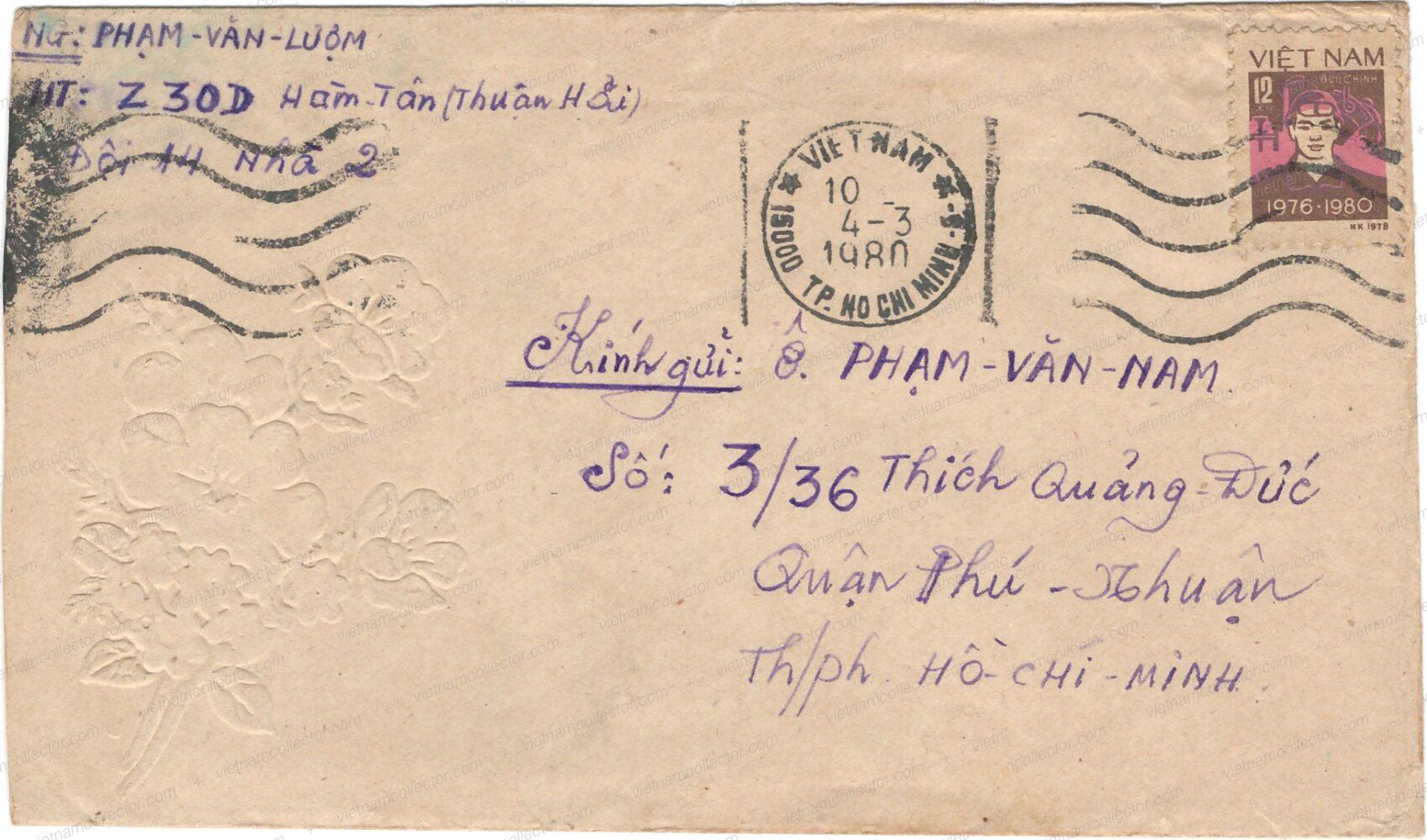
Rare letter sent in May of 1984 by a guard of Chi Hoa Prison to another guard located in Camp Z30D located to the East of HCM City in Ham Tan district. Franked with a 50xu Karl Marx civilian stamp and canceled with the rural Chi Hua canceler.
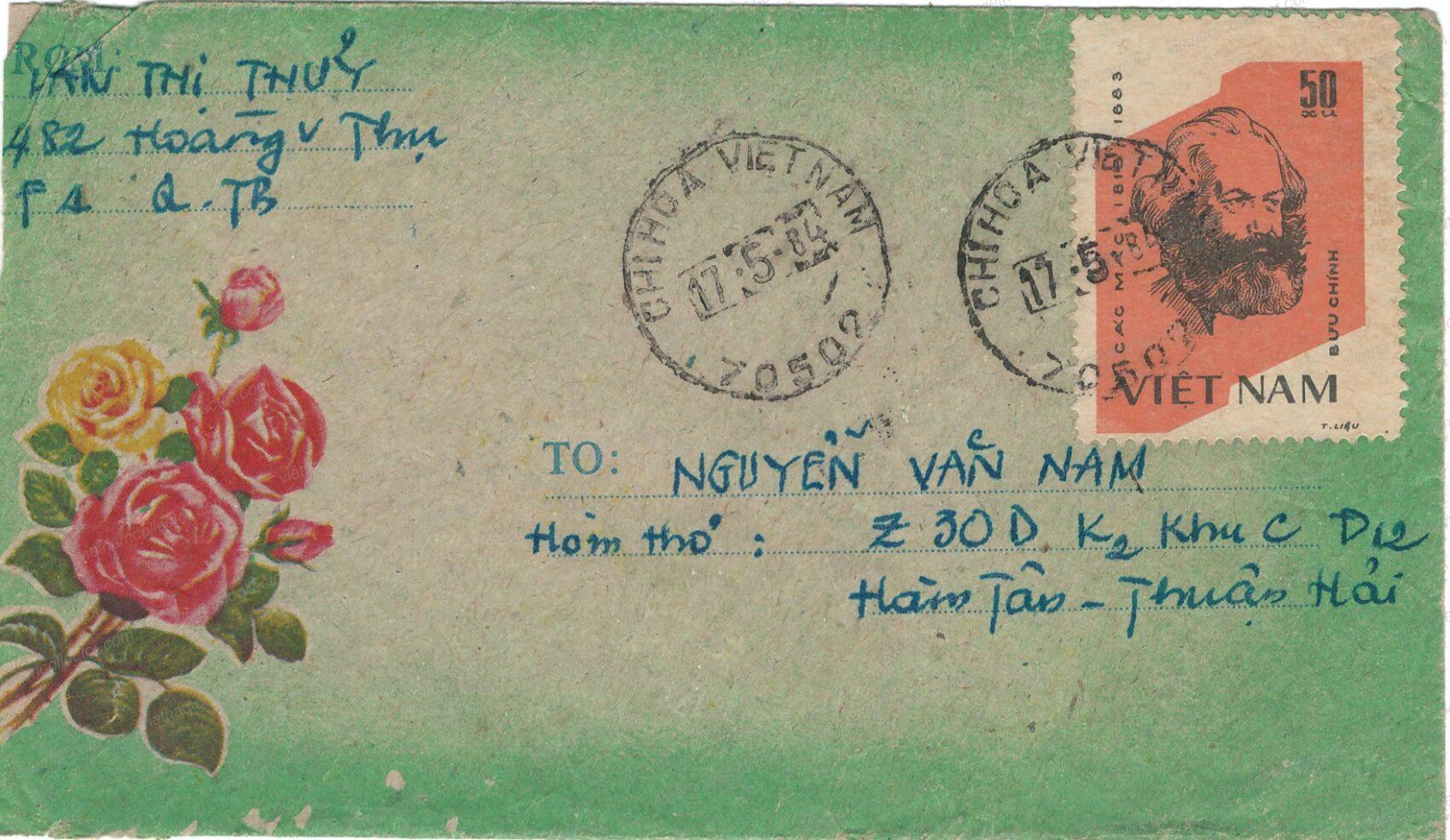
Registration Nr. 200401
]]>Here is there mint set.
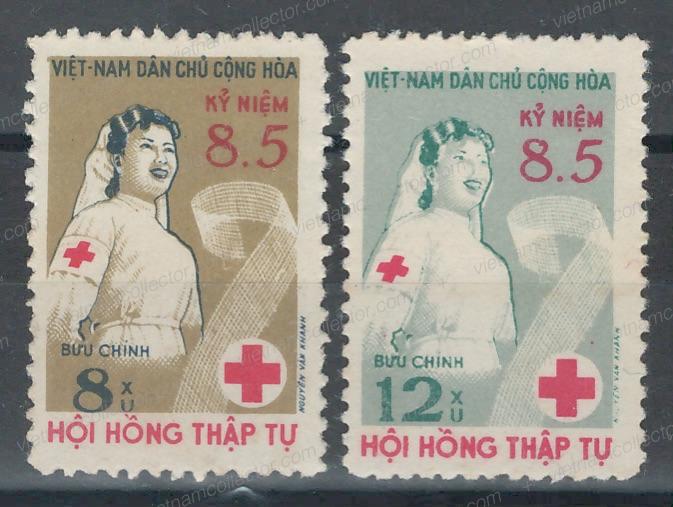
Mint blocks of four.
Cancelled to order block of four of the 8xu value on which the top right stamp shows the plate error “broken ET in VIETNAM”.
Official Xunhasaba stamp bulletin for this issue.
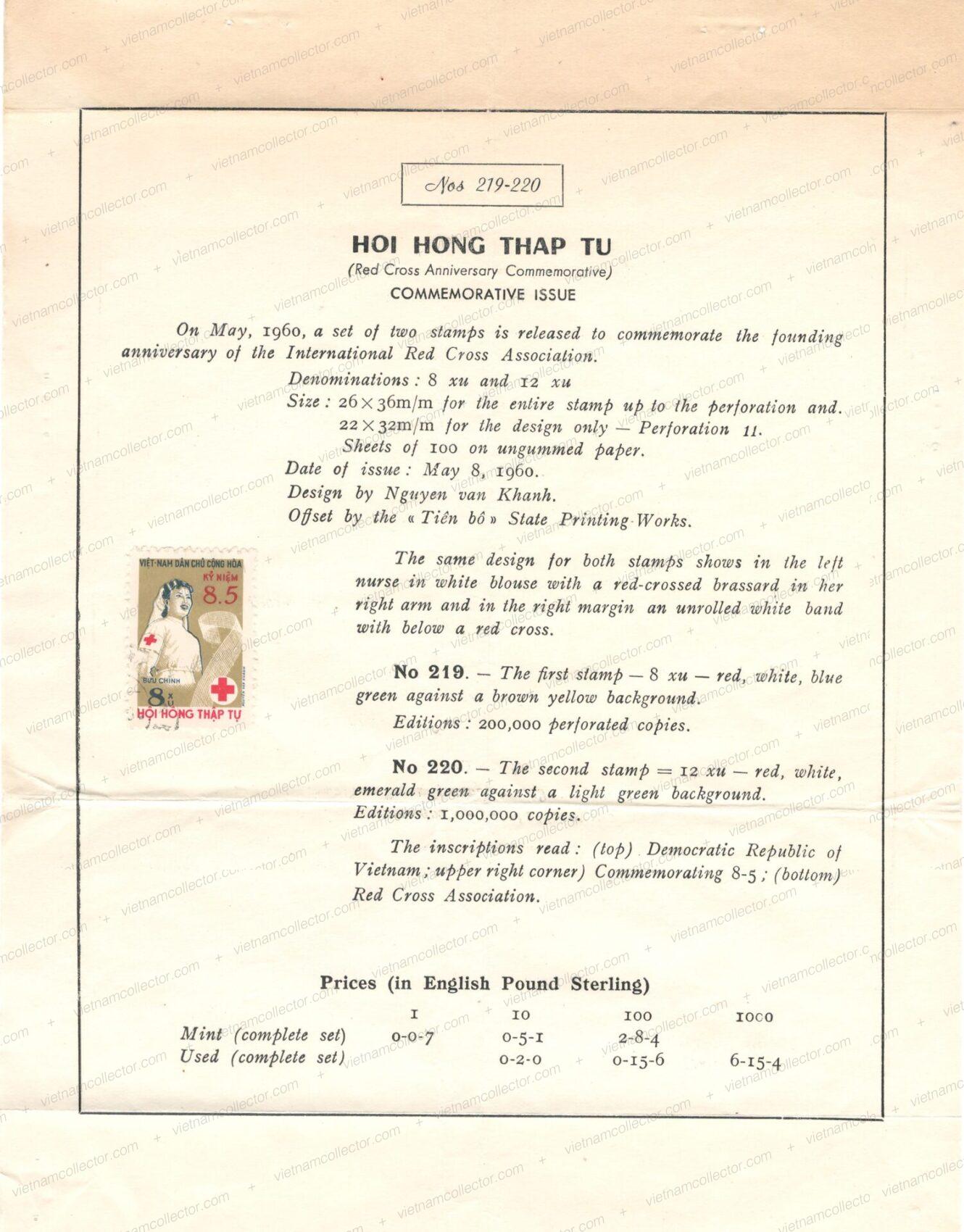
Letter ex Klewitz from June of 1960 that carries a variety of 1960’s North Vietnamese stamps including the Red Cross stamps. The letter was mailed registered and carries an overall franking of 72 xu. This postage would have been insufficient for a letter to West Germany (standard letter rate of 50 xu) but the clever sender wrote Cong Hoa Dan Chu Duc” which stands for “East Germany”. A letter to East Germany only cost 12 xu plus the 60xu international registration fee which made the franking look perfectly fine to the duped postal clerk.
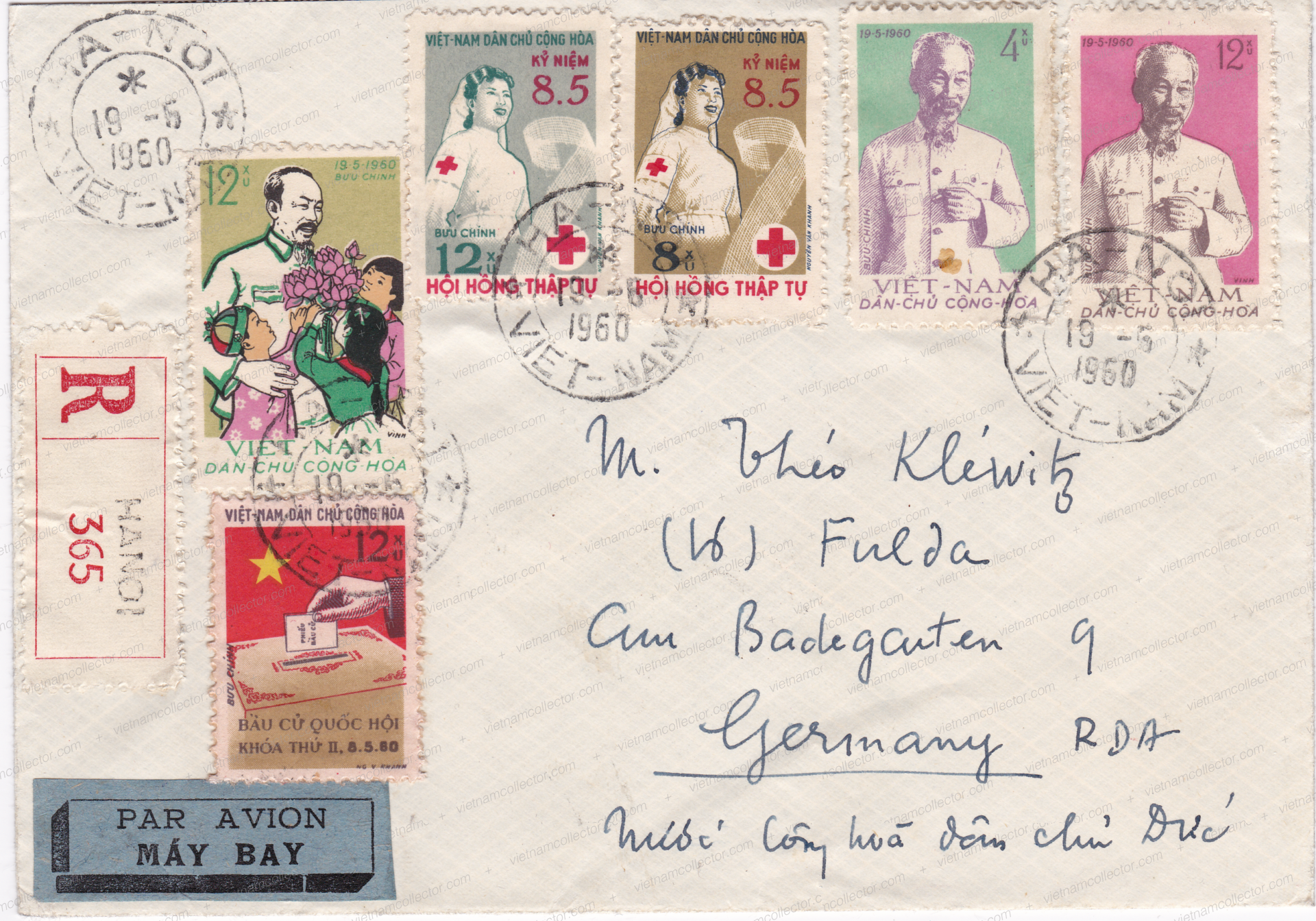
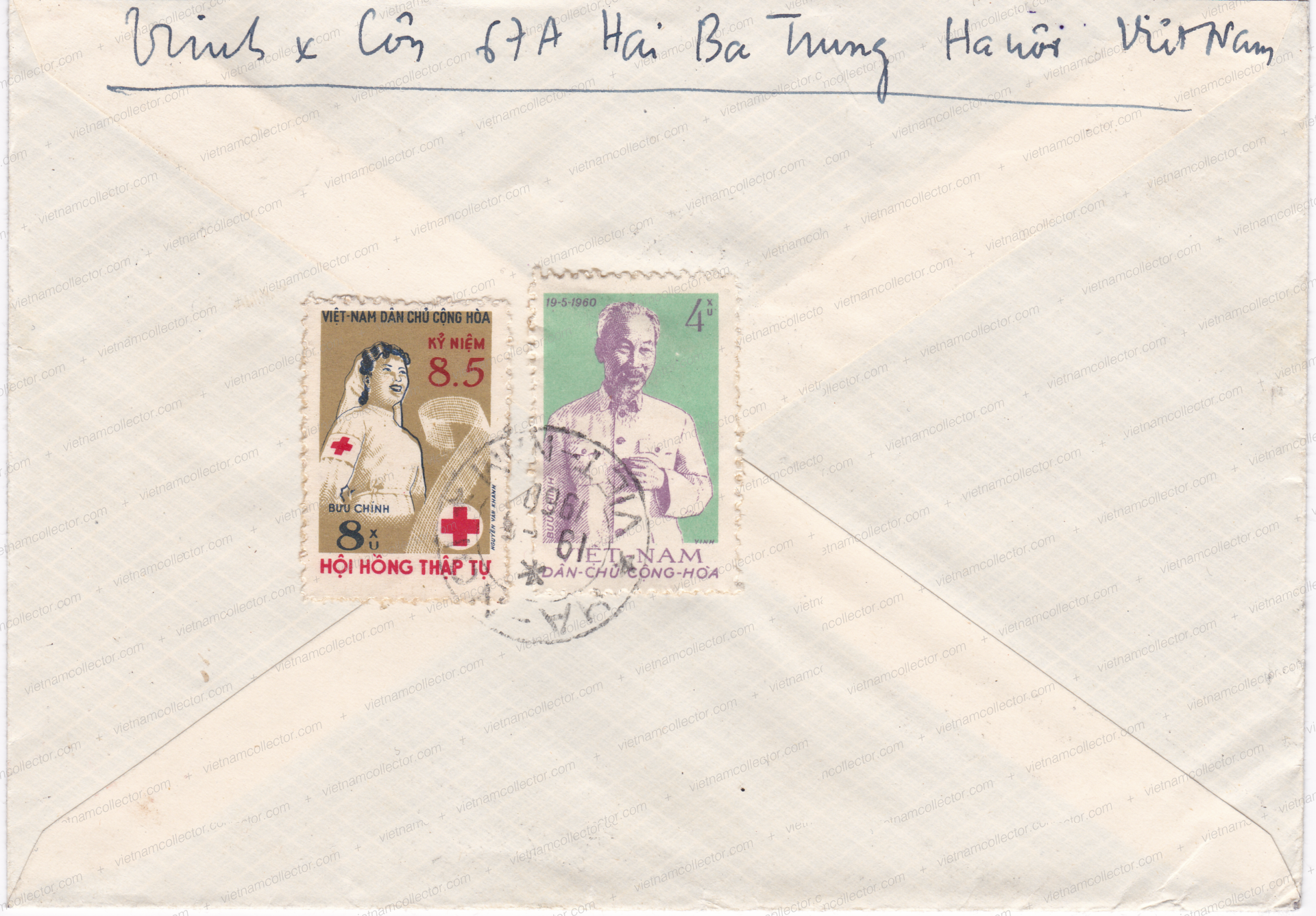
Registration Nr. 100390
]]>
Little is known about the Indochinese machine free franks. The International Postage Meter Stamp Catalogue list free franks for Vietnam but not forIndochina. So, it is not clear to the editor when the machines were first used in Indochina
Here is a rare proof strike of the Satas C machine that was later on also used in the State of Vietnam.
International air mail letter sent from Saigon to Switzerland in December of 1948 franked with 5.90P using the Satas C franking machine.
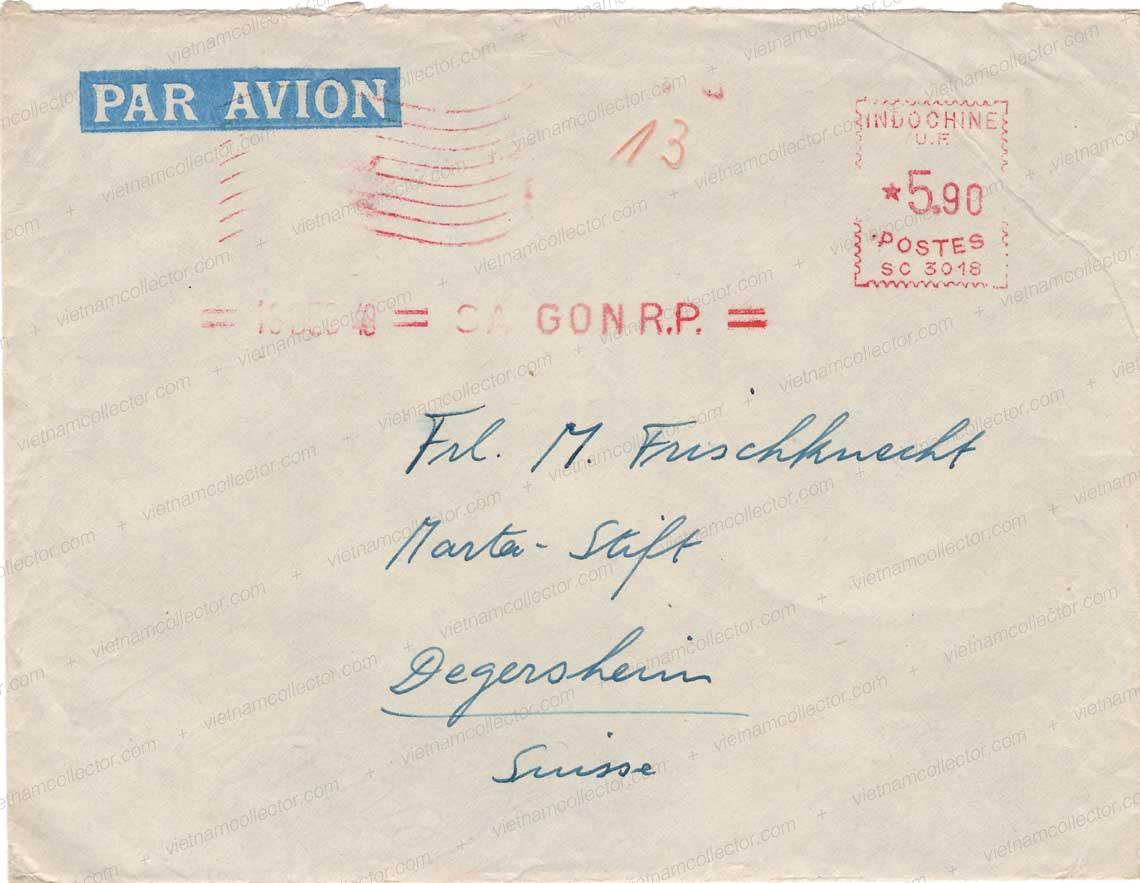
International air mail letter sent from Saigon to Switzerland in September of 1950 franked with 6.80P using the Satas C franking machine. Swiss arrival cancel on front.
Registration Nr. 090006
]]>A few years ago the editor was able to purchase an Indochinese cancel collection. The cancels were collected by what appears to be an Englishman or American on stamps that were common for the period. Most of the stamps were cancelled during the Japanese Occupation of Indochina that lasted from September of 1940 through August of 1945. This in itself is surprising as the mail volume in Indochina during the Japanese Occupation was very limited and hence stamps or postal history cancelled in that time period are pretty hard to find. Cancel collections are an important tool to identify genuine cancels of the time period and to unmask cancel and postal history forgeries. No forger would apply forged cancels common stamps with low value! The collection is featured as it was originally put together including the sometimes philosophical annotations of the collector who appears to have spent some time in Indochina.
To obtain a complete listing and depiction of the postal cancels used in Indochina over time is not exactly easy. Robert G. Stone in his booklet “An alphabetical List of Postoffice Names and Other Words in Postmarks Used on the General French Colonies”, published in 1978 provides an alphabetical listing of the known cancels and potentially existing cancels for the time period from 1860 through 1892 but does not actually depict any cancels. For the time period thereafter the best collection of postal marks the editor could find so far is contained in the publication “Les Obliterations des Bureaux de Poste des Colonies Francaise” by M.Langlois and V.Bourselet. The latter has been out of print since 1927 but at least for that year it provides an alphabetical listing of all post offices and depictions of the various cancel formats. Here are the pages of this booklet that pertain to Indochina.

Jacques Dessrousseaux provides additional information on certain post offices in Indochina in his booklets “Les Posted et Courriers Francais en Extreme-Orient” (Books 1 and 2) but he also only shows some sample cancels.







 Registration Nr. 089000
British stamp dealer Stanley Gibbons purchased the one of a kind 1 C British Guiana magenta for the 8.3 million U.S. Dollars and is now offering fractial ownership of the stamp to philatelists and investors worldwide, which could be the advent of a new investor class. But more on that later.
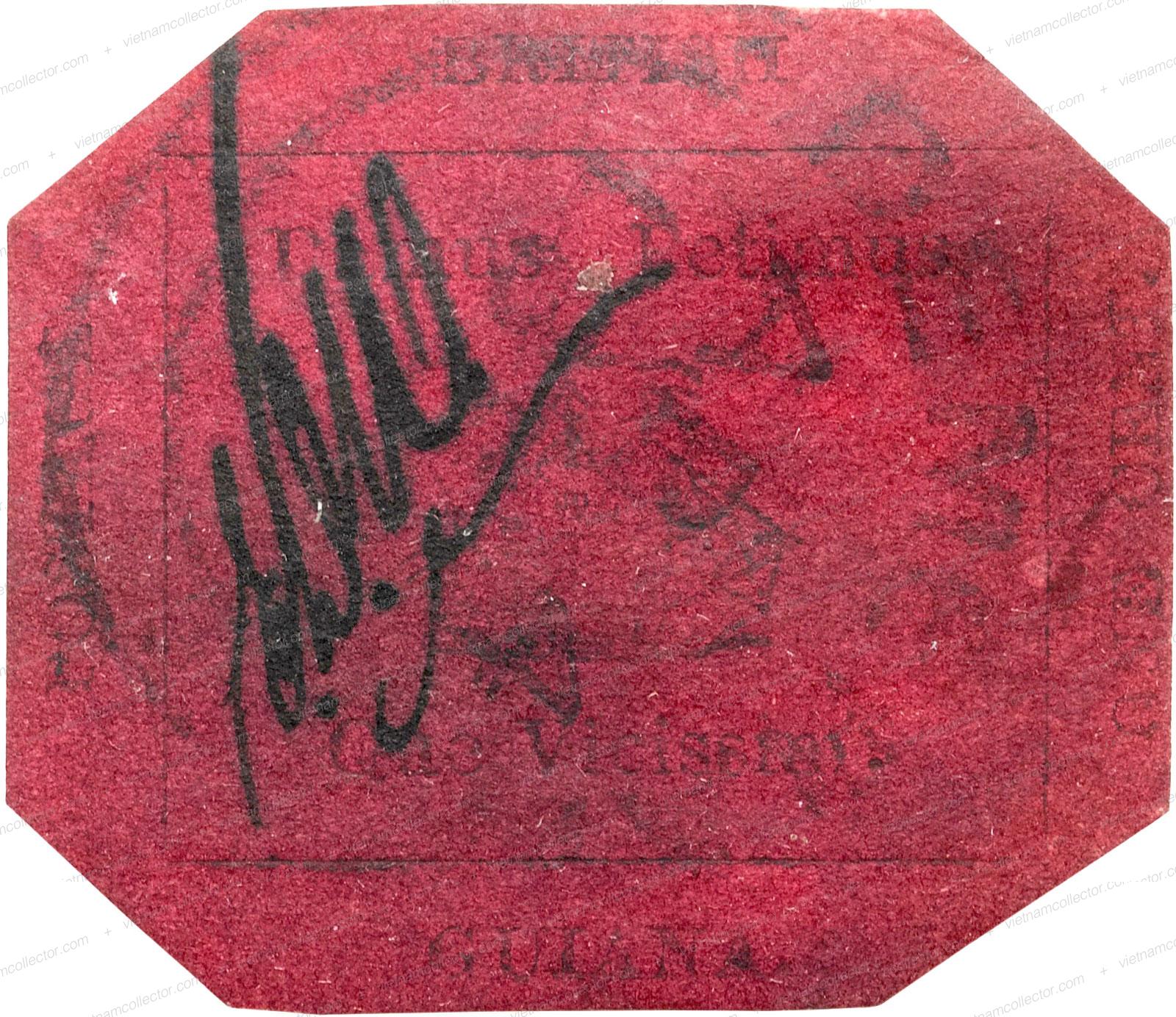
The fabled 1 C British Guiana magenta stamp (refer to wikipedia.com)
Super rare stamps are mostly a classical affair with most rare and valuable stamps having been printed and discovered already in the second half of the 19th and early part of the 20th century. Information flow was much slower in those times than it is today, so even very rare stamps, such as the fabled Red and Blue Mauritius stamps, that were printed in 1847 and of which only 12 specimens of the Blue Mauritius and 15 of the Red Mauritius stamps still exist, were not discovered for years.
Rare stamps – the Stories behind
A letter with a single copy of the Red Mauritius was sold in the summer of 2021 by the auction house Gärtner in Germany for 8 million Euros plus commission. It took until 1864 for the Mauritius stamps to be noticed by the wife of a French merchant. Of course, the stories of these discoveries reverberated in the general population and helped to push philately into the mindset of generations and instilled a kind of egalitarian treasure hunt in which everyone was free to participate.
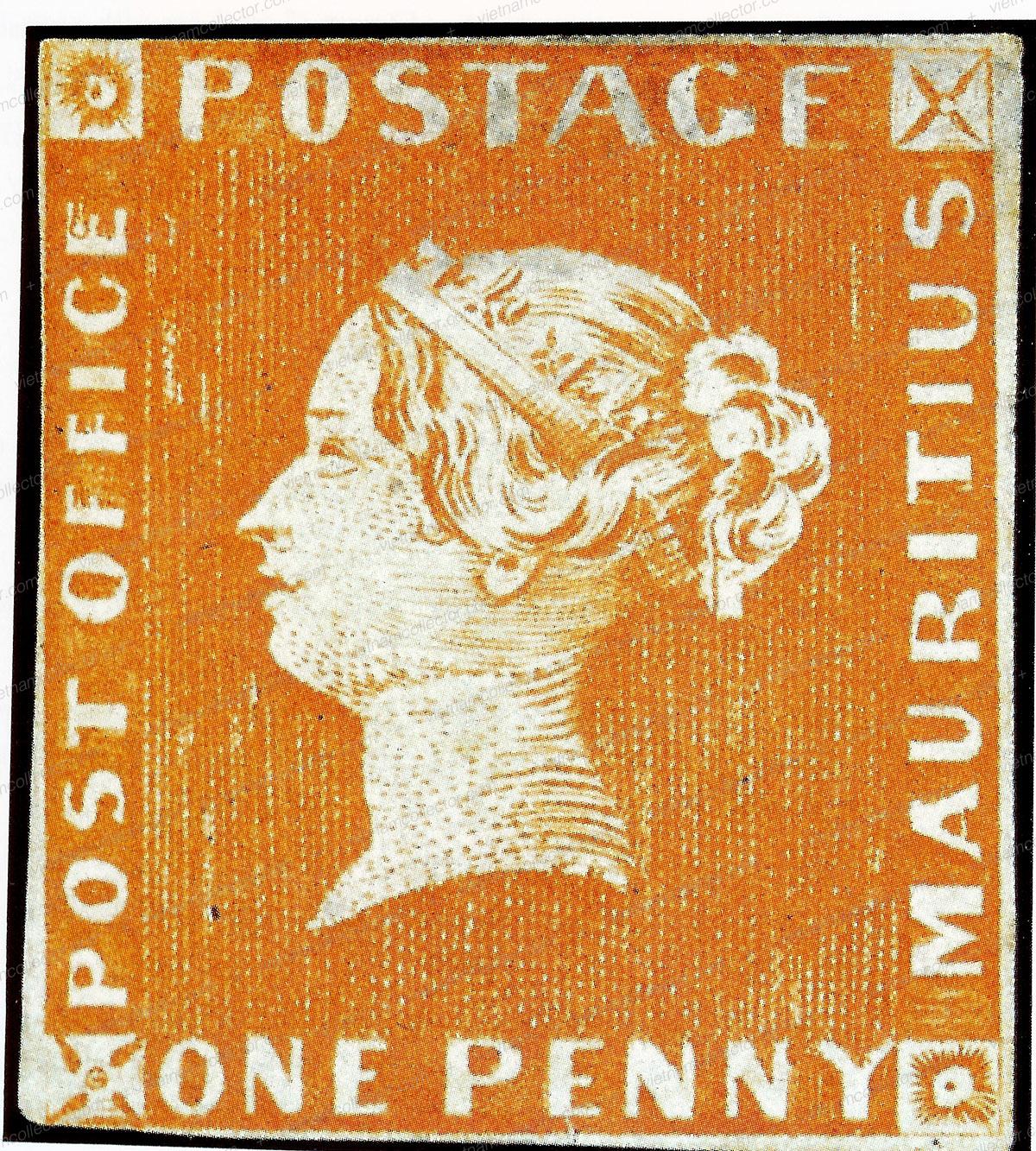
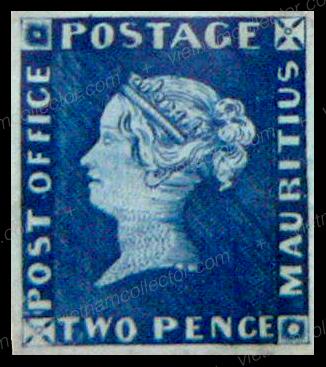
The Red and Blue Mauritius Post Office stamps (wikipedia.com)
So, one would assume that new discoveries of super rare stamps are a thing of the past as most stamps produced today are issued in such large numbers that they will never be rare and hence expensive. Alas, that is not the case. Just in 2015 a stamp that rivals the fabled 1C British Guiana in that there is only one known copy to exist, was introduced to philatelic circles. In this case the discovery pertains to Asia; specifically to Vietnam.
After World War II, Ho Chi Minh led the Viet Minh, a guerilla army, in a war against the French. The French had temporarily lost control of the former colony of Indochina to the Japanese but with the Japanese surrender in August of 1945, the French were trying to reassert their dominance by re-occupying the country.
For a while, both parties tolerated each other, but this temporary truce came to an end on December 19th, 1946 when open hostilities broke out between them. This forced the Viet Minh, which had temporarily taken over the administration of the country from the Japanese, into the underground. The Viet Minh controlled mostly areas in the countryside, while the French held the large cities, key industries and the transportation infrastructure.
Nevertheless, the Viet Minh managed to create their own Government, army and currency, and even maintained their own postal system. The latter was no easy feat. Given that the Viet Minh controlled mostly rural and mountainous territory that, in some cases was not contiguous, securely delivering messages over enemy lines was a dangerous profession conducted mostly on foot and on paths away from the main roads. Mail was carried by people in civilian clothes and hidden on their body by wrapping plastic or leather pouches around it.
Ho Chi Minh gives a lecture to Viet Minh troops in 1954 (Vh postcards)
Sympathizers and supporters of the Viet Minh faced strong repercussions by manner of imprisonment and sometimes even summary execution. Under the French, any sign that someone was connected to the guerilla group was immediately hidden or destroyed as a result. In this atmosphere the Viet Minh printed some crude imperforate stamps in the archaic book-print method that showed the effigy of Ho Chi Minh in rather small quantities. How many, no one knows, but what we do know, is that today less than 200 of these stamps remain overall (see also here).
This scarcity was a function of the fact that messages were required to be destroyed immediately upon reading due to the aforementioned severe personal sanctions. The very humid climate of Vietnam, in which paper can disintegrate within months, the decade long wars, and a chronic shortage in raw materials that led to the recycling of many products, including paper, did not help to preserve additional specimens.
Because the Viet Minh currency was not backed by solid assets such as gold or productive financial assets inflation was rampant. Postal rates increased every few months, which required the printing of stamps with higher nominals. Because paper and ink was scarce, sometimes previous stamps were simply overprinted with new nominals to make them useful again.
The 50 Dong on 15 Dong Ho Chi Minh underground stamp – a new star on the horizon of philately and investors?
One particular stamp, an uprated 15 Dong (50 Dong on 15 Dong) stamp in light-brown color that was overprinted with a new 50 Dong value has so far only been found once. That puts it on par with the 1C British Guiana. So far, it has not been offered for sale by its owner, but given that economical and with that, political power, is rapidly shifting to Asia, one would expect that once it does come to market, the interest in this stamp will be great worldwide.
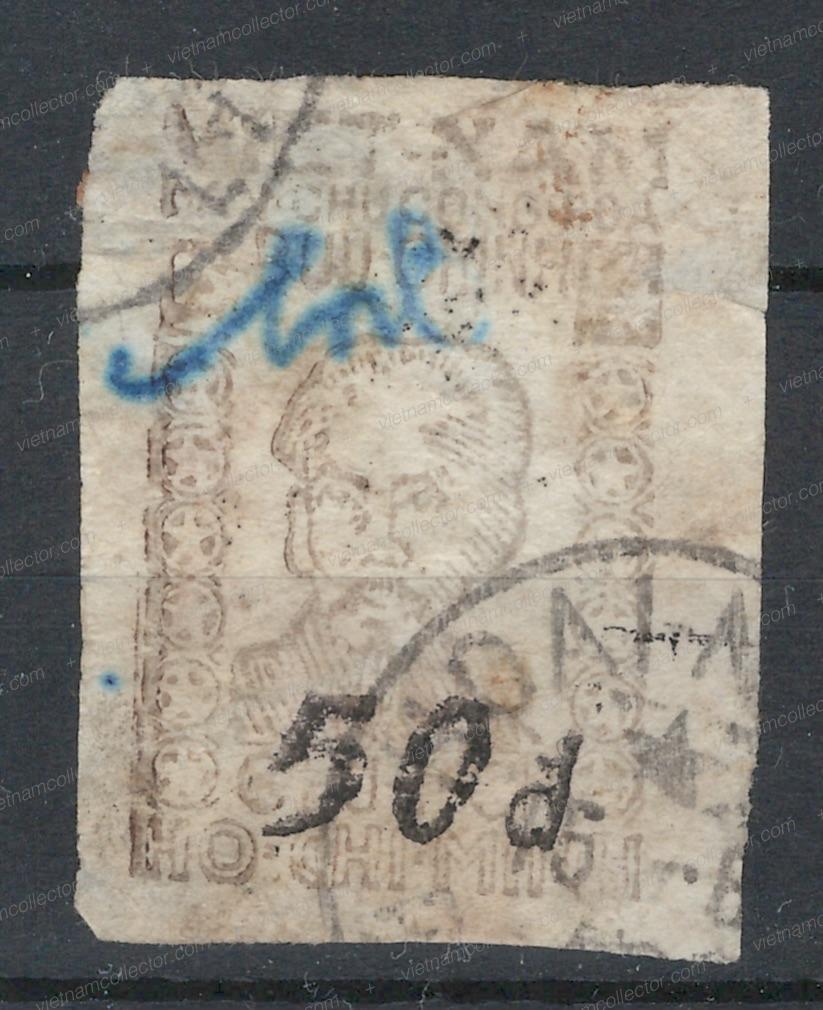
Not pretty, but one of a kind; the 50 Dong on 15 Dong Ho Chi Minh underground stamp
Russian and Chinese philately has, for quite a while, shown the way; not only by the newly minted billionaire class, but also by an emerging wealthy middle-class that is interested in re-patriating its cultural heritage. This new demand backed by financial wherewithal has resulted in a very significant increase in valuation of rare Russian and Chinese stamps in the past 20 years.
Therefore, it is not unreasonable to assume that the same will be true for an emerging Vietnamese middle and upper class. Rising wages in China and free trade status have placed Vietnam and its 100 million inhabitants in the favorable position to imitate the Chinese economic success without penalties of customs duty and the dissonance caused by an assertive nationalistic Chinese “Wolf-Warrior” class.
Other trends are making very rare stamps an interesting investment choice as well. With the Federal Reserve and European Community Banks applying zero or even negative interest rate policies, financial markets have seen a remarkable inflation in asset prices. This has mostly showed up in stock and real estate markets around the world and also in prices paid for other asset classes such as stamps, coins, artwork and classic automobiles. While Government sponsored currencies are remarkably fungible, these asset classes cannot simply be multiplied by fiat; and, hence, are seen as a secure store of value in a world with unclear inflation trends
Small sized assets like rare stamps – the new stroke of genius?
Some of the smaller sized assets are also pretty convenient to store and transport. At a time when banks around the globe charge customers 0.5% interest penalty for holding their cash Euros, the apparent solution to store one’s cash privately in a bank vault, has become surprisingly expensive. Some Governments have withdrawn larger banknotes in order to combat money-laundering and storing cash in 100 Euro notes has become a rather bulky affair.
Super rare stamps and coins on the other hand, have the advantage that these items are of limited physical size and thus allowing investors to store value in a very concentrated form at low cost. They can also be transported around the globe with ease and often, being not very identifiable, they are less prone to theft, as is the case, with well-known paintings by famous artists.
Fractional ownership that has recently become popular in stocks worldwide also offers an interesting upside to the super rare stamps asset class. While in the past only very wealthy people could afford to spend millions in Euros or Dollars to buy these stamps, fractional ownership allows even small time investors to now participate in the financial development of these assets. The 1 C British Guiana magenta certainly will not be the last super rare stamp that is acquired by an investment fund and that changes the game.
In the past, pricing of these assets was determined by a very small number of individuals with significant means and often inflated egos who wanted to show the world that “they had arrived”. This means very limited supply met with very limited demand. In the future, prices for these items will be determined by a broader class of micro investors which will significantly change the equation. Very limited supply will be met with much larger demand which should mean increased and more robust prices.
Registration Nr. 109000
]]>